
I will not go quiet into that Kindle Light
I will not go quiet into that Kindle light.
I don’t ever see myself curling up with a Kindle, or a Nook, or any other e-book for that matter.

I will not go quiet into that Kindle light.
I don’t ever see myself curling up with a Kindle, or a Nook, or any other e-book for that matter.
There has been so much news about books. The drop in the sale of physical books and the recent scanning of 5.2 billion books into digital form to study trends in culture and literature, as reported by the New York Times. According to a recent article in the Wall Street Journal, Barnes & Noble recently cited studies that suggest consumer spending on new physical books will fall to $19 billion in 2014 from $20.5 billion in 2009.
But books are more than carefully strung words. Books create communities and friendships. A book has physical attributes – the feel of its Tattered Cover, the texture of the dog-eared pages inside and the wonder about by whom the book has been previously held and read.
A few years ago, a friend of mine was making what she thought at the time a permanent move back to her home of Cape town South Africa. The trans-Atlantic container could only carry so much of her possessions, so she held a yard sale.
Among the precious things she agreed to part with was her vast collection of books. An avid reader, my friend always had a stack of books – from the library, finds at other yard sales or book sales – on her nightstand. From the pile of books that was spread on a blanket, I picked up “The Notebook” by Nicholas Sparks and offered her the asking price of a dollar. She refused to take money from me and instead, pressed the book into my hand, smiled, and just said “enjoy.”
So I took it home and read it. I’ll admit it wasn’t my favorite. But it was a book given to me by a friend, a friend I feared I would never see again short of a very long plane ride. So, the year she was away, I had her book on my shelf as a reminder of our friendship. I have given and received many previously enjoyed books, as a symbol of family and friendship. Before a family vacation, my doorbell rang and it was another friend, who, just because, wanted to give me a book to read on the beach. It was The Secret Life of Bees, by Sue Monk Kidd.
I have also given my books away to friends: like Sarah’s Key and Snow Flower and the Secret Fan to my mom, and A Thousand Splendid Suns to my dad.
Can you do that with a Kindle?
Now I know that e-books have their advantages: less trees are cut down to make and read books, less clutter in one’s home, ease of traveling with multiple books, instant gratification of downloading the latest book, and so on. But the clutter of books is legacies of family and friendships that our society will lose with the emerging popularity of the e-book. No, I fear that this next generation coming up, if predictions hold true and purchases of physical books will fall away to one more screen that we must stare at for information. Something will be lost.
Because of paper books, a multi-generation legacy of books rests in my house.
My grandparents lived in a tiny apartment in Bensonhurst Brooklyn for over 60 years. In the foyer, they had their treasured library. Into each book that was added to their collection – books like Jane Eyre and Wuthering Heights, and fairy tales by Hans Christian Anderson- a seal was placed, saying that this book was part of the Library of Pauline and Milton Kasmere. Some of these books, with their spines embellished with fading gold lettering, are now propped on the bookshelves in my home. I hope that my kids will read these classics from the pages that their great-grandparents held, not an e-book.
In the future, what will we put on our bookshelves?
Now, call me a luddite, but I can go on about how much I like e-books, if only for sentimental reasons. I’d write more about my feelings and dislikes about e-books, but I am off to a book exchange at my son’s middle school – off to sort books that will be donated to a city Literacy project to share with inner city schools in Rochester.
Tell me, in the future, if physical books go away, will there be books to share and book exchanges to give away books?
Bye-bye Tar Beach, Hello Green Roof

Growing up in Brooklyn, if you couldn’t make it to the real beach on a hot summer day, all you had to do was go up to Tar Beach. Did you go to Tar Beach?
“It was really hot up there,” my mom told me on a recent visit, as she told me about how she and her friends would spend hours up on the roof using sun-reflectors even to maximize their tans. Ahh, the good old days!
Tar roofs, though hot and contributors to global warming, made great song material, though, you must admit.
The Drifters sang about the sun burning the tar up on the roof in “Under the Boardwalk” and how to forget all your cares “Up on the Roof.” Elton John sat up on his roof and kicked off some moss in “Your Song.”
Perhaps Elton should have cooled his boots for a moment and left the moss alone. Growing plants on roofs — from vegetable gardening to sophisticated sod membranes that soak up urban water runoff and cool the air — are becoming a required building material in cities like Toronto and Chicago.
I know that tar roofs are not exclusive to Brooklyn, no matter how Brooklyn-centric my point of reference may be. In fact, cities like Chicago, where new laws are in place requiring new buildings to have green roofing materials, the temperature on a tar roof can be 78 degrees hotter than that on a green roof.
Walk across any asphalt parking lot on a summer day and then walk across a green lawn. You don’t have to be a scientist writing a big fat feasibility study to understand how black top paved surfaces and roofs heat the earth and green areas have the potential to cool it.
In Rochester, NY, The Harley School is employing this technology as one long-term science project and can boast that they are the area’s first school to have a green roof. This sustainable technology will not only act as a natural insulator, keeping the school warmer in winter and cooler in summer, but it will teach its high school students about how buildings affect the environment.
The tar roofs of the past, according to environmentalists, are the bane of city living because they create urban heat islands and contribute vastly to water runoff. Rather than being just a green trend, cities such as Chicago and Toronto require roofs of new buildings to include cooling, greenhouse-gas absorbing plants.
The Harley School on Oct. 18 installed two 10 x 10 ft. plots of hearty winter grass on the roof of their building on 1981 Clover St. The school spent $2,000 for materials and also received an in-kind installation and materials donation from Zaretsky & Associates landscapers in Western New York. In order to grow a section of green roofing, school engineers had to assess if the school’s roof could withstand the additional weight of a weatherproof membrane barrier, two inches of topsoil, the weight of the growing plants, and the water they will retain. The grassy roof serves as a natural insulator and will keep the building cooler in the summer and warmer in the winter. School officials expect to reap the benefits of these initial costs within 3-10 years.
Peter Hentschke, a science teacher who will be working with Harley’s upper classmen on researching the impact of the green roof, said the project provides students with hands-on learning. The students will develop mathematical methods and equations to determine how much energy their school saves by comparing temperatures of the school’s different roofing materials. They will also calculate how water runoff is affected by the green roof.
“Rooftop plants catch rainwater and runoff that would have ultimately run into the sewer and overburden water treatment centers. The students are tracking current rainwater runoff with water gauges and will track this throughout the school year,” he said.
Chris Hartman, Harley’s social and environmental sustainability coordinator said the students are “all fired up” about learning about the green roof because it has real-world implications.
“The Harley students are really in the driver’s seat of this project. They know that it is cool to have a green roof, but the challenge will be to come up with the methodology to show how green roofs have an impact in the world around them,” said Hartman. He added that students hope to share the data from the green roof with their classmates, and perhaps local colleges such as the University of Rochester and Rochester Institute of Technology.
If we all started growing green things on our roofs, perhaps by the time these kids graduate college, our cities would from above look less like Tar Beach and more like the ancient hanging gardens of Babylonia. I wonder what songs they will inspire by then.
A Blessing and a Curse: Israeli advocacy though Social Networking
How do you connect to a country that is oceans and languages away? In the 21st Century, where can you go to have conversations with or show positive visual images of a country that has been dear to the Jewish soul for more than 2,000 years but the mainstream media continues to portray it as a human rights violator?
The best way to connect with Israel and meet Israelis is to make a visit. Or maybe two. Or live there for a while. Or, maybe move there. But, in the meantime, there is the blessing and the curse of connecting with Israelis and standing up for Israel through social networking.
There are about 13.5 million Jews in the world, give or take depending on who you ask. About half live in the United States, and 6.5 million live in Israel. Both these countries embrace democracy, diversity, religious freedom. In spite of these similarities, time, distance, and language barriers keep the world’s largest Jewish populations from feeling truly connected. Most Jewish Americans know little about modern Israeli life, history or politics. And Israeli counterparts, only know of America from what they see in their media.
Last summer, the Maurice and Marilyn Cohen Center for Jewish Studies at Brandeis University published a study called “Still Connected: American Jewish Attitudes About Israel,” The study, conducted in response to media coverage of the Gaza flotilla incident, found that participants aged 45 and under had less of a connected feeling to Israel.
If the Jewish people want to see continuity into future generations and a strong connection to Israel, it’s time that Jews in Israel and Jews in America start talking to each other and the best way is social networking.
In the 1980’s connecting with Israel seemed like a no-brainer. Many Jewish families during this time took a trip to Israel the year a child became a Bar or Bat Mitzvah. You toured the country with your family and had a ceremony either at the Western Wall or at the top of Masada. These were moments in Jewish family life that forged strong Jewish identities. If you couldn’t make it the year of your Bar or Bat Mitzvah, perhaps a trip during high school was in your plans, or a semester or year abroad in Israel.
Then came the intifadas of 1989 and 2000. Along with the death and the terror came the fear and doubt among American Jews how they felt connected to Israel based on what they saw on the news. Reports of terrorist attacks within Israel in 2000 saw tourism to the Jewish state plummet.
I taught Hebrew school to sixth graders that year who told me you had to be “crazy” to want to visit Israel. I asked parents during a family education program if they had anything to share with the students on how they felt about Israel or if they had memories of trips to Israel and I was met with blank stares.
So how to you teach Israel to children who may see Israel as nothing more than a tiny spec on the worldwide map? Again, the answer is through social networking.
I have been a Hebrew School teacher for almost 10 years and have used sites like Facebook, Twitter and YouTube to teach kids young and old about the daily ongoings of Israeli citizens. I have shown my littlest students on YouTube how families in Israel celebrate Tu B’shvat, the New Year of the Trees by singing the same songs we sang in our classroom. For my older students, I downloaded a video on the many faces and places of Israel set to pop song “New Soul” by Israeli singer Yael Naim.
The Internet provides a podium – to stand up for Israel but also provides an equal podium for those to wish to delegitimize the Jewish state. The flotilla that attempted to breach Israel’s blockade around the Gaza Strip launched hundreds of anti and pro Israel Facebook groups, including one I joined, called The Truth about Israel’s Defensive Actions Against the Flotilla The group aims to be online ambassadors to Israel, where supporters of Israel around the world, Jewish or not, can start discussions or point out the way Israel is being covered in the media.
In recent years, I had the opportunity to develop partnerships with Israeli teachers by both visiting and living with Israelis and hosting Israeli visitors to America.
I documented my trip in this video set to the background music of popular Israeli musicians such as The Idan Raichel Project and Shlomo Artzi, who also have Facebook pages. I wanted to show my students and members of my local Jewish community the beauty of Israel and everyday life in this tiny, diverse country. Take a look below:
“
Another time I empowered social networking to support Israel was during Operation Cast Lead, or Israel’s war on Gaza. During this time, many hateful comments were posted to the photos I posted from Israel on Facebook’s pro-Israel groups. I used discussion boards to request that a typical Israeli write back to me to explain to my 7th grade students what it was like to be in Israel during this time. I got a response from a young man living in Ashdod, not far from the Gaza strip. He was discharged from serving in the IDF from an ankle injury and was happy to help out my cause. In perfect English, he composed a letter to my seventh graders what it was like for he and his family to live under a daily barrage of missiles from Gaza. The email put a personal touch to the headlines that winter and sparked my students desire to make cards for Israeli soldiers.
These are just a few of the many ways ordinary people can stand up for Israel. What can you do?
About Me
Kreativ Blogger

Versatile Blogger Award


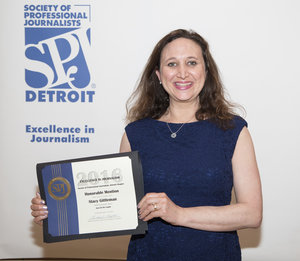
 Stacy Gittleman