
A Hand and a Name, and a Voice – Yad Vashem

Since I’ve returned from Israel with my family, friends and acquaintances stop and ask me:”So, how was your trip?”
As much as I like talking about the trip, it is just so hard to sum up Israel in a quick conversation in the produce aisle. My husband is also experiencing the same when asked this question at work. How was the trip? Well, in a word: life-altering? Or, how about, transformative?
To start retelling a multi-generation trip of a lifetime to Israel, unfortunately one has to start with the hard things first. It is only from these low points: visiting the Har Herzl National cemetery, and then the Yad Vashem Holocaust Memorial, can one only understand the miracle that is Israel and how hard we have to work to never, ever take for granted the existence of this tiny country.
Before I take you to the heights of happiness of three generations celebrating a Bar Mitzvah, drinking fresh pomegranate juice, dancing on the beaches of Tel Aviv, or welcoming Shabbbat with thousands of Jews at the Western Wall, I must take you to the depths of sorrow.
It was a very hard first day. We first toured Mt. Herzl cemetery, Israel’s equivalent of Arlington National cemetery. Among Israel’s deceased prime ministers and other dignitaries lie the graves of the many fallen soldiers who paid the ultimate sacrifice during Israel’s wars.

Here, there is no rank. Privates are not separated from generals. The word “Nofel” – to fall – appears next to ages: 18, 22, 23, 25, young people cut down serving their country in the prime of life. The freedom to walk casually in Israel’s city streets or flowering mountainsides, we owe to them.
As part of officer training, it is common to see Israel Defense Force soldiers coming to pay their respects to those who served:

After this visit, we toured Yad Vashem, Israel’s memorial to the Holocaust.
The imposing concrete triangular prism architecture of the museum adds to the physical experience of the museum.

The triangular prism of the main exhibit hall is as powerful as the evidence within it. The viewer just wants to make it to that distant light at the end
This is the central hallway: grey, dark, lit only by overhead skylights. On the sides of this triangular structure is the progression of evidence of the annihilation of 6 million Jews. How the Holocaust was engineered through cultivating a centuries-long culture of hate against European Jewry that culminated with the Nazis war against the Jews from 1939-1945. In this short amount of time, the Nazis murdered six million Jews, one-third of European Jewry.
The viewer zigs and zags through each exhibit. There is no cutting straight through to that light at the end. One must enter each gallery. And with each turn, you know the story will just get worse.
Sometimes, one can just get numb to the enormity of the Holocaust. The numbers of vicitms. How many were murdered from this shtetl or how many were deported from this city. Especially if you have seen the photos, confronted the numbers, and heard the testimonies of survivors for the better part of your life.
That is why within this exhibit, the story of one voice, of one victim, is powerful enough to shatter the anonymity of the number 6,000,000 and bring the narrative to one person, one name, who was lost.
On a wall was a small framed poem of a boy, age 14. He wrote: When I grow up to be 20, I will fly free away from here like a bird. I want to travel all over the world and cruise over the seas, and just be free.
The boy was murdered at Auschwitz at age 17.
Then, another voice, the voice of my daughter, who made her own discovery.
She was chanting Torah. Her Torah portion. From a battered, water-stained Torah robbed by the Nazis, to be used one day in a museum Hitler intended to create for an extinct people.
She said, this is my Torah portion, I can totally read it and make out the letters. It was also to be the same reading we would in a few days chant for the Jerusalem celebration of my son’s Bar Mitzvah, just days later.
What were the odds that this tarnished, damaged Torah scroll would be open to this very passage? How many kids in that dark time did not live to see their own Bnei Mitzvah? The tears refused to keep flowing.
So, you see, the Nazis did not fulfill their final solution. We are still here. We still live. We got through the darkness and made it into the light to behold the view of Jerusalem on a clear sunny day:

Oh Chanukkah, Oh Chanukkah … in Israel!

Here is a blog post on the furthest place I’ve traveled. The plane ride is noisy and crowded, but I’ve traveled there four times and I’ll do it again as soon as time and money permits. With the earliest chanukkah ever recorded in just two weeks, I thought this would be an appropriate post for this challenge:
I’ve spent all of my chanukkahs in America. As a Jewish kid, yes, the omnipotence of Christmas can test anyone’s Jewish identity and make even those with the strongest feel a bit left out. You can totally relate to Adam Sandler‘s song. You are that only kid on the block without a Christmas tree.
As I got older, I grew to understand that, yes, Chanukkah is a minor Jewish holiday. No, it’s not even in the Torah. Yes, Jews have our major holidays in the fall.
But, still, come December, you can’t help but feel a bit marginalized.
Except in Israel. Because there’s a whole country that is Jewish, just like you and me……
Chanukkah in Israel is the little things, like peeking into a Jerusalem apartment window to watch a mother lift her baby to see the chanukkah candles.
Chanukkah is big, as every corner on every street is decorated with Chanukkiot. No, not menorahs. A menorah is the seven-branched candelabra, and though it is the symbol of Israel, the chanukkia, the nine-branched candelabra, is for chanukkah:


Chanukkah in Israel is walking through the Western Wall Tunnels where Judah Maccabee and his army used to reclaim Jerusalem and the Temple from the Assyrian Greeks in 165 B.C.E.

Chanukkah in Israel is sufganiyot piled high in every bakery window.
Chanukkah in Israel is lighting the chanukkiah in the hotel lobbies amidst the glow of so many others:
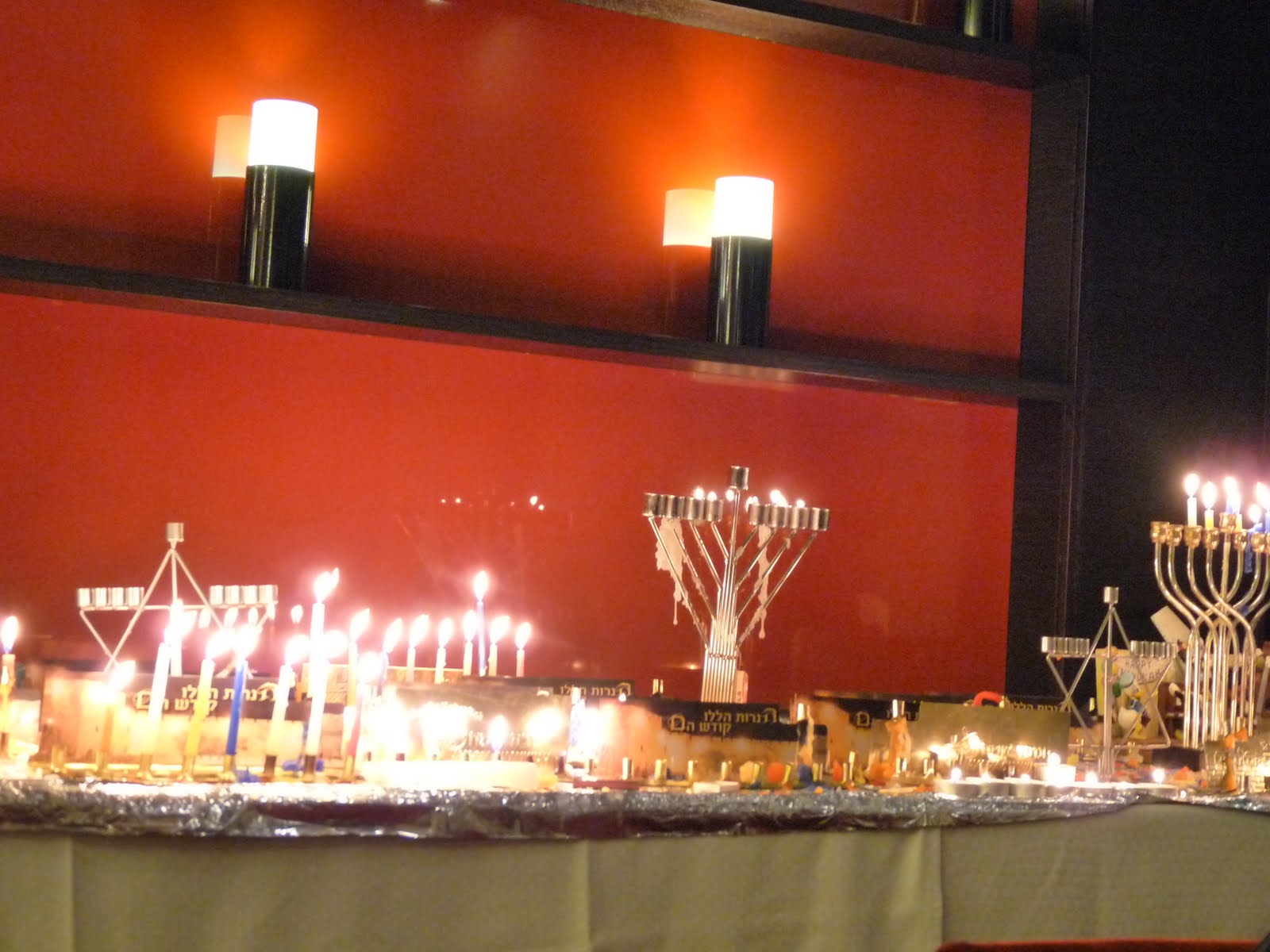

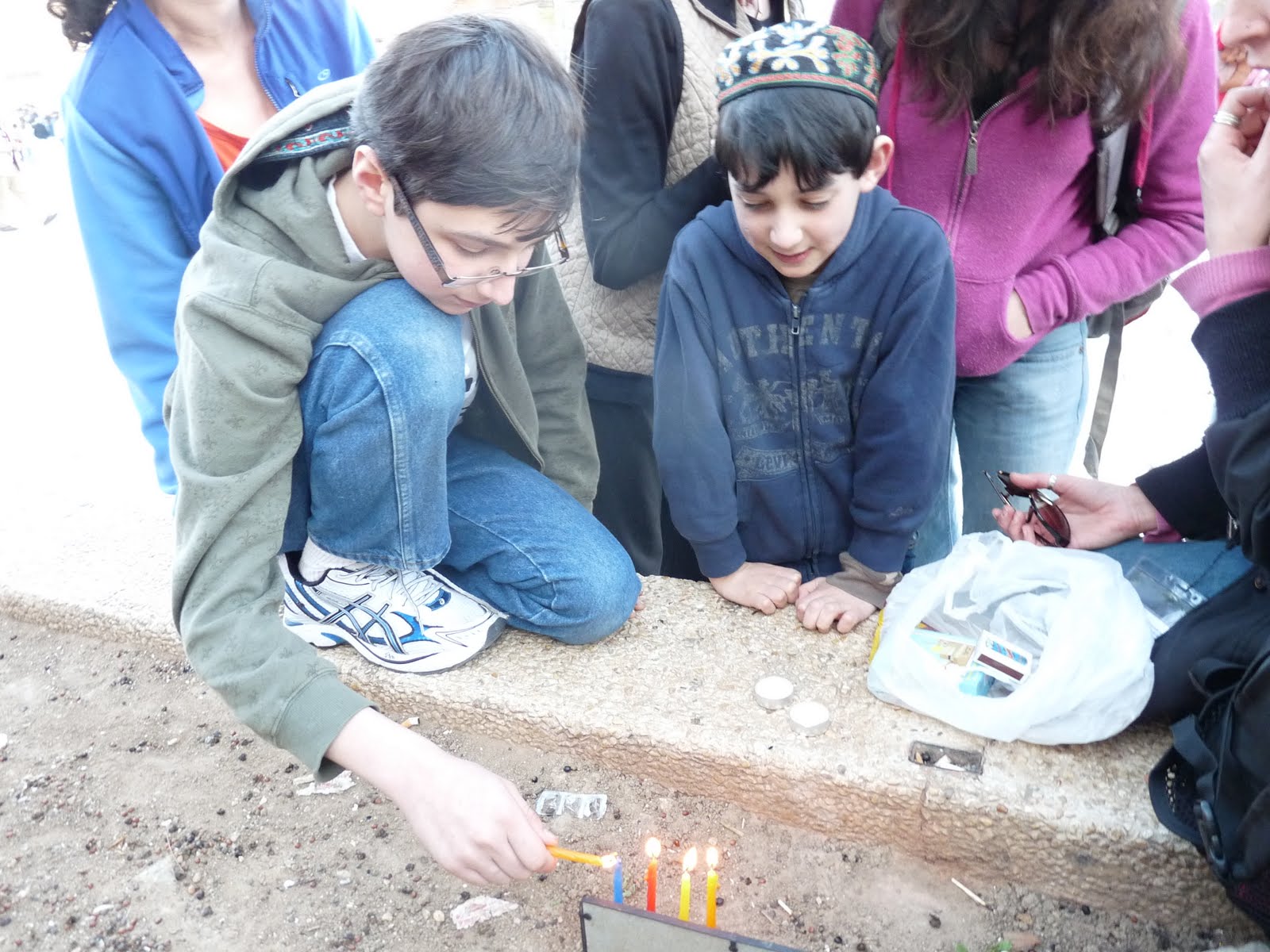
lighting chanukkah candles by the Kotel
Chanukkah in Israel is digging in a cave thought to be used by the Maccabees, where coins have been found with an insignia of Assyrian King Antiochus on them.

exploring a cave in Tel Maresha Archeological Dig Site
Most of all, Chanukkah is filled with smiling kids:

meeting up with friends from home

Where Jesus Walked: Via Dolorosa, Jerusalem
In Judaism, if Israel is the Jewish state, then Jerusalem is Judaism’ holiest city and its eternal united capital. But it is also holy to all faiths. As recognition of this, ever since Israel reunified Jerusalem after capturing it from the Jordanians after the 1967 Six-Day War, it has made sure that all of Jerusalem’s religious sites are open, safe and accessible to all religions.
This is why though I am a practicing Jew and a Jewish educator, for one of my first post-Israel posts, I wanted to show you the walk of the Via Dolorosa. As you look at these photos, keep in mind how preserved and maintained are these stations. Keep in mind that my family walked the streets of the Old City safe and without fear because of the constant present of the Israeli Defense Forces. Keep in mind that all religious sites in Jerusalem are open and accessible to all faiths. This was not the case before 1967.
The week our family visited Israel was during Christmas. We saw thousands of Christian Pilgrims walking Jesus’ final steps:
Pride, and Shame, in Israel
When I return to the United States, I promise to create individual blog posts about the many aspects of our Israel trip, but there is an underlying vibe in Israeli society today that is making news that I cannot go on any longer without mentioning.
Let me preface all this by saying how overall, I have absolute love for my (that’s MY) spiritual homeland. It is ancient. It is wi-fi’d high tech and hydrophonic modern. Every rock and stone tells a history of the Jewish people and the other civilizations that have come and gone here. I am not a tourist here, though I am living in hotels out of my suitcase. I can get by somewhat with my Hebrew. My kids and I have friends here. Though I am here right now I am already longing to come back again, and wonder how long will that be, and when will I ever be able to stay here for more than 10 or 14 days at a time?
I take pride that my children are walking through their history. More than any mid-afternoon Hebrew school class can offer, they have all week been immersed in hearing people speak Hebrew all around them, witnessing the miracle of chanukkah in the land that chanukkah happened, walking through the tunnels the Maccabees forged to reclaim and rededicate the temple.
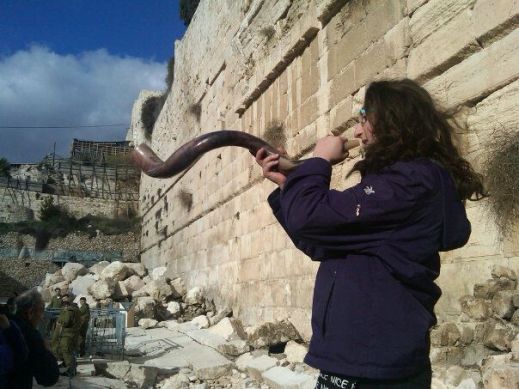
How can I not be proud when I witness how much Israel has changed since my last visits? In 1967, most of Jerusalem’s old city, reclaimed from Jordan, lay in ruins. Now: synagogues have been rebuilt. Archeologic wonders like the excavations revealing access to all the length of the Western Wall of the Great Temple and then the Davidson Archeological Center giving access to all visitors the Southern Wall of the Temple Mount; the fact that my daughter blew her new Shofar in the very place that the Kohanim priests blew their horns to mark the end of Shabbat at Sundown on Saturday night:

The pride of how Israel has preserved artifacts of not only its own ancient peoples but of the cultures of Greeks, Romans, Ottomans, Byzantines, and so many that tried to conquer and occupy Jerusalem. You want to see ancient sites? Greek? Roman? Byzantine? Come to Israel, it’s a historian’s one stop shopping place.
And then the pride of being at the Kotel on Friday night with thousands of Jews celebrating Shabbat and Chanukkah, blessing my children at Judaism’s holiest spot, how could I not feel pride at what Israel and the Jewish people have accomplished?
But then….
I was first very disturbed that first night at the Kotel. As Shabbat descended, men and women gathered to pray on their respective sides of the Kotel. And, like most times at the Kotel, I noticed women standing on chairs, looking over the mechitza, or separation wall, to wave to husbands, sons…
Then, a man came over to them. Shouted to them “Modesty, Modesty!” Get down! Get out of here!”
Slapping their hands. Slapping them. Shooing them away like they were children. Is this how a Torah Jew is supposed to treat the mothers and Daughters of Israel?
Then, more news reports.
- Haredi men saying that women may not walk on the same sidewalks as men in certain towns like Ben Shemesh.
- Haredi men spitting on a seven year old girl and calling her a prostitute because she was not dressed modestly enough in their eyes (the girl was orthodox and she was wearing a long sleeved blouse and a knee length skirt.)
We spend the last two nights at Kibbutz Halavi. A beautiful Kibbutz, a beautiful hotel. But many of the guests were ultra Orthodox Jews. Would it be too much for these, our fellow Jewish bretheren, to return a smile when I gave it to them, to even ask where we were from and make some small chat? Have they forgotten the mitzvah of greeting people with a cheerful disposition? Have they fogotten in their zealousness of making sure that every piece of lettuce and every cut of meat is under the correct hekshcer (kosher certification) that every Jew is responsible for one another and the meaning of Kibbutz is to gather together?
Have they forgotten the words, Henei Matov U Ma Naim, Shevet Achim Gam Yachad – How wonderful it is to gather and sit and be together like brothers?
The direction of religious extremism in Israel is the wrong direction.
The email in the Wall
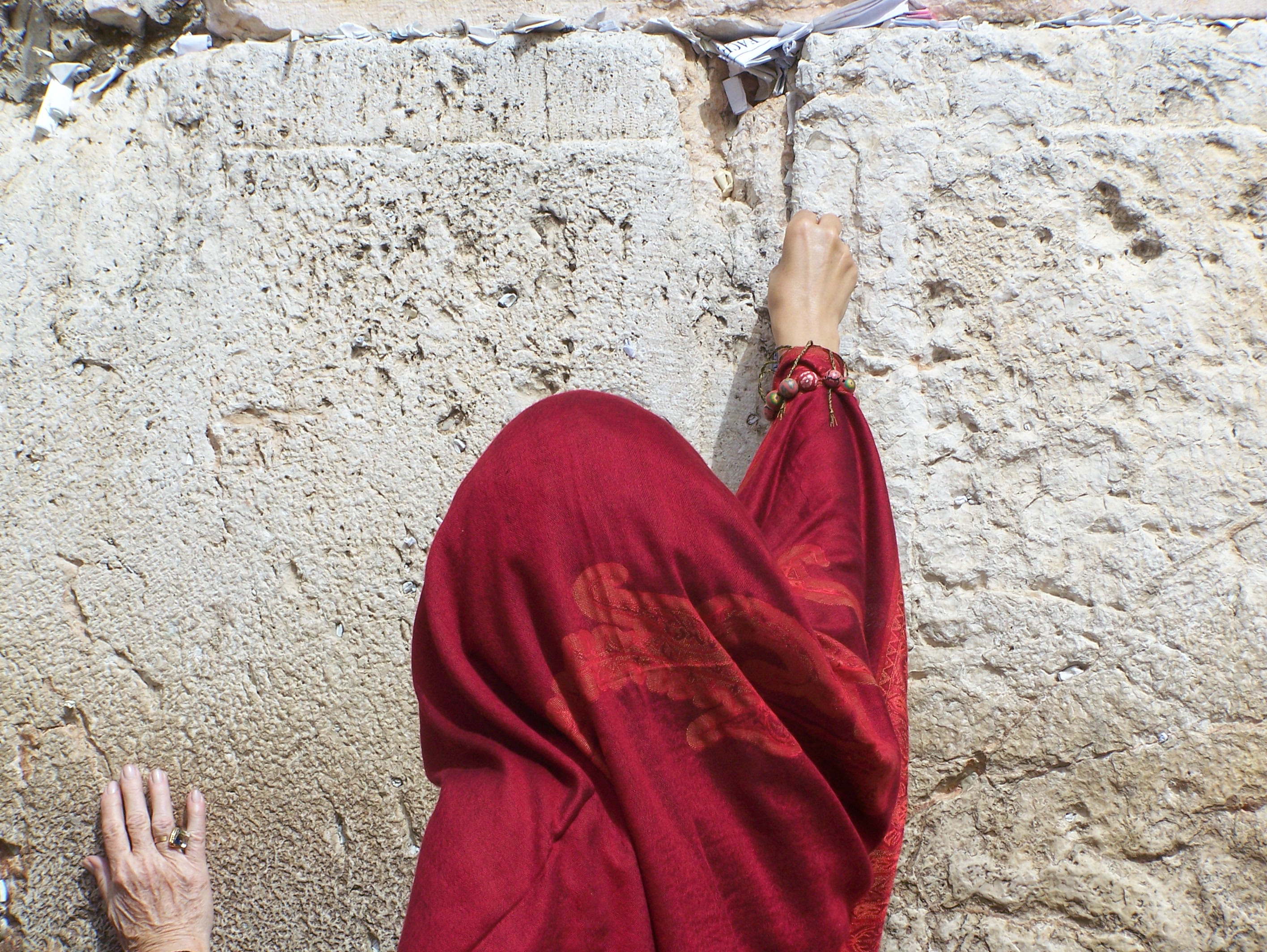 I’ve been making final arrangements for my son to have his Bar Mitzvah at the “Masorti Kotel,” a part of the Kotel off to the side of the main Kotel Plaza that is known as Robinson’s Arch. This is the designated spot in the Kotel Plaza that allows for a mixed prayer group of men and women.
How do I know the final arrangements are official? The rabbi of whom I am in correspondence with in Jerusalem cc’ed his email to “hakotel.” Yes, the Holiest spot to Judaism in the world was kept in the loop that my son will be called to the Torah in Jerusalem. Now it’s really official.
There is no way of documenting in words what emotions my family will be experiencing when my son, his brother and sister, parents and both sets of grandparents along with friends and a few surprise guests will come to Robinson’s arch to pray in honor of Nathan’s Bar Mitzvah. We’ve been planning this moment since around his birth.
But this story goes back perhaps even farther, it’s a story of the power of prayer and placing a note in the Western Wall, and how Gd answers these notes in Gd’s own time.
Once upon a time, a boy and a girl met one summer at Camp Ramah in the Berkshires. They met through mutual friends on a cracked tennis court. The girl kept missing every shot, and the boy didn’t seem to mind chasing all these balls and retrieving them for her.
The boy really liked the girl. Loved the girl. But the girl just wanted to be friends.
That winter, the boy visited Israel with his family. They visited the Kotel, or the Western Wall. The holiest place in all of Judaism where Jews for centuries pour out their hearts in prayer for a united Jerusalem, for a rebuilt Jerusalem. The boy wrote a note to Gd asking that the girl would one day fall in love with him, his family would be blessed with health, and (a bit of a more material and earthly ask), that he would make it into the Engineering program at MIT.
Within a month of writing that note, the girl (who would be me) turned him down when asked to prom. Within a month, the boy’s sister became seriously ill with meningitis and lapsed into a coma. And, the rejection letter from MIT showed up soon after that.
That boy felt like he was truly being punished by the Divine.
Not to worry. Gd answers prayers. Just not in the instant we would like them to be granted.
The sister of the boy recovered and thrived, went to MIT and went on to finish an MBA at Columbia University, has a tri-athlete husband and four beautiful children, and a thriving cupcake business!
Nine years later the girl that turned down the boy for prom came around and they were married before 247 guests!
The boy in the story is my husband. Whenever we are having an argument, or whenever my husband is getting on my nerves like when he doesn’t like the way I load the dishwasher, I think back to his note in the Kotel, realize that our marriage is meant to be by Gd, so I let it slide.
Now, I’m going back to the Kotel again, the fourth time in my life. No two trips to Israel or the Kotel are ever the same. Each time you go there, you are a different person perhaps at a different phase in your life. So, I’m going not only with my family, but I will also be going as a messenger taking along the notes my students wrote to place in the Kotel.
Most of them.
As my students started their note writing, they had many questions: How will Gd know it’s me? What should I write? How long does it have to be? Can I ask for anything…. anything? Is this a wish, or is this a prayer? And, will it come true, what I ask? How do they keep all the notes from falling out of the cracks?” …. and so on.
I guess this is a lesson to myself that it is hard for a child to know exactly how to compose a prayer of one’s own to be placed in such a holy place when one has only an abstract concept of the place itself. These students have only the most fledgling connections with Israel, let alone an understanding of the emotional impact that a united Jerusalem, and access to Judaism’s holiest site, has on the Jewish psyche. But they did their best, and I answered their questions as best as I could.
A note in the Kotel can express thanks to Gd for the health of family and friends. A note to the Kotel can ask to heal broken friendships or relationships. A note to the Kotel can ask to be provided for, and to never know hunger but one should not ask for “Lots of Money and an iPhone.” A note to the Kotel can ask for world peace and haters of peace, for their plans to be destroyed. But a note should never ask for the death of your enemies, let alone a family member. Gd is not your hitman. These notes will not be placed, nor do they deserve a place in such a holy place.
The Netnanny Diaries, or How to Keep your Teens Safe Online

if you don't want to disable your computer, DO NOT buy this product
This time of year, Americans everywhere are shopping and carefully wrapping gifts picked out for those special someones in our lives. Odds are, if that special someone is a teenager, that Christmas or Chanukkah gift, I’m talking the big-ticket item, will come with a screen.
Last year, my husband and I bit the bullet and begrudgingly gave our adolescent children a laptop. We rationalized that the laptop was a necessity for homework. Our children get assignments that have to be completed at online websites like Pearson’s Successnet. We further rationalized that the children would want to send the occasional email to a friend. Furthermore, we told our children the laptop was to be used in a common room like the kitchen.
But, laptops being what they are, and teens being who they are, my kids inevitably used their gift to chat with friends in the privacy of their rooms behind closed doors.
There are many pros and cons to this virtual social life. Through Facebook and Skype, my kids share their daily minutia with faraway friends without running up my phone bill. They will never know what it was like to have to wait until late at night for the phone rates to go down to place that long distance call.
Just one generation ago, having a phone line in one’s own room caused concerns for parents. Remember hiding under the covers with the phone?
Now, the Internet is the place where parents of teens feel like they are losing control. Will they become vulnerable to online bullying if they are not savvy to the nuances of social networking? Will one wrong click result in viewing inappropriate web content?
In a last-gasp effort to maintain some control of my kids’ online activities, I hired Netnanny. This is a content monitoring software program that allows parents to use customizable filters to monitor where kids can go online.
- parents can customize the program as they wish to limit or completely block sites containing violence, sexual or hateful language or images
- Parents can limit or completely block websites to games or sites that support online gambling
- parents can monitor posts or conversations on social networking sites like Faceboook
- Parents can also use Netnanny to put limits on Internet time. You can set how many hours a child can use the Internet, and what times of day these hours are to take place. If you don’t want your kids on the Internet after 10 on a school night, Netnanny shuts off Internet capabilities after 10 p.m.
Sounds great, right? Perhaps there are parents who use this program with success. However, our situation wrote itself out like a bad reality TV show that could have been called “Netnannies Gone Wild.”
My daughter’s Netnanny woes:
- One day, she wanted to go online to search for ski equipment on Dicks Sporting Goods’ website. Netnanny blocked her because the retailer also sold guns for hunting. Reason for blocking: possible violent content.
- When she wanted to do some online window shopping for some bathing suits on Landsend.com, Netnanny again pulled her back by the apron strings. This time: risqué sexual content. On Land’s End. Sure.
- When she needed to research a paper for social studies about racism, she could not enter certain sites because they contained “hateful language.” or images of swastikas.
- Finally, Netnanny blocked my daughter from Skyping with a friend in Israel. Perhaps the program detected a Middle Eastern ISP address and determined it was thwarting some kind of terror plot.
I did find Netnanny’s monitoring reports useful in terms of tracking what she and her Facebook friends were chatting about. However, Netnanny was a bit too overprotective when she deemed that “Hiya Hon, Luv ya” written by one of her BFFs was considered sexually explicit language.
My son had his own woes with Miss Netnanny
- He could play no games on miniclips.com. Wait, that was my intention. Miniclips always spread viruses on my computer and I find these games to be a complete waste of time.
- But, in an attempt to play an innocent game of solitaire, my son was blocked. Why? The game involved the use of cards: potential for online gambling. In my defense, I did block video games, but barring a game of solitaire was going a bit too far.
- My son is an avid guitar player. Often, he looks guitar tabs up to play the latest song he hears on the radio. But Netnanny blocked guitar tab websites. The reason: Music and entertainment, may have explicit language.
After a few months, Netnanny disabled and corrupted all of the laptop’s Internet capabilities. I needed outside help and turned to Microworx, a Brighton information technology company that specializes in computer troubleshooting.
It took several days and about $200 to free my computer from Netnanny’s clutches. When I called the company to ask for a refund, Content Watch, the maker of Netnanny, refused because the software’s warranty had expired. In the end, there is no substitute for giving your teens a good lesson in common sense, social networking etiquette and harsh warnings about not trying to search for anything illicit before you let them go online.
Excuse me, Content Watch, if I was not a fortune teller and could not predict your crappy software would cause my computer such problems.
In the end, we fired Netnanny. In the New Year, and the years to come, raising teens will come with many challenges. Now, it is navigating the information superhighway. Soon, it will be learning to drive on a real highway.
The best I can do is to offer my guidance and always let them know that if they need me, I will always be on the other side of that closed door.
Am I a Bad Jew? An open letter to Benjamin Netanyahu

 Dear Bibi,
I am writing to you somewhere within the American diaspora. In a few weeks, my husband and I will be taking our children and our parents on our first family trip to Israel. When we get there, I hope that the Israelis we meet there don’t think that we are devoid of any Judaism or Jewish life back in evil America.
Let me explain. I just viewed some commercials made by the Israeli government warning them of the risk of assimilation, of losing their Jewish identity if they move to and remain in America. The Jewish Federations of America, along with most American Jews, took offense.
A lot of controversy has been stirred by this ad campaign trying to lure Israelis living in America to come back home to Israel if they want their own children to remain Jewish.
To those of you not familiar with it, here is an example of such an ad. Basically, an Israeli grandma and Grandpa in Israel are skyping with their family in America. The grandparents, seated in a living room with a lit Chanukkiah (candles for chanukkah, it’s NOT a menorah) in the background, ask their granddaughter what holiday she is celebrating. She joyfully shouts (to her parents’ dismay) “Christmas!”
(this ad has been removed as I write this post)
Here is what I know, good and bad, about Jewish life in America and Jewish life in Israel.
- Israel, you have no better friends in the world than the Jews of America.
- I am involved with the Partnership2Gether program in my city. Each time we are visited by our Israeli counterparts, friendships are forged and dialogues begin about Jewish identity on both sides of the sea.
- The Israelis making their first visit to America greatly admire how hard American Jews have to work to maintain our Jewish ties. Yes, we are pulled in many directions trying to balance secular commitments with the religious. But yes, we enjoy the freedom we have of making our own choices.
- The Israelis who came here greatly admire the role of women in synagogue life. Some of them for the first time saw women serving as rabbis. Some of them for the first time had the honor of being called to the Torah for an aliyah.
- Israelis who visited America expressed their disgust with extremist religious strains that take an “all or nothing” approach to observing mitzvot to the point that rather than trying to observe Judaism to their own comfort level, they have abandoned any Jewish practice at all.
- Yes, some of my middle-school aged Hebrew school students are from intermarriages. And many of them struggle with their identity, especially in December. But we have to respect that non-Jewish parents who love their children made the hard choice and the sacrifice to raise their child in a religion that is not their own. It is a choice they believe in and many try to learn about Judaism right along with their children.
- My students ask if they are a “bad Jew” if their family doesn’t light Shabbat candles every Friday night. They ask if they are a bad Jew if they help their non-Jewish parent set up Christmas lights. What can I possibly tell them? I can’t. All I can teach them are the tools and the mechanics of Hebrew language and the religion. It is up to the individual parents and families to apply or not apply, these teachings in the privacy of their homes.
- Am I a bad Jew if I find myself this time of year humming a Christmas tune? Not really, as Christmas permeates every facet of American culture between October 31 and December 25. For impressionable Jewish American children, it is all the more impossible to ignore. I teach my students and my own children that it is okay to admire the lights and decorations, but know it is not our holiday.
Bibi, I’ll be in Israel all of Chanukkah. Why don’t fly over to the states and spend your Chanukkah in America and see how hard Jewish Americans work to say “no, Christmas is not our holiday. In spite of being a minority, we choose to worship our God and practice our religion the way we choose.”
Isn’t that after all the message of Chanukkah?
I’m routing for this Science Mom: Vote for her today!
Every now and again, I get a story idea in my inbox that just cannot wait a week until it is published in my column. In our age of overtesting our children to the point of desparation where they even cheat on college entrance examinations, here is a story of Melissa Gertner.
Melissa is a mom who was inspired by her son’s curiosity to solve problems by tinkering with old machine parts in his basement to start an after school club called FIRST LEGO® League that lights the spark of science and technology in tween and teen-aged kids in Victor, NY.
She is competing for a scholarship to win $10,000 for the Victor school district to continue and grow the LEGO program for years to come in Victor.
Here is her story. Vote for her at this link
A Mom and a STEM Advocate

I never liked science. Or math. Technology scares me. So, you must wonder, how could I have helped connect others to science, technology, engineering and math? I am not a teacher. Or an engineer. I can barely balance my checkbook. Still you wonder…
The answer is simple. I am a mom and an advocate. My son is endlessly curious and creative. He is always inventing things in the basement, taking machines apart to see how they work, reading about the way our world works, drawing his plans, bringing them to life, making a mess, starting all over again. Every day. All day. And he inspires me. To provide opportunities for him and others like him to find their very special and immensely valuable place our world.
So, two and a half years ago, with the guidance of the Victor Intermediate School, another devoted mom and I started the Victor Intermediate School FIRST LEGO League (VIS FLL) Club, a 3 year after-school pilot program designed to capture students’ interest in science, technology and engineering. The program offers hands-on real–world learning experiences that reach beyond the traditional classroom.
In our first year, we served 26 4th graders in a non-competitive format. In 2010, we took six teams of 43 4th and 5th graders to qualifiers. Three of those teams advanced to the Regional Championship. This year we will serve 80 students, including six teams of 5th and 6th graders attending the qualifiers in November and six teams of 4th and 5th graders participating in a non-competitive season starting in January 2012.
How did I find my way to this program you ask. Well, three years ago, I had the privilege of coaching my son’s Jr. FIRST LEGO® League team. Little did I know, I had embarked upon the journey of a lifetime. Somewhere along the way, perhaps when I saw the pride in the faces of my son and his teammates at their show and share event or the incredible ideas they generated or the solutions these 8 year olds developed, I was hooked and committed to providing a continuum of science and engineering opportunities to as many students as I could possibly embrace.
Since that time, I have coached his FLL team for two more consecutive years, been a co-coordinator for the club in the off-season and am currently the coordinator of the VIS FLL Club. I have also actively helped other teams get started in our region by sharing information, resources and encouragement.
I continue to be inspired by the imagination, ideas, teamwork and passion these kids generate. Not only do our students participate in community events and competitions, they also mentor local students and others throughout our region, and spread the word about how exciting science and engineering can be. As much as I am helping to connect all these kids with science, technology and engineering experiences, they are the true connectors, connecting me with the best of myself and the best of themselves with our world.
How Not to do your kid’s elementary school take-home project
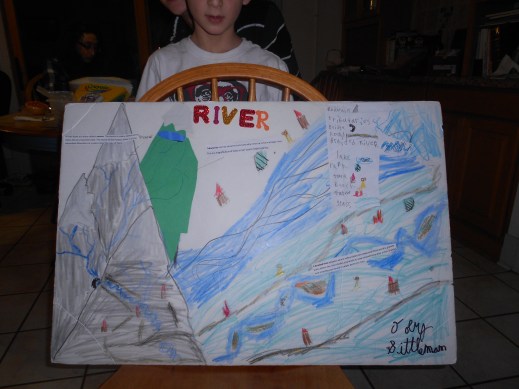
My son came home at the beginning of November with his first serious take home project in his academic career. To thoroughly research and display a natural landform.
Cry me a River.
If you have elementary school-aged children, you have been presented with the following scenario:
Your child comes home with a project assignment. They must research a topic and then display their findings in a creative way. Suggestions included making a diorama, a puppet show, a video dramatization. The project instructions come with a rubric so the child knows just what the teacher will be looking for in the research, delivery of facts and visual presentation before giving the grade.
In true tradition of thinking in terms of our achievement and perfection driven culture, as demonstrated in the film Race To Nowhere, I initially got it into my head that this was not my third grader’s project, but it was mine. It would have to be mine if I was to make sure my son got the highest grade possible. I couldn’t just let my eight year old go it on his own, could I? Because other parents in my highly competitive school district wouldn’t just hand off their kids project, would they? If I let him do this on his own, would I seem neglectful? Would I come off as apathetic mom in a tiger mom school district?
Right away, I approached the project – Rivers – like the 40something I am and not like the eight-year-0ld child that my child is. As far as the research, I would visit three different library branches to take out every children’s nonfiction book on rivers in publication.
The research went well and with much enthusiasm, my son, with some direction, came up with vocabulary flashcards with river terminology like “mouth” and “source” and “delta”. He also created about six flashcards with facts on the world’s longest rivers and New York State rivers. To top it off, he wrote the flashcards showing off his latest 3rd Grade skill: using cursive letters!
Next came the all-important presentation of Rivers. Should we create a video? I had the FlipCam ready. We could go off to the Genesee River with the University of Rochester in the background …..we could script a newscast and dress him in outdoorsman clothing….what would he say? … Or, we can go in the über diorama direction. It would have to include mixed media like clay and pebbles for the river embankments and shiny cellophane for the river. And, some parts of it should be relief sculpture and for artistry’s sake, there must be perspective and depth to show a river’s origins far away and its mouth up close…
All these ideas were shot down during the design conceptualization meeting with my son.
“I really just want to color, mom.”
Really? Just Color? Would there be an initial sketch? How would a sense of scale and perspective be achieved?
“MOM! I DON’T WANT TO MAKE A SCULPTURE OR A DRAFT. I’M JUST GOING TO COLOR! IT’S MY PROJECT, OKAY?”
The more suggestions I made, the madder he became until he started to cry.
Remember, this was supposed to be an enjoyable project to be completed at home.
So I backed off. And this is what he created: 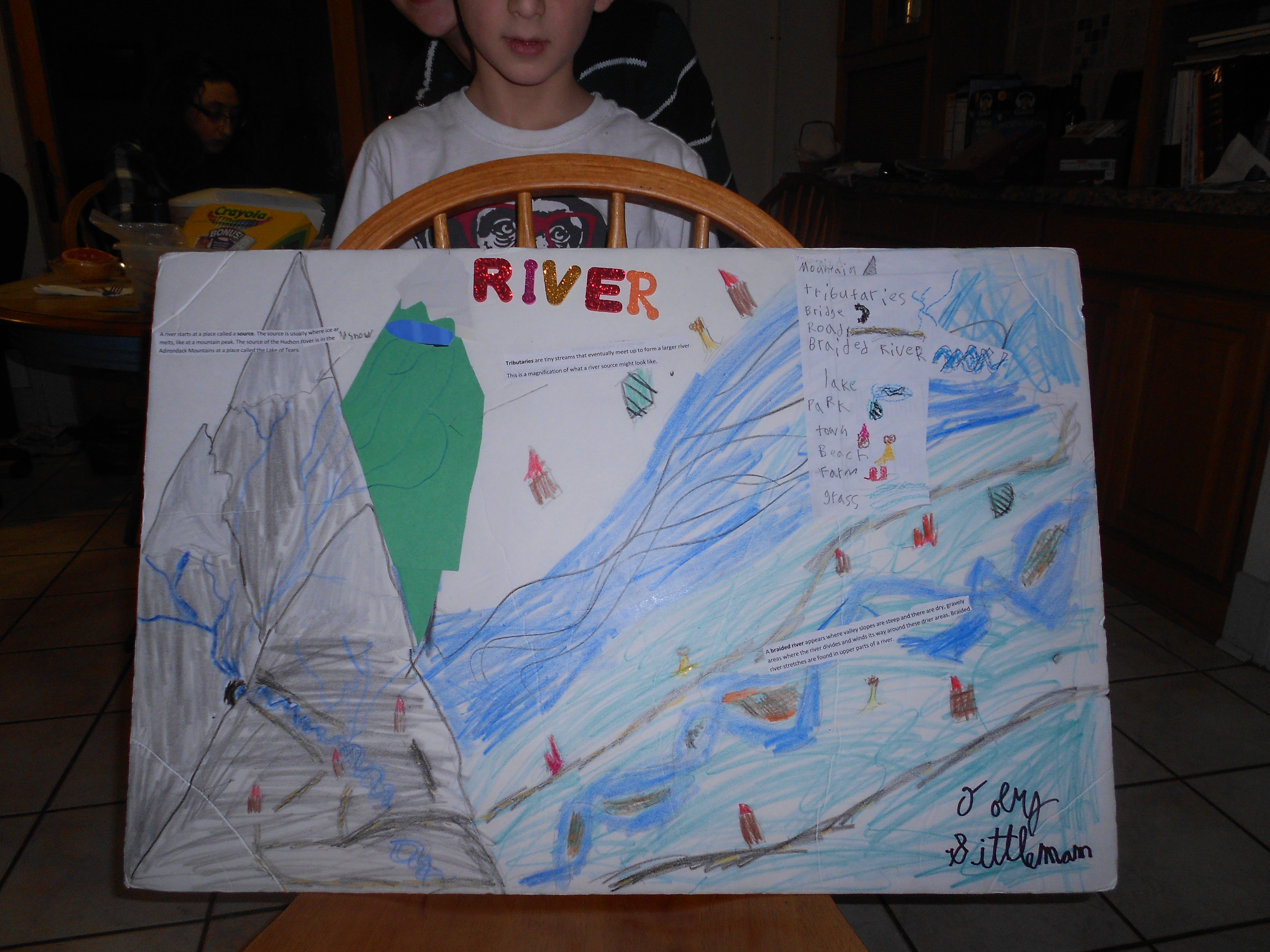
Three days later, he came home with his final grade: Outstanding. Well, good for us.
I mean, good for HIM!
Pareve Pumpkin Pie


photo found on marthastewartliving website
Everyone in my nuclear family loves LOVES pumpkin pie. And for only the second time in 12 years, my pumpkin-pie eating little family of five will not be going over the NY Thruway and through any tunnels or bridges to New York City. Nope, as much as we love seeing the family and sitting in 10 hours of traffic, this year, we are staying put.
When you are Transplantednorth, there are some disadvantages of being a nuclear family in a town where it seems you are surrounded by friends who all have extended family in town. Come holidays like Thanksgiving, you once again become the disappearing transplant.
I’m not complaining, really. This was my choice to stay “home.” But can a place be home where there are no extended family within 300 miles? The rest of the year, Rochester indeed feels like home. Come holidays, without aunts, uncles cousins and grandparents around, it can feel like how the Ingalls family must have felt on the wild, windblown frontier.
But this is a story about pareve pumpkin pie.
One small advantage of staying put (okay my kids will think a big advantage) is that at our Thanksgiving table, we’ll have pumpkin pie.
As much as she has tried to like it, my mom does not like anything pumpkin. My kids, however, can’t get enough of the orange stuff. I put it in breads, waffles and pancakes. I even made a pumpkin challah just so I can make pumpkin challah stuffing.
But, most of you know that pumpkin pie calls for milk, cream, condensed milk, or some other dairy ingredient. This poses a challenge to Jewish families like ours who observe the dietary laws of keeping kosher.
There are ways to get around the dairy dilemma by finding pareve ingredients.
What is pareve? Not many know. It is so esoteric, the word does not appear in the WordPress spellcheck.
It’s a term meaning food that is neither meat or dairy. It’s neutral. Like Switzerland. Does it taste as creamy and delicious as real cream? No. But, I’d rather have an imitation dairy dessert any day than serving a Tofurky at my Thanksgiving feast!
Here is the recipe. I based it on a recipe used from Martha Stewart Living, I just replaced the dairy ingredients with some stuff called Coffee Rich, found in the frozen section of most grocery stores. For those of you in upstate New York, I found this chemical-laden substance at Tops, and not Wegmans this year. But I still love you, Wegmans.
All-purpose flour, for surface
- Pate Brisee for Traditional Pumpkin Pie
- 1 can (15 ounces) solid-pack pumpkin
- 3/4 cup packed light-brown sugar
- 1 tablespoon cornstarch
- 1/2 teaspoon coarse salt
- 3/4 teaspoon ground cinnamon
- 3/4 teaspoon ground ginger
- 1/4 teaspoon freshly grated nutmeg
- 1 teaspoon pure vanilla extract
- 3 large eggs
- 1 Cup Pareve Nondairy Creamer, like Coffee Rich
- Ground cloves
- Whipped cream, for serving
Directions
- Preheat oven to 375 degrees.
On a lightly floured surface, roll pate brisee disk 1/8 inch thick, then cut into a 16-inch circle. Fit circle into a 9-inch deep-dish pie dish, leaving a 1-inch overhang. Fold edges under. Shape large, loose half circles at edge of dough, then fold into a wavelike pattern to create a fluted edge. Prick bottom of dough all over with a fork. Freeze for 15 minutes.Cut a circle of parchment, at least 16 inches wide, and fit into pie shell. Fill with pie weights or dried beans. – Buy a premade Pareve piecrust. Bake until edges of crust begin to turn gold, about 15 minutes. Transfer to a wire rack, and let cool.- Meanwhile, whisk pumpkin, sugar, cornstarch, salt, cinnamon, ginger, nutmeg, vanilla, eggs, creamer, and a pinch of cloves in a large bowl.
- Reduce oven temperature to 325 degrees. Transfer pie dish to a rimmed baking sheet, and pour pumpkin mixture into cooled crust. Bake until center is set but still a bit wobbly, 50 to 55 minutes. (If crust browns too quickly, tent edges with a strip of foil folded in half lengthwise.) Let cool in pie dish on a wire rack. Refrigerate until well chilled, at least 6 hours (preferably overnight.
Happy Thanksgiving!
About Me

Kreativ Blogger

Versatile Blogger Award


 Stacy Gittleman