
The Passover-Israel Connection

It would be funny if it were not so tellingly sad.
After weeks of rehearsing Passover songs for a school wide Seder and in anticipation of April break, I knew my students would be feeling a bit burned out. But still, there was so much left to teach about Passover, especially the idea of redemption and how for modern Jews, Israel is our redemption. However, as our generations get further away from knowing a time before there was the existence of the modern Jewish State, one can take Israel, and teaching for Israel for granted. In afternoon supplementary Hebrew schools, where hours are shaved for time’s sake, teachers must focus most of their time just teaching Hebrew reading. There is little time to teach Israel.
So, in the final Hebrew school hours before Pesach, I wanted to part with my students with thinking about the Israel-Pesach Connection with a slide show. (if you want a copy of this slide show, please send me an email at stacy.gittleman@yahoo.com and I’ll happily send it along.)
I put a picture up from my laptop projector of the following people. Can you name them?
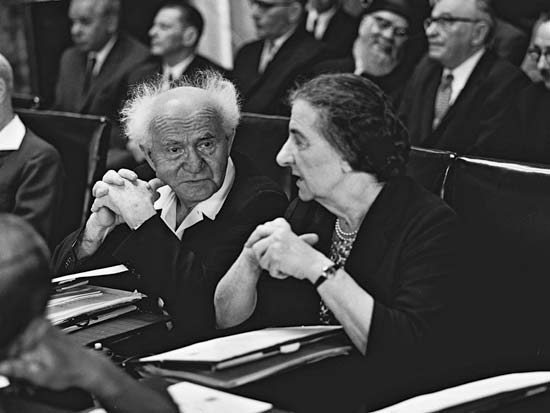
Now, to give them credit, I said I was going to show students slide show presentation from photos that were mostly ones I took in Israel, and told them that most of the photos were mine, but others were those I found on the Internet.
I just didn’t tell them which were which.
So, when I put this picture up and asked if anyone knew who these folks might be, I got some pretty interesting answers:
“Umm…. they must be husband and wife.”
“Are they your parents?”
No. No, I corrected them. These people are two of Israel’s most influential leaders in the formation of a Jewish state. Can you name them now?
Still no answers.
“Children, the man is David Ben Gurion, the first prime Minister of Israel and the woman is Gol-“
“Oh, now I know! Is that Golda Meir, the first woman Israeli prime minister?”
“Yes, that’s right!” Now we were getting somewhere.
The next hand flew up.
“Did you… meet them?”
So, in the final weeks of Hebrew school after Pesach, I realize I have my work cut out for me. I’m pretty sure I knew who David Ben Gurion and Golda Meir were by the end of the sixth grade. And I knew that, like Moses, these pioneers of the modern state of Israel went to European leaders in the 1930’s asking to let their people go to emigrate to the British Palestine Mandate to escape Hitler’s mad plan for the Jews.
When I get back to class, even though there are only weeks to go, I will put up photos up of Ben Gurion and Golda Meir. And Moshe Dayan. And Menachem Begin. And Rabin and Sharon.
Because, just as we tell our children the story of the Exodus from Egypt, and just as we vow to never forget the horrors of the Holocaust, so must we tell our children the history of the formation of the modern State of Israel. We must somehow weave that right into our Seder narrative just as we sing Dayenu and Adir Hu.
One great resource that I found online this week is the Israel 365 Hagaddah. It is 60 pages of the traditional hagaddah text combined with beautiful Israel photography plus specially marked “Israel moments” to highlight at your Seder. I hope that just some of this amazing Hagaddah makes it to your family’s Seder celebration.
Pesach Sameach. Happy Passover. And next year in Jerusalem.
Pride, and Shame, in Israel
When I return to the United States, I promise to create individual blog posts about the many aspects of our Israel trip, but there is an underlying vibe in Israeli society today that is making news that I cannot go on any longer without mentioning.
Let me preface all this by saying how overall, I have absolute love for my (that’s MY) spiritual homeland. It is ancient. It is wi-fi’d high tech and hydrophonic modern. Every rock and stone tells a history of the Jewish people and the other civilizations that have come and gone here. I am not a tourist here, though I am living in hotels out of my suitcase. I can get by somewhat with my Hebrew. My kids and I have friends here. Though I am here right now I am already longing to come back again, and wonder how long will that be, and when will I ever be able to stay here for more than 10 or 14 days at a time?
I take pride that my children are walking through their history. More than any mid-afternoon Hebrew school class can offer, they have all week been immersed in hearing people speak Hebrew all around them, witnessing the miracle of chanukkah in the land that chanukkah happened, walking through the tunnels the Maccabees forged to reclaim and rededicate the temple.
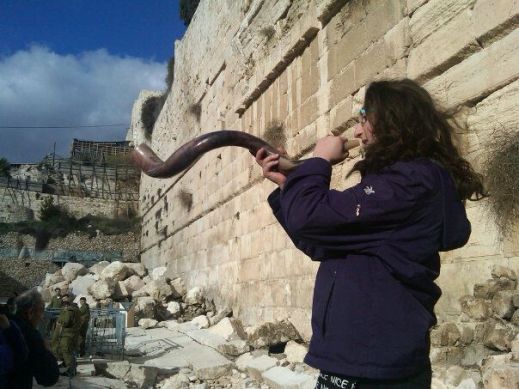
How can I not be proud when I witness how much Israel has changed since my last visits? In 1967, most of Jerusalem’s old city, reclaimed from Jordan, lay in ruins. Now: synagogues have been rebuilt. Archeologic wonders like the excavations revealing access to all the length of the Western Wall of the Great Temple and then the Davidson Archeological Center giving access to all visitors the Southern Wall of the Temple Mount; the fact that my daughter blew her new Shofar in the very place that the Kohanim priests blew their horns to mark the end of Shabbat at Sundown on Saturday night:

The pride of how Israel has preserved artifacts of not only its own ancient peoples but of the cultures of Greeks, Romans, Ottomans, Byzantines, and so many that tried to conquer and occupy Jerusalem. You want to see ancient sites? Greek? Roman? Byzantine? Come to Israel, it’s a historian’s one stop shopping place.
And then the pride of being at the Kotel on Friday night with thousands of Jews celebrating Shabbat and Chanukkah, blessing my children at Judaism’s holiest spot, how could I not feel pride at what Israel and the Jewish people have accomplished?
But then….
I was first very disturbed that first night at the Kotel. As Shabbat descended, men and women gathered to pray on their respective sides of the Kotel. And, like most times at the Kotel, I noticed women standing on chairs, looking over the mechitza, or separation wall, to wave to husbands, sons…
Then, a man came over to them. Shouted to them “Modesty, Modesty!” Get down! Get out of here!”
Slapping their hands. Slapping them. Shooing them away like they were children. Is this how a Torah Jew is supposed to treat the mothers and Daughters of Israel?
Then, more news reports.
- Haredi men saying that women may not walk on the same sidewalks as men in certain towns like Ben Shemesh.
- Haredi men spitting on a seven year old girl and calling her a prostitute because she was not dressed modestly enough in their eyes (the girl was orthodox and she was wearing a long sleeved blouse and a knee length skirt.)
We spend the last two nights at Kibbutz Halavi. A beautiful Kibbutz, a beautiful hotel. But many of the guests were ultra Orthodox Jews. Would it be too much for these, our fellow Jewish bretheren, to return a smile when I gave it to them, to even ask where we were from and make some small chat? Have they forgotten the mitzvah of greeting people with a cheerful disposition? Have they fogotten in their zealousness of making sure that every piece of lettuce and every cut of meat is under the correct hekshcer (kosher certification) that every Jew is responsible for one another and the meaning of Kibbutz is to gather together?
Have they forgotten the words, Henei Matov U Ma Naim, Shevet Achim Gam Yachad – How wonderful it is to gather and sit and be together like brothers?
The direction of religious extremism in Israel is the wrong direction.
Am I a Bad Jew? An open letter to Benjamin Netanyahu
 Dear Bibi,
I am writing to you somewhere within the American diaspora. In a few weeks, my husband and I will be taking our children and our parents on our first family trip to Israel. When we get there, I hope that the Israelis we meet there don’t think that we are devoid of any Judaism or Jewish life back in evil America.
Let me explain. I just viewed some commercials made by the Israeli government warning them of the risk of assimilation, of losing their Jewish identity if they move to and remain in America. The Jewish Federations of America, along with most American Jews, took offense.
A lot of controversy has been stirred by this ad campaign trying to lure Israelis living in America to come back home to Israel if they want their own children to remain Jewish.
To those of you not familiar with it, here is an example of such an ad. Basically, an Israeli grandma and Grandpa in Israel are skyping with their family in America. The grandparents, seated in a living room with a lit Chanukkiah (candles for chanukkah, it’s NOT a menorah) in the background, ask their granddaughter what holiday she is celebrating. She joyfully shouts (to her parents’ dismay) “Christmas!”
(this ad has been removed as I write this post)
Here is what I know, good and bad, about Jewish life in America and Jewish life in Israel.
- Israel, you have no better friends in the world than the Jews of America.
- I am involved with the Partnership2Gether program in my city. Each time we are visited by our Israeli counterparts, friendships are forged and dialogues begin about Jewish identity on both sides of the sea.
- The Israelis making their first visit to America greatly admire how hard American Jews have to work to maintain our Jewish ties. Yes, we are pulled in many directions trying to balance secular commitments with the religious. But yes, we enjoy the freedom we have of making our own choices.
- The Israelis who came here greatly admire the role of women in synagogue life. Some of them for the first time saw women serving as rabbis. Some of them for the first time had the honor of being called to the Torah for an aliyah.
- Israelis who visited America expressed their disgust with extremist religious strains that take an “all or nothing” approach to observing mitzvot to the point that rather than trying to observe Judaism to their own comfort level, they have abandoned any Jewish practice at all.
- Yes, some of my middle-school aged Hebrew school students are from intermarriages. And many of them struggle with their identity, especially in December. But we have to respect that non-Jewish parents who love their children made the hard choice and the sacrifice to raise their child in a religion that is not their own. It is a choice they believe in and many try to learn about Judaism right along with their children.
- My students ask if they are a “bad Jew” if their family doesn’t light Shabbat candles every Friday night. They ask if they are a bad Jew if they help their non-Jewish parent set up Christmas lights. What can I possibly tell them? I can’t. All I can teach them are the tools and the mechanics of Hebrew language and the religion. It is up to the individual parents and families to apply or not apply, these teachings in the privacy of their homes.
- Am I a bad Jew if I find myself this time of year humming a Christmas tune? Not really, as Christmas permeates every facet of American culture between October 31 and December 25. For impressionable Jewish American children, it is all the more impossible to ignore. I teach my students and my own children that it is okay to admire the lights and decorations, but know it is not our holiday.
Bibi, I’ll be in Israel all of Chanukkah. Why don’t fly over to the states and spend your Chanukkah in America and see how hard Jewish Americans work to say “no, Christmas is not our holiday. In spite of being a minority, we choose to worship our God and practice our religion the way we choose.”
Isn’t that after all the message of Chanukkah?
Do Jews hold a Grudge Against Germany?
edit: To add some more to this sentiment: My parents this summer visited Germany. My mom was hesitant to go but she went. They took a river cruise on the Rhine and had a wonderful time. And, everywhere they went, there was not a single place visited where their tour guide did NOT make a mention of the atrocities that happened to the Jews during the Holocaust. The tourguide was extremely compassionate as he discussed the plight of the German Jews with my parents. They would certainly recommend a trip to Germany now that they visited.
A few nights ago, I had the pleasure of participating in some intense Jewish study with some very intelligent women in my neighborood. The study session was held in preparation for a nine-day mourning period in Judaism that happens each summer culminating with the fast day of Tish B’Av, or the ninth of the Hebrew month of Av.
During this time, no meat is consumed. Religious women run lots of clothes through the wash before the nine days because no clothing can be laundered in this time period. Swimming is off limits as well.
Why?
This time marks some of the saddest occasions in Jewish history, most notable are the destruction of the two Holy Temples – first in 423 B.C.E. and then 70 C.E. – that once stood on the Temple Mount in Jerusalem. The destruction of the Temples also marked the Jewish Exile from Israel, which ended only with the establishment of the modern State of Israel in 1948.
So, why mourn something that happened millenia ago? The issue of how to make that feeling of mourning relevant today was the topic of our study session.
I started to write this post a day before our study, but what gave me the chills is how our moderator opened the talk with another time of destruction in recent Jewish history: the Holocaust. Even if you didn’t have a direct loss in your family, it was a loss for the Jewish family as a whole, a loss that is still viscerally ingrained in the Jewish psyche today. We should also strive as Jews to make the loss of the Temples just as palpable.
Getting back to the Holocaust:
A few things I deducted from my Hebrew school education about the Holocaust, as taught by our rabbi, son of Holocaust survivors:
- After the destruction of Jewish life and Jewish culture under the Third Reich, Jews should Never Forget. Therefore, Jews should never again set foot in Germany
- Because of Hitler’s infatuation with composer Richard Wagner, because Wagner’s music was the soundtrack of music played as Jews marched to their deaths in concentration camps, Jews shoud Never listen to or play compositions by Wagner.
- Jews don’t buy BMWs or Volkswagons
- Again, Jews don’t visit Germany
I held onto these notions a for a long time, including during the summer of 1989, when I spent a month in Israel volunteering on a kibbutz in Israel’s northern region. To my surprise, many of the other volunteers were not Jewish kids; most were European. To my further surprise, many of them were German.
I never knew any Germans before this encounter. As I got to know them, I found them to be gentle and kind. They also had a thirst for learning all they could about Jewish culture, Hebrew, Jewish holidays – anything Jewish they could get their hands on, they wanted to learn about.
I asked them – why?
Their explanation: Germans of their generation felt an enormous sense of guilt as to what happened in their country, and that guilt was unjustified. They wanted to learn about Judaism, because, at the time, there were very few Jews in Germany. Still, I expressed my reluctance to ever visit their country.
Instead of being angry with me, their reaction was one of sadness.
Over 20 years have passed and I still struggle with my feelings about contemporary Germany. But just in the last week, there was media coverage about Jews and Germany that is making me reconsider.
The other evening, I listened on NPR the unthinkable: that the Israeli symphony was in Germany playing Wagner compositions.
Former Soviet Jews and young Israelis are settling in Berlin. There, they enjoy a thriving cosmopolitan culture with nighclubs, art galleries and community centers – all with an Israeli twist.
Another one of my brilliant neighbors, Athene Goldstein, returned from a visit to Germany, where her son-in-law, a professor, was delivering a talk on Jewish history in Germany. There, she also visited a museum in Berlin dedicated to Jewish culture. From her working knowledge of German, she could tell that none of the museum’s visitors were Jewish, but again, just as I experienced on that kibbutz, there was that intense curioustiy of wanting to know about Judaism.
“The museum was filled with basic Jewish artifacts: Sabbath candles, Torah Scrolls, a menorah for Chanukkah,” said Athene. “It was Judaism 101. But that is where they are. Germans are very up front about what happened in their country under the Nazis. Now, they just want to know about who their country tried to completely destroy.”
Is the fact that the Jewish population is growing in Germany a sign that Jews are forgetting their past? Or is it perhaps, maybe the best way to deal with the memory of the six million lives lost is to replace what was lost by renewing life there once again?
Community through a Cookbook: my Speech Before Hadassah
The other night, I was the featured speaker at the Installation Dinner of the Rochester, NY chapter of Hadassah. For those of you who wanted to know what I spoke about, here it is, all 20 spoken minutes of it, though changed slightly as I had some visual cues for some of the jokes. And some of the jokes, well, it’s a Hadassah thing, so you may not understand. Also, if you are not up on the Jewish faith, there is a LOT of jargon that you may not get, so if you want to skip this post, I will understand. But it was an honor to speak and a great evening I’ll remember for a long time.
Hadassah is an organization known throughout the world for promoting Zionism and Israel, supporting advances in medicine, and advocating Jewish education. Any art lover the world over surely knows about the Marc Chagall stained glass windows that grace the chapel in Jerusalem’s Hadassah Hospital.
But, when I think of the Rochester chapter of Hadassah, the Rochester Hadassah Cookbook immediately comes to mind.
I have to tell you, I got this cookbook by way of Berkeley California. I had just become engaged to my husband, Craig. He was in graduate school. I was – uummmmm, hanging out and enjoying the California scene!
We got the Rochester Hadassah cookbook as an engagement present by way of a grad school friend of Craig’s named Mike. Mike was born and raised in Rochester. Mike came back to California after a trip back East and presented us with this book as an engagement gift from his mother.
And I said “Oh, Rochester. That’s somewhere upstate, like near Poughkeepsie!”
At that point in my life, I had no connection to Rochester outside of this cookbook. Rochester was the furthest thing from my mind. We were living in California but that was temporary for us East Coasters. Craig would finish his PhD, and then we were moving back to New York City, center of the universe!
and that
was that.
We did move back to New York City. Well, New Jersey actually. Craig found a job in the suburbs and I also found one – in Manhattan. Complete with a three-hour round trip commute on New Jersey Transit!
I landed this great job at a growing high-tech public relations firm. It was a time when they couldn’t find people fast enough to perform quality account work for the burgeoning, brand-new high-tech industry. Ah, I miss the 90’s!
My boss was a stunning, statuesque blonde woman of 35. She had the corner office of our Park Avenue suite. To the north, her view faced uptown to Grand Central Station. To the West, she overlooked Park Avenue. She loved living the life of a single Manhattanite PR executive. However, she would tell us many times that her parents in Florida wished she would marry and give them grandchildren already. When she visited them, she instructed us to call her often on her cell phone, so her parents would see how important she was back at the office.
Sitting in my cube as a lowly – NO rising – account executive, I would imagine what it would be like to live that kind of life. Most of my co-workers were in their 20’s and single. Half their salary went to paying rent.
The other half – alcohol.
At 28, I was already the old married lady of the office, and Craig and I were starting our family.
After a few years and two kids later, we moved up to Rochester for Craig’s employment. It was then I learned that Rochester is waaaay further upstate than Poughkeepsie.
My company back in New York City still wanted me. They even offered to set up a virtual home office. But, reality set in. I was staring down at our first long Rochester winter with a one year-old and a three year-old as my only companions. I didn’t know a soul in town. Virtual office or not, I realized that building my social network here for my family would be more important than racking up more media hits for IBM. So, I politely said thanks but no thanks, and became a stay-at-home full time mom.
Stay-at-home moms rarely stay at home, as you know. Those first few years here, I spent most of my time at Wegmans, the Strong Museum of Play, and the JCC. When you’re the new mommy in town, people are very interested in getting to know you. I realized that the Jewish moms I was meeting were fulfilling the mitzvah to welcome new Jews into the community. We were invited as a family for Shabbat dinners on Friday nights and, during the week, playdates for the kids and I. I’ve heard that this courtship is called “mommy dating.”
More than a few times, I would eat something prepared by a prospective mommy friend and say,
“WOW, this is great, where did you get this recipe?”
And one woman after the next would reply, “I made it from the Rochester Hadassah cook book!”
And I would reply, “OHHHH, I have that cookbook, I’ve had it for YEARS! I think I’ll start using it now.”
The JCC opened up to me a network of great women who believed in giving their kids a Jewish education in early childhood. I’m now over the rainbow from my own kids’ preschool years and teach preschool myself. I am in forever debt to people like Tzippy Kleinberg, Andrea Paprocki and Emily Fishman at the JCC and later, Randi Fox Tabb at Keshet preschool for planting the very first seeds of Jewish knowledge for my kids. Now that I’m a preschool teacher, I see the appreciation parents show when their little ones come home singing “Shabbat Shalom – Hey” or say a bracha every time they put a cookie in their little mouths.
Becoming a new parent can be the road back to Jewish observances. In fact, a 2002 study by the Jewish Early Childhood Education Partnership described Jewish preschools as the Gateways to Jewish Life. The time to get young families rooted back into Jewish community life is when their children are between the ages of birth and three years of age.
I remember when my son Nathan was in his first year of preschool at the JCC. I had an “aha” moment – a moment you knew that the Jewish foundations you lay for your child are really sinking in – in all places but at Michael’s.
Nathan was just 2 ½. I picked him up at the J and we went schmoozing at Michael’s. From his seat in the shopping cart, he spied one of these big fake terra cotta gardening urns.
“Mommy” he said, in an angelic voice that only two and one half year olds have “They have a really big – Kiddush cup!”
By the way, Nathan is now well into his Torah studies as he becomes a Bar Mitzvah this November.
In addition to giving my children a Jewish education in their earliest years, being a stay-at-home mom afforded me the time to continue my own learning. When living in New Jersey, I admired women who could get up and read Torah on Saturday mornings or who were involved with other aspects of Jewish communal life. But my three- hour round trip commute into the city left time for little else during the week.
Why did I decide to learn to read Torah later in life? I have to confess, it’s the rush. I have to get my adrenaline rush somewhere. For one thing, I hate roller coasters. The only time I rode one was on a dare from Craig on the boardwalk in Santa Cruz, California. Craig jokingly said he would not marry me unless I rode the famed Big Dipper, a classic, rickety wooden roller coaster. As expected, I hated every second of that 60-second ride. But I guess it was a religious experience because I kept praying aloud to God to please get me off!
So, if I want to get my heart pumping, I sign up for a Torah reading.
I encourage more Jewish women to also get on this thrill ride. And don’t think, “I can’t do it because I didn’t grow up reading Torah,” because neither did I!
Growing up within my very Conservative synagogue in Staten Island, New York, boys preparing for their Bar Mitzvah were required to attend services on Saturday morning. Girls were required to go on Friday night. Girls would chant their Haftarah on Friday night and boys would be called to the Torah on Saturday morning. It was never questioned or debated if girls should have a larger role. That’s how it was.
We were taught that after our B’nei Mitzvot, boys were still required to go to shul but girls didn’t have to. Our rabbis, all Orthodox, said that girls were more spiritual by nature, thus relieving them of the obligation to attend services. They said if men were not required to go to shul, they would never go.
It’s true. Spirituality did come naturally to me. Each Friday night, I followed along with all of the melodies of Kabalat Shabbat. I never thought about the fact that after my Bat Mitzvah, I would not be asked to join a minyan if they needed a tenth, because I was not a man. I would not be asked to read from the Torah or participate in services. It made me feel as though I didn’t count, and on a certain level, as a Jewish woman, I didn’t.
That summer, my parents took our family to Israel, where I was to have a Bat Mitzvah ceremony at the Kotel! Imagine that! In my 13-year-old mind, I envisioned me chanting my Haftarah, the Kotel behind me, and all of Jerusalem listening!
Well, my actual “Bat Mitzvah” ceremony went something like this: I stood in a white blouse and a flowery skirt outside of the Kotel Plaza. I really did have a copy of my haftarah to chant. But a rabbi in a black hat from some agency handed me a siddur, and asked me to read the Shma in English.
“But, I have my Haftarah! And I can chant the Sh’ma in Hebrew,”
“That’s not necessary. You are a girl. Just read it in English.”
Tova Hartman, a lecturer in the department of gender studies and education in Bar Ilan University wrote in her book, Feminism Encounters Traditional Judaism, that living in Israel, she “knew there is no recipe or a structure on how to join Orthodoxy with feminism. In her own life, in order to give her daughters a model of religion she could live with, she had to form her own shul with a group of like-minded people, even if that meant she had to leave certain loyalties behind.”
Please don’t misunderstand me. I do have great respect for Orthodox Judaism. I admire their commitment to observing Shabbat, the hospitality they extend to guests on Saturday afternoons for lunch, and their dedication to a Jewish day school education.
I can also understand the values that Orthodoxy places on mothers as the first Jewish educators in a child’s life by being charged with creating a Jewish home. But even Blu Greenberg, author of How to Run a Traditional Jewish Household, commented in her book On Women and Judaism that “leaders of Orthodox halacha (law) must recognize that the general effect of exempting women from prayer conditions them to a negative or indifferent attitude toward prayer altogether.”
My feminist notions aside, when I became a mother, I appreciated why it is that women are not obligated to participate in time-bound mitzvot which could interfere with their tasks of mothering. But what I cannot accept is where “not obligated” evolved into “not allowed.”
My horizons on the role of women in synagogue life expanded when I moved out to California. Aside from daring me to ride roller coasters, Craig encouraged and taught me how to lead kabbalat shabbat at the Hillel at Cal Berkeley. There, the rabbi was a woman. For the first time, I heard the matriarchs mentioned next to the patriarchs in the chanting of the Amidah. Women lead services, had aliyot, and read from the Torah. This was so common, in fact, that once, a non-Jew came to our services and quietly asked, “Are men allowed to read from the Torah?”
I learned how to read Torah at age 37 thanks to a six-week adult education class led by Chazzan Martin Leubitz at Temple Beth El. On the first day of class, Chazan Leubitz informed us all that he had signed us up to read Torah in six week. That would be our final exam.
For me, I have come to realize that learning Torah is not an exercise in perfection, rather an act of participation and performing the mitzvah of studying Torah as a full-fledged member of the Jewish community.
Connections in the Jewish community, actually, would you believe a conversation in the women’s locker room at the JCC – led me to landing my column at the Rochester Democrat & Chronicle. Writing this column has been a return to my first love of newspaper writing. It has also given me a reason to set up a home office, with a corner office in my kitchen. To the south of my lavish two square-foot corner office – I have an excellent view of the piles of laundry that pile up in my family room. To the East, there are dishes in the sink and groceries to put away. Directly before me is my blank computer screen, which I must fill with 600 well written words every week.
Writing my column is like riding a bicycle up and down a series of hills. All year long. On deadline day, I pedal the hardest. I do a lot of the writing – as I did this speech, in my head, long before I sit down to my computer. I think about it at red lights, on walks, on line at Wegman’s. Writing takes a lot of rewriting, moving paragraphs around, weaving and reweaving them until every word fits into place.
It’s like that feeling you get when you untangle a necklace.
Then, I hit send. And I can finally coast downhill, for about a day. I finally pick myself up from my cushy corner office to the mundane never-ending tasks of laundry and dishes. I also take some time to get in a workout. A shabasana, the restive pose at the end of my Wednesday night yoga classes, are divine and well deserved after hitting send on my column.
Then, the search continues again. Because most of my connections are in the Jewish community, lots of people pitch me with Jewish story ideas. But, I’ve had to gently turn a lot of them away. When it comes to my personal identity, I am a Jewish American. But for the sake of the wider audience of the Democrat & Chronicle.
I’m not a Jewish reporter, I’m a reporter who is Jewish.
Between the lines of my column, however, Jewish themes can still be found. A day devoted to cleaning up our parks or collecting unwanted pharmaceuticals – those are the values of Tikkun Olam, or repairing the world. Events that speak on helping care for our seniors or events at a senior center? That is Gimilut Hasadim – acts of kindness.
So I try not to comment or cover too many events or issues that impact the Jewish community.
Except for the recent incident where some teens were caught and charged with the hate crime of burning a swastika in Brighton. On the night before Yom Hashoah, Holocaust Rememberence Day. I had to speak out on that.
After a lot of back and forth with my editors, who questioned if such a heavy topic was the right fit for the Our Towns section, they agreed to keep my words. I thank them immensely for hearing me through on this. As I stated in last week’s column, I love covering the good in our communities. There is so much bad news in our world and I’m honored to be able to bring to readers news on events where they can participate and help out their community. But suddenly, this columnist who is Jewish became a Jewish columnist and I had to speak out. Because, what do we mean, when we are saying “Never Again?”
You have to remember that when the news broke, our community was immersed in daylong Yom Hashoah observances. Included in this was a community wide program for teens: a staging of the play “What Will You Tell Your Children” written by Rochester native Jessie Atkin upon her return from a Journey for Jewish identity trip in 2005, where Jewish teens from the United States and Israel spend time together here, visiting concentration camps in Poland, and finally in Israel. I’d like to thank Jodi Beckwith for directing the play and to our Jewish education leaders for bringing the event to our children.
And how was this play received by our teens, many who never experienced anti-Semitism first hand? To give you an idea – there were about 250 kids in the room to watch the 90 minute performance. Suzie Lyons, the director of Education at Temple Brith Kodesh, noted that only 11 kids got up the whole time to use the bathroom
Have you ever been on the receiving end of hearing a racial or religious joke? Usually, the joker defends his joke by saying – it’s okay, some of my best friends are: Black or Jewish, Chinese, you fill in the ethnic group.
On a positive note, I want to bring to your attention the overwhelming response of coming together in the Jewish and wider community. The morning after the swastika was burned, the Home Acres neighborhood had a vigil attended by Brighton Town Supervisor Sandra Frankel who called it a despicable act. In last week’s editorial page, the hate crime received a “thumbs down” by the D&C. There were several letters to the editor – one jointly written by leaders in the Christian and Muslim communities – condemning the act.
.
Our Jewish youth, many who know this boy, a student at Brighton High School, are struggling. They are searching for a rationalization why he may have done this, they think – there must be a reason, There’s got to be a reasonable answer.
Seventeen is an extremely vulnerable age where friendships run thick and rule supreme. And the apparent betrayal of a friend at age 17 is painful to accept. I’m sorry, but I don’t think that this young man was considering the feelings the Jewish kids he knew when he allegedly planned to burn a swastika. Or maybe he just thought it would be okay to do this as a joke, because after all, some of his best friends were Jewish!
Both boys have pled not guilty which means that they will have another hearing in town court on May 25. This leaves us with many questions. Was this an isolated event or should we fear a wave of similar copy cat crimes? Did these boys really understand the gravity of the timing of their act or do they truly comprehend what horrors were committed under the symbol of the swastika? And if they didn’t, where are we going wrong, in our school system, in our discussions at home, that we are not telling our youth enough about that very dark chapter in human history.
To leave you on a positive note about this, I want to tell you about the group of seventh graders I had the pleasure of teaching this year at Temple Brith Kodesh. They were absolutely dreamy, I mean it! While they are not exactly enthralled about learning about the minutia of the Hebrew language, the topic of carrying on Jewish identity, especially as they face post Bne’ Mitzvah life, keeps them engaged. On the Macro level, they have a very strong sense of who they are as Jews. After the swastika incident, the debate arose in my class whether middle school trips to Washington D.C. should include a mandatory visit to the US Holocaust memorial. Some students, in light of what just happened, thought it should be a priority to visit the museum for all students – Jewish and non-Jewish. Others thought that the serious theme of this museum would overshadow what may be the first time a young student visits our nation’s capital. But it was good to see my seventh graders debating and discussing, trying to work it out. And again, not one of my students asked to leave the class to go to the bathroom, can you imagine?
So, my advice to you tonight? I guess it is to maintain a focus in your life on Jewish education, from the earliest years of our children and well into our own adulthood. While raising a family, keep a hand in your own profession, however small, and as much as your family and your own sanity can handle. Mothering is the best job of all. But don’t disappear, don’t let your own individuality get folded and lost into the lives of your husband and children, just as egg whites get folded into the batter of a Passover Sponge Cake, which a recipe can be found within the pages of the Rochester Hadassah Cookbook. Thank you for listening.
Sisters are Doing it For Themselves – but we can do better

Women, we need your voice and leadership in Judaism
To my dear readers,
This blog post focuses on synagogue life inside Conservative Judaism. If you follow a different faith and don’t wish to read on and get bogged down in all the Jewish lingo, I will completely understand. But, if you want to read on and offer your point of view on women participation in religious life, Jewish or not, read on and chime in with your comments.
Last Saturday afternoon, after many warm hugs and handshakes on a job well done, and a shot of chocolate schnapps over a Kiddush lunch with my volunteer co-chair, I finally breathed a sigh of relief.
I co-chaired Sisterhood Shabbat at my synagogue as part of a nationwide celebration of women and women participating in synagogue life. The service went splendidly with many firsts for our congregation: The first part of the service was led by our congregation’s first woman rabbi. During the Torah service, the Torah was capably lifted by a woman who is a weightlifting fitness instructor. My co-chair and I felt a great sense of accomplishment that we had risen to the challenge to find a woman to lead every part of the service. Every woman who volunteered rose to the occasion as well and did their parts beautifully.
What troubles me is who will lead in the years and decades to come.
My concern over the last few months as I helped put this service together was on two fronts:
- The sparse feeling that I get when I see the increasingly empty blue seats week after week indicates the dwindling number of families who take the time to be with their community on Shabbat mornings. I get a little concerned about the future of my synagogue and the future of Conservative Judaism as a whole.
- I also was troubled by the number of women who I approached to participate who were not comfortable leading services or not comfortable with their knowledge of Hebrew. Among those who politely said no to participating were Jewish educators themselves. This level of discomfort, the scarcity of women who are comfortable enough to lead services, comes after nearly two decades of the Conservative movement counting women in a minyan and allowing full participation in synagogue life.
Sisters, we have to do better. If we truly want to see egalitarian Judaism survive and flourish, if we have the privilege of being counted in a minyan, than we owe it to ourselves and our daughters to push out of our comfort levels and learn to lead.
Is this a challenge? Of course it is. But it is not impossible. Look how far women have come.
- Don’t be afraid of not being comfortable leading services. We all need to start somewhere. Know that however you do, your community deeply appreciates that you participated in this mitzvah, or good deed, of leading your community.
- There are so many resources available for learning. If enough people voice interest and commitment, synagogues will happily create classes or sessions with our clergy. I didn’t learn to read Torah until I was 38 years old. Why? Because when I was a kid, girls “didn’t have to” learn Torah. But I knew even as a child that I would someday learn.
- If you are more comfortable learning at home and are tech savvy, there are online programs galore to help. For example, Siddur Audio walks you through nearly every page of the Siddur Sim Shalom prayerbook of the Conservative Judaism movement. You can even download mp3 clips and listen to them on your iPod to learn.
Lastly, don’t be afraid of making mistakes or screwing up. Or the butterflies in your stomach. I get nervous – complete with sweaty palms – nearly every time I read Torah. I often say to myself right before I read, why am I putting myself through this? But I know why I do it: it’s good for the community, and reading Torah is really good for your brain!
But it is not an exercise in perfection, rather an act in participation, because if you falter, there are people right beside you who are there to help. That is why it is called a kehilah kedosha – a holy community.
What’s a Nice Jewish Girl to do about Halloween?

Some of my neighbors really get into decorating for Halloween
My birthday falls in late October. I will not disclose my age, and those of you who know me know what that number is. Unless a birthday is one that ends in a 0 or a 5, birthdays at this stage of life are no big deal.
But think back to when you were a kid. Those were the days when one counted down the days to their birthday party. And if you were lucky enough to be born on the cusp of the Scorpio sign, birthday parties were all about Halloween. Late October babies have a built-in costumed, candy-corn flavored theme that is perfectly gift wrapped with a giant fake spiderweb and grooves to the music of a Monster Mash soundtrack.
Each year, even up through high school, I celebrated my birthday with a costume party. On my seventh or eighth birthday, my grandmother transformed herself into a gypsy storyteller to the delight of all my costumed friends. My parents and grandparents even staged special effects, complete with a charmed stuffed snake to rise out of a wicker basket with the help of an invisible fishing wire.
All through childhood, my mother and grandmother were the master costume makers. My mom said that when she was growing up in her Bensonhurst, Brooklyn apartment, my grandmother would dress up as a witch and concoct costumes for every kid in the building.
And when it was my turn to dress up, mom and grandma could make me into anything I wanted because they both knew their way around a sewing machine. Pity my own children this time of year. I cook, I bake, I garden, I teach, I read Torah, but I cannot even decently hem a pair of pants.
I wanted to be a sunflower one year: mom made me a sunflower. And then scarecrow, and Indian Princess, and even a hairdryer. And my final Halloween birthday party, I made a really convincing Boy George.
Halloween birthday parties, trick-or-treating and getting candy went on happily and innocently until the seventh grade. That year, Halloween fell out on a Tuesday which was afternoon Hebrew School.
Hebrew School started at 4:30 and let out around 6 p.m. Through Chumash (bible) lessons, you could feel the tension in the class start to bubble like a witch’s cauldron: we were missing out on prime trick-or-treating time! We realized that by the time we got home, scarfed down some dinner and put on our costumes, maybe we could collect half a pillowcase worth of candy if we were lucky. But we had a plan.
“Rabbi,” one of our classmates sweetly inquired, “Can we get out of Hebrew School early today so we can go trick-or-treating?”
“Yeladim!” He shouted, saying the Hebrew word for children. “Jewish children should not celebrate Halloween. It is NOT a Jewish Holiday! If you want to dress up and have fun, we can do that later in the year, on Purim.”
In unison, the entire class gasped in disbelief. Up till this point, we were all completely unaware that Halloween could have other meanings besides dressing up, running around the neighborhood and getting candy. And, in the streets of Staten Island, we didn’t exactly live in a part of the world where Purim, a costume-filled Jewish holiday in the spring, was universally celebrated.
We were not deterred that night, or any year after, from our right as American kids to trick-or-treat. Okay, Halloween is not a Jewish holiday. In fact, I knew even back then that Halloween must have some Christian implications, because all the parochial school kids I knew in my neighborhood had off Nov. 1 for All Saint’s Day.
Halloween must be okay because my grandmother, the most Jewish lady I knew, still loved Halloween. One year, my grandparents went to Greenwich Village to see the famous Halloween parade. My grandmother had a blast and made friends with everyone, including “all the nice young men dressed up in the most elaborate costumes” who offered her a chair along the parade route.
My Yiddishe grandma, the one who made gifilte fish from scratch and sang me Jewish songs, found delight in hanging out in the Village with the drag queens on Halloween!
I always wanted to go into the Village for Halloween, but it wasn’t until my grandparents raved about it did I got the nerve to go to one of the best places in the country to celebrate on Oct. 31.
I spent two Halloweens in the Village in my 20’s, although I didn’t wear a costume. Then, out in San Francisco’s Castro district, I dressed as Mona Lisa in a frame and my beloved dressed as the Mad Hatter. People sang “Mona Lisa” to me. A few people even got the Elton John reference and sang a few bars of that song with us. The streets got crowded, and my frame did get entangled with other costumes, but it was all in good fun.
Those were some of the most memorable nights of my life. More than the candy, as young adult I saw Halloween as a time when people can express themselves and become someone else for just one night. Halloween costumes break down barriers between strangers. But beneath the costumes and candy, the darker messages that lurk below are just plain not Jewish.
I still love Halloween and my heart is tied to the Halloween memories of my childhood. But Halloween has shifted lower on my priority list.
After a month of putting energies into the Jewish fall holidays I mentioned in a recent blog post, I have little desire to turn my front lawn into a graveyard or put together a costume with a hot glue gun.
But we still carve our pumpkin. And I still let my kids go trick-or-treating. But they well understand and love that come spring, we will be busy making hamantashen cookies and baskets of food for friends and neighbors for the Jewish holiday of Purim. In that way, they learn that Purim, when you walk around the neighborhood giving treats, is in essence the exact opposite of Halloween’s tradition of going around the neighborhood begging for treats.
Am I sending my Jewish children mixed messages? Maybe. Will I someday, because of Jewish observance, let go of Halloween go altogether? Perhaps.
But in the meantime, it’s still fun to walk the neighborhood’s darkened streets, check out the glow in the dark decorations, and maybe get a little scared.
How a Sukkah is like a Christmas tree
 Okay, so the headline of this post might shock and offend some, but please let me explain my bold statement.
Growing up in a predominantly Italian neighborhood in Staten Island, as the Chanukkah song from Adam Sandler song goes, I was the only kid on the block without a Christmas tree. Our neighbors invited my family over for cake and tree decorating and we in turn invited them on Chanukkah to light our menorah, spin a dreidel and eat fried potato latkes.
Even back then I understood that Christmas was a big holiday, and Chanukkah was a minor Jewish one. But Christmas trees still left me with a feeling of being on the outside, my nose pressed to the frosted window.
A menorah, no matter how big, even the ones that the Chabad Lubavich movement lights, just can’t compete with the smell of fresh pine, the twinkling lights and the tinsel to a Jewish kid on Staten Island. I even had my secret Christmas tree fantasies. If I ever had a Christmas tree, it would be simple: just candy canes and white lights would hang off the branches of the Christmas tree of my dreams. And it would only be in my dreams, because I knew very well that there is no such thing as a Chanukkah bush.
I did have childhood associations with Sukkot, the eight-day autumn festival of Booths, because of Hebrew school. I made the standard paper sukkah chains and ate within the large sukkah of my synagogue. In fact, the first time I was ever asked on a date was in a sukkah. It was in the seventh grade and a classmate asked me to go roller skating at Skate Odyesy as our teacher, on Orthodox rabbi, continually shushed us as he attempted to recite kiddush, the blessing over the grape juice.
But because my family didn’t build a sukkah of our own, the holiday still felt remote to me. I didn’t have a sukkah to eat my bowl of breakfast cereal in, or sleep in.
Now, in adulthood, my family enjoys putting up a sukkah every autmn, and we have done so for eleven years. And because we have a family sukkah, I can now say why this celebration, one of the major holidays on the Jewish calendar, blows that overblown attention we give to that other holiday in December right out of the water. Why? Because a sukkah fulfills the Jewish Americans’ need to decorate a large, religious object with branches and lights and have social gatherings within or around it.
Sukkot is known in Hebrew as one of the “three legs” of Jewish holidays, one of the three times of the year when the ancient Israelites were commanded to make a pilgrimage by foot to Jerusalem. Imagine Israelites building one of these temporary huts and sleeping in their fields under a harvest moon.
This same harvest moon shines through the roof of our family sukkah on the first few nights as we feast and sing. After a month of self scrutiny, asking for forgiveness, and finally, fasting on Yom Kippur, sitting within the walls of a sukkah is like getting a hug from God and feeling His forgiveness, as one Chabad rabbi in my college years so eloquently explained it.
In my neighborhood, Sukkot is all around us. As we are finishing up our meal of brisket and sweet potatoes, our neighbor, an Orthodox rabbi, is starting his meal with his family within their sukkah. We can hear his voice as he joyfully sings the kiddush as we clear off our table. This is followed by the clanking of plates and the laughter of his grandchildren as they dine. This coming outside to eat, either in these formal meals or sukkah hopping later in the week may be the last chance we get before the long Rochester winter, makes our neighborhood just feel more neighborly.
How is a sukkah not like a Christmas tree? For one thing, Jews are commanded by God in Torah to build one to remind us of the booths that the Israelites lived in during their wandering in the desert after we were freed from Egypt. Plain and simple, it’s a mitzvah just to sit in a sukkah. I still don’t understand if there is a religious connection between a tree and the birth of Jesus, but I’d be happy to learn how this tradition got started.
So, now that it is December, I still admire Christmas trees, but with a knowledge and experience that the Jewish people have our time of year for our big celebrations with something to decorate and gather in. Come this Christmas, don’t feel bad for the Jewish people who have no Christmas tree. Instead, feel bad for the Jewish people who have not yet built, or ate, or slept, or dwelt in a Sukkah, back in September.
Hungry, Fasting, yet Happy Campers
It’s the middle of the afternoon and it hasn’t quite hit me yet, that my two oldest children left this morning for a month of sleep-a-way camp at Camp Ramah in Canada. Even though we packed them up, four duffel bags worth, handed their passports over to a young capable looking bus counselor, and hugged and kissed them goodbye.
After all, I say goodbye to my kids every morning for the entire school year – sometimes with a kiss, sometimes not.
It’s tonight that will be hard. When they don’t come home. When there will be two less at the dinner table and when my daughter’s bedroom will be empty. When my oldest son won’t be in the top bunk and my youngest son will have no one to fight with or talk to all hours of the night as he usually does. Then it will hit me.
Tonight will also be hard because tonight begins one of the saddest days on the Jewish calendar — the ninth of the Hebrew month of Av, or Tisha B’Av.
This is the first blog entry I have mentioned I am Jewish. I don’t intend to make this a blog about Judaism, or write this blog only for Jews. But because I am Jewish, and a Jewish educator, Judaism may come up from time to time. And if it helps to lift some of the mystique of what Judaism is beyond Hava Nagila and Hanukkah, all the better!
What makes this day a sad one? On this date in the Hebrew Calendar many tragedies fell on the Jewish people -including the destruction of the two Temples – one in 586 BCE, or BC and the other in 70 CE or AD by the Romans, followed by a 2,000 year exile of the Jewish people. Heavy, sad stuff.
Jews observing this solemn day hold a fast from sundown to sundown, starting tonight, and read from the Book of Lamentations. To demonstrate the sadness, many sit on the floor.
I can just imagine the scene at their arrival at camp: my kids will have to get off the bus, have a screaming, squealing joyful reunion with friends, and then get ready to fast. Because this holiday falls in the summer, when school and Hebrew school is not in session, many Jews don’t know much about it.
Unless, you go to a Jewish summer camp. Tish B’Av has claimed its right in the Jewish religion as a very campy holiday.
A camping experience that begins with a fast to commemorate the saddest moments in Jewish history probably does not sound like a good time to the outside world. But my kids live for their time at Camp Ramah. They talk about all the fun they have there, the friends they make and the songs they sing, the whole year long. They count down the days until they return, to live Jewishly every day with friends they only see this one month a year.
Unlike most who will be fasting alone or at work tomorrow, in the supportive community of camp, I know that my son and daughter will find encouragement to either fast the whole day, or the wisdom from counselors and staff who will determine it’s time to get something to eat or drink.
Next, I will write about the good points and adjustments of having two out of three children away at sleep-a-way camp. And to all of you who are observing, an easy and meaningful fast.
About Me
Kreativ Blogger

Versatile Blogger Award


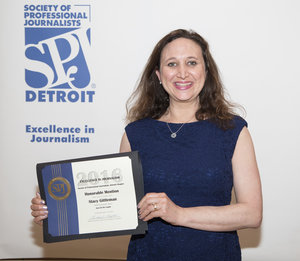
 Stacy Gittleman