
Weekly Photo Challenge: The Golden Hour

As the sun sets on this day, I will add this photo post to my blog, inspired by the Weekly Photo Challenge. Taken mid-June around sunset in Pittsford, NY while walking along the Erie Canal. In the foreground, my youngest enjoys an ice cream cone. The Erie Canal was a big part of our life in NY and we will miss it very much.
10 Things I’m Going to Miss about Living in Rochester, NY: 1-5



It’s been an emotional weekend.
Our friends, neighbors, and extended community threw us not one but two good-bye/sendoff parties on Sunday. One was a brunch in the morning and the other a dinner in the evening.
Hubby and I, as we saw friends file in bearing platters of fruit and food, agreed that we felt the love. But to hubby, who has already moved on, who is already living in Detroit and only coming “home” on weekends, the day was anti-climactic.
I asked, what was he expecting?
He said, finality. Closure.
But to many of us, maybe all of us, good-bye is too hard a word. So instead of hearing good-bye, when friends left the party they gave us a departing hug with the reassurance of “I know I’ll see you in the neighborhood before you go” or “I’m sure I’ll see you again before you take off.”
Maybe their claims are true and maybe they are not. But it’s easier to say than “when will we ever see each other again?” or “I’m going to miss you so much!” That stuff is for high school. For the end of camp. Not for a move in mid-life.
Between the morning good-bye brunch and the evening good-bye dinner, the new owners of our house stopped by for an hour-long visit.
The newly-minted home owners are a sweet couple who cannot be more than 30. The young woman held a 16-month infant boy with cherubic lips in her arms.
They told us how much they loved the old charm of the house and it’s “flow” for entertaining and living. They loved the basket-weave tile (original from 1929) in the bathrooms. She loved the shady backyard and the swing set that my dad and husband built for our kids.
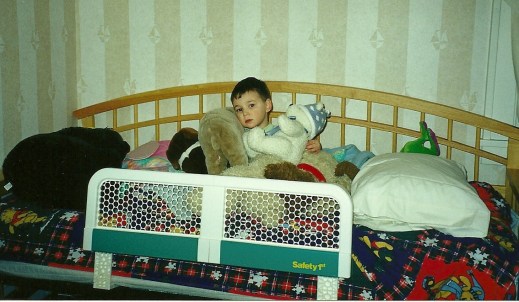
Now I know who will be sleeping in “our” bedrooms when we leave. Now I know there will be a tiny boy sleeping in the room with the sailboat wallpaper, the pattern I picked out for my own little boy 13 years ago.
Outside of friends that have come into our life, there is Rochester itself. I’ll say it:
I am going to miss you, Rochester. A lot.
To all those friends from “downstate” New York Metro area (and that means you too, New Jersey girls and boys) who ever told me they would love to come up and visit me in Rochester, New York, your time has run out.
It’s too late babies, it’s too late.
Maybe the reality of moving has given me perspective on just how great a little city like Rochester can be. Maybe the coming move has finally made this Rochester transplant feel like a native.
Even though I will no longer be living here, a trip to Rochester in the summer, the fall, and yes, even the winter is totally worth it. Here are a few reasons why:
1. Wegmans –

My first twinges of separation anxiety about leaving the Rochester happened not in the company of friends, but in the produce, health food, and patisserie departments of the world’s greatest supermarket. Yes, Wegmans has elevated food shopping from a mundane chore to an art form. What other supermarket will employees approach you if you seem puzzled and proactively ask you “are you finding everything okay?” And if you cannot find that box of pre-cut Asian gourmet mushrooms, they will send out an APB throughout the store, and check their latest shipment, to make sure they get it for you. What other grocer has designated employees waiting for you in the parking lot with huge golf umbrellas, eager to help you put your groceries in your car in the rain, or who will help mothers with young children?
Wegmans, you have spoiled me for life.
So, Michigan grocers, I give you my warning. If someone in your check-out line starts to cry or whimper because you didn’t give me a smile and a hello while you asked if I prefer my milk in a bag, or you didn’t bag all my frozen items together (or maybe you don’t bag customer groceries at all!), that will be me. And you’ll have to comfort me and give me a tissue because I am mourning and pining for my WEGMANS!
2 – Small size – On our first area tour of Rochester, our realtor drove us West on Monroe Avenue. In the immediate horizon stood three or four tallish buildings. “There’s our Rochester skyline!” she proudly boasted.
The big city New York City woman in the back seat covered her mouth supress a laugh. That’s a skyline? I’ll show you a skyline, she thought smugly, thinking of the imposing New York City skyline of her childhood.
But now, I so appreciate a city where it’s not a huge production to get into “the city.”
In 10 minutes, I can leave my house, find a parking spot on the street or in a $5 garage and be downtown. To take in a museum, a parade on Memorial Day or a film at The Little Theatre, meet a friend for lunch or coffee, or a concert at the Eastman Theatre.
In 10 minutes, my family and I can enjoy a night at Frontier Field, a stadium where I can let my kids roam free and on their own, and take in a Rochester Red Wings game.
3. Festivals – Rochesterians relish the weather when the snows melt and the sun finally arrives.Nearly every week from May through October, there is a festival going on somewhere, complete with great food, crafts and music. From the Lilac Festival, to the Xerox International Jazz Festival

The Barrel House Blues Band performed for free last year at the RG&E Fusion Stage
(it’s become one of the best in the country, no lie!), to the Park Avenue and Clothesline Festivals, there is something to enjoy every week.
And because of the size of Rochester, you will always run into friend, to hang out with and sample the fried dough or a candied New York apple. 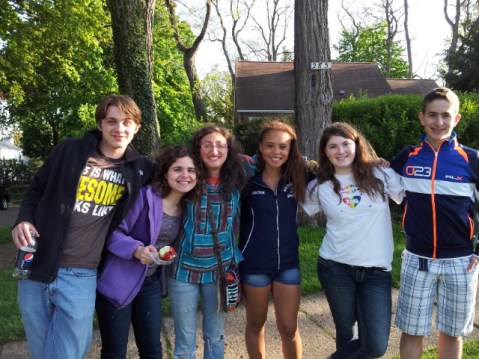
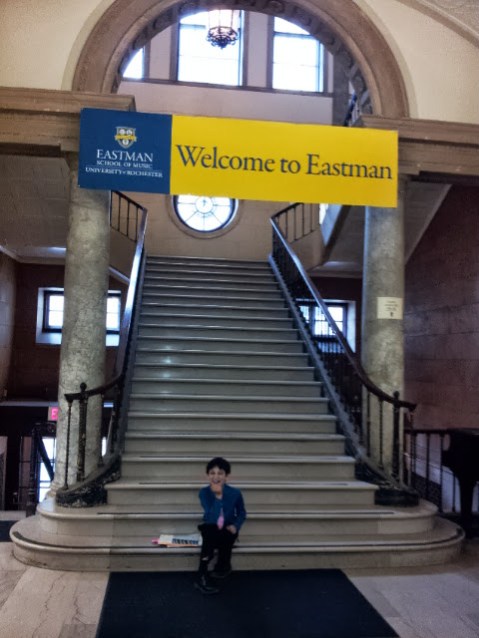
4. Music – Spiraling out from the Eastman School of Music, Rochester has fantastic musical resources. My kids took lessons and had recitals starting in preschool at the Hochstein School of Music. There has never been a shortage of dedicated and talented music teachers to share their love and gift with our children. Time and time again, the Brighton School District, as others in the Rochester area, have been bestowed awards in excellence for music education. My children each play several instruments and have been exposed to so many opportunities to perform. Most recently, my youngest, along with other local young musicians had his budding piano skills tested by the Canadian Royal Conservatory of Music. Thank you to the dedication of his piano teacher Sherry McCarthy for bringing this program to Rochester for the first time this year!
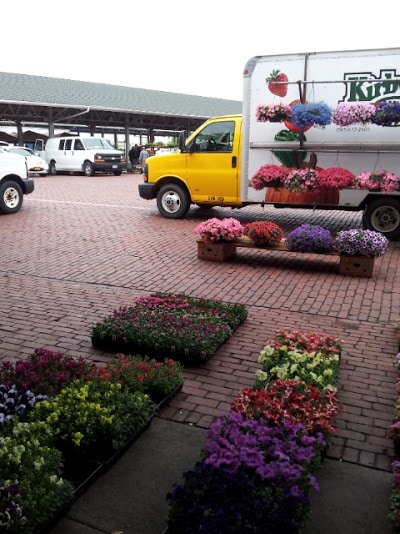
5. Rochester Public Market – When the weather warms, I skip my trip to Wegmans and make my way to the century-old Rochester Public Market. Voted one of the best public spaces in the world (yes, right up there with Seattle’s Pike Market), it has grown from a market where you can get the best local corn New York has to offer after July 15, to a center for music, plant sales, a newly established Food Truck Rodeo each Wednesday this summer, and yes, another great venue for local festivals.
That’s about all the nostalgia I can handle for one post. Tomorrow, reasons 6-10.
Rochesterians, what would YOU have a hard time leaving behind?
Detroit: what do you have in store for me to explore?
I’m all ears.

Rochester Red Wings (Photo credit: Wikipedia)

The facade of the Eastman Theatre, an historic auditorium in Rochester, New York. Conceived by, and named for, photography pioneer and philanthropist George Eastman, the Theatre opened in 1922. This is the primary performance space for the large ensembles at the Eastman School of Music and for the Rochester Philharmonic Orchestra. The streets in the foreground are East Main Street (left) and Gibbs Street (right). (Photo credit: Wikipedia)

So, the cardinals voted in a new pope. Why don’t you vote for a new name for my blog, results will be smoke free!

Thank, you, WordPress, for your latest daily prompt: All About Me.
It was the impetus that got me thinking: Once I move to Detroit, the name of my blog will be outdated.
When I started this blog about three years ago, I named it Transplantednorth because that’s how I felt. Even after nine years of moving from the New York Metro Area to Rochester, I still felt somewhat on the outside, still very much a transplant.
Now, (as we native New Yorkers say) whadaya know? Just as I’m feeling grounded and rooted, it’s time to move, to transplant, yet again! (Yay.)
So, this is where you come in. And you get to vote.
When I move, what shall I name my blog:
I’m waiting with bated breath for your vote OR other suggestions!
Let All Who are Hungry Come and Eat … at the Table!
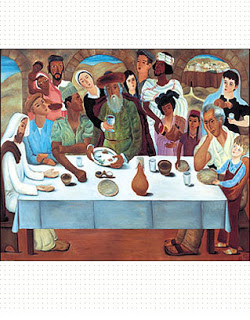

Israeli, born Romania, 1893-1974
First Seder in Jerusalem
1950
Oil on canvas
129 x 162 cm
Collection of the Rubin Family
You know that piece of furniture in your kitchen, the one with the round or sometimes square flat surface? How many times do you eat at it with all family members present and accounted for?
I’ll fess up: Now that my family is in transition, it’s boiled down to the weekends.
In American culture, the days where families gather at the table to eat dinner on a nightly basis are going the way of Saturday mail delivery.
Eating on the fly, wherever and whenever, has become the norm, right? We eat walking, driving, or even standing up at elevated tables because we didn’t get a table with seats at the mall food court.
We can go on and on in school about nutrition, but often our kids are rushed through their meals at their lunch period, that’s if they HAVE a lunch period. My high school daughter eats lunch in class nearly every day. She can’t fit in lunch because of her electives.
The proof in the pudding (a food substance I would highly implore be eaten at a table) is a conversation I had with a bunch of my 7th Grade Hebrew school students as we prepared to study the Birkat Hamazon. This is a long Hebrew blessing known as Grace after meals, but it actually translates to: the blessing of nourishment.
I think that hundreds of years ago, those wise rabbis who constructed this prayer were onto something: eating together and then SINGING together at a table gives us nourishment that goes way beyond the physical.
Before we got into the nitty-gritty of the Hebrew vocabulary of the prayer, I asked a general question that can be asked to any kid regardless of their faith:
How often do you eat together as a family?
The general response was, “not much.”
“Everyone has sports so people eat at different times whenever.”
“My mom doesn’t make dinner so i just grab something from the fridge and eat it in my room.”
“My dad works late so we eat without him lots of the time.”
I listened to these honest yet sad confessions just one week after hearing a recent report on National Public Radio of the demise of family time around the table.
On a positive side, because of Jewish camping, some of my students were quite familiar with the Birkat Hamazon. And in the summer, they do sit and eat meals with others and then sing this prayer together, complete with all the campy hand motions. Thank you camp!
And even if we ARE around the table, we often bring some kind of electronic device with us to further distract ourselves from the people in our lives who really count.
As Passover and Easter approach, who will be around your table?
This is Part Three of my Helping Out series. When I was down in NY helping out Sandy victims, I got the word of the horrible shooting and fire in my current hometown. This blog post reports on what people can do when they set out to do good in the face of evil, the story of thousands of dollars raised for the victims of the West Webster Fire Department and their families. Kudos to the organizers of this raffle, who pulled together dozens of prizes to raffle off in a matter of weeks. In the end, they passed their goal and presented the West Webster Fire Department with a check for $14,000.


As local readers know, it all started on December 24, 2012, when a mentally ill criminal set a house on fire, then opened fire on first responders, killing two West Webster firefighters and seriously wounding two other firefighters, plus an off-duty police officer. Firefighters were unable to attend to the fire, so ultimately 7 houses burned to the ground. Making this unbelievable event even more tough to swallow was that it happened 10 days after the massacre in Newtown, CT, where 27 people were murdered, 20 of whom were children. (In both incidences, the gunmen took their own lives.)
Deputy Sheriff Wally MacDonald was moved to do something to help these families, something more than drop money in one of the many “boot drives” that sprouted. He decided that his business, Empire Academy could make a donation. Wally thought maybe he’d hold a raffle with a few more donations and…
View original post 457 more words
Sculptor Susan Ferrari Rowley goes in New Directions with Minimalism
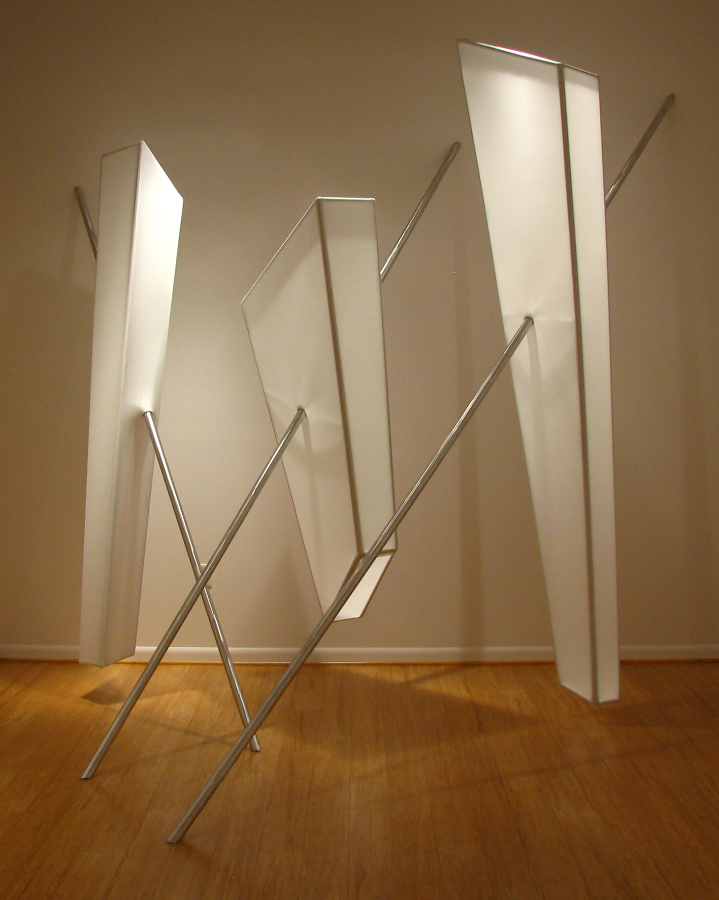
4-2-2, Susan Ferrari Rowley, photo courtesy of AXOM Gallery
Here is my article on Susan Ferrari Rowley’s Rochester exhibit which ran in the November 11, 2012 Living Section of the Democrat 7 Chronicle:
In the male-dominated world of art, it’s tough to be a woman sculptor. Women artists seldom get the space they deserve in the pages of an Art History 101 textbook.
The exclusion of works by women is further evidenced in the inventory of American museums, where only about 5 percent of museum collections include works by women artists, according to the Museum of Women in the Arts in Washington, D.C. An even smaller percentage include sculptures by women.
That is why Robin Muto, who is the co-curator of one of Rochester’s newer galleries, AXOM Gallery & Exhibition Space, jumped at the opportunity to show the work of Rochester-based minimalist sculptor Susan Ferrari Rowley in an exhibit specifically designed for the studio’s airy, high-ceilinged space.
“New Directions,” on exhibit at AXOM, 176 Anderson Ave., through Saturday, offers the viewer a range of human emotions in stark white fabrics, stretched and sewn onto soldered aluminum frames. The works will head to New York City’s OK Harris gallery in December.
Contrast in form
“New Directions” reveals Rowley’s current migration from creating larger outdoor and public sculptures to works scaled for private residences. Asymmetric pieces likeInseparable, Centered and Off-Balance exude an edgy tension as they balance precariously on pedestals Rowley custom designed to be just big enough for their footprint.
The “living on the edge” quality of these smaller works also suggests anatomical elements of a body, legs and arms. A calming, translucent glow that seems to start from within the sculptures hints at an inner soul.
Rowley’s sculptures are a contrast of materials and moods. They are large and imposing, yet they invite the viewer to come closer. Through cloth and metal and angular and curved lines, the exhibit of about a dozen abstract pieces can be experienced by stepping around, over and through them.
Outside the main gallery is the story of the art through photos of Rowley making them in her Scottsville studio.
The dominating work in “New Directions” is 4-2-2, a 10-foot composition of three geometric forms. This construct of three white, billowy shapes gives off a peaceful, translucent glow made possible by the carefully placed overhead track lighting. At the same time, three enormous metal poles that extend from the floor to the 14-foot ceiling impale the composition. The very moment of this piercing appears to be captured within the tension of the cloth.
Though abstract and stark in composition, 4-2-2 was created out of a very human emotion: the heartbreak of impending loss. Rowley says it was inspired by the death of her dog Tu-Tu (pronounced tiyu-tiyu), who was a loyal companion for almost 14 years.
Rowley melds techniques like sewing, traditionally regarded as a feminine skill that she learned from her grandmother, with the more masculine crafts of soldering metal and machine tooling. The combined media make each sculpture confrontational in its large scale, yet lightweight and vulnerable in overall appearance.
“I like to work in opposites,” says Rowley, associate professor of fine arts at Monroe Community College. “Metal is hard, and poly fiber fabric is soft. There are male and female qualities, a vulnerability yet strength in my work that are emotions I needed to embrace in my own life as I evolved as an artist.”
A cause in jewelry
“New Directions” also includes Angular Extremes, wearable bracelet art that is the result of Rowley’s tenacious three-year campaign to convince American machine tooling factories and other manufacturers that they can make art and jewelry.
The aluminum bracelets are cast in a Milwaukee factory that did not think they were cut out to manufacture jewelry until Rowley talked them into it. The bracelets are shipped to Rochester, where another company provides the black-and-white nickel color coating.
She then designs the boxes, made from post-consumer recycled materials, with New York’s Jamestown Container.
It is a company where her late mother-in-law spent most of her working life. The label for the packaging was produced by another American company.
These bracelets are also part of the AXOM exhibit and available for purchase at Shop One2 Gallery on the Rochester Institute of Technology campus and the Memorial Art Gallery Store.
Influences on work
Growing up on Long Island, Rowley developed an appreciation for the arts by making treks into New York City. She found art in museums, but also in the windows of Macy’s or in the hand-drawn fashion advertisements in the Sunday New York Times.
On a sixth-grade field trip to the Museum of Modern Art, Rowley fell for a sculpture of abstract feminist sculptor Louise Nevelson. Rowley had found her calling.
“I remember on the train ride home thinking, ‘Making sculptures and placing them on pedestals, that’s what I want to do with my life!’ ” she says.
Later in graduate school, Rowley wanted to find additional 20th century female sculptors to emulate. She had studied the work of Constantin Brancusi and Marcel Duchamp. Then she found fiberglass artist Eva Hesse and sculptor and printmaker Nancy Graves.
“When I read about their lives and how they struggled as women sculptors, their drive inspired me. I knew if I was driven, I would be OK,” Rowley says. “I had to live up to my potential; I had to produce and show as a woman sculptor.”
More than 30 years into her career, Rowley still possesses that drive. She sometimes works alone in her studio. Sometimes she is “making it happen” on group collaborations. In 2004, she proved to be a quick study on zoning and construction codes when she designed relief art for noise-barrier panels placed along Rochester’s western highways for the New York Department of Transportation.
Rowley also made a suspended sculpture for the set of Garth Fagan’sLight Night and Melanin.
The diversification of work, trying to make it fit in several situations, is what she tries to impart to her MCC students, says Rowley, who received the 2011 SUNY Chancellor’s Award of Excellence in Scholarship and Creative Activities.
“I tell my students that our brains have tremendous capacity to diversify,” she says. “Artists today have to have communication and business skills as well as artistic talents, especially when they are commissioned on a piece and will need to work with those with non-artistic backgrounds.”
The Words of Serving Soldiers: The Griffin Theater’s Letters Home Visits Rochester

Here is my piece that ran in the October 28, 2012 Living section of the Democrat & Chronicle:
For a soldier deployed in Iraq, a good day is a slow one spent on the base, learning to squeak out a tune on an old violin in the company of Iraqi and Kurdish soldiers. For a soldier deployed in Afghanistan, a horrible day is one spent in full battle, watching your commanding lieutenant dying on the ground from a gunshot wound to the gut.
It is this wide range of wartime moments, pulled from the letters written by soldiers who fought, or are still fighting, that are the building blocks of the play Letters Home. Written for the stage in 2007 by Chicago’s William Massolia, the award-winning play makes its Rochester debut at 7 p.m. Friday in the Nazareth College Arts Center.
Letters Home is a series of dramatic monologues set against a backdrop of photos and video taken directly from soldiers’ blogs and websites. It aims to shed a non-political light on the everyday life of soldiers in an 11-year war that still goes on today although few Americans feel directly affected by its impact. Massolia hopes to expose his audiences to the toll this war has taken on thousands of their fellow citizens.
“As we move on to more than a decade since the start of the war, it is becoming part of our history while still being fought in the present. I hope the play gives people with little connections to the military a better understanding of what it means to serve one’s country during wartime,” Massolia, the artistic director and founder of Chicago’s Griffin Theatre Company, said in a phone interview while his cast ran through a technical rehearsal for an Atlanta performance.
Massolia and actor Michael Bartz, 24, of Chicago, who plays several roles in the traveling production, say reception to the play varies depending on how many audience members are part of military families.
In one scene, he plays Sgt. Jeremy Lussi, who wrote that the most gratifying part of serving in the war was cheering local children with gifts as simple as a pen or a piece of candy.
In another scene, Bartz plays Sgt. Cory Mracek, who died on Jan. 27, 2004, just eight days after arriving in Iraq. In Mracek’s letters, he repeatedly asks his family why he has not heard from them. Across the stage, an actress playing Cory’s mother is wrenched with guilt, knowing her son never received the letters she sent before he died.
Bartz says he knows when there are military families in the audience. Even if he cannot see their faces in the darkness, he can hear their reactions.
“During a performance, you can hear the sobs, and it definitely gets to me while I’m up on stage,” says Bartz, who has a friend who lost both legs in Iraq. In such moments on stage, and in post-performance conversations with those who have lost loved ones in battle, “you can feel their pride and pain.”
Ryan Flynn and Claude Jordy, combat veterans in their late 20s who are now Nazareth College students, are not sure they will see the play. The material, they say, may hit too close to home.
Jordy keeps the letters he wrote in Iraq and Afghanistan in a shoebox. He does not reread them, but says it is a comfort to have them because they are a part of his history. After he graduates, the native Texan hopes to become a college history professor specializing in American military history.
During an 18-month deployment in Nazaria, Iraq, Jordy was so focused on his mission as a sergeant in the U.S. Army 1st Cavalry Division, he could almost forget “that the other side of the world still turned.” One day, he received a letter from his parents with a picture of his little sister. Her arm was in a cast. Only through that letter was he updated of little details such as a sister’s broken arm back home in Texas.
“The longer you are deployed (over there), you start forgetting the reason why you are there in the first place,” he says. “Those letters from home remind you why.”
While the veteran soldiers said they often wrote home about the long stretches of doldrums they faced, they rarely went into detail about the conditions they endured or the battles they witnessed.
“Every soldier has a different experience. Each of us had different ways of coping. I can’t speak for all soldiers, but when I wrote home, I never wanted to worry my family about the things I saw,” says Flynn, a native of Rochester who is studying information technology.
Flynn and Jordy say Letters Home is a good idea if it sheds light on what a soldier must cope with while at war. Perhaps it can also lead to an understanding of what they go through as they transition back to civilian life as students.
Nazareth College has 63 veterans enrolled as students this year. That number is expected to double next year, says Jeremy Bagley, coordinator of veteran student enrollment and support services at the school. Bagley is a vital resource to student veterans, helping them get special grants for tuition and fees and internships with vet-friendly businesses and organizations. Bagley also provides veterans who are students with assistance in areas such as figuring out complicated financial aid packages or talking about the difficulties of transitioning from the military to a classroom setting.
Now that he is a student, Flynn says he has had to “lighten up” to adjust to the college campus culture.
“It took me a year to relax and adjust to campus standards. The urgency to hand in a paper on time is just not as intense as combat urgency,” says Flynn.
In Memory of Teacher, Artist and Musician Daniel Lempert

A little over a year ago, I had the pleasure of writing a story about the father-in-law of a very good friend. At the time, Mr. Lempert, a longtime Brighton resident, was mourning the death of his beloved wife Ruth, an artist and writer in her own rite.
Now, Daniel has also passed on and was given a burial with a full military honor. I was so honored to have written down his story in his final year on this earth. May his memory be for a blessing.
This was published last November in the Democrat & Chronicle:
It is said that a picture paints one thousand words. When Daniel Lempert completes a painting, he wants its viewers to hear music as well.
“I paint what I feel. As a musician, I feel the rhythms and chords of music,” said Lempert in his Brighton home, which is adorned with paintings he started creating in his 40’s.
Now, at 87, the retired music teacher claims to have painted hundreds of works. The paintings above his mantelpiece are filled with intersecting multicolored lines to represent the textures of a jazz improvisation. Other abstract works include pieces of sheet music or actual workings of old instruments layered on top of brightly colored shapes.
Lempert also paints local landscapes such as the lakeshores of Mendon Ponds and Lake Ontario. He does not bring his oils or canvas out to the scene, but rather paints from his mind’s eye. His works are the stuff of memory. That way, his emotions shape the outcome and look of the final painting.
His beloved wife Ruth, who passed away on Oct. 1 at 81, inspired his artistry through their 58-year marriage. “Ruth really pushed me with my art. I had teachers back in grade school that said I was no good at it. If it weren’t for my wife, I never would have painted,” he said.
When he was a music teacher in the East Rochester school district, Lempert came home from work one day quite upset that the custodial staff had left his music room a cluttered jumble of desks and chairs in efforts to empty out another classroom.
“I told this to Ruth and she said, ‘Why don’t you paint it?’” So he did. The result is one of Lempert’s earliest works: a jumble of chairs and desks in an abstract composition, and painted between the furniture is a sousaphone. It remains one of Lempert’s favorite pieces.
It was Ruth who bought her husband his first set of oil paints in 1968. The University of Rochester alumna and author of the 2008 memoir “Fish, Faith and Family,”also encouraged her husband to take art lessons at this time at the Memorial Art Gallery, where he has been taking classes since 1976.
Like his paintings, the photographs in Lempert’s home also tell stories. One is a black-and-white snapshot of Lempert as a young man with a head of thick wavy black hair playing trumpet in front of a tent.
After high school, Lempert enlisted in the U.S. Army during WWII. He finished basic training in North Carolina and was about to get shipped overseas when opportunity came knocking. The army needed a stateside trumpet player. He auditioned before a group of officers. He still remembers playing the “Carnival of Venice,” a folk song that most known as the melody for “My Hat it has Three Corners.”
The complexity of the trumpet solos won the approval of his commanders. Instead of going off to battle, Lempert stayed in North Carolina for the war’s duration playing reverie in the morning and taps each evening.
“The trumpet saved my life,” he said.
Lempert’s son David recalls how his dad had three jobs when he was growing up: He was a school music teacher, a private tutor on Saturdays, and a big band player late at night. “He would teach during the day, head to a club around 10 in the evening, come home at 3 in the morning and then get up to teach. He was tired but he loved it,” said David Lempert.
The talent for the arts runs in the Lempert family gene pool. His late daughter Judith earned a degree in fine arts from RIT. Judith’s daughter Rebecca Zaretsky is now studying art at Wheelock College in Boston. Lempert still practices for up to two hours a day every day. The only time he stopped playing was for a brief time after Ruth passed away.
His advice to young musicians and artists: “If art and music are a part of you, you must keep practicing your craft.”
Getting to Know Daniel Lempert
Age: 87
Education: Graduate of Fredonia Music School and Columbia University
Occupation: 37 years as music teacher in East Rochester. Retired in 1984
Hobbies: Painting. Trumpet player in Jack Allen’s Big Band
wrote this back in June, but now all fears and speculations have become reality

“Quick, someone SOMEONE open the door to the garage!”
My daughter’s voice boomed down the staircase. I didn’t appreciate her barking orders at me.
After all, that’s my job. Why couldn’t she open the door herself?
I followed the sound of her voice and soon realize why she couldn’t open the door.

Her arms were full of a year’s worth of notes. Her entire Freshman year of high school. A tree’s worth of it, was piled in her arms and about to topple over.
“I think I killed a whole tree this year,” she said.
Fortunately, it will all be recycled, I told her.
To follow suit, my husband then got rid of his own notes. Five years of notes he took in graduate school at the University of California at Berkeley. Notes he hung on to for nearly 17 years. They overflowed the recycle bin. A summer wind picked…
View original post 106 more words
On This Day of Destruction, a Word (and photo) about Creation

Charlie Chaplin – created by tin cans by Israeli artist Goded Geier
Last year, as the 10th anniversary of 9/11 approached, I went with my daughter to Rochester’ s Annual M&T Bank Clothesline Festival. Set on the grounds of Rochester’s main art museum, the Memorial Art Galllery, the Clothesline Festival celebrates and features over 400 selected artists, potters, jewelery makers, and photographers selling their creations under white billowy tents.
As my daughter and I browsed and sipped frozen lemonade slushies on that hot September 10th day in 2011, I tried my best to distract myself from thinking about the heaviness and sadness that the next day would bring.
I couldn’t help but think of the stark contrast of being surrounded by art and creativity on the eve of a day of destruction. I thought to myself: Look what the human mind can do when people put their energies in their life to create, to sculpt, to paint and weave.
Look what people can accomplish when they put their energies and efforts into loving, not hating, creating and not destroying.
So again, on this September 11, I’m keeping in mind the families of those thousands of victims, but one more morning of thinking about where I was and what I was doing is making me shake like a leaf.
I’d rather think of the good, and the creative good in people.
Take the artwork of native Israeli Goded Geier, for example whose work is on display at JGK Galleries in Rochester as a part of the Greentopia Festival. He comes from a country that right now is grappling with threats to its own existence as Iran gets closer each day for developing a nuclear bomb. Instead of surrendering to defeat or despair, he creates art, made of hundreds of soda cans that could have been disposed of or thrown away.
On this day, this lonesome day, what good and beauty can you bring into the world?
About Me

Kreativ Blogger

Versatile Blogger Award


 Stacy Gittleman