
The Bats in My Belfry: Part I
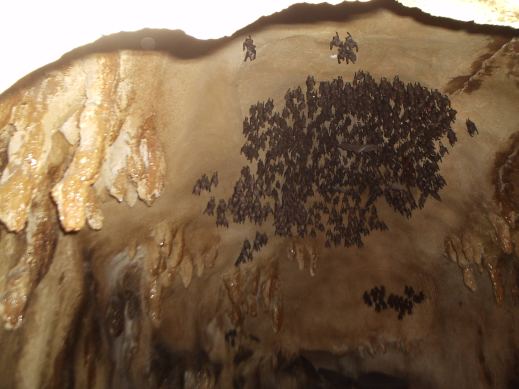

Could there be a colony of bats in your attic?
Since this is the Season of the Witch and all things creepy, it’s time to share a scary, true story with a very educational ending. This story is about bats … and the Batman.
I love our old house. We live in a 1920’s English Tudor with all the old-world English Tudor charm. This charm includes leaded glass windows that are beautiful yet leak in the cold Rochester winter drafts, and copper plumbing that offers enough water pressure to either take a shower OR run the washing machine, but not both at the same time.
It also features a walk-up, half-finished attic, with its own bedroom/bathroom suite and a claw foot tub in the bathroom. This is where all our guests spend the night.
I greatly respect and appreciate bats. I love that the average bat can consume 1,000 mosquitos per night, and how they use sonar to get around, and I love the children’s story Stellaluna.
I even worry about how white-nose syndrome is decimating bat populations in northeast. On October 28, the U.S. Fish and Wildlife Service posted new white-nose syndrome decontamination protocols and supporting documentation for cavers.
I want bats to have disease-free homes and be fruitful and multiply, just as long as their home is outside my home.
This is the part where things get scary.
One Saturday night, my husband and I were doing what we do on most Saturday nights: we were lying in bed watching Saturday Night Live. As you can see we do not get out much and that is why I blog for excitement.
We were nearly dozing off between the opening monologue and the musical guest when we thought we saw something fly by our bedroom door.
“Did you see that?”
“Wha….” my husband was nearly asleep…
“Um, did we close Charlie’s cage before we went to bed?” I asked, hopefully.
At the time, our daughter had a sweet green parakeet named Charlie. I desperately convinced myself that it was Charlie that just flew down the hall. Charlie got out, yup.
Please let that winged thing be Charlie.
We went to our daughter’s bedroom. Charlie the parakeet was safe in his cage, door closed. But something was still flying in the hall. Something with a wingspan far larger than your average parakeet.
We could now safely say we had a bat in our house.
I ran screaming into the bathroom in our bedroom. My brave husband threw a towel over his head and went to pursue the winged rodent with our bed sheet.
Then, like that, it disappeared.
The only thing worse than having a bat in your house is knowing there is a bat in your house but not knowing where it is.
With towels over our heads, my husband and I crept down to the kitchen to get the telephone book to search for someone, anyone, to help us. We dialed the town animal control hotline only to learn their hours were from 10-4 on Tuesdays and Thursdays. The outgoing message said to call 911 in an animal-related emergency.
Was this an emergency? SURE! There could be a rabid bat attacking us at any moment!
So my fingers shakily punched 911 and I alerted the local police that I had three sleeping children, including a 7-month-infant, and a bat was loose in my house.
In minutes, the police were at our door. Remember, this is Brighton, and not Staten Island, where years earlier I waited 45 minutes for police to arrive after calling about girls trying to break into my house to beat me up with a very different bat.
The friendly policeman came and humoured us by shining a flashlight all around the kids’ bedrooms and our living room, but found no bat.
“He probably found somewhere to hide. Bats are really shy and wherever he is, he will stay there till morning,” he reassured us.
This left me no comfort, and I scanned the Yellow Pages for more help after he left. By this time it was around 12:45 a.m.
Then, I found him. An ad for the Batman. From our bedroom, I called the number, figuring I would leave a message and someone would call me in the morning. Instead, to my surprise, I heard a low mysterious voice after a few rings.
“Hello?
“Um, are you — the Bat Man?”
“Yes, I am the Bat Man, how can I help you?”
I immediately apologized for calling at such a late hour, only to be answered with the Batman’s strange response.
“No need for apologies. This is usually the time when the calls come.”
Okaaayy. I told him the situation, and then he told me that this could wait until morning, that bats were very shy, want nothing to do with humans, and he would be by in the morning.
Oh, but one more thing, he said. There was a good possibility that if we found one bat, chances are there were not one – but a colony of bats in our attic.
A colony?
With that the Batman bid me goodnight.
Nighty night and sleep tight. Stay tuned for the conculsion of this bat tale.
What’s a Nice Jewish Girl to do about Halloween?

Some of my neighbors really get into decorating for Halloween
My birthday falls in late October. I will not disclose my age, and those of you who know me know what that number is. Unless a birthday is one that ends in a 0 or a 5, birthdays at this stage of life are no big deal.
But think back to when you were a kid. Those were the days when one counted down the days to their birthday party. And if you were lucky enough to be born on the cusp of the Scorpio sign, birthday parties were all about Halloween. Late October babies have a built-in costumed, candy-corn flavored theme that is perfectly gift wrapped with a giant fake spiderweb and grooves to the music of a Monster Mash soundtrack.
Each year, even up through high school, I celebrated my birthday with a costume party. On my seventh or eighth birthday, my grandmother transformed herself into a gypsy storyteller to the delight of all my costumed friends. My parents and grandparents even staged special effects, complete with a charmed stuffed snake to rise out of a wicker basket with the help of an invisible fishing wire.
All through childhood, my mother and grandmother were the master costume makers. My mom said that when she was growing up in her Bensonhurst, Brooklyn apartment, my grandmother would dress up as a witch and concoct costumes for every kid in the building.
And when it was my turn to dress up, mom and grandma could make me into anything I wanted because they both knew their way around a sewing machine. Pity my own children this time of year. I cook, I bake, I garden, I teach, I read Torah, but I cannot even decently hem a pair of pants.
I wanted to be a sunflower one year: mom made me a sunflower. And then scarecrow, and Indian Princess, and even a hairdryer. And my final Halloween birthday party, I made a really convincing Boy George.
Halloween birthday parties, trick-or-treating and getting candy went on happily and innocently until the seventh grade. That year, Halloween fell out on a Tuesday which was afternoon Hebrew School.
Hebrew School started at 4:30 and let out around 6 p.m. Through Chumash (bible) lessons, you could feel the tension in the class start to bubble like a witch’s cauldron: we were missing out on prime trick-or-treating time! We realized that by the time we got home, scarfed down some dinner and put on our costumes, maybe we could collect half a pillowcase worth of candy if we were lucky. But we had a plan.
“Rabbi,” one of our classmates sweetly inquired, “Can we get out of Hebrew School early today so we can go trick-or-treating?”
“Yeladim!” He shouted, saying the Hebrew word for children. “Jewish children should not celebrate Halloween. It is NOT a Jewish Holiday! If you want to dress up and have fun, we can do that later in the year, on Purim.”
In unison, the entire class gasped in disbelief. Up till this point, we were all completely unaware that Halloween could have other meanings besides dressing up, running around the neighborhood and getting candy. And, in the streets of Staten Island, we didn’t exactly live in a part of the world where Purim, a costume-filled Jewish holiday in the spring, was universally celebrated.
We were not deterred that night, or any year after, from our right as American kids to trick-or-treat. Okay, Halloween is not a Jewish holiday. In fact, I knew even back then that Halloween must have some Christian implications, because all the parochial school kids I knew in my neighborhood had off Nov. 1 for All Saint’s Day.
Halloween must be okay because my grandmother, the most Jewish lady I knew, still loved Halloween. One year, my grandparents went to Greenwich Village to see the famous Halloween parade. My grandmother had a blast and made friends with everyone, including “all the nice young men dressed up in the most elaborate costumes” who offered her a chair along the parade route.
My Yiddishe grandma, the one who made gifilte fish from scratch and sang me Jewish songs, found delight in hanging out in the Village with the drag queens on Halloween!
I always wanted to go into the Village for Halloween, but it wasn’t until my grandparents raved about it did I got the nerve to go to one of the best places in the country to celebrate on Oct. 31.
I spent two Halloweens in the Village in my 20’s, although I didn’t wear a costume. Then, out in San Francisco’s Castro district, I dressed as Mona Lisa in a frame and my beloved dressed as the Mad Hatter. People sang “Mona Lisa” to me. A few people even got the Elton John reference and sang a few bars of that song with us. The streets got crowded, and my frame did get entangled with other costumes, but it was all in good fun.
Those were some of the most memorable nights of my life. More than the candy, as young adult I saw Halloween as a time when people can express themselves and become someone else for just one night. Halloween costumes break down barriers between strangers. But beneath the costumes and candy, the darker messages that lurk below are just plain not Jewish.
I still love Halloween and my heart is tied to the Halloween memories of my childhood. But Halloween has shifted lower on my priority list.
After a month of putting energies into the Jewish fall holidays I mentioned in a recent blog post, I have little desire to turn my front lawn into a graveyard or put together a costume with a hot glue gun.
But we still carve our pumpkin. And I still let my kids go trick-or-treating. But they well understand and love that come spring, we will be busy making hamantashen cookies and baskets of food for friends and neighbors for the Jewish holiday of Purim. In that way, they learn that Purim, when you walk around the neighborhood giving treats, is in essence the exact opposite of Halloween’s tradition of going around the neighborhood begging for treats.
Am I sending my Jewish children mixed messages? Maybe. Will I someday, because of Jewish observance, let go of Halloween go altogether? Perhaps.
But in the meantime, it’s still fun to walk the neighborhood’s darkened streets, check out the glow in the dark decorations, and maybe get a little scared.
A Blessing and a Curse: Israeli advocacy though Social Networking
How do you connect to a country that is oceans and languages away? In the 21st Century, where can you go to have conversations with or show positive visual images of a country that has been dear to the Jewish soul for more than 2,000 years but the mainstream media continues to portray it as a human rights violator?
The best way to connect with Israel and meet Israelis is to make a visit. Or maybe two. Or live there for a while. Or, maybe move there. But, in the meantime, there is the blessing and the curse of connecting with Israelis and standing up for Israel through social networking.
There are about 13.5 million Jews in the world, give or take depending on who you ask. About half live in the United States, and 6.5 million live in Israel. Both these countries embrace democracy, diversity, religious freedom. In spite of these similarities, time, distance, and language barriers keep the world’s largest Jewish populations from feeling truly connected. Most Jewish Americans know little about modern Israeli life, history or politics. And Israeli counterparts, only know of America from what they see in their media.
Last summer, the Maurice and Marilyn Cohen Center for Jewish Studies at Brandeis University published a study called “Still Connected: American Jewish Attitudes About Israel,” The study, conducted in response to media coverage of the Gaza flotilla incident, found that participants aged 45 and under had less of a connected feeling to Israel.
If the Jewish people want to see continuity into future generations and a strong connection to Israel, it’s time that Jews in Israel and Jews in America start talking to each other and the best way is social networking.
In the 1980’s connecting with Israel seemed like a no-brainer. Many Jewish families during this time took a trip to Israel the year a child became a Bar or Bat Mitzvah. You toured the country with your family and had a ceremony either at the Western Wall or at the top of Masada. These were moments in Jewish family life that forged strong Jewish identities. If you couldn’t make it the year of your Bar or Bat Mitzvah, perhaps a trip during high school was in your plans, or a semester or year abroad in Israel.
Then came the intifadas of 1989 and 2000. Along with the death and the terror came the fear and doubt among American Jews how they felt connected to Israel based on what they saw on the news. Reports of terrorist attacks within Israel in 2000 saw tourism to the Jewish state plummet.
I taught Hebrew school to sixth graders that year who told me you had to be “crazy” to want to visit Israel. I asked parents during a family education program if they had anything to share with the students on how they felt about Israel or if they had memories of trips to Israel and I was met with blank stares.
So how to you teach Israel to children who may see Israel as nothing more than a tiny spec on the worldwide map? Again, the answer is through social networking.
I have been a Hebrew School teacher for almost 10 years and have used sites like Facebook, Twitter and YouTube to teach kids young and old about the daily ongoings of Israeli citizens. I have shown my littlest students on YouTube how families in Israel celebrate Tu B’shvat, the New Year of the Trees by singing the same songs we sang in our classroom. For my older students, I downloaded a video on the many faces and places of Israel set to pop song “New Soul” by Israeli singer Yael Naim.
The Internet provides a podium – to stand up for Israel but also provides an equal podium for those to wish to delegitimize the Jewish state. The flotilla that attempted to breach Israel’s blockade around the Gaza Strip launched hundreds of anti and pro Israel Facebook groups, including one I joined, called The Truth about Israel’s Defensive Actions Against the Flotilla The group aims to be online ambassadors to Israel, where supporters of Israel around the world, Jewish or not, can start discussions or point out the way Israel is being covered in the media.
In recent years, I had the opportunity to develop partnerships with Israeli teachers by both visiting and living with Israelis and hosting Israeli visitors to America.
I documented my trip in this video set to the background music of popular Israeli musicians such as The Idan Raichel Project and Shlomo Artzi, who also have Facebook pages. I wanted to show my students and members of my local Jewish community the beauty of Israel and everyday life in this tiny, diverse country. Take a look below:
“
Another time I empowered social networking to support Israel was during Operation Cast Lead, or Israel’s war on Gaza. During this time, many hateful comments were posted to the photos I posted from Israel on Facebook’s pro-Israel groups. I used discussion boards to request that a typical Israeli write back to me to explain to my 7th grade students what it was like to be in Israel during this time. I got a response from a young man living in Ashdod, not far from the Gaza strip. He was discharged from serving in the IDF from an ankle injury and was happy to help out my cause. In perfect English, he composed a letter to my seventh graders what it was like for he and his family to live under a daily barrage of missiles from Gaza. The email put a personal touch to the headlines that winter and sparked my students desire to make cards for Israeli soldiers.
These are just a few of the many ways ordinary people can stand up for Israel. What can you do?
A Married Woman’s Peek inside the Single Man’s Shopping Cart
 When I was a newlywed living out in California, I would stop on my way home from work at the Safeway to pick up groceries for dinner. I would cut, clip, and shop for gourmet recipes involving roasted peppers and wild rice and pumpkin ravioli to cook for my new husband. Cooking for two was fun and it seemed we had all the time in the world to prepare a meal.
One of the checkout cashiers would play this little game of guessing what I was making for dinner, or what kind of night was ahead, based on the contents of my shopping cart.
One night was pretty easy: Romaine lettuce. Anchovy Paste. Parmesan Cheese.
“Ahh, I’ve guessed it!” He exclaimed. “You must be making Cesar Salad! The anchovy paste is the key ingredient for a good Cesar salad,” he said with a big smile. I guess in his line of work he played this game a lot to stave off boredom.
The contents of my shopping cart have changed over the years. The newlywed lifestyle ingredients were first replaced by boxes of diapers and jars of baby food, and these items have been replaced by the basic stuff of lunchbox meals and quick meals at home: Bread. Eggs. Milk. Peanut Butter. Turkey Slices.
This weekend, as I unloaded my last item onto the belt, a young single man got in line behind me. He had cropped sandy blond hair and wore a light brown hooded sweatshirt with apparent skulls embroidered into it. I couldn’t help notice that each time he reached into his cart, me and everyone around him got a glimpse of striped, bright pastel underwear that ballooned out on top of his low-cut jeans. Really. WHY do low-hanging jeans remain in fashion?
On the conveyor belt, right next to my boring cut up chicken and bag of Yukon gold potatoes, he placed one, single-serving Baked Alaska from the patisserie. Yes, my local supermarket, Wegmans, has a real French patisserie inside, along with a real wood-burning oven for artisan breads, a sushi kiosk and a Kosher deli.
But this blog post isn’t about Wegmans, and it’s not about the Helping Hands at Wegmans who will on rainy days escort you to your car with a huge golf umbrella and unload the grocery bags into your cart. This is about the groceries of the single man.
So, this dainty treat, with its broiled meringue topping, was carefully placed inside a clear plastic container. This dessert for one, maybe two, also included its own garnish: five raspberries and three thin slices of what looked like the perfectly ripened peach. A perfectly ripened peach — in October.
The single man continued to load other contents of his cart onto the checkout belt – a big bottle of Listerine Complete that whitened teeth while it freshened breath. Several boxes of frozen gourmet gnocchi, and a box of flatbread sausage pizza.
In my head, I silently wished single man good luck for whatever his evening entailed, and hope that whatever girl was on the receiving end of that Baked Alaska appreciated that a man would buy her a Baked Alaska, complete with a raspberry garnish, for dinner on a Sunday night.
How a Sukkah is like a Christmas tree
 Okay, so the headline of this post might shock and offend some, but please let me explain my bold statement.
Growing up in a predominantly Italian neighborhood in Staten Island, as the Chanukkah song from Adam Sandler song goes, I was the only kid on the block without a Christmas tree. Our neighbors invited my family over for cake and tree decorating and we in turn invited them on Chanukkah to light our menorah, spin a dreidel and eat fried potato latkes.
Even back then I understood that Christmas was a big holiday, and Chanukkah was a minor Jewish one. But Christmas trees still left me with a feeling of being on the outside, my nose pressed to the frosted window.
A menorah, no matter how big, even the ones that the Chabad Lubavich movement lights, just can’t compete with the smell of fresh pine, the twinkling lights and the tinsel to a Jewish kid on Staten Island. I even had my secret Christmas tree fantasies. If I ever had a Christmas tree, it would be simple: just candy canes and white lights would hang off the branches of the Christmas tree of my dreams. And it would only be in my dreams, because I knew very well that there is no such thing as a Chanukkah bush.
I did have childhood associations with Sukkot, the eight-day autumn festival of Booths, because of Hebrew school. I made the standard paper sukkah chains and ate within the large sukkah of my synagogue. In fact, the first time I was ever asked on a date was in a sukkah. It was in the seventh grade and a classmate asked me to go roller skating at Skate Odyesy as our teacher, on Orthodox rabbi, continually shushed us as he attempted to recite kiddush, the blessing over the grape juice.
But because my family didn’t build a sukkah of our own, the holiday still felt remote to me. I didn’t have a sukkah to eat my bowl of breakfast cereal in, or sleep in.
Now, in adulthood, my family enjoys putting up a sukkah every autmn, and we have done so for eleven years. And because we have a family sukkah, I can now say why this celebration, one of the major holidays on the Jewish calendar, blows that overblown attention we give to that other holiday in December right out of the water. Why? Because a sukkah fulfills the Jewish Americans’ need to decorate a large, religious object with branches and lights and have social gatherings within or around it.
Sukkot is known in Hebrew as one of the “three legs” of Jewish holidays, one of the three times of the year when the ancient Israelites were commanded to make a pilgrimage by foot to Jerusalem. Imagine Israelites building one of these temporary huts and sleeping in their fields under a harvest moon.
This same harvest moon shines through the roof of our family sukkah on the first few nights as we feast and sing. After a month of self scrutiny, asking for forgiveness, and finally, fasting on Yom Kippur, sitting within the walls of a sukkah is like getting a hug from God and feeling His forgiveness, as one Chabad rabbi in my college years so eloquently explained it.
In my neighborhood, Sukkot is all around us. As we are finishing up our meal of brisket and sweet potatoes, our neighbor, an Orthodox rabbi, is starting his meal with his family within their sukkah. We can hear his voice as he joyfully sings the kiddush as we clear off our table. This is followed by the clanking of plates and the laughter of his grandchildren as they dine. This coming outside to eat, either in these formal meals or sukkah hopping later in the week may be the last chance we get before the long Rochester winter, makes our neighborhood just feel more neighborly.
How is a sukkah not like a Christmas tree? For one thing, Jews are commanded by God in Torah to build one to remind us of the booths that the Israelites lived in during their wandering in the desert after we were freed from Egypt. Plain and simple, it’s a mitzvah just to sit in a sukkah. I still don’t understand if there is a religious connection between a tree and the birth of Jesus, but I’d be happy to learn how this tradition got started.
So, now that it is December, I still admire Christmas trees, but with a knowledge and experience that the Jewish people have our time of year for our big celebrations with something to decorate and gather in. Come this Christmas, don’t feel bad for the Jewish people who have no Christmas tree. Instead, feel bad for the Jewish people who have not yet built, or ate, or slept, or dwelt in a Sukkah, back in September.
About Me

Kreativ Blogger

Versatile Blogger Award


 Stacy Gittleman