
It’s Heritage Day at my Son’s School. What are we, anyway?

A note came home in my son’s backpack to state that today, this Friday, the school would be celebrating “International Heritage Day.” Third through fifth grade in my town is a time when students study the cultures of many countries. My child this year studied the cultures of Egypt, Japan, Australia. In successive years they will study about China and ancient civilizations from Greece to Rome to the Inca and Mayan Indians in social studies.
As a culmination and celebration of all this international study, third graders in my son’s school were asked to wear a hat that represents the culture of their immigrant ancestry.
Like most self-respecting Ashkenazi Jews, my family has roots in Russia and Poland. And, if you want to find some real exotic roots in my family, I believe my paternal grandmother was from Vienna, Austria.
But the Polish and Russians never looked upon my ancestors as their fellow countrymen. We were just: Jews. Yids. Pretty much second class citizens. That’s why Jews from Poland and Russia came over in droves to the United States – for economic if not religious freedom.
In my house, we don’t have any connection to Russian or Polish culture. How we identify, ethnically, is through Jewish culture.
So, what hat to use? The Moroccans have the Fez. The Mexicans, the Sombrero and the French, the beret, the Italians have the Fedora (acually, my older son has taken up wearing the fedora because he is so very dapper).
So, this brings me back to the question: What country do we identify?
I should have just put a Yankee Doodle style hat on my son’s head. We are Americans. But are we something else as well? Is Judaism a people? A religion? A Culture?
With what other country do we identify?
I could have chosen an Israeli Kibbutznik style hat, but that would be so … 1950’s.

So outdated. And, as much love as we have for our spiritual homeland, we are not Israeli.
So of course, to show off our heritage, we selected this one.

A kippah, in the Bukharan style, that we purchased this winter in Jerusalem as we made our way to the Western Wall.
This is the hat of our heritage.
Two great websites for a little Jewish learning each day

From the Museum of the Diaspora in Tel Aviv
It’s been a month since the Hebrew school where I teach has let out and I guess you can say I’m going through a bit of teaching/classroom withdrawal. Yes, I love having my Sunday mornings to myself once again and don’t miss the late afternoon juggle of teaching and then rushing home to figure out dinner at 6:15 (I figured teaching at this hour will train me for the day when I actually do return to work full-time. Someday.)
But what I do miss is the discussions, watching and helping my students as they work through some Hebrew reading; watching them make their own discoveries as they decode a Hebrew sentence and have an “ahah!” moment about their emerging Jewish identities and the cool way the Hebrew language itself is constructed.
Sure, I see some of them in this post-Hebrew school twilight between the end of Hebrew school and the end of secular school. I see them at my kids’ track meets, on baseball fields and evening school concerts. We are happy to see each other, but I can’t exactly ask them a question on the week’s Torah portion in these secular settings.
I’ve gotta teach SOME Jewish kids, so I turn to my own. Namely, my youngest.
Each morning, before the school bus and after a bowl of cereal, we have been checking out this great website called Israel365. On it’s Facebook page, it states:
Israel365 promotes the beauty and religious significance of Israel. Featuring the stunning photographs of more than 30 award winning Israeli photographers alongside an inspiring Biblical verse, Israel365 connects you with Israel each day.
The photos are inspiring.And, each day there is a sentence from the Torah in English, Hebrew, and Hebrew transliteration. I scroll down the page with the transliteration part so my 8-year-old son has to read the Hebrew.
“There!” I say to him, after he reads the sentence. “You’ve done a mitzvah of learning just a little bit of Torah today!”
“I did?”
“Yup!” I proudly reply, and I feel like I’ve validated myself as doing my job as a Jewish parent for the day.
Check out the site with your kids and tell me what you’ve learned.
Another site, this time dealing directly with the Hebrew language is My Hebrew Dictionary which can help you with Hebrew verbs, useful vocabulary and word pronunciation. It even breaks words into themes, like Food, Animals, and a Bar/Bat Mitzvah resource center.
Over the past week, I referred this site to my cousin in Seattle, who is preparing to sing some Hebrew songs in an upcoming choral concert. If she takes the quality of her singing as seriously as she takes which syllables are accented and word pronunciation, this is bound to be a concert that is Metzuyan (excellent!)
Last night, I attended a great working gathering with about 80 other 20, 30 and 40something Jews in Rochester who are very concerned about carrying Jewish continuity here into future generations. This grassroots group, in its very infancy, calls itself ROC Echad (one Rochester) and I wish them all the success in the world in infusing energy back into our Jewish community.
At this meeting, we learned the biggest issue that is keeping people up at night: Providing quality Jewish education in our community.
At the end of the meeting, I challenged those who were there to go out and seek for themselves in the next day some Jewish knowledge for themselves.
While there is no substitute for learning and doing Jewish in the company of others, these websites are a good start for some independent Jewish learning.
If you are reading this and decide to do some Jewish learning, tell me what you find out and I will share it on my blog so others can learn. Thanks!
The Passover-Israel Connection

It would be funny if it were not so tellingly sad.
After weeks of rehearsing Passover songs for a school wide Seder and in anticipation of April break, I knew my students would be feeling a bit burned out. But still, there was so much left to teach about Passover, especially the idea of redemption and how for modern Jews, Israel is our redemption. However, as our generations get further away from knowing a time before there was the existence of the modern Jewish State, one can take Israel, and teaching for Israel for granted. In afternoon supplementary Hebrew schools, where hours are shaved for time’s sake, teachers must focus most of their time just teaching Hebrew reading. There is little time to teach Israel.
So, in the final Hebrew school hours before Pesach, I wanted to part with my students with thinking about the Israel-Pesach Connection with a slide show. (if you want a copy of this slide show, please send me an email at stacy.gittleman@yahoo.com and I’ll happily send it along.)
I put a picture up from my laptop projector of the following people. Can you name them?
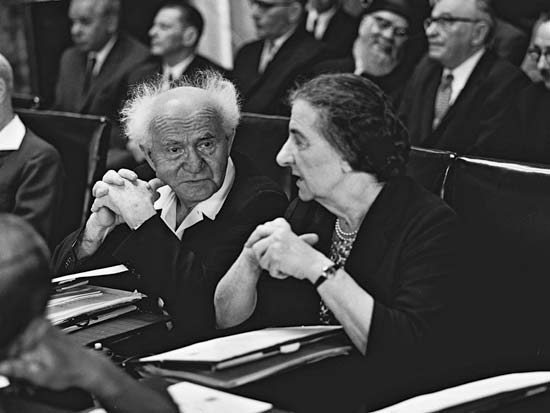
Now, to give them credit, I said I was going to show students slide show presentation from photos that were mostly ones I took in Israel, and told them that most of the photos were mine, but others were those I found on the Internet.
I just didn’t tell them which were which.
So, when I put this picture up and asked if anyone knew who these folks might be, I got some pretty interesting answers:
“Umm…. they must be husband and wife.”
“Are they your parents?”
No. No, I corrected them. These people are two of Israel’s most influential leaders in the formation of a Jewish state. Can you name them now?
Still no answers.
“Children, the man is David Ben Gurion, the first prime Minister of Israel and the woman is Gol-“
“Oh, now I know! Is that Golda Meir, the first woman Israeli prime minister?”
“Yes, that’s right!” Now we were getting somewhere.
The next hand flew up.
“Did you… meet them?”
So, in the final weeks of Hebrew school after Pesach, I realize I have my work cut out for me. I’m pretty sure I knew who David Ben Gurion and Golda Meir were by the end of the sixth grade. And I knew that, like Moses, these pioneers of the modern state of Israel went to European leaders in the 1930’s asking to let their people go to emigrate to the British Palestine Mandate to escape Hitler’s mad plan for the Jews.
When I get back to class, even though there are only weeks to go, I will put up photos up of Ben Gurion and Golda Meir. And Moshe Dayan. And Menachem Begin. And Rabin and Sharon.
Because, just as we tell our children the story of the Exodus from Egypt, and just as we vow to never forget the horrors of the Holocaust, so must we tell our children the history of the formation of the modern State of Israel. We must somehow weave that right into our Seder narrative just as we sing Dayenu and Adir Hu.
One great resource that I found online this week is the Israel 365 Hagaddah. It is 60 pages of the traditional hagaddah text combined with beautiful Israel photography plus specially marked “Israel moments” to highlight at your Seder. I hope that just some of this amazing Hagaddah makes it to your family’s Seder celebration.
Pesach Sameach. Happy Passover. And next year in Jerusalem.
The email in the Wall
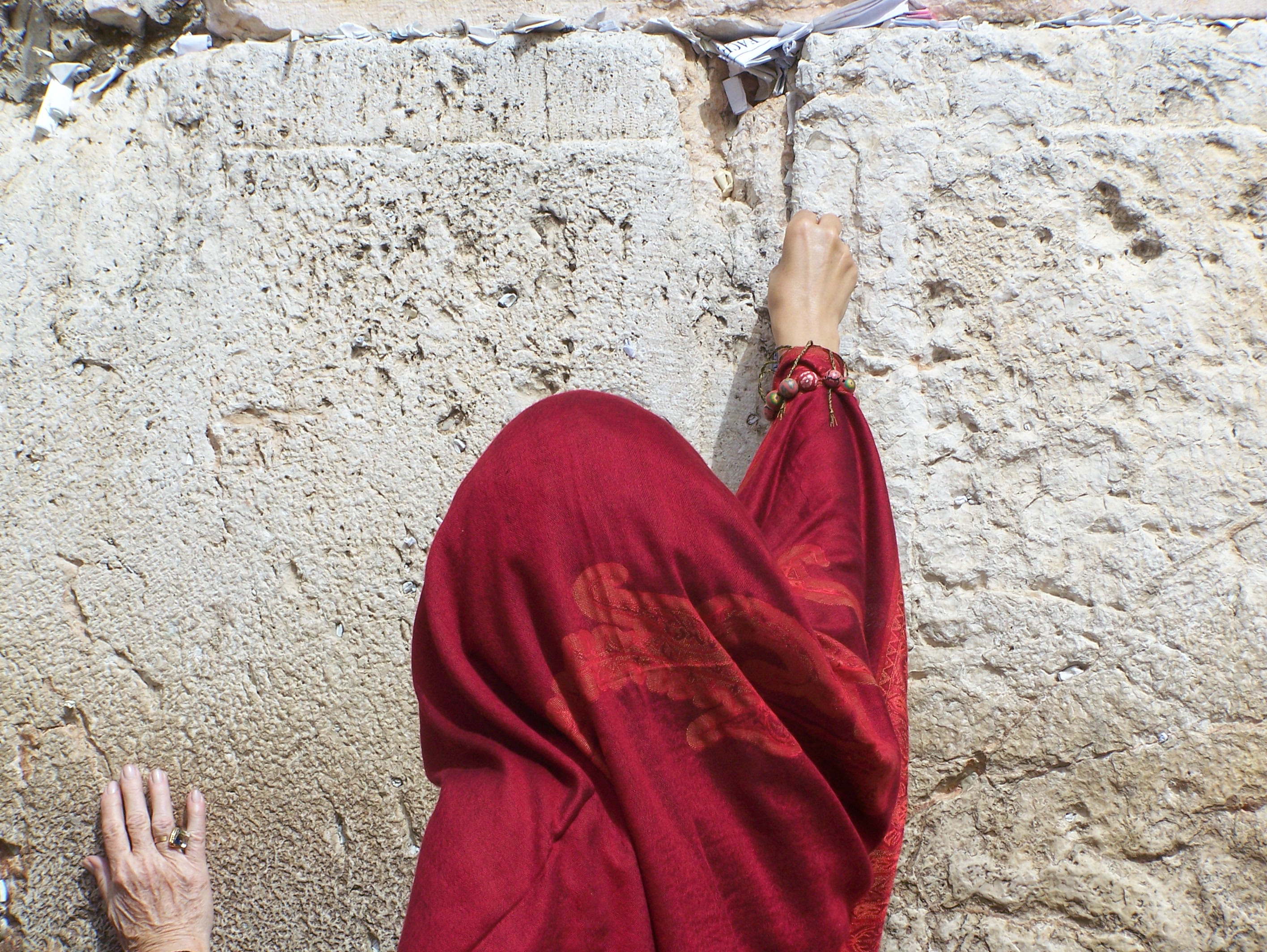 I’ve been making final arrangements for my son to have his Bar Mitzvah at the “Masorti Kotel,” a part of the Kotel off to the side of the main Kotel Plaza that is known as Robinson’s Arch. This is the designated spot in the Kotel Plaza that allows for a mixed prayer group of men and women.
How do I know the final arrangements are official? The rabbi of whom I am in correspondence with in Jerusalem cc’ed his email to “hakotel.” Yes, the Holiest spot to Judaism in the world was kept in the loop that my son will be called to the Torah in Jerusalem. Now it’s really official.
There is no way of documenting in words what emotions my family will be experiencing when my son, his brother and sister, parents and both sets of grandparents along with friends and a few surprise guests will come to Robinson’s arch to pray in honor of Nathan’s Bar Mitzvah. We’ve been planning this moment since around his birth.
But this story goes back perhaps even farther, it’s a story of the power of prayer and placing a note in the Western Wall, and how Gd answers these notes in Gd’s own time.
Once upon a time, a boy and a girl met one summer at Camp Ramah in the Berkshires. They met through mutual friends on a cracked tennis court. The girl kept missing every shot, and the boy didn’t seem to mind chasing all these balls and retrieving them for her.
The boy really liked the girl. Loved the girl. But the girl just wanted to be friends.
That winter, the boy visited Israel with his family. They visited the Kotel, or the Western Wall. The holiest place in all of Judaism where Jews for centuries pour out their hearts in prayer for a united Jerusalem, for a rebuilt Jerusalem. The boy wrote a note to Gd asking that the girl would one day fall in love with him, his family would be blessed with health, and (a bit of a more material and earthly ask), that he would make it into the Engineering program at MIT.
Within a month of writing that note, the girl (who would be me) turned him down when asked to prom. Within a month, the boy’s sister became seriously ill with meningitis and lapsed into a coma. And, the rejection letter from MIT showed up soon after that.
That boy felt like he was truly being punished by the Divine.
Not to worry. Gd answers prayers. Just not in the instant we would like them to be granted.
The sister of the boy recovered and thrived, went to MIT and went on to finish an MBA at Columbia University, has a tri-athlete husband and four beautiful children, and a thriving cupcake business!
Nine years later the girl that turned down the boy for prom came around and they were married before 247 guests!
The boy in the story is my husband. Whenever we are having an argument, or whenever my husband is getting on my nerves like when he doesn’t like the way I load the dishwasher, I think back to his note in the Kotel, realize that our marriage is meant to be by Gd, so I let it slide.
Now, I’m going back to the Kotel again, the fourth time in my life. No two trips to Israel or the Kotel are ever the same. Each time you go there, you are a different person perhaps at a different phase in your life. So, I’m going not only with my family, but I will also be going as a messenger taking along the notes my students wrote to place in the Kotel.
Most of them.
As my students started their note writing, they had many questions: How will Gd know it’s me? What should I write? How long does it have to be? Can I ask for anything…. anything? Is this a wish, or is this a prayer? And, will it come true, what I ask? How do they keep all the notes from falling out of the cracks?” …. and so on.
I guess this is a lesson to myself that it is hard for a child to know exactly how to compose a prayer of one’s own to be placed in such a holy place when one has only an abstract concept of the place itself. These students have only the most fledgling connections with Israel, let alone an understanding of the emotional impact that a united Jerusalem, and access to Judaism’s holiest site, has on the Jewish psyche. But they did their best, and I answered their questions as best as I could.
A note in the Kotel can express thanks to Gd for the health of family and friends. A note to the Kotel can ask to heal broken friendships or relationships. A note to the Kotel can ask to be provided for, and to never know hunger but one should not ask for “Lots of Money and an iPhone.” A note to the Kotel can ask for world peace and haters of peace, for their plans to be destroyed. But a note should never ask for the death of your enemies, let alone a family member. Gd is not your hitman. These notes will not be placed, nor do they deserve a place in such a holy place.
A lesson in hospitality
It’s been a while since I’ve had the time to write a blog post, perhaps because I’ve been a little pre-occupied. Hosting a Bar Mitzvah that includes many out of town guests becomes a four-day affair. My column, teaching and profile pieces also kept me spinning these last few weeks. So instead of my rantings, I’ll offer my son’s Bar Mitzvah speech (otherwise known as a d’var Torah – words of Torah) for this post. I am thankful that he took direction from me during the writing process. After all, what are writing/blogging moms for?
Shabbat shalom,
It has been an honor reading from the torah today. Actually, I was kind of lucky
that my parasha is Vayera. Unlike other parts in the Torah that deal with leprosy, animal sacrifices, or the appropriate punishment for stealing an ox, Vayera offers a classic narrative of stories we all know: the destruction of Sodom and Gomorrah, Abraham casting his handmaiden Hagar and their Child Ishmael into the wilderness; and finally the long-awaited birth of Isaac to Abraham and Sarah after they showed hospitality to three visiting angels.
If anything, there was too much to write about in my parasha. But I would like to
focus on two central themes: bargaining with Gd and the mitzvah of hachnasat orchim, or hospitality. These themes were repeatedly contrasted in this morning’s reading. Let’s start
withSodom and Gomorrah.
Gd calls out to Abraham on the news that He is about to destroy Sodom and Gomorrah. This
is one of several instances where Gd calls to Abraham, who then says: Heneini –
here I am. The inhabitants of these two cities are said to be so evil that a kind act such as hospitality to strangers is decreed a crime. The rabbis capture just how bad
the Sodomites were with this Midrash: The Sodomites refused to expend any of their
lavish wealth on strangers. In fact, Sodom provided only one bed for strangers;
if an unlucky traveler was too short to fit, he was stretched until he could;
if another was too tall, his legs were chopped off.
Even so, when informed of the news of the impending destruction, Abraham shows
courage and actually bargains with Gd: Finally, Abraham agreed with Gd about
the destruction when not even 10 good people could be found. Gd was pleased that Abraham bargained for the sake of his fellow human beings, even though Gd knew there were not enough good people to save Sodom andGomorrah.
This part of the parsha taught me that one should work very hard to try finding the
good in any instance or that one can find the good in any person.
But this d’var Torah is not about the evil in the world, it’s about people doing
good for others. The main message I learned from Vayera that I can apply
throughout my life is the mitzvah of hospitality. The Talmud states that
hospitality is such a great mitzvah that it is more important to show
hospitality than it is to attend classes of study or to greet Gd in prayer.
In one point in today’s Torah reading, we find Abraham sick and old, yet he is
still waiting in front of his tent to receive guests. In the distance, he sees three strangers
walking towards him. Suddenly, he moves into action. The text in the Torah
demonstrates how animated he became for the sake of greeting guests. He BOWS to
his guests, he RUNS into his house and SHOUTS to his wife Sarah,
“maheri shalosh s’eem kamah solet lushi, v’asi oogot.”
This translates into something along the lines of “Quick woman! We have guests, make
some cake!”
The words “run” and “quick” are repeated over and over as Abraham hurries to attend
to the strangers’ every need. He personally gets the whole family into the
catering business as they lavish their guests with an abundant feast.
This teaches me that although Abraham is weak and advanced in age, when he sees the
weary travelers, he suddenly finds energy in the mitzvah of welcoming guests
into his tent. Greeting guests to Abraham is more important than his own
comfort.
In another reference to hospitality, Lot, who is
living in the town of Sodom, is also greeted by angels. He also makes haste in preparing their meal.
However, he does not involve his family, and where Abraham serves his guests at
the doorway of his tent – in view of the public eye – Lot’s
hospitality is done secretly. Still, the Sodomites show their true nature and
look to punishingLot for his good deed.
Perhaps the reason why Abraham enjoyed having so many guests is because of the things
he learned from them.
Pirkei Avot asks: “Who is wise? He who learns from many is wise.”
As long as I can remember, my family participates in a chavurah every other Friday
night for Erev Shabbat. Everyone in the chavurah takes turn hosting the other
families, and we all pitch in bringing different parts of the meal. When it is
my family’s turn to host, for us kids, it’s not easy. It’s the end of a long
school week and we are tired. But, we are expected to help get the house ready
for our guests. There’s no time to sit around and watch “That 70’s Show.” We
have to rid the kitchen of any papers or any evidence that three busy children
live in the house. After sterilizing the kitchen, we have to find white
tablecloths, sort the silverware, and set up the glasses for Kiddush. But after
our guests arrive, the beautiful singing of Kabbalat Shabbat, plus the usual
ice cream for dessert makes all that work totally worth it.
Inviting guests into your home makes them feel special and more connected to the
community. In turn, perhaps the hospitality they were shown will inspire them
to extend hospitality to someone else.
Sometimes, guests can be close friends and family. Other times, guests can be complete
strangers.
I’ve learned a lot about Israelis by having teachers from Modi’in stay with us. This past Sukkot, we
opened our sukkah not only to our guest Inbar, but the other teachers who were
visiting plus their hosts. The house was full of energy and about 30 people had
a chance to eat in our Sukkah before the rain started.
Another form of hospitality is letting someone into a group. A good example of this is when you
are in school and your math teacher asks you to split up into groups of two to
work on a project. Kids, don’t wait for that fellow student that didn’t get put in a group to go through the humiliation of sitting alone in class. Go over and invite him or her into your group.
Another example of being shown hospitality by being included in a group I learned from my mitzvah
project. Over the past few months, I helped train dogs for Guiding Eyes for the Blind. The tricky thing is, I don’t have a dog.
YET!
But one puppy raiser named
Becky showed me hospitality by letting me “borrow” her dog Ben during the
class. If it wasn’t for her, I would not have gotten anything out of my mitzvah
project. She and Ben wouldn’t have progressed at a more rapid pace if I wasn’t tagging
along saying things like like “how do you hold the leash?” or “Ooops, I dropped
all the treats on the floor again.”
Guiding Eyes is an all-volunteer run foundation for people who take dogs into their homes, train
them and prepare the dogs for one day serving as a companion to a blind or
disabled person. It has been very inspiring to see how much Ben has improved in paying attention in the weeks I have worked with him.
Now that I am a Bar Mitzvah, I am honored that the entire Jewish
community is showing hospitality to me, welcoming me in as a fully participating Jewish adult. Now, if I’m home, or in Hebrew school one afternoon and there is no minyan for mincha/ma’ariv, I can be called upon to help. This will really make me feel important and part of the community.
Vayera concludes with the Akedah, the binding of Isaac. It’s hard to argue that Abraham was being
very hospitable when he obeyed Gd’s command and brought his son Isaac to Mount
Moriah to be sacrificed.
I find that strange, this is a man who bargains and with Gd to save two cities full of strangers who
are really bad people but doesn’t open his mouth in defense of his son.
I think about my own life, and situations that might happen that might somehow
relate to this, for instance: if my father ever asks me to hike up a mountain
for no apparent reason, I might buy it, but that will change when I notice a saddled donkey in the driveway.
Curbing Anger, Switching to Decaf: Yom Kippur

Yom Kippur, the Day of Atonement and the holiest day on the Jewish Calendar, begins tonight at sundown. It is a day of deep self-reflection and examination. Included in the liturgy of the day is a prayer we say over and over again throughout the 25-hour fast. The Al Cheyt prayer is a laundry list of sins and transgressions that we may have committed during the year. Most of them are not against Gd. The big sins listed are not: I played golf on Saturday instead of attending synagogue; or I ate a bacon double cheeseburger at McDonald’s ……
Most of the transgressions that are found within the prayers in Yom Kippur involve what fellow human beings do and think about one another. Most of the sins involve our ill behaviour. Most of the sins involve crimes of ill speech.
I asked my Hebrew school students what wrongdoings they see in their immediate lives. And from what they told me, we live in an angry society.
- One student, while waiting in line at Wegmans, overheard a customer yelling at a cashier that she had charged her too much for an item.
- Another student, again at Wegmans, witnessed one customer chasing another customer claiming that he had hit her shopping cart with his and had not apologized.
- One kid said his dad yelled way too much
- Another hand went up and a seventh grader confessed that his mom got mad because a food server at a Bruggers Bagels informed her that they did not have the exact flavor of bagel she had requested.
Road rage. Rage against stewardesses on airplanes. Angry Birds. Let’s face it, there is way too much anger in our society.
I am no innocent in this department.
This week my family experienced an onslaught of technical difficulties. My bottom freezer would not seal properly and there was a snowstorrm of frost accumulating. I quickly blamed this in my youngest son, who often puts all his weight (well, he is only in the fifth percentile of his age group for weight) on the freezer door when looking for an ice cream treat. The frostier my freezer became, the angrier I got at my son.
My computer, a Lenovo, which really turned out to be a Lemono, had to go back in the shop,for a third time. I was getting very angry at the business that sold me this computer.
As I spent the entire Monday morning waiting for the Sears repairman to come for my freezing freezer, I could feel my anger swelling. Where was he? Why did I have to reschedule my day and wait around from 8 a.m to 12 p.m. and here it was 12 and he still had not yet arrived?
When he did come, I did not greet him as warmly as I should. But he did to me. Mike the Sears repair guy shook my hand as he humbly apologized for being stuck at another call all morning fixing a tricky washing machine. He put on plastic booties over his shoes so he would not bring extra dirt into my already messy house.
He quickly pulled all the shelving out of my freezer. Got to the bottom of the problem: too much build-up of frost around the door. My son was off the hook. Mike also remarked that he had been here before and asked how my oven was doing.
He had been to my house to repair an oven I had long replaced. He remembered me.
After cleaning out my freezer, he apologized for getting melted ice on my floor as he replaced the freezer shelving. My anger melted.
“Really, it’s all okay.” I said.
God sends signs in funny ways to help us put life in perspective. Sometimes, it’s in the form of Mike the repairman.
This year, I will pray to try once again to stop myself from jumping to angry conclusions.
Maybe curbing my caffeine habit will help. At the very least, it will prevent a caffeine withdrawal headache that is bound to hit most of us fasters by 2 p.m. tomorrow.
May your Yom Kippur Fast be one that is meaningful and anger-free.
With friends like NPR and Egypt, who needs enemies?

 Picture this:
New Jersey is its own independent country-state, and it borders with another state – say, Pennsylvania – that has cold yet peaceful relations. On another adjacent border, let’s pretend that Delaware, is a hotbed territory for terrorist activity bent on destroying the Garden State.
You are on a chartered bus headed down from New York City to Atlantic City via the New Jersey Turnpike. You are with the guys or some girlfriends to have a little getaway to kick back for a weekend of gambling and enjoying the nightlife of and beaches of this resort town. Then, out of nowhere, your bus is ambushed by some armed terrorists who snuck in from Delaware through Pennsylvania.
They shower the bus with bullets and kill several of the passengers on board.
In defense of this bus, New Jersey military forces swoop down on the attackers and kill some of them on the spot, no question asked. But some flee across a state border, a border that is supposed to be monitored by the military of this other country to prevent terrorists from infiltrating into New Jersey. The New Jersey military pursue the fleeing terrorists and as an indirect result, some border patrol soldiers die.
Then, it is New Jersey, not the bordering state, asked to make apologies by the international community.
Does this scenario sound ridiculous? From the perspective of most Americans, of course it is. For the most part, our borders are secure and generally peaceful. And American civilians are so rarely attacked by terrorist organizations.
But Israel once again is being criticized for defending herself after tour buses headed for the resort city of Eilat were attacked by terrorists (excuse me NPR, they are not militants) from Gaza.
I first got word of these attacks through social networking: friends in Israel posted links to the news on Facebook. I listened to NPR the whole morning and not a single mention of these unprovoked attacks on civilians by a terrorist cell from Gaza that infiltrated the Israel-Sinai border Israel shares with Egypt.
Only when an Israeli airstrike into Gaza killed several members of a terrorist cell and, unfortunately, a 13-year-old boy, did NPR report the news. And, why did NPR have to use language like “Israel wasted no time retaliating” and record the sounds of people mourning for the gunmen and those killed in an Israeli airstrike at a Gaza morgue? Did NPR list the names and find relatives of Israeli victims and record their crying?
As much as I love NPR’s coverage on any other topic, such as their summer reading lists from All Books Considered, and their cooking segments with Nigella Lawson, they have boiled my blood on Israel coverage for the last time. Don’t count on my support any more.
On the other side of the word, my daughter wrote me from Camp Ramah in Canada. She said that she saw her Israeli counselors crying and comforting one another after hearing the news from Southern Israel. These Israelis were not shouting for revenge, they just hugged and consoled one another. Because no one in Israel wants violence, because any reprisal attack could involve a brother, sister, uncle, or friend who is serving in the Israeli Defense Forces. Because many of these counselors themselves just got out of the army.
Though the news from Israel is horrible, I was glad that my daughter was moved by her Israeli counselors comforting one another. It will make her connection to the Jewish state that more tangible and real. She will hopefully reunite with these Israelis on our visit to Israel in December.
Because, yes, we are still going.
Do Jews hold a Grudge Against Germany?
edit: To add some more to this sentiment: My parents this summer visited Germany. My mom was hesitant to go but she went. They took a river cruise on the Rhine and had a wonderful time. And, everywhere they went, there was not a single place visited where their tour guide did NOT make a mention of the atrocities that happened to the Jews during the Holocaust. The tourguide was extremely compassionate as he discussed the plight of the German Jews with my parents. They would certainly recommend a trip to Germany now that they visited.
A few nights ago, I had the pleasure of participating in some intense Jewish study with some very intelligent women in my neighborood. The study session was held in preparation for a nine-day mourning period in Judaism that happens each summer culminating with the fast day of Tish B’Av, or the ninth of the Hebrew month of Av.
During this time, no meat is consumed. Religious women run lots of clothes through the wash before the nine days because no clothing can be laundered in this time period. Swimming is off limits as well.
Why?
This time marks some of the saddest occasions in Jewish history, most notable are the destruction of the two Holy Temples – first in 423 B.C.E. and then 70 C.E. – that once stood on the Temple Mount in Jerusalem. The destruction of the Temples also marked the Jewish Exile from Israel, which ended only with the establishment of the modern State of Israel in 1948.
So, why mourn something that happened millenia ago? The issue of how to make that feeling of mourning relevant today was the topic of our study session.
I started to write this post a day before our study, but what gave me the chills is how our moderator opened the talk with another time of destruction in recent Jewish history: the Holocaust. Even if you didn’t have a direct loss in your family, it was a loss for the Jewish family as a whole, a loss that is still viscerally ingrained in the Jewish psyche today. We should also strive as Jews to make the loss of the Temples just as palpable.
Getting back to the Holocaust:
A few things I deducted from my Hebrew school education about the Holocaust, as taught by our rabbi, son of Holocaust survivors:
- After the destruction of Jewish life and Jewish culture under the Third Reich, Jews should Never Forget. Therefore, Jews should never again set foot in Germany
- Because of Hitler’s infatuation with composer Richard Wagner, because Wagner’s music was the soundtrack of music played as Jews marched to their deaths in concentration camps, Jews shoud Never listen to or play compositions by Wagner.
- Jews don’t buy BMWs or Volkswagons
- Again, Jews don’t visit Germany
I held onto these notions a for a long time, including during the summer of 1989, when I spent a month in Israel volunteering on a kibbutz in Israel’s northern region. To my surprise, many of the other volunteers were not Jewish kids; most were European. To my further surprise, many of them were German.
I never knew any Germans before this encounter. As I got to know them, I found them to be gentle and kind. They also had a thirst for learning all they could about Jewish culture, Hebrew, Jewish holidays – anything Jewish they could get their hands on, they wanted to learn about.
I asked them – why?
Their explanation: Germans of their generation felt an enormous sense of guilt as to what happened in their country, and that guilt was unjustified. They wanted to learn about Judaism, because, at the time, there were very few Jews in Germany. Still, I expressed my reluctance to ever visit their country.
Instead of being angry with me, their reaction was one of sadness.
Over 20 years have passed and I still struggle with my feelings about contemporary Germany. But just in the last week, there was media coverage about Jews and Germany that is making me reconsider.
The other evening, I listened on NPR the unthinkable: that the Israeli symphony was in Germany playing Wagner compositions.
Former Soviet Jews and young Israelis are settling in Berlin. There, they enjoy a thriving cosmopolitan culture with nighclubs, art galleries and community centers – all with an Israeli twist.
Another one of my brilliant neighbors, Athene Goldstein, returned from a visit to Germany, where her son-in-law, a professor, was delivering a talk on Jewish history in Germany. There, she also visited a museum in Berlin dedicated to Jewish culture. From her working knowledge of German, she could tell that none of the museum’s visitors were Jewish, but again, just as I experienced on that kibbutz, there was that intense curioustiy of wanting to know about Judaism.
“The museum was filled with basic Jewish artifacts: Sabbath candles, Torah Scrolls, a menorah for Chanukkah,” said Athene. “It was Judaism 101. But that is where they are. Germans are very up front about what happened in their country under the Nazis. Now, they just want to know about who their country tried to completely destroy.”
Is the fact that the Jewish population is growing in Germany a sign that Jews are forgetting their past? Or is it perhaps, maybe the best way to deal with the memory of the six million lives lost is to replace what was lost by renewing life there once again?
The Holocaust in Degrees of Separation
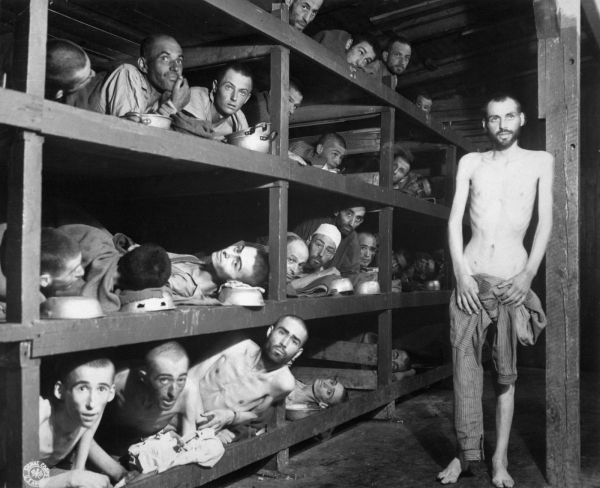
a photo of Jews, including Elie Wiesel and my friend's dad, liberated at Buchenwald
Leon Posen, a congregant from my synagogue, passed last week. He lived to the age of 94, blessed with a long life that could have been cut very short. His passing is still a sad one. Leon was a Holocaust survivor.
As the years and decades stretch away from World War II and Hitler’s war against the Jews, there are fewer people to tell first hand accounts of what happened in the ghettos and the concentration camps in Europe.
So who will bear witness in generations to come? Even if we don’t have a direct personal connection to the Holocaust, it is our turn to hear as many accounts as possible, and then tell them to the next generation. This is the only way to keep the vow of Never Again.
In Rochester, about 300 area Hebrew school kids in grades 6-12 watched their peers put on a play called “What Will You Tell Your Children” written by local playwright Jessie Atkin about her trip as a teen to the concentration camps in Poland. The play focused on the reactions of contemporary teens as they toured Auchwitz and faced anti-semitism and a general lack of understanding of Judaism at home.
I wonder if this new take on the Holocaust – telling the story second-hand and not directly from survivors’ accounts – actually disturbed,unsettled, and horrified the young audience enough to make them really remember. To make them relate. Was it too much of a softball throw in teaching the Holocaust? Is there – should there ever be — a gentle way to teach the Holocaust? How can it be unforgettable if we do not teach the inhumanity and the horror?
As the students watched the play, I watched the students. And then, I looked them as a whole – a bunch of healthy, creative, sometimes fidgety, teens and preteens. This was the same age demographic that Hitler selected for his Terezin concentration camp in Prague. A room with this many kids, multiply that number until you reach 15,000 kids. That’s how many died in Terezin, I thought. I shivered.
In my Hebrew school, we were spared nothing. My teacher, Rabbi Tzvi Berkowitz, was born in a displaced person’s camp in Cypress. The one depicted in the historical fiction novel “Exodus” by Leon Uris. He was the child of concentration camp survivors. Because of this, in our Holocaust education, we watched many horrible films shot in grainy black and white of the ghettos and camps filled with emaciated bodies. Some tortured and barely alive, some already dead.
But, still, it happened to someone else’s family, not my family, all those years ago. They were disturbing and yes, the first year I really learned about the horrors, I spent many nights curled up at the foot of my parent’s bed to sleep.
Now, I live in Rochester, a small town with an unofficial, intimate club that no one wants to belong to, yet they are proud members of it. Rochester has many Holocaust survivors whose families are now second, third and even fourth generation survivors.
It wasn’t until I had friends in this club, that I began to think: if his mother, if her grandfather didn’t survive, than this friend wouldn’t exist, or certain friends of my children would not be here.
Unlike the Yom Hashoah services of my childhood, when it seemed that everyone in my synagogue attended, it seems that Yom Hashoah services are attended mainly by those directly touched by the Holocaust, survivors and their decendants, leaders of the community, particpants in Rochester’s march of hope or our teen trip to the Holocaust museum in Washington D.C. So, going to these events, I still feel, thankfully, disconnected.
But in 2006, I had the privlelege of attending in Los Angeles the United Jewish Community’s General Assembly. That year I was the recipient of my community’s young leadership award, along with my traveling companion, Ron. Ron has the biggest heart of anyone I know, and lots of energy. An entrepreneur, he always seems to have three or four business ventures going on as well as several philanthropic projects. This is the kind of guy he is: we were stuck in an airport on the way home waiting for a delayed flight. It was late and people were crabby. Ron goes to the only remaining open store in the terminal, buys a bag of candy, and walks around, offering candy to the stranded travelers.
One part of the trip, young leadership delegates from around the world were taken to L.A.’s Museum of Tolerance. The museum, chronicles the Holocaust and current genocides in world history. Sadly, it shows visitors that vows of “Never Again” cannot ring true. In the decades since the Holocaust, there has been genocide in Cambodia, the Balkans, Rawanda, Sudan. Our docent said that the museum has been a destination of feuding gangs of LA to teach them the consequences of hate.
Further into the emotionally-charged museum, we came to the tail end of the Holocaust exhibit. There, transported from a concentration camp, in the corner of a dark room, was an actual bunk where prisioners slept, stacked three levels deep. Two to three men slept on planks on a bed the width as narrow as a twin bed. In the background, behind the bunk, was a life-sized photo, a well-known photo of survivors of Barrack 66 in Buchenwald. In this photo, is an emaciated Elie Weisel. I had seen this photo dozens of time in my life. Then, all of a sudden, Ron grabs me by the arm and points. Impossibly, my friend Ron’s face was peering out from the bunk one level above Weisel.
“Stacy!’ my friend cried, “That’s my DAD!”
And that is my degree of separation from the Holocaust. What is yours?
About Me

Kreativ Blogger

Versatile Blogger Award


 Stacy Gittleman