
Buy Daughter Skis, Feed the Chickadees, Mendon, NY
 Ever since my daughter started high school, I don’t see her that much. She doesn’t talk to me that much either. She is either in school, at practice, or up in her room studying, texting or skyping.
So, when she starts talking to me about taking on a new challenge like cross-country skiing, even though it’s a language almost foreign to me, I had better listen.
I tried to downhill ski, once. It was in California on a weekend away with my husband’s grad school buddies. Long ago, on a bunny hill somewhere in Lake Tahoe, Calif., I decided that strapping waxed wooden pieces to my feet and then surrenduring my body to the mercy of gravity was simply a horrible idea.
I was better suited for a flatter, more level playing field. So, the next year, I attempted cross-country skiing. I thought, how hard could it be? There are no hills to hurtle down and cause bodily injury. There are no ski lifts to try to jump on. Again, my new husband and I headed to Lake Tahoe for the weekend. It was a perfect, fresh-powdered blue-skied day to take my first five-mile trek on cross-country skis. I could run five miles at a time, so how much harder could skiing it be?
Much harder. Much.
Any ability to get my poles and my arms in rhythm with my feet in my skis completely escaped me. As soon as I would get any momentum going, I’d topple over into the snow. After falling over for about the 72nd time (I’m not exaggerating), I just sat there and wept in frustration. I took off my skis, walked back to the lodge and had a hot chocolate while the others effortlessly glided along the lakeshore.
So, when my daughter came to me with those big blue eyes sparkling with the promise of a new challenge, I was not going to put my failure on the slopes and the trails on her. But how much was this going to cost us?
We head out to a ski swap and sale at a middle school surrounded by farmland. This is one of the biggest ski swap and sales in the area, and the gym is packed with parents like us shopping from the area’s ski retailers. Thankfully, the high school ski coach is there to teach us the lingo (Classic skis, Combi skis and boots, Poles, Bindings.) and show us what we needed to buy. We need skis that she can use for both disciplines.
No, the two disciplines are not scary downhill and frustrating cross-country, as I thought. There are actually two disciplines of cross-country: classic and skate. About 40 minutes, — and hundreds of dollars – later, she had what she needed to hit the trails.
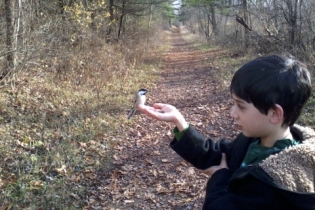
On the way home, we stopped at one of our favorite places to hike, Mendon Ponds Park, where my kids have been hand feeding the chickadees since they were little. It is one thing they still like to do and each time a bird lands in their hand, I get a glimpse into the past, see the little kids my big kids once were.
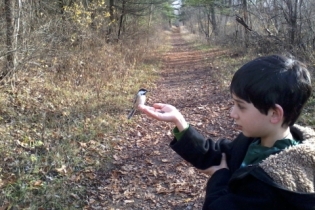
My daughter brings her poles along for the 2 mile hike, just to get a feel for them. Then, out of nowhere, my daughter wants me to give them a try. I listen to her and slip my thumb in the proper hole, adjust the velcro secure around the rest of my hand. Bend my elbows just so. And, in one final hike before the snows fall, my daughter and I take turns with the poles along the trail. Together. Side by side.
Let the Thanking Begin


How much do I have to be thankful for as we approach Thanskgiving week, the week after my son’s Bar Mitzvah? First, I’m thankful for my husband for creating an excel spreadsheet to track it all, among other things.
After weeks of not sleeping well, with millions of details running around in my head, I gave my permission this week to sleep in a bit. To become somewhat of a slacker. To laze in bed after the kids went off to school to read. To read chapters in The Hunger Games, a book my kids have been begging me to finish already after starting it two months ago. To read A Legacy of Madness, a memoir written by a college friend and forever mentor, who edited nearly everything I wrote at the college paper at Rutgers.
In this way, I made a little room to thank myself for getting through a blessed and wonderful weekend that was Nathan’s Bar Mitzvah.
Next week is Thankgiving, where we will thank everyone else.
- For friends and family for driving north and south, for flying east, to be with us in Rochester.
- For friends, who helped us prepare the gift bags for our out of town guests.
- For friends who are more like sisters who helped serve dinner on Friday night.
- For friends and family who read Torah, who learned an aliyah or took a reading during the service.
- For nieces and nephews who gave out candy, and then ate the candy, after we showered Nathan with sweets.
- For our synagogue’s rabbis, chazzan and teachers, for preparing my son with all he needed to know as he became a Bar Mitzvah
- My mother-in-law for knitting almost 100 kippot in Mets colors for the Saturday morning service
- Mom, for making cookies and her famous mandelbrodt for the sunday brunch, and friends for making the eggs, fruit salad, cake, that everyone wants the recipes
- The staff at the JCC for putting on a seamless party
Now that Nathan is a man (see above), it will be his turn to say thank you all for making his day so meaningful. And he’s going to thank you the old fashioned way, with a card to soon be apppearing in your mailbox.
Happy Thanksgiving!
A lesson in hospitality
It’s been a while since I’ve had the time to write a blog post, perhaps because I’ve been a little pre-occupied. Hosting a Bar Mitzvah that includes many out of town guests becomes a four-day affair. My column, teaching and profile pieces also kept me spinning these last few weeks. So instead of my rantings, I’ll offer my son’s Bar Mitzvah speech (otherwise known as a d’var Torah – words of Torah) for this post. I am thankful that he took direction from me during the writing process. After all, what are writing/blogging moms for?
Shabbat shalom,
It has been an honor reading from the torah today. Actually, I was kind of lucky
that my parasha is Vayera. Unlike other parts in the Torah that deal with leprosy, animal sacrifices, or the appropriate punishment for stealing an ox, Vayera offers a classic narrative of stories we all know: the destruction of Sodom and Gomorrah, Abraham casting his handmaiden Hagar and their Child Ishmael into the wilderness; and finally the long-awaited birth of Isaac to Abraham and Sarah after they showed hospitality to three visiting angels.
If anything, there was too much to write about in my parasha. But I would like to
focus on two central themes: bargaining with Gd and the mitzvah of hachnasat orchim, or hospitality. These themes were repeatedly contrasted in this morning’s reading. Let’s start
withSodom and Gomorrah.
Gd calls out to Abraham on the news that He is about to destroy Sodom and Gomorrah. This
is one of several instances where Gd calls to Abraham, who then says: Heneini –
here I am. The inhabitants of these two cities are said to be so evil that a kind act such as hospitality to strangers is decreed a crime. The rabbis capture just how bad
the Sodomites were with this Midrash: The Sodomites refused to expend any of their
lavish wealth on strangers. In fact, Sodom provided only one bed for strangers;
if an unlucky traveler was too short to fit, he was stretched until he could;
if another was too tall, his legs were chopped off.
Even so, when informed of the news of the impending destruction, Abraham shows
courage and actually bargains with Gd: Finally, Abraham agreed with Gd about
the destruction when not even 10 good people could be found. Gd was pleased that Abraham bargained for the sake of his fellow human beings, even though Gd knew there were not enough good people to save Sodom andGomorrah.
This part of the parsha taught me that one should work very hard to try finding the
good in any instance or that one can find the good in any person.
But this d’var Torah is not about the evil in the world, it’s about people doing
good for others. The main message I learned from Vayera that I can apply
throughout my life is the mitzvah of hospitality. The Talmud states that
hospitality is such a great mitzvah that it is more important to show
hospitality than it is to attend classes of study or to greet Gd in prayer.
In one point in today’s Torah reading, we find Abraham sick and old, yet he is
still waiting in front of his tent to receive guests. In the distance, he sees three strangers
walking towards him. Suddenly, he moves into action. The text in the Torah
demonstrates how animated he became for the sake of greeting guests. He BOWS to
his guests, he RUNS into his house and SHOUTS to his wife Sarah,
“maheri shalosh s’eem kamah solet lushi, v’asi oogot.”
This translates into something along the lines of “Quick woman! We have guests, make
some cake!”
The words “run” and “quick” are repeated over and over as Abraham hurries to attend
to the strangers’ every need. He personally gets the whole family into the
catering business as they lavish their guests with an abundant feast.
This teaches me that although Abraham is weak and advanced in age, when he sees the
weary travelers, he suddenly finds energy in the mitzvah of welcoming guests
into his tent. Greeting guests to Abraham is more important than his own
comfort.
In another reference to hospitality, Lot, who is
living in the town of Sodom, is also greeted by angels. He also makes haste in preparing their meal.
However, he does not involve his family, and where Abraham serves his guests at
the doorway of his tent – in view of the public eye – Lot’s
hospitality is done secretly. Still, the Sodomites show their true nature and
look to punishingLot for his good deed.
Perhaps the reason why Abraham enjoyed having so many guests is because of the things
he learned from them.
Pirkei Avot asks: “Who is wise? He who learns from many is wise.”
As long as I can remember, my family participates in a chavurah every other Friday
night for Erev Shabbat. Everyone in the chavurah takes turn hosting the other
families, and we all pitch in bringing different parts of the meal. When it is
my family’s turn to host, for us kids, it’s not easy. It’s the end of a long
school week and we are tired. But, we are expected to help get the house ready
for our guests. There’s no time to sit around and watch “That 70’s Show.” We
have to rid the kitchen of any papers or any evidence that three busy children
live in the house. After sterilizing the kitchen, we have to find white
tablecloths, sort the silverware, and set up the glasses for Kiddush. But after
our guests arrive, the beautiful singing of Kabbalat Shabbat, plus the usual
ice cream for dessert makes all that work totally worth it.
Inviting guests into your home makes them feel special and more connected to the
community. In turn, perhaps the hospitality they were shown will inspire them
to extend hospitality to someone else.
Sometimes, guests can be close friends and family. Other times, guests can be complete
strangers.
I’ve learned a lot about Israelis by having teachers from Modi’in stay with us. This past Sukkot, we
opened our sukkah not only to our guest Inbar, but the other teachers who were
visiting plus their hosts. The house was full of energy and about 30 people had
a chance to eat in our Sukkah before the rain started.
Another form of hospitality is letting someone into a group. A good example of this is when you
are in school and your math teacher asks you to split up into groups of two to
work on a project. Kids, don’t wait for that fellow student that didn’t get put in a group to go through the humiliation of sitting alone in class. Go over and invite him or her into your group.
Another example of being shown hospitality by being included in a group I learned from my mitzvah
project. Over the past few months, I helped train dogs for Guiding Eyes for the Blind. The tricky thing is, I don’t have a dog.
YET!
But one puppy raiser named
Becky showed me hospitality by letting me “borrow” her dog Ben during the
class. If it wasn’t for her, I would not have gotten anything out of my mitzvah
project. She and Ben wouldn’t have progressed at a more rapid pace if I wasn’t tagging
along saying things like like “how do you hold the leash?” or “Ooops, I dropped
all the treats on the floor again.”
Guiding Eyes is an all-volunteer run foundation for people who take dogs into their homes, train
them and prepare the dogs for one day serving as a companion to a blind or
disabled person. It has been very inspiring to see how much Ben has improved in paying attention in the weeks I have worked with him.
Now that I am a Bar Mitzvah, I am honored that the entire Jewish
community is showing hospitality to me, welcoming me in as a fully participating Jewish adult. Now, if I’m home, or in Hebrew school one afternoon and there is no minyan for mincha/ma’ariv, I can be called upon to help. This will really make me feel important and part of the community.
Vayera concludes with the Akedah, the binding of Isaac. It’s hard to argue that Abraham was being
very hospitable when he obeyed Gd’s command and brought his son Isaac to Mount
Moriah to be sacrificed.
I find that strange, this is a man who bargains and with Gd to save two cities full of strangers who
are really bad people but doesn’t open his mouth in defense of his son.
I think about my own life, and situations that might happen that might somehow
relate to this, for instance: if my father ever asks me to hike up a mountain
for no apparent reason, I might buy it, but that will change when I notice a saddled donkey in the driveway.
Three Friends, Three WWII and Honor Flight Veterans
 Jack Hennessy’s handshake is still very strong at age
89. This enduring strength might be attributed to the rigorous training he
received decades ago as a member of the Glider Corps, a little-known part of
101st Airborne Division during World War II.
Last May, the father of four and grandfather of 10
received many firm handshakes of gratitude when he took an all-expenses-paid day
trip to Washington, D.C., sponsored by the Honor Flight Network. Hennessy is
just one of 63,000 veterans of WWII and the Korean and Vietnam wars who have
taken an Honor Flight since 2005 to see the monuments built for their
sacrifices. The nonprofit organization is fighting against time to bring all
able WWII veterans on this trip.
“People were rushing up to thank me. People I didn’t
know from a pile of brooms were lining up to shake my hand. It was all very
moving,” said the Victor resident of the Legacy at the Fairways, about the
reception he received during his trip
Eight WWII veterans living at the Fairways have been on
Honor Flights, including Hennessy’s friends Bill Ryan and Ted Vangellow.
For each trip, the men were picked up in a limousine for an early morning
flight. They visited key monuments as well as Arlington National Cemetery for
the changing of the guard. They were treated to a dinner at the Washington
Hilton Hotel before their trip home.
Vangellow, who went in June 2010, said he was
overwhelmed at the recognition and appreciation he received from the public at
the monuments.
“People knew who we were because of our orange shirts. When we visited the
Iwo Jima memorial, a group of high school students sang ‘Amazing Grace’ to us.
That was a real tear-jerker,” said Vangellow, who served in the U.S. Air Force
in Europe.
Hennessy served in the 101st Airborne in a lesser-known
unit called the Glider Corps. All major invasions and operations of the war,
including the invasion of Normandy on June 6, 1944, were heavily reliant on the
Glider Corps to fly supplies in behind enemy lines.
Hennessy said he “gets a little upset” that not many
people today know about the courageous contributions of the Glider Corps. The
paratroopers in the 101st Airborne were considered to be elite troops and
received extra compensation for their hazardous missions. The glider troops,
however, had duties just as dangerous, but got no extra pay.
Hennessy enlisted in the Army in 1942 after he
graduated from Aquinas High School. He left in August 1943 for Europe, where he
helped set up camps in England in advance of the invasion of Normandy.
“The physical training to be a glider was pretty
grueling. We were up and working by 5 a.m. In the beginning, I thought it would
kill me, but I ended up in the best shape of my life.”
One exercise he remembers in particular was digging a
foxhole with his regiment. It had to have a roof strong enough to withstand the
weight of a tank driving over it.
“Our foxhole made it. The guys next to us, theirs fell
through, but they got out OK,” he said.
Though Hennessy spent many hours practicing in the gliders, he never went
into battle. However, many of his compatriots were killed in the Battle of
Normandy, as well as on the frontlines around Dusseldorf, Germany.
When the war ended in Europe in May 1945, Hennessey
spent additional months abroad studying at the American University in the
seaside resort city of Biarritz, France.
“The U.S. military took over all the town’s fancy
hotels and that’s where we slept. After sleeping for years in tents in old cots
during the war, it was heaven to lie down in a real bed with soft sheets,” said
Hennessey, who added that he loved being treated like a student and not like a
soldier.
When he returned to the United States, he earned his
bachelor’s degree on the GI Bill at Syracuse University. He was 27 years old. He
met the woman who would become his wife, Veronica, and they raised four children
in the Rochester area. They were married for 58 years before she passed away in
2010.
Hennessey said although it is not like having one’s own
home, he enjoys his lifestyle at the Fairways, especially the friendship of
Ryder, Vangellow and other seniors he has met. They share meals in the dining
room, play bingo and cards, and go on trips to the Finger Lakes and Niagara
Falls.
Hennessy is fighting another fight against cancer and
said that he is lucky that his daughter lives nearby in Fairport to take him to
his treatments.
As the country waits to bring home its next generation
of veterans from Iraq, the three WWII veterans also stand together in their
opinion on the wars in Iraq and Afghanistan.
“We have no business being there for so long. We have
lost too many good people,” said Hennessey.
They wish for the returning veterans an easy transition back to civilian
life.
Stacy Gittleman is a freelance writer from
Brighton.
My name is transplantednorth and I blog for the trees
 The other morning I phoned my sister-in-law in northern New Jersey. I needed to know her Hebrew name for an honor she was receiving for the morning service at my son’s Bar Mitzvah, now only days away.
Now, I should have known this, and certainly my husband should have known his sister’s Hebrew name, but we didn’t.
I called her cell phone a few days ago after 8:45 in the morning. With four kids in school, she had to be up. She is always on the go. Instead, a very groggy voice answered.
“It’s Malka”
“Who’s Malka?”
“I am. That’s my Hebrew name.”
Oh, of course, that’s why I was calling. But why did she sound so tired?
“Why arent’ you up? Don’t you have kids to get to school?” Fool that I was, with the glorious November day outside, and the fact that Western New York again survived the latest storm to hit the east coast unscathed, I was not thinking about how bad things were back in the NYC/NJ Metro area. The now-dubbed Halloween snowstorm had turned the streets of parts of New Jersey into what looked like a war zone. With downed trees and downed power lines, it was even too dangerous to go trick-or-treating.
“I’m sleeping at a friend’s house. We have no power and no heat.”
She sounded so sad. She still had no power after two days. The kids had no school for two days straight. But the one thing that seemed to make her the saddest was:
“You should see my block. We lost so many big, beautiful trees.”
It takes decades for a tree to really mature. I know because I live on a street with huge Sugar Maples that look like this: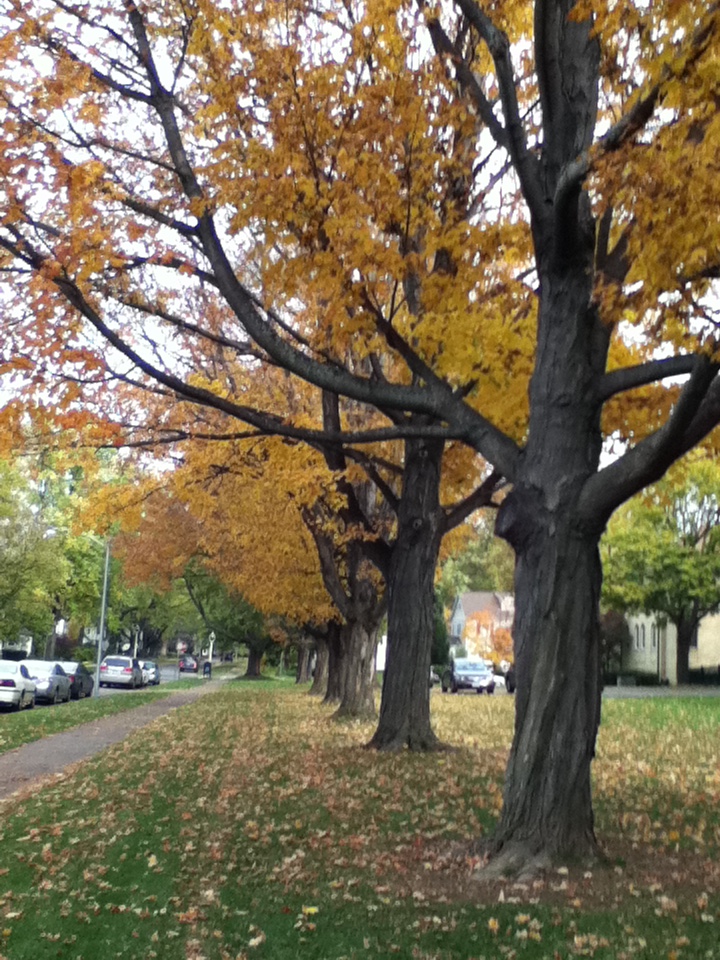
In the winter, when the snow is wet and heavy enough to put a coat of sugar on every last branch and twig, my street looks like this:

Sadly, even trees don’t last forever.
The snow-laden trees above were planted because they were fast-growing trees for Rochester’s first suburban development. They are now almost 90 years old.
Trees planted closely to houses are dangerous when they age and begin to rot from the inside out. Last weekend, our neighbors took down one of these trees. The bottom trunk was this big:
 This tree saw 90 years of changes of seasons, survived ice storms and blizzards. It saw generations of school children off on their first day of school. It was a home to birds and squirrels who played in its branches. But it lived out its days and succumbed to “crotch rot” of all things. Now, where its branches once stretched out, there is a whole punched into the sky where it once stood.
When snows fall heavy before the leaves drop, trees come down before they get a chance to live out their days. Back in New York City, Central Park lost 1,000 trees; trees that were just beginning to peak in their fall splendor of color. Trees that were planted generations ago so that we may enjoy them.
The other week, my son got a gift from a relative in honor of his Bar Mitzvah. In the true Jewish tradition, a ring of trees had been planted in his name in Israel. It’s a good thing we are headed there this winter to water them!
Now after this devistating storm that cancelled trick-or-treating and felled countless trees close to home, it seems like New York City needs new trees just as much as the land of milk and honey. The Central Park Conservancy is now asking for donations to restore its tree population.
Do you have a favorite tree? How would you feel if it were destroyed or it had to come down? Or, did you lose a tree to the Halloween storm? If so, I am sorry for your loss. Why don’t you write about it here?
If we knew you were coming… the art of the R.S.V.P.

 A friend of mine recently took on a community outreach job where she has to arrange free events for a local non-profit organization.
The carefully targeted invitees are sent invitations both by snail mail and e-mail. The invitations are sent in a timely manner and indicate the event is free but space is limited and one must RSVP to attend.
There is a handy email address to send a response, a mailer to mail back, and a website to also let the event organizer of ones decision of attending or not attending.
At such a recent family friendly event, I watched my friend fly around the event venue in a panic. Around 25 families responded that they would be coming. Double that amount had lined up outside the door, waiting to come in. She feared she did not have enough forks or plates, or food ordered for the unexpected who showed up. Would she run out of craft supplies and disappoint some unsuspecting children. After all, it wasn’t their fault if their parents failed to R.S.V.P. And, in an event with a purpose to create inclusiveness, it would be wrong and off-putting to turn people away.
Do you R.S.V.P. yes or no to every invite you receive?
To an event planner, that yes or no response makes the difference between having enough pre-cut craft pieces or not having enough. It is the difference between having enough juice boxes for the kids whose parents responded or having to turn people away with kids who may have wanted to do a craft project and a juice box but didn’t respond and feeling badly about it. And, if you don’t RSVP to an event like a wedding that requires head counts by the caterer or table seating arrangements, you may quickly fall off invitee lists of the future.
This problem seems systematic in my community, I wonder if this goes on everywhere. Are the e-vites that appear in our overloaded e-mail and social networking in boxes not as significant as the invitations that are mailed to us the old-fashioned way?
Now, am I innocent of the crime of not RSVPing to something, and then showing up? Absolutely not.
A few months ago, I had plans to attend what I thought was an informal learning session after Saturday morning services at my synagogue. What I, in my hurry in reading the email, failed to see that it was a LUNCH and learn, and one had to RSVP.
I didn’t RSVP
As a result, I felt like a heel. An idiot.
I had no premade name tag. No table tent had been carefully prepared by an administrative assistant who made ones for those who made it their business to RSVP in a timely manner.
There was food. None of it was ordered for me. Because they didn’t think I was coming.
So, I took no food. Not until after all the people who had the decency to respond had theirs first. Even though people said no worries, I should go up and help myself. No, I thought. I didnt’ RSVP properly. It served me right.
So, if you get in your email or social networking inbox an event, remember there are people behind that invite who have a lot of details to take care of, budgets to stay within, name tags to print and a finite number of sandwiches to order.
Even if you have to say ‘no,’ a regret is far more appreciated than no response at all.
Speak trippingly on the tongue – the complete works of Shakespeare in 90 minutes at Pittsford Mendon HS

 Make use of
time, let not advantage slip.
William Shakespeare
As a columnist who has to write ahead, I am always thinking two weeks into the future. But, in the whirlgig of time, I was not in time on writing an advance for a great high school play taking place this weekend. But this sounds too auspicious of an event, and I had too good a time looking up Shakespeare quotes not to share. Thanks to all my friends on Facebook who fed me with witty Shakespearean quotes and sources for this post:
The Sutherland High School players present a fall comedy, The Complete Works of Shakespeare Abridged. This parody incorporates all the plays written by William Shakespeare into one show and will be on the SHS stage October 27, 28, and 29 at 7:30 p.m. Tickets are available at the door for $10 each.
“This is different from anything I’ve ever done before,” said Colin Perinello, a senior who will major in musical theatre next fall at a college to be determined.
“In one sentence, I have to use a high falsetto voice when I say Juliet’s line, then have to drop to a deeper voice in a Scottish accent when I am the narrator. Sometimes, I mix up my voices and roles, so what comes out is a twisted Juliet with a Scottish accent. Let’s just say it is a very humourous outcome,” he said.
In our world of 140 character tweets, it’s refreshing to know that there are still high school kids out there who will put on puffy shirts, tights and kilts and learn the poetry of Shakespeare. But, in this age of short attention-span theatre, this play indeed makes “use of time” to “let not advantage slip” as snippets of all 37 Shakespearean plays are squeezed into this upcoming 90 minute performance.
This weekend, I’m planning on seeing the movie Anonymous, a movie with a premise that Shakespeare never wrote a word. Shakespeare: was he or wasn’t he? But in the end, does it matter?
Is one life worth it?
I usually don’t like when Israel is in the news. That is because US media coverage of Israel is rarely about the medical advances of Israeli doctors, or technological breakthroughs that happen in this tiny country with the world’s most high-tech startups per capita.
Coverage is usually about Occupation. Conflict. Tit-for-tat attacks and “disproportionate acts of aggression” by Israel to her neighbors, most who are hell-bent on the destruction of the only country on the planet with a Jewish majority.
So last week, when news first surfaced about Gilad Shalit, an Israeli soldier who was kidnapped in 2006 by Hamas, I immediately thought it was bad news. The person who was telling me the potentially good news was sitting in the passenger seat of my car. She was a teacher. And she had vested interest in the outcome of one of the most unprecedented prisoner exchanges in Israeli history. Because she was Israeli.
My guest was Inbar, one person in an eight-member Israeli delegation visiting Rochester area schools, both Jewish and non-Jewish, as part of the Partnership 2Gether Education Bridge program, sponsored by the Jewish Federation of Greater Rochester.
Israeli teachers and community leaders visited both religious and secular public schools such
as Scribner Elementary School in Penfield, Webster High School; and Twelve
Corners Middle School and French Road Elementary School in Brighton. Questions
from children in younger grades included what types of sports are played and
what kids wear in Israel. High school students posed more ethical questions
about religious diversity and the current prisoner swap that unfolded each day
of the Israeli’s visit.
They stayed with hosts, both Jewish and non-Jewish.
Does it shock you that Israeli Jews, like many Americans, struggle with their own Jewish identity? Is living in Israel enough for them?
The Israelis left Rochester with an enormous appreciation of the degree at which Americans tolerate one another’s different customs, religions and different levels of observance. They hopped around in our sukkahs. They attended services in our synagogues and many of them saw women participating in religious congregational life for the first time. Women here can be rabbis. Women here in America can read from and be called to the Torah for an aliyah. Then, they went shopping.
From what our Israeli guests told me, many have chosen a purely secular life, though in Israel, all Jewish holidays are national ones. Most Israelis are tired of being dictated by the religious right, which have a very strong hold on government. But, after visiting American Jews, who try to mix traditions with modernism, they want to welcome back Jewish traditions into their lives, but on their terms. As secular as they are, the lives of Israelis, including decisions made by the Israel Defense Forces, are governed by Jewish values. One of these values is the commandment of Pidyon Shvuyim, the redemption of captives.
As the week went on, the pending release of Gilad Shalit in exchange for Arabs with known blood on their hands, weighed heavily on our guest’s minds. Was it really true? Was Gilad coming home at last? And would he be released alive?
Gilad was kept in our hearts, prayers, and classrooms all week. We read from a story that Gilad wrote when he was only 11 years old. It had been illustrated and published into a book. It has been read by children the world over as a message of peace.
In the very early hours of Oct. 18, I climbed the stairs to the guest bedroom in my attic to wake Inbar with some very good news. Gilad Shalit, 25, was home and free.
Many have questioned the logic of this lopsided swap. As TV coverage streamed the news later that day at a gym where I was working out, a fitness instructor apologized if her question sounded crass, but she asked if he was worth it.
What do you think? Is one life worth saving?
October in New York: East Hill Farm/Folk Art Guild Open House

Last Sunday morning, though I could have slept in, I woke up early. I woke up my family too. I told them we were about to take a trip into the country. No, we weren’t going through a corn Maze.No, there would be no pumpkin catapult contests. But I promised them, they would enjoy it. They were going to have a good time. Because I SAID SO!
Life has been way too hectic lately. I feel like I have barely seen my three children since late June. It seems like no sooner did my older son and daughter return from sleep-away camp and I washed all their laundry, the summer ended and so began the school grind. Homework and tests. Track meets and band practice.
But last Sunday morning, we had this glorious sunny perfect day. And we had no school and no work. I just wanted one chore-free day of me not nagging anyone spent out in the country. One day of me not badgering anyone to stop texting friends while I am talking to them or stop playing games on the computer.
So off we went.
The ride along Canandaigua Lake had the whole family, plus a friend of my son’s, singing along to “American Pie” on the radio and marveling at the colors of the trees that dotted the hills
as we whizzed past withering cornfields.

To reach our destination: the East Hill Community Supported Agriculture (CSA) Farm and Folk Art Guild in beautiful, Middlesex, NY. There, we got a chance to see where our vegetables were grown all summer.
East Hill Farm is a project of the Rochester Folk Art Guild, a nonprofit organization and community of craftspeople and farmers. Since 1967, they have grown food and produced handmade practical folk art on a 350 acre farm. East Hill Farm uses old fashioned, chemical-free, hands-on organic methods to grow fruit, vegetables, herbs, eggs, pigs, and chickens for the community and for sale through our CSA and markets.
For the past 20 weeks, our family took part in a great experiment of owning a CSA share. Each Friday since mid-May we were presented with a portion of vegetables, fruit, herbs and flowers organically and lovingly grown by a group of young entrepreneurial farmers. Whether it was spring’s excessive rains or July’s excessive heat, we shared in the farmers’ risky dance with Mother Nature.
The farm had limited cell phone service so we got a chance to sample the simpler, slower style of life. We actually got a chance to catch up, share and talk as a family. How many times are family members distracted from each other by screens: laptops, DS games, cell phones, iPods?
Well, on this day in October my teen-aged daughter actually sat and talked to me. She sat and reminisced with me about the first time she used a pottters wheel this summer at camp as we watched a master potter throw and mold a clay jar before our eyes:

How many toys, clothing, dishes do we buy that are made of cheaply made mass-produced?
At East Hill Farm, in the woodworking shop, bare-footed craftsmen showed off their lathes.

And my kids played with real wooden toys.

 Made in the USA.
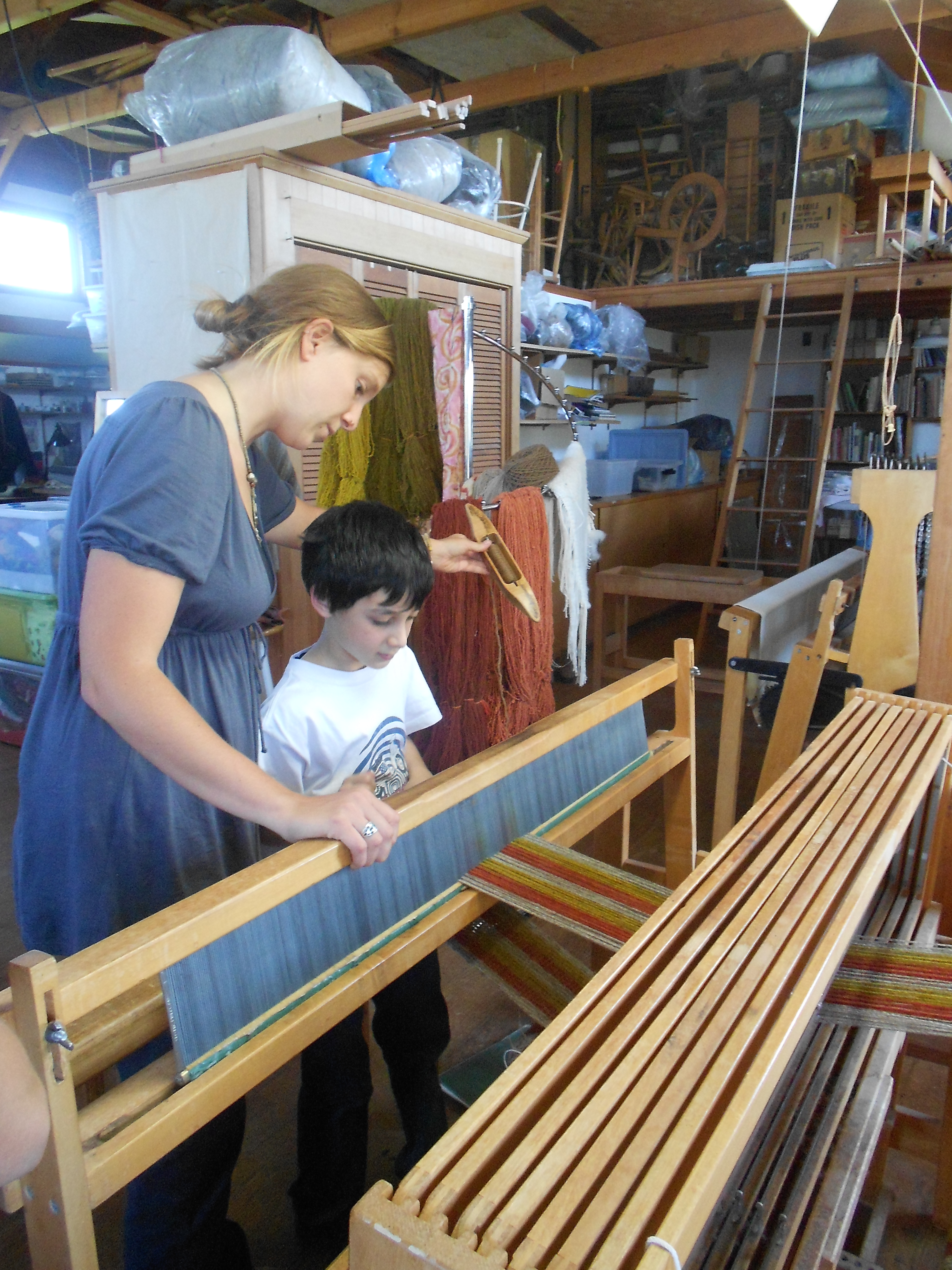
Then, in the weaver’s studio, my son got to try his hand at a loom, using wool that was dyed by an apprentice, the same young woman who brings us our week’s worth of vegetables. Thank you, East Hill Farm farmers. It’s been a great summer.
Behold, I am the drain whisperer
 Nothing, NOTHING gets me more bent out of shape than a clogged drain in the shower or sink. I obsess over it. I can do nothing else until I can witness that ultimate sound of water flowing effortlessly through a clear drain, the appearance of the tornado-like whirlpool signaling that the block has been unblocked.
And when you live in a house that is nearly 90 years old as I do, I can look forward to this cycle of first frustration and then elation every three months.
At first, we try to ignore it. For some reason, we don’t learn from one clogged cycle to the next. We don’t use those plastic guards to keep the long hair of mine and my daughter’s from going down the drain. Nor do we consider shorter hairstyles to prevent the buildup of (ewwwww) hair.
Yes, this is gross. But perhaps a topic that most can relate to have the stomach to read on.
So, as we stand in the tepid water that accumulates around our toes, we think, “maybe this will work itself out….”
But then, one fateful morning, my husband leaves for work, not telling me that the shower is clogged, seemingly for good. And my kids don’t bother to tell me their sink is clogged until it is overflowing between the original basket-weaved floor tiles, through the floor boards, and into my repeatedly plastered dining room ceiling. In desperation, I hoist the new dining room table from harm’s way of the water trickling down the dining room chandelier.
Then, it is time for my mission, my quest to unclog the clog.
First, I try the method that will do the least harm to the environment and my pipes: A cup of baking soda followed with a cup of white vinegar. The mixture momentarily fizzes in the sink or shower…. and then… nothing. Clog still there. No motion in the murky waters.
I go downstairs. Have breakfast. A cup of coffee. All the while killing time to see if there is any progress, any movement.
After about an hour, I get out the plunger. No luck. Another cup each of vinegar and baking soda. Another wait. Another plunge. Still no luck.
Frustration. Black goopy muck seeping from my drain. I’m about to give up. I’m about to call my husband and cry and ask him to pick up some deadly chemical substance.
But then, suddenly, the waters subside. I achieve swirl. The clog is unplugged. I have conquered the clog, once again.
My drain is clear. My work is done. I am hit with a wave of triumph.
Screw college. I should have been a plumber… I would have been making a lot more money by now.
About Me

Kreativ Blogger

Versatile Blogger Award


 Stacy Gittleman