
Goodbye, Summer. I’ll See You in my Freezer
During the long Rochester winters, what I miss most about the summer is my garden. One fall day in early October, when my older son was very small, he accompanied me into the garden as I pulled out the last annuals and put the soil to bed.
As I yanked out the last withering tomato plant, he burst into tears and cried:
“It’s really OVER!!”
One of the favorite dishes of summer for my family that smells as good as it tastes is Pesto.
Take one leaf of basil and rub it between your fingers. The powerful scent it gives off is the stuff of summer. Then, when it is crushed into a paste and mixed with pine nuts, olive oil and cheese, it makes any boring pasta meal a celebration.
To live without basil all winter would be too cruel a reality.
Sure, you can buy yourself some hydroponically-grown basil in the middle of January. One plant, that has about 20 good leaves on it, will cost about 2.99 these days at the supermarket.
Or…..
You can get out to your nearest public market, like the Rochester Public Market, one of the world’s greatest public spaces. Buy the biggest bunch of basil you can find for about $1.50. It will be waiting for you in a big bucket filled with water and if it’s fresh, will still have the roots attached, dirt and all.
Then, take this green bouquet home. It’s so pretty you may want to photograph it, like I did:

My Nikon camera has a setting for photographing food. Who knew?
It isn’t long before basil leaves wither. As harsh as it may seem, pick all those leaves off (I amassed 3 cups of basil leaves with this bunch), wash them well in a colander, and place them in a food processor.

I also put in three cloves of garlic that I roasted. Roasting the garlic cloves brings out their sweetness.
Add to this puree 1/3 cup of some very good olive oil and 1/4 cup of toasted pine nuts or walnuts. You can add 1/3 cup of Parmesan cheese here, but this can be added when you are ready to use your Pesto.
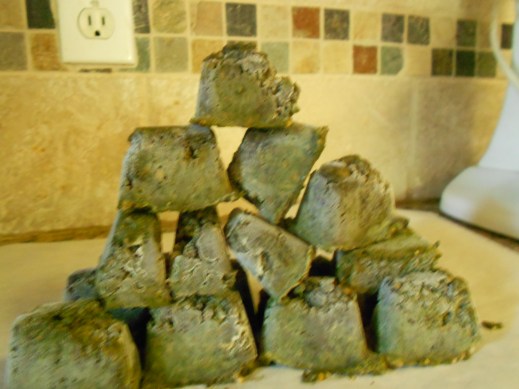
Then, pour the mixture into an ice-cube tray sprayed with cooking oil. (My children think this is very strange and have at times placed a pesto cube, in error, into their water. I don’t recommend this.)
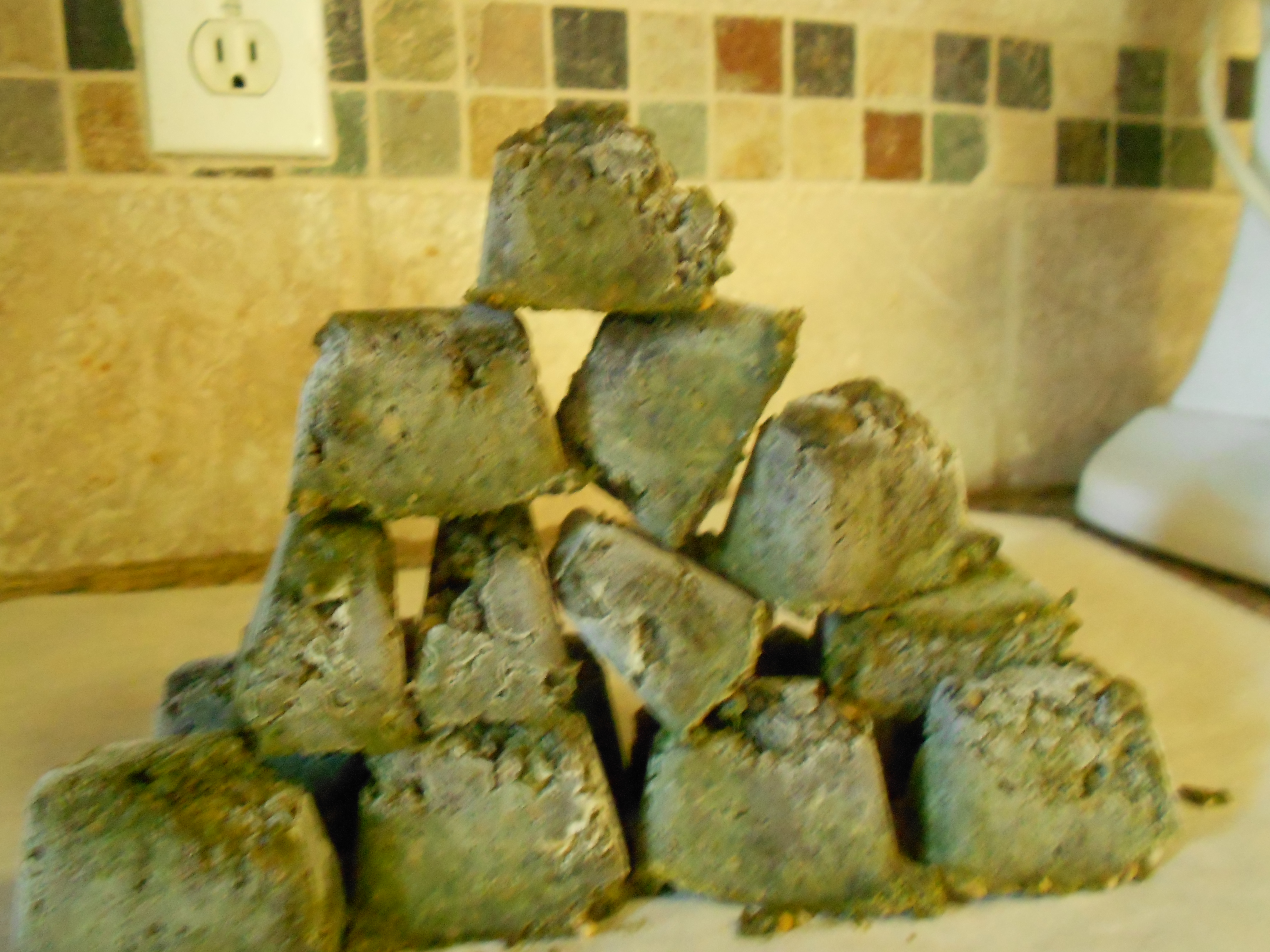
Pesto cubes can be used in sauces, soups, or as Pesto in the dead of winter.
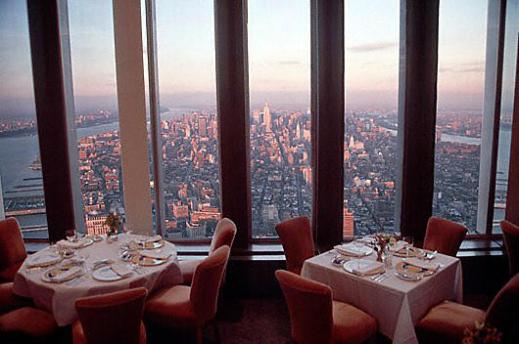
Dinner at Windows on the World, 1998
 When I was younger, I don’t remember feeling sad in August. As summer waned, I looked forward to September: crisp nights, new school supplies, and thick. back-to-school fashion magazines.
But for ten years now, as September approaches, I get this feeling of dread. I hate any date after August 15. I hate how the days get shorter and I hate the back to school commericals. It’s all leading to that one black day. Even the birthday of my youngest child on September 3, 2003 can’t erase it.
I guess that is just how it’s going to be from here on in: there will be the years before September 2001, and everything after. And a decade later, the emotions are no less raw.
I cannot imagine what thesee weeks leading up to September 11 must feel like if you’ve lost a loved one or friend on that day. Just knowing that day is coming without having directly lost someone is painful enough. But to all of us in the Metro Area who grew up watching them being built, and then, watched them tumble down, we truly did lose something profound that day.
This memory is one trivial, stupid sliver of before and after September 11, 2001. But I am sure it is just one of the millions of memories and associations that New Yorkers share about what role the physical presence World Trade Center had in their own memories.
This is not about what I remember from that day, but what I remember about what is no more.
In the spring of 1998, I was invited to dine at Windows on the World. It was not a romantic dinner like one portrayed in the movie Sleepless in Seattle. Windows on the World was the spot for the 1998 CIPRA public relations award dinner. The account team I worked on at my public relations firm had won the CIPRA Golden Anvil Award for our Deep Blue IBM campaign.
It was the glitziest night of my very brief career as a PR professional in Manhattan. Our boss hired a limousine to take us from our Park Avenue offices downtown to the World Trade Center. After the team piled in, we sipped champagne as the driver navigated down the FDR.
I remember taking the elevator up, up, up, and feeling that drop in my stomach the same way I did when I was a child and visited the Observatory Deck with my parents and grandparents.
I don’t quite remember what we ate. I do remember sitting next to my boss, the owner Technolgy Solutions Public Relations. A great, genuine guy who built his firm from the ground up in the high-tech boom of the 1990’s, I was humbled to sit next to him as he explained how he was avoiding eating the bread that night because he was on a new, low carb diet. I also remember how proud he was of us of us that night to be sitting on top of the world at this prestigious dinner in our industry, and how appreciative our clients were that night of the tireless work we did for IBM’s Deep Blue chess-playing supercomputer.
That was the last time I was ever at the World Trade Center. And when you were up there at sunset, you really were on the top of the world.
Do Jews hold a Grudge Against Germany?
edit: To add some more to this sentiment: My parents this summer visited Germany. My mom was hesitant to go but she went. They took a river cruise on the Rhine and had a wonderful time. And, everywhere they went, there was not a single place visited where their tour guide did NOT make a mention of the atrocities that happened to the Jews during the Holocaust. The tourguide was extremely compassionate as he discussed the plight of the German Jews with my parents. They would certainly recommend a trip to Germany now that they visited.
A few nights ago, I had the pleasure of participating in some intense Jewish study with some very intelligent women in my neighborood. The study session was held in preparation for a nine-day mourning period in Judaism that happens each summer culminating with the fast day of Tish B’Av, or the ninth of the Hebrew month of Av.
During this time, no meat is consumed. Religious women run lots of clothes through the wash before the nine days because no clothing can be laundered in this time period. Swimming is off limits as well.
Why?
This time marks some of the saddest occasions in Jewish history, most notable are the destruction of the two Holy Temples – first in 423 B.C.E. and then 70 C.E. – that once stood on the Temple Mount in Jerusalem. The destruction of the Temples also marked the Jewish Exile from Israel, which ended only with the establishment of the modern State of Israel in 1948.
So, why mourn something that happened millenia ago? The issue of how to make that feeling of mourning relevant today was the topic of our study session.
I started to write this post a day before our study, but what gave me the chills is how our moderator opened the talk with another time of destruction in recent Jewish history: the Holocaust. Even if you didn’t have a direct loss in your family, it was a loss for the Jewish family as a whole, a loss that is still viscerally ingrained in the Jewish psyche today. We should also strive as Jews to make the loss of the Temples just as palpable.
Getting back to the Holocaust:
A few things I deducted from my Hebrew school education about the Holocaust, as taught by our rabbi, son of Holocaust survivors:
- After the destruction of Jewish life and Jewish culture under the Third Reich, Jews should Never Forget. Therefore, Jews should never again set foot in Germany
- Because of Hitler’s infatuation with composer Richard Wagner, because Wagner’s music was the soundtrack of music played as Jews marched to their deaths in concentration camps, Jews shoud Never listen to or play compositions by Wagner.
- Jews don’t buy BMWs or Volkswagons
- Again, Jews don’t visit Germany
I held onto these notions a for a long time, including during the summer of 1989, when I spent a month in Israel volunteering on a kibbutz in Israel’s northern region. To my surprise, many of the other volunteers were not Jewish kids; most were European. To my further surprise, many of them were German.
I never knew any Germans before this encounter. As I got to know them, I found them to be gentle and kind. They also had a thirst for learning all they could about Jewish culture, Hebrew, Jewish holidays – anything Jewish they could get their hands on, they wanted to learn about.
I asked them – why?
Their explanation: Germans of their generation felt an enormous sense of guilt as to what happened in their country, and that guilt was unjustified. They wanted to learn about Judaism, because, at the time, there were very few Jews in Germany. Still, I expressed my reluctance to ever visit their country.
Instead of being angry with me, their reaction was one of sadness.
Over 20 years have passed and I still struggle with my feelings about contemporary Germany. But just in the last week, there was media coverage about Jews and Germany that is making me reconsider.
The other evening, I listened on NPR the unthinkable: that the Israeli symphony was in Germany playing Wagner compositions.
Former Soviet Jews and young Israelis are settling in Berlin. There, they enjoy a thriving cosmopolitan culture with nighclubs, art galleries and community centers – all with an Israeli twist.
Another one of my brilliant neighbors, Athene Goldstein, returned from a visit to Germany, where her son-in-law, a professor, was delivering a talk on Jewish history in Germany. There, she also visited a museum in Berlin dedicated to Jewish culture. From her working knowledge of German, she could tell that none of the museum’s visitors were Jewish, but again, just as I experienced on that kibbutz, there was that intense curioustiy of wanting to know about Judaism.
“The museum was filled with basic Jewish artifacts: Sabbath candles, Torah Scrolls, a menorah for Chanukkah,” said Athene. “It was Judaism 101. But that is where they are. Germans are very up front about what happened in their country under the Nazis. Now, they just want to know about who their country tried to completely destroy.”
Is the fact that the Jewish population is growing in Germany a sign that Jews are forgetting their past? Or is it perhaps, maybe the best way to deal with the memory of the six million lives lost is to replace what was lost by renewing life there once again?
Yes It’s Hot, even in Rochester
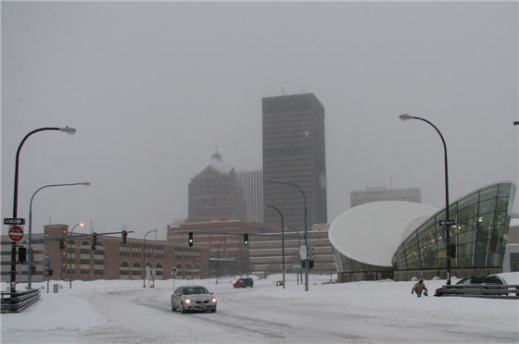
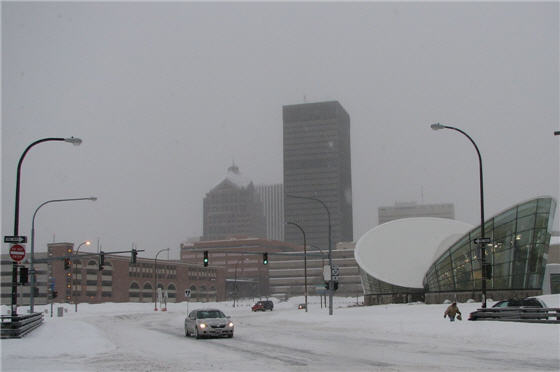
Think cool! Rochester skyline on a wintry day
A few months ago, were we ever really complaining about the snow and cold?
A few months from now, will we long to feel as hot as it will be today?
When I visit friends and family “downstate” New York, I get a lot of jabs about living in Rochester.
“So, it’s June… has the snow melted yet?”
“You know what the two seasons are in Rochester? Winter and July 14.”
“Do you get snowed in all the time and how do you go grocery shopping to get food in the snow?”
But guess what, folks? We really do get summer in Rochester, and it’s just as hot as anywhere else, especially this year.
Today, if temperatures reach 100 or above, as forecasters are predicting, it will be the hottest recorded day on this day in Rochester since ….. 1894
One of the many advantages of living in Rochester – less traffic, one of the nation’s most affordable housing prices, and great cultural resources – is our pleasant summer. Usually, after a brutally cold winter, our summers are pleasant and comfortable.
Since I moved to Rochester in 2000, we have had summers where the rain fell more than the sun shone. Some summers, the temperatures barely climbed out of the 70’s. Some summers, we feared we would never get a summer.
Right now, I am glad that I did not sign up for a spot in my community garden, as this has been the driest summers in some time. There, gardeners must haul water in cans to quench their crops. I’m content with my little garden that is watered with several yards of irrigation tubing.

Instead of hauling buckets in the heat like a peasant woman, all that is required is connecting a hose and turning a spigot.


So far, I’m getting plenty of tomatoes – though still green,

a few pumpkins

and some peppers.
Most summers, I complain about the limited hours of sun my garden receives. This year, it is getting just the right amount of heat to grow and the limited sun is preventing it from completely shriveling up and dying.
The only thing, or person, I’m worried about shriveling up or wilting in the heat is my son, who is on his first overnight at day camp. I slathered him up with sunscreen, slapped on his white, sun reflecting hat, packed his frozen metal water bottle, and will hope for the best.
“Mom, is this the hottest summer of my life?” The seven-year-old inquired at the breakfast table.
“Yes” I said, popping his Eggo waffles in the toaster.
“Will summers get hotter than this even?”
For that, I don’t have an answer.
So, besides sweltering day campers, what will most Rochesterians do? They will survive just as they do in the winter:
They’ll duck inside a mall, movie theatre, or museum, if not a chilly office
At camps, they will stay inside and play board games, do lots of arts & crafts. And only brave the heat for a dip in the pool.
But in Rochester, we’ll take the heat. After all, the burn of summer’s swelter is better any day than the bite of winter’s wind chills.
As for me, I finished writing and filing my two newspaper articles for the week. I’ll catch up on some summer reading and spend time with my oldest son, already packed up for summer camp. Then, I’ll settle down for a long summer’s nap.
Wear Your Bicycle Helmet, Damn It!

Yesterday, both my sons were glum and grumpy. They were missing their big sister who had just left for sleep-a-way camp for the entire summer. My youngest simply missed her because she was his big sister. My oldest, he was just mad because HE wasn’t going to camp the whole summer.
So, to cheer them up, I cleared my day for an activity that would set us soaring and put us all in a good mood. We embarked on an extra long bicycle ride. On their bikes, they had to get along as brothers. They could not cut each other off because they would crash. The older one had to stay with the younger one and remind him about traffic rules like staying to the right of traffic, look out for parked cars, and stopping at stop signs.
Finally, after winding our way through side streets we had discovered in a previous bicycle ride. we made it to Brighton’s Buckland Park. Finally, I could let my guard down, if just a little, and feel free to let them ride in safety the park’s dirt bike trails that took us through tall bulrushes filled with red-winged blackbirds and over wooden bridges. On the paths, I didn’t have to think about a car coming up from behind them or, well YELL at them to get off their bikes and walk them across the busy intersections.
The other night, as I was drifting to sleep, came on the Late News that a 15-year-old boy had been killed while riding his bicycle. He was not wearing his helmet.The next day, my husband came home from work and let me know that the boy was the son of a man who worked at his office. When you live in a small town, the local news is very local.
Today, I also read about a woman in her 50’s who had just died from injuries she sustained while bicycling. She also was not wearing her bicycle helmet.
But, back to our joyful bicycle ride……
On our way home, I saw a kid of about 13 on his bicycle. We both came to a stop at a 4-way Stop intersection. He said “Hi” and I said “Hi” back.
Yeah, he had left the house with his bike helmet. But somewhere away from his mother’s eye – he took it off and strapped it not to his head but the handlebars of his bike.
Little did he know there are a lot of other mothers out there.
“Put on your helmet.” I said. No pussy-footing around this time, no saying “I’m sorry for being pushy” or “I hope you don’t mind saying..”
I just said it:
“Put on your hemet. A kid your age was just killed this week on his bicycle and HE was not wearing a helmet.”
Maybe another kid would have snickered and flipped me off. But all this kid said was:
“Okay.”
And the helmet went right back on his head.
IF YOU SEE SOMEONE, PARTICULARLY A KID THIS SUMMER WITHOUT A HELMET, BUTT IN AND TELL THEM TO PUT ONE ON!
The Last Seconds of the Second Grade

 Council Rock Primary School in Brighton is shaped like a hug. It has one main hallway flanked on each side by two other hallways that stretch out like two arms. These arms hold about 800 happy kids from Kindergarten through second grade. These arms are adorned with the colors and words that these children write, draw and sculpt. You’ve never seen happier hallways.
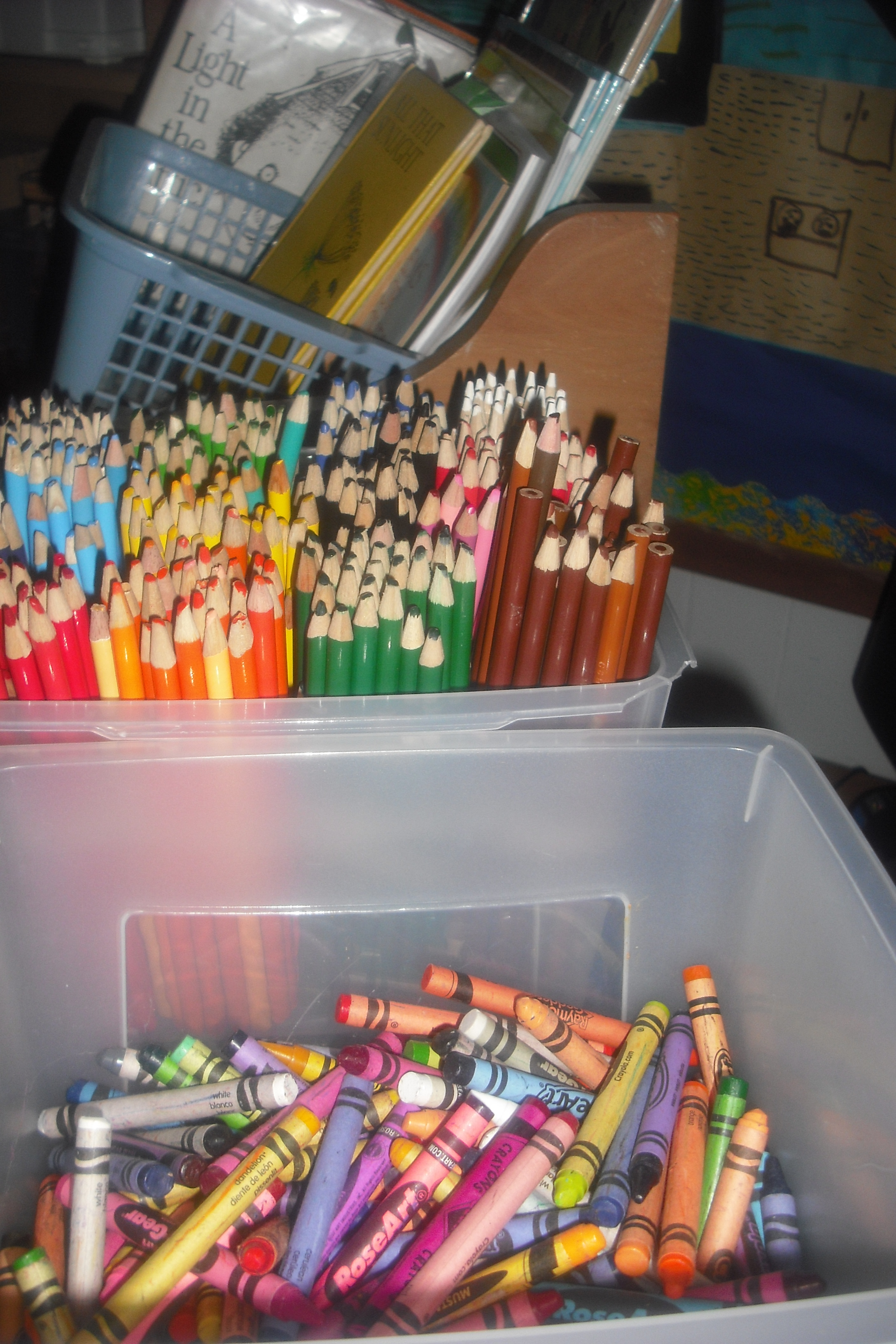
This school has hugged my kids – and well, me – for eight years. Now it’s over. Cradling a folder full of Crayola art and essays about butterflies and tadpoles, I walked out of this little school for the last time today.
My youngest, the second grade graduate, was born on the first day of school in 2003. My husband left the hospital for home a few hours after he was born, showered, and then woke up our two big kids for the school bus.
The first time Toby went Council Rock Primary School, he was under 20 days old. We carried him in the infant car seat for my daughter’s first grade curriculum night. As the school year progressed, Toby visited the school with me about twice a week while big brother got occupational and physical therapy. Sometimes he would be in his car seat, other times I would hold him in the rocking chairs that are in the lobby. The school aides would ask me how old my baby was and I would proudly proclaim, “He is as old as the school year!”
And in a flash, he is nearly eight years old. He will still kiss me and let me hug him in front of his friends, but not really. My baby is growing up.
How dare he!
He already has the wisdom to know that time flies when you are having fun. He already senses how fast a school year can go.
Tomorrow, I’ll go through all the worksheets about math. I’ll look over how many ways my youngest got to 100 and the worksheets on how to write his ABCS. Then these will go in the recycling bin.
But what I’ll treasure most is his journal on his day-to-day life. His poetry on what it would be like to be an inanimate object such as a tape dispenser. And his self-portrait. And if I only look at them on rainy days when I am looking to clean out my closets, to make room for the stuff from school years to come, it will be just enough.
Third grade, (and, for my daughter, High School) here we come!
The Hunt for my next Human – Interest Story, that is….
 This summer and hopefully for many months to follow, my editors have given me a new challenge – find interesting people to profile in the ROC East Towns of Pittsford, Victor, and Webster. Find people with a unique way of making a living or those who possess a hobby, craft, talent, or story in their past that sets them apart. And make the idea photogenic, and coordinate your source’s schedule with a staff photographer; because photographers have to make a living too.
Come on people, I know you’re out there.
How do I know this? Because within one walking block of my house, I have found interesting people that would make incredible subjects for profile stories. Artists. Gardeners. Mysterious Xylophone players. People who used to live in Nepal. But I only know these facts about my fabulous neighbors is because they are my neighbors.
And if all these people inhabit just one small block of Rochester’s eastern towns, then just imagine who else could be out there – other fabulous people with hobbies, businesses, causes, or talents that really make them stand out.
So, if you know of any such people and they are your Pittsford, Victor or Webster neighbors, won’t you please ask them if they might like to be possibly featured in the Our Towns section of the Democrat & Chronicle? If they are a budding entrepreneur, artist, musician, this could only be a win-win situation.
If not, I just might show up in a suburban development near you, walking the sidewalkless streets wearing a placard that says “Got Story?”
Down and Dirty, Laissez faire Gardening
There are many magazine articles and blog posts that feature sumptuous photo spreads of gardens in full bloomed glory. Beds of perfect tulips. Rodent and insect-free vegetable gardens bursting with a unbitten, sun-ripened bounty.
This blog post will not be one of those. This is for the rest of us.
Any chance of me having one of those gardens, where the sun actually ripens tomatoes on the vine before the first frost, is gone. I missed out. For whatever reason – maybe it was procrastination, or maybe for lack of believing that winter would ever end this year – I missed the March 1 deadline in signing up for a plot in the Brighton Community Garden. Yes, I believe that day in March, we were under a blizzard warning.
Gardening up North can be frustrating. The season is very short. Veteran Rochester gardeners warn the uninitiated not to plant anything in the ground before Memorial Day weekend. I received gasps of horror when I informed some that I had planted my tomatoes two weeks ago. But they had become so leggy and pale looking under my basement grow lights, I really had no choice.
And my flowers? I’m trying not to have a meltdown after the bunnies in my garden CHOMPED off the heads the poppies that I have waited all winter to bloom. At least those red bugs have not attacked my Asiatic lilies. At least not yet.
That perfect garden is just not going to happen. So, this year I am just going to relax and keep it in perspective. I think about the ravaged midwest and how lucky we are in boring, tornado-free upstate New York. I think of the farmers who rely on the land and ideal weather conditions to make their living.
It has been one soggy spring, one of the rainiest in record in Western New York. In fact, in April, Western New York received 5.81 inches. So far, in May: 3.32 inches. Upstate farmers are weeks behind in planting their peas and corn. And the farmers at my East Hill CSA have already warned us that this year’s crops are getting a late start because of the soggy conditions.
This year, I am leaving my garden primarily up to nature, because I think She is the best gardener after all. I will embrace my failures.
The Zinnias that I started from seed in the winter are quite puny and can really use some sun and heat:

This Burpee "raspberry lemonade" zinnia did not make much progress under grow lights. Zinnias need heat to thrive
And tomatoes? These are the ones I planted from seed back in February, they also need some sun and need to dry out:

This tomato plant has a long way to go before it fills its cage
But some plants do well in cold wet weather. Here is a picture of the arugula I started from seed way back in the winter:

Arugula Grows well in cold weather - and the rabbits hate it.
But nature is the best gardener. I call these volunteers. This year, if it is not a weed, I’m letting it grow. And who cares if they are not in perfectly straight lines. If it is a seedling left over from last year, I’m letting it be and will let it grow:
Like Dill

Dill always comes back from the seeds of last year's plant: no need to replant.
That will go very nice with the cucumbers that will grow on this vine, also a pop-up volunteer:

Cucumber vine - or maybe it's a pumpkin vine/
And as for perennial flowers. If you see one of these growing in your garden, jump for joy. It is not a weed, but the start of a beautiful lupine:

Lupine Seedling
Leave it alone, just where it is, and it may grow up to look just like its mom:

Community through a Cookbook: my Speech Before Hadassah
The other night, I was the featured speaker at the Installation Dinner of the Rochester, NY chapter of Hadassah. For those of you who wanted to know what I spoke about, here it is, all 20 spoken minutes of it, though changed slightly as I had some visual cues for some of the jokes. And some of the jokes, well, it’s a Hadassah thing, so you may not understand. Also, if you are not up on the Jewish faith, there is a LOT of jargon that you may not get, so if you want to skip this post, I will understand. But it was an honor to speak and a great evening I’ll remember for a long time.
Hadassah is an organization known throughout the world for promoting Zionism and Israel, supporting advances in medicine, and advocating Jewish education. Any art lover the world over surely knows about the Marc Chagall stained glass windows that grace the chapel in Jerusalem’s Hadassah Hospital.
But, when I think of the Rochester chapter of Hadassah, the Rochester Hadassah Cookbook immediately comes to mind.
I have to tell you, I got this cookbook by way of Berkeley California. I had just become engaged to my husband, Craig. He was in graduate school. I was – uummmmm, hanging out and enjoying the California scene!
We got the Rochester Hadassah cookbook as an engagement present by way of a grad school friend of Craig’s named Mike. Mike was born and raised in Rochester. Mike came back to California after a trip back East and presented us with this book as an engagement gift from his mother.
And I said “Oh, Rochester. That’s somewhere upstate, like near Poughkeepsie!”
At that point in my life, I had no connection to Rochester outside of this cookbook. Rochester was the furthest thing from my mind. We were living in California but that was temporary for us East Coasters. Craig would finish his PhD, and then we were moving back to New York City, center of the universe!
and that
was that.
We did move back to New York City. Well, New Jersey actually. Craig found a job in the suburbs and I also found one – in Manhattan. Complete with a three-hour round trip commute on New Jersey Transit!
I landed this great job at a growing high-tech public relations firm. It was a time when they couldn’t find people fast enough to perform quality account work for the burgeoning, brand-new high-tech industry. Ah, I miss the 90’s!
My boss was a stunning, statuesque blonde woman of 35. She had the corner office of our Park Avenue suite. To the north, her view faced uptown to Grand Central Station. To the West, she overlooked Park Avenue. She loved living the life of a single Manhattanite PR executive. However, she would tell us many times that her parents in Florida wished she would marry and give them grandchildren already. When she visited them, she instructed us to call her often on her cell phone, so her parents would see how important she was back at the office.
Sitting in my cube as a lowly – NO rising – account executive, I would imagine what it would be like to live that kind of life. Most of my co-workers were in their 20’s and single. Half their salary went to paying rent.
The other half – alcohol.
At 28, I was already the old married lady of the office, and Craig and I were starting our family.
After a few years and two kids later, we moved up to Rochester for Craig’s employment. It was then I learned that Rochester is waaaay further upstate than Poughkeepsie.
My company back in New York City still wanted me. They even offered to set up a virtual home office. But, reality set in. I was staring down at our first long Rochester winter with a one year-old and a three year-old as my only companions. I didn’t know a soul in town. Virtual office or not, I realized that building my social network here for my family would be more important than racking up more media hits for IBM. So, I politely said thanks but no thanks, and became a stay-at-home full time mom.
Stay-at-home moms rarely stay at home, as you know. Those first few years here, I spent most of my time at Wegmans, the Strong Museum of Play, and the JCC. When you’re the new mommy in town, people are very interested in getting to know you. I realized that the Jewish moms I was meeting were fulfilling the mitzvah to welcome new Jews into the community. We were invited as a family for Shabbat dinners on Friday nights and, during the week, playdates for the kids and I. I’ve heard that this courtship is called “mommy dating.”
More than a few times, I would eat something prepared by a prospective mommy friend and say,
“WOW, this is great, where did you get this recipe?”
And one woman after the next would reply, “I made it from the Rochester Hadassah cook book!”
And I would reply, “OHHHH, I have that cookbook, I’ve had it for YEARS! I think I’ll start using it now.”
The JCC opened up to me a network of great women who believed in giving their kids a Jewish education in early childhood. I’m now over the rainbow from my own kids’ preschool years and teach preschool myself. I am in forever debt to people like Tzippy Kleinberg, Andrea Paprocki and Emily Fishman at the JCC and later, Randi Fox Tabb at Keshet preschool for planting the very first seeds of Jewish knowledge for my kids. Now that I’m a preschool teacher, I see the appreciation parents show when their little ones come home singing “Shabbat Shalom – Hey” or say a bracha every time they put a cookie in their little mouths.
Becoming a new parent can be the road back to Jewish observances. In fact, a 2002 study by the Jewish Early Childhood Education Partnership described Jewish preschools as the Gateways to Jewish Life. The time to get young families rooted back into Jewish community life is when their children are between the ages of birth and three years of age.
I remember when my son Nathan was in his first year of preschool at the JCC. I had an “aha” moment – a moment you knew that the Jewish foundations you lay for your child are really sinking in – in all places but at Michael’s.
Nathan was just 2 ½. I picked him up at the J and we went schmoozing at Michael’s. From his seat in the shopping cart, he spied one of these big fake terra cotta gardening urns.
“Mommy” he said, in an angelic voice that only two and one half year olds have “They have a really big – Kiddush cup!”
By the way, Nathan is now well into his Torah studies as he becomes a Bar Mitzvah this November.
In addition to giving my children a Jewish education in their earliest years, being a stay-at-home mom afforded me the time to continue my own learning. When living in New Jersey, I admired women who could get up and read Torah on Saturday mornings or who were involved with other aspects of Jewish communal life. But my three- hour round trip commute into the city left time for little else during the week.
Why did I decide to learn to read Torah later in life? I have to confess, it’s the rush. I have to get my adrenaline rush somewhere. For one thing, I hate roller coasters. The only time I rode one was on a dare from Craig on the boardwalk in Santa Cruz, California. Craig jokingly said he would not marry me unless I rode the famed Big Dipper, a classic, rickety wooden roller coaster. As expected, I hated every second of that 60-second ride. But I guess it was a religious experience because I kept praying aloud to God to please get me off!
So, if I want to get my heart pumping, I sign up for a Torah reading.
I encourage more Jewish women to also get on this thrill ride. And don’t think, “I can’t do it because I didn’t grow up reading Torah,” because neither did I!
Growing up within my very Conservative synagogue in Staten Island, New York, boys preparing for their Bar Mitzvah were required to attend services on Saturday morning. Girls were required to go on Friday night. Girls would chant their Haftarah on Friday night and boys would be called to the Torah on Saturday morning. It was never questioned or debated if girls should have a larger role. That’s how it was.
We were taught that after our B’nei Mitzvot, boys were still required to go to shul but girls didn’t have to. Our rabbis, all Orthodox, said that girls were more spiritual by nature, thus relieving them of the obligation to attend services. They said if men were not required to go to shul, they would never go.
It’s true. Spirituality did come naturally to me. Each Friday night, I followed along with all of the melodies of Kabalat Shabbat. I never thought about the fact that after my Bat Mitzvah, I would not be asked to join a minyan if they needed a tenth, because I was not a man. I would not be asked to read from the Torah or participate in services. It made me feel as though I didn’t count, and on a certain level, as a Jewish woman, I didn’t.
That summer, my parents took our family to Israel, where I was to have a Bat Mitzvah ceremony at the Kotel! Imagine that! In my 13-year-old mind, I envisioned me chanting my Haftarah, the Kotel behind me, and all of Jerusalem listening!
Well, my actual “Bat Mitzvah” ceremony went something like this: I stood in a white blouse and a flowery skirt outside of the Kotel Plaza. I really did have a copy of my haftarah to chant. But a rabbi in a black hat from some agency handed me a siddur, and asked me to read the Shma in English.
“But, I have my Haftarah! And I can chant the Sh’ma in Hebrew,”
“That’s not necessary. You are a girl. Just read it in English.”
Tova Hartman, a lecturer in the department of gender studies and education in Bar Ilan University wrote in her book, Feminism Encounters Traditional Judaism, that living in Israel, she “knew there is no recipe or a structure on how to join Orthodoxy with feminism. In her own life, in order to give her daughters a model of religion she could live with, she had to form her own shul with a group of like-minded people, even if that meant she had to leave certain loyalties behind.”
Please don’t misunderstand me. I do have great respect for Orthodox Judaism. I admire their commitment to observing Shabbat, the hospitality they extend to guests on Saturday afternoons for lunch, and their dedication to a Jewish day school education.
I can also understand the values that Orthodoxy places on mothers as the first Jewish educators in a child’s life by being charged with creating a Jewish home. But even Blu Greenberg, author of How to Run a Traditional Jewish Household, commented in her book On Women and Judaism that “leaders of Orthodox halacha (law) must recognize that the general effect of exempting women from prayer conditions them to a negative or indifferent attitude toward prayer altogether.”
My feminist notions aside, when I became a mother, I appreciated why it is that women are not obligated to participate in time-bound mitzvot which could interfere with their tasks of mothering. But what I cannot accept is where “not obligated” evolved into “not allowed.”
My horizons on the role of women in synagogue life expanded when I moved out to California. Aside from daring me to ride roller coasters, Craig encouraged and taught me how to lead kabbalat shabbat at the Hillel at Cal Berkeley. There, the rabbi was a woman. For the first time, I heard the matriarchs mentioned next to the patriarchs in the chanting of the Amidah. Women lead services, had aliyot, and read from the Torah. This was so common, in fact, that once, a non-Jew came to our services and quietly asked, “Are men allowed to read from the Torah?”
I learned how to read Torah at age 37 thanks to a six-week adult education class led by Chazzan Martin Leubitz at Temple Beth El. On the first day of class, Chazan Leubitz informed us all that he had signed us up to read Torah in six week. That would be our final exam.
For me, I have come to realize that learning Torah is not an exercise in perfection, rather an act of participation and performing the mitzvah of studying Torah as a full-fledged member of the Jewish community.
Connections in the Jewish community, actually, would you believe a conversation in the women’s locker room at the JCC – led me to landing my column at the Rochester Democrat & Chronicle. Writing this column has been a return to my first love of newspaper writing. It has also given me a reason to set up a home office, with a corner office in my kitchen. To the south of my lavish two square-foot corner office – I have an excellent view of the piles of laundry that pile up in my family room. To the East, there are dishes in the sink and groceries to put away. Directly before me is my blank computer screen, which I must fill with 600 well written words every week.
Writing my column is like riding a bicycle up and down a series of hills. All year long. On deadline day, I pedal the hardest. I do a lot of the writing – as I did this speech, in my head, long before I sit down to my computer. I think about it at red lights, on walks, on line at Wegman’s. Writing takes a lot of rewriting, moving paragraphs around, weaving and reweaving them until every word fits into place.
It’s like that feeling you get when you untangle a necklace.
Then, I hit send. And I can finally coast downhill, for about a day. I finally pick myself up from my cushy corner office to the mundane never-ending tasks of laundry and dishes. I also take some time to get in a workout. A shabasana, the restive pose at the end of my Wednesday night yoga classes, are divine and well deserved after hitting send on my column.
Then, the search continues again. Because most of my connections are in the Jewish community, lots of people pitch me with Jewish story ideas. But, I’ve had to gently turn a lot of them away. When it comes to my personal identity, I am a Jewish American. But for the sake of the wider audience of the Democrat & Chronicle.
I’m not a Jewish reporter, I’m a reporter who is Jewish.
Between the lines of my column, however, Jewish themes can still be found. A day devoted to cleaning up our parks or collecting unwanted pharmaceuticals – those are the values of Tikkun Olam, or repairing the world. Events that speak on helping care for our seniors or events at a senior center? That is Gimilut Hasadim – acts of kindness.
So I try not to comment or cover too many events or issues that impact the Jewish community.
Except for the recent incident where some teens were caught and charged with the hate crime of burning a swastika in Brighton. On the night before Yom Hashoah, Holocaust Rememberence Day. I had to speak out on that.
After a lot of back and forth with my editors, who questioned if such a heavy topic was the right fit for the Our Towns section, they agreed to keep my words. I thank them immensely for hearing me through on this. As I stated in last week’s column, I love covering the good in our communities. There is so much bad news in our world and I’m honored to be able to bring to readers news on events where they can participate and help out their community. But suddenly, this columnist who is Jewish became a Jewish columnist and I had to speak out. Because, what do we mean, when we are saying “Never Again?”
You have to remember that when the news broke, our community was immersed in daylong Yom Hashoah observances. Included in this was a community wide program for teens: a staging of the play “What Will You Tell Your Children” written by Rochester native Jessie Atkin upon her return from a Journey for Jewish identity trip in 2005, where Jewish teens from the United States and Israel spend time together here, visiting concentration camps in Poland, and finally in Israel. I’d like to thank Jodi Beckwith for directing the play and to our Jewish education leaders for bringing the event to our children.
And how was this play received by our teens, many who never experienced anti-Semitism first hand? To give you an idea – there were about 250 kids in the room to watch the 90 minute performance. Suzie Lyons, the director of Education at Temple Brith Kodesh, noted that only 11 kids got up the whole time to use the bathroom
Have you ever been on the receiving end of hearing a racial or religious joke? Usually, the joker defends his joke by saying – it’s okay, some of my best friends are: Black or Jewish, Chinese, you fill in the ethnic group.
On a positive note, I want to bring to your attention the overwhelming response of coming together in the Jewish and wider community. The morning after the swastika was burned, the Home Acres neighborhood had a vigil attended by Brighton Town Supervisor Sandra Frankel who called it a despicable act. In last week’s editorial page, the hate crime received a “thumbs down” by the D&C. There were several letters to the editor – one jointly written by leaders in the Christian and Muslim communities – condemning the act.
.
Our Jewish youth, many who know this boy, a student at Brighton High School, are struggling. They are searching for a rationalization why he may have done this, they think – there must be a reason, There’s got to be a reasonable answer.
Seventeen is an extremely vulnerable age where friendships run thick and rule supreme. And the apparent betrayal of a friend at age 17 is painful to accept. I’m sorry, but I don’t think that this young man was considering the feelings the Jewish kids he knew when he allegedly planned to burn a swastika. Or maybe he just thought it would be okay to do this as a joke, because after all, some of his best friends were Jewish!
Both boys have pled not guilty which means that they will have another hearing in town court on May 25. This leaves us with many questions. Was this an isolated event or should we fear a wave of similar copy cat crimes? Did these boys really understand the gravity of the timing of their act or do they truly comprehend what horrors were committed under the symbol of the swastika? And if they didn’t, where are we going wrong, in our school system, in our discussions at home, that we are not telling our youth enough about that very dark chapter in human history.
To leave you on a positive note about this, I want to tell you about the group of seventh graders I had the pleasure of teaching this year at Temple Brith Kodesh. They were absolutely dreamy, I mean it! While they are not exactly enthralled about learning about the minutia of the Hebrew language, the topic of carrying on Jewish identity, especially as they face post Bne’ Mitzvah life, keeps them engaged. On the Macro level, they have a very strong sense of who they are as Jews. After the swastika incident, the debate arose in my class whether middle school trips to Washington D.C. should include a mandatory visit to the US Holocaust memorial. Some students, in light of what just happened, thought it should be a priority to visit the museum for all students – Jewish and non-Jewish. Others thought that the serious theme of this museum would overshadow what may be the first time a young student visits our nation’s capital. But it was good to see my seventh graders debating and discussing, trying to work it out. And again, not one of my students asked to leave the class to go to the bathroom, can you imagine?
So, my advice to you tonight? I guess it is to maintain a focus in your life on Jewish education, from the earliest years of our children and well into our own adulthood. While raising a family, keep a hand in your own profession, however small, and as much as your family and your own sanity can handle. Mothering is the best job of all. But don’t disappear, don’t let your own individuality get folded and lost into the lives of your husband and children, just as egg whites get folded into the batter of a Passover Sponge Cake, which a recipe can be found within the pages of the Rochester Hadassah Cookbook. Thank you for listening.
Like a Walk in Highland Park


every year, the entrance bed of the park is filled with pansies
It’s been a cold dark week. The news nationally, while triumphant, stirred up a lot of questions and decade-old images. What is closure anyway?
Locally, a hate crime has been committed in our town. Our high schoolers are wrestling with the news that this action was allegedly committed by someone they consider a close friend.
But, yesterday the sun finally came out. May is nature’s reward to Rochesterians for sticking it out through the long winter.
So, to forget it all, I took a walk in Rochester’s Highland Park. This park is known for its vast lilac collection – one of the nation’s largest. And with it, Rochester hosts one of its most popular festivals.
So, before the crowds, and the vendors selling fry bread and fried artichokes and – fried everything arrive. I took a walk in Highland Park and snapped the following photographs:

the earliest lilacs are just starting to bloombut the trees along the path were burstinga field of daffodilsI walked past a grove of magnoliasuntil I reached the reservoir and enjoyed this view
About Me
Kreativ Blogger

Versatile Blogger Award


 Stacy Gittleman