
Still Cold, Still Snowy in Detroit
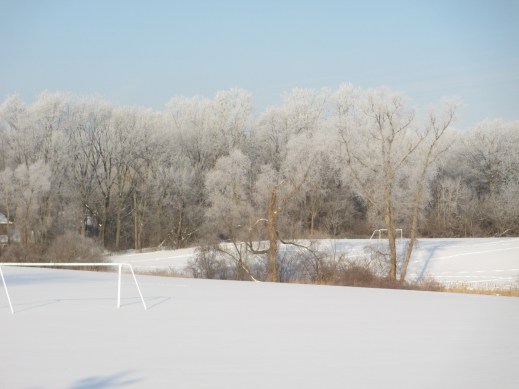
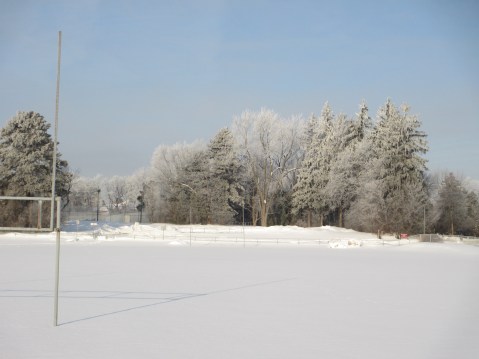 About a week ago, a friend back in Rochester asked how the weather has been in Michigan. It’s really not that much different than the winters spent in Rochester. Except this winter, there really has not been much of a break from the frigid cold. In Rochester, I remember weeks of cold, but broken up with weeks (or at least a few days) in the upper 30’s and 40’s.
This winter, we long for a day just in the 20’s.
But extreme cold does have beauty.
Last week I got a call from my son at school. He said his eye was “goopy.” Now, his eyes weren’t nearly as bad as fellow conjunctivitis sufferer Bob Costas,
 Bob Costas Benched Due to Pink Eye
but it was enough to spring him out of school for a day.
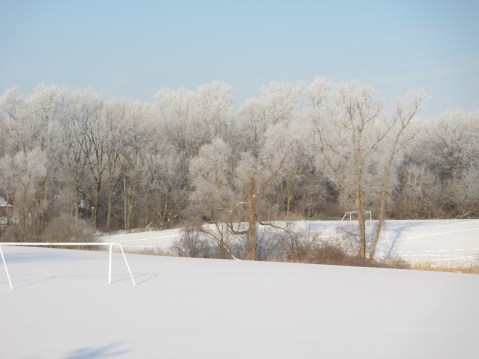
The night before, temperatures plummeted again below zero and created this phenomenon known as freezing fog. The result was a frosty ice-coated world, if only for a few hours:


France Can Take A Lesson in Religious Tolerance from Detroit’s Interfaith Council

On these snowy days I admit I have done way too much trolling on my Facebook news feed. One alarming video clip that came across my newsfeed was a very disturbing video of Fascists in France waving a red swastika flag, shouting Jews Out! Jews Out!
Do they have the right to march peacefully and express their views in a democratic society? Maybe. Have these French citizens forgotten the history of WWII when the Nazis themselves goose-stepped through the streets of Paris shouting the same hatred? Absolutely.
Today’s Germany would not stand for such hate marches, free speech or not. In fact, it is illegal to fly the Nazi Flag anywhere in Germany or have a Nazi rally.
I wonder, in this country which proposes to ban the wearing of any religious symbol or clothing, what they teach their children about religious tolerance.
A few weeks back, I had the honor of attending and covering a “Face to Faith” Journey to Judaism sponsored by the Interfaith Council of Greater Detroit. Sitting in the massive sanctuary of Temple Israel of West Bloomfield with 150 seventh graders, I felt right at home. And you know something, so did the kids. Even if they never set foot in a Jewish house of worship. Even if they never had a Jewish friend.
Cynics might wonder if such interfaith explorations organized by Detroit’s Interfaith Council really teach tolerance. But, after you watch the disturbing and disgusting video of Fascists marching down a street of what is supposed to be the world’s most civilized city shouting “Jews Out!” consider the alternatives.
Here is the article which ran in the Detroit Jewish News
What does a rabbi look like? To the uninitiated, a rabbi wears a long black coat, grows a long beard, and therefore must always be a man.
Temple Israel rabbis, teachers, and other volunteers at Temple Israel in West Bloomfield helped to dispel this and many other misconceptions about Judaism as they guided a diverse group of 150 seventh graders from six school districts through a “Jewish Religious Diversity Journey.” The trip was part of a series of explorations into different religions created by the Interfaith Leadership Council of Metropolitan Detroit.
According to the council’s administrator Meredith Skowronski, Religious Diversity Journeys for the past 11 years has taken young leaders – 25 handpicked students from each school district – on six trips to a different house of worship to foster understanding and a celebration of cultural differences. Participating school districts include Berkeley, Birmingham, Bloomfield Hills, Clarkston, West Bloomfield, and Walled Lake.
Gail Katz, a retired Berkeley teacher and the director of Religious Diversity Journeys, explained that the program fits in perfectly with the World Religions unit of the seventh Grade curriculum.
“The Journey only extends what they are learning beyond the textbook and the classroom,” said Katz as she mingled with the students during a morning icebreaker. “We strive to increase respect and understanding among all students.”
Rabbi Josh Bennett – who is clean-shaven and does not wear a long black coat – kicked off the formal component of the day of learning in the temple’s large sanctuary. Students, impressed by the large golden ark on the bimah, learned about the three different branches of Judaism and the belief in one God, learning Torah and the connection to Israel, which unites Jews across every level of observance
Later in the morning, groups of students took turns touring the building and listening to Rabbi Ariana Gordon explain the cycle of Jewish holidays, the complexity of having a Hebrew calendar that is both lunar and solar, and the odd phenomena this year that was “Thanksgivingkah.”
The students also visited the building’s mikvah and viewed an open Torah Scroll with Rabbi Jennifer Kaluzny.
“These trips are an invaluable lesson where kids get a hands-on learning experience and are made to feel welcome in different houses of worship,” said Kaluzny after teaching a group about how a Torah scroll is made and written.
Over a Mediterranean vegetarian lunch prepared by Mezza of West Bloomfield and sponsored by Temple Israel, students expressed their appreciation for the program, which allows them to explore other traditions and pose questions that would seem inappropriate or uncomfortable in a classroom setting.
Ben Johnston of West Hills Middle School came away from the program with a better understanding of the different branches of Judaism and the customs and holidays his Jewish friends celebrate.
“This program is important to me because we have a diverse society,” Johnston said. “We go to school with different kinds of kids, and as we get older, these are the people we’ll go to college and work with. We must have the knowledge of their backgrounds so we can be more tolerant and understanding.”

Ben Johnston, a student at West Hills Middle school, learns about the role of a mikvah in Jewish life during a Religious Diversity Journey.
Ashley Liles and Maddy Merritt, both of Sashabaw Middle School in Clarkston, do not go to school with many Jewish kids. The program allowed them to peer into a Siddur and not feel embarrassed to ask why it opens up backwards or why the letters look different than English.
 Maddy Merritt left, and Ashley Liles, right, seventh graders from Clarkston’s Sashabaw Middle school, examine Hebrew letters in the sanctuary at Temple Israel at during a Religious Diversity Journey.
The “journey” gave them a better perspective of the history and origins of the Jewish people. Not only did it widen their understanding of Jewish holidays beyond Chanukkah, but the lesson with Rabbi Gordon also gave them a broader understanding of a holiday they would otherwise only know as a “Jewish Christmas.”

Rabbi Jennifer Kaluzny of Temple Israel, West Bloomfield, displays a Torah scroll to seventh graders on a Religious Diversity Journey with the help of parent volunteer Janet Cummins of Birmingham.
Two Karmic Tales from the Polar Vortex

 Two true tales from the coldest winters we’ve seen in decades. One an example of how to treat others. The other, an example of how not to treat others. I hope that someday, both givers of kindness and meanness will receive their Karmic justice in this life or the ones to come.
First tale, as retold by my mother-in-law on an incident that happened to the grown children and grandchildren of their longtime friends:
In December, two families from suburban Long Island, each with two or three children with the oldest of age 12, followed each other caravan-style north to a ski vacation rental in Vermont. There was a winter storm warning and, thinking they could push through, the families drove into the night. Main highways became impassible so the families decided to take alternative routes on local roads.
As the roads began to ice over, one family’s car swerved to avoid another car, slid and became stuck in an embankment.
Witnessing what happened to the first car, the second car in the traveling party pulled over to see if they could be of assistance. In trying to help, the second car also then became dangerously stuck in a snow embankment. On a strange rural street. In the dark. In the cold. In the storm.
All the while, the two stranded families were unaware that a family living on the property was watching them. They approached the families who were stranded on their property – a group of about 12 complete strangers – four adults and their children – invited them in for the night, and gave them dinner and a place to sleep, and shelter until their vehicles could be dug out the next day.
To that angelic New England family who opened their doors to strangers on a stormy winter night, they will most certainly receive good Karma in this life or the next.
Next story. My story.
Funny how appearances change of buildings and streets in the snow. Especially in suburban Detroit neighborhoods you think you’ve gotten to know pretty well in the six months I’ve lived here.
I was on my way over to a good friend’s house to pick up my son from an extended play date. I was not sure of the exact address, and I didn’t feel like punching it into my GPS system. After all, I had been there several times in the summer and fall, to press cider and just enjoy the company of our new friends. I thought I knew my way and knew the house.
But like I said, something very disorienting happens in the low light and snowy landscape of winter. So disorienting that I pulled up the curvy, snow-covered driveway of the wrong house. Just one identical looking wrong house away were my friends, their daughter and son, and my son, happily playing.
Just one house away, I was catching some bad Karma.
I realized my mistake, and started to attempt to back down the driveway. Only, because of the curve and the snow, I missed it, and backed up into a soft, snowy part of the front lawn.
Funny how one can still use the word “lawn” in a polar vortex winter. Because no one has seen their lawn here since November.
So, there I was, on a lawn. If I just eased the car back and forth – Reverse, Drive, Reverse, Drive – I’d be on my way.
No luck.
Instead, my wheels spun and whirred deeper into the lawn.
A man living next door saw my plight. He bundled up (it was 9 degrees) came out with two shovels, and we both set to work trying to dig me out. He even offered to get some chains and hooks from his car to drag my car out. I thanked him, but turned down his offer, afraid of the damage either of our vehicles might incur.
Finally, after 20 minutes of this, she came out.
A thin, blond woman.
She was not helpful.
She was mad.
“What the hell do you think you are doing to my lawn???”
“I’m sorry, ma’am… I was going to pick up my son at your neighbor’s house and I mixed up the houses and – ”
“WHAT ARE YOU DOING ON MY LAWN? WHO IS GOING TO PAY FOR THIS??” She went on and on about her poor lawn and the damage I was doing to it. She did not ask if I was okay, if I had called for help, if I was cold, needed a cup of hot coffee.
In suburban Detroit, some people care about their lawns – even in the winter – more than they care about people.
Angry and embarrassed, I left my car and ran to my friends’ house. I’m not surprised that the two neighbors don’t even know one another. Usually, nice people don’t tend to socialize with mean people.
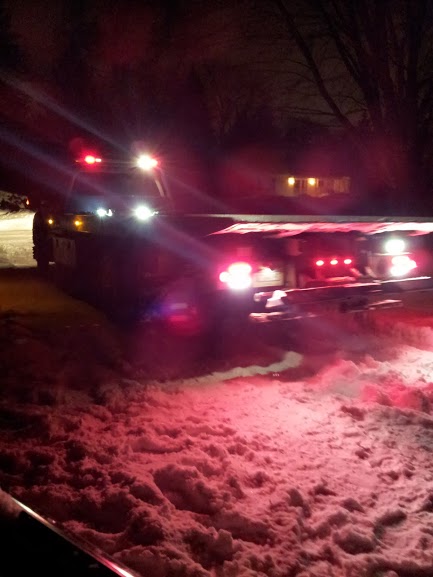
My car was eventually towed out by AAA, and my friend, her husband, and my husband came to my aid.
But not the mean blond lady, who actually took a photograph of my license plate as I was on my hands and knees trying to dig away the snow to free my car.
Mean blond lady, your lawn will be just fine. I’ll even come over with a bag of dirt and seed in the spring to fix your precious lawn. Because I said I was sorry 10 times. Because I’m that fucking nice.
Mean blond lady, you will also get your Karmic justice. It’s coming.
Has old man winter been a bitch to you? If so, rant away and please SHARE!
Let’s Explore Owls – with Owls: Michigan Owl Prowl

From the attic bedroom window in my Rochester home, deep deep in the night, you could hear the sound of a train. The (unwelcome but necessary) woosh of the two nearby highways. Then, every once in a while, an eerie sound could be heard: Whoo Whoo Hooooooo…. It was the Barred Owl who lived in a grove of woods up at the Cobbs Hill Reservoir.
Since moving to our development in suburban Detroit, things are a lot more quiet. I miss the sound of the trains. I don’t miss the woosh of the highway. But, and this is strange, because we live in a more wooded suburban area, I no longer hear any owls. And I miss that late-night hoot of that Barred owl very, very much.

Chouette rayée / Barred Owl (Photo credit: meantux)night Barred Owl hoot very much.
I’m not much of a birder. I leave that hobby up to my husband. He even has a life list. I like to hike. And if I hear a bird, I think, fantastic, what a beautiful song that bird has, now let’s move on. I don’t like standing in one place for too long for the sake of identifying or calling to a bird.
But, then again, those owls have a soft spot with me. So, the other morning, as I drowsily heard the report that the Michigan Department of Natural Resources would be hosting “Owl Prowl” evenings all over the state,I did some further investigation and found the one happening closest to our house.
Turns out it took place last Sunday night at Bald Mountain State Recreation Area in Auburn Hills. The free event attracted about 125 people of all ages for a talk, some s’mores by a campfire, and the hope of sighting some owls.
Around the campfire, our guides, members of the Audobon Society, explained the order of calling the owls. It turns out that the larger owls tend to eat the smaller screech owls. So, the screech owls would be called first, then the larger owls in a different part of the forest. If the larger owls were called first, the smaller ones would make themselves scarce.
Another thing that scares away owls, and other wildlife, are humans. The guides advised us to be as quiet as possible. We were a big group. As I explained earlier, about 150 owl enthusiasts had come out that freezing night, with temperatures in the teens, to sight some owls. Those were 100 plus pairs of boots stomping in the snow. Children’s snow pants swish swished as they walked. Yet, when we were deep enough in the woods and the bird guides released their calls, it was quiet enough to hear the snow falling on our parkas.
In the end, a screech-owl and a Barred Owl called back to us. We didn’t see any owls, but just hearing them call back to our calls in the night was enough. And, it was time spent in the cold refreshing winter air.
If you live in Michigan and want to find an Owl Prowl near you, check out this site, and tell me what you saw and heard.
Related articles


It’s New to Me: A night out at Detroit’s Fox Theatre

I need to get out more often. And by that, I don’t mean dinner at the Outback and a movie at the local suburban multiplex.
I am going to put this blog post into a new I-know-you’ve-lived-here-all-your-life-but-ya’ll-it’s-all-new-to-me category. Because, I know all of you Detroiters know all about the Fox Theatre like I know about Radio City Music Hall (but hey, real New Yorkers know a trip to Radio City is just for TOURISTS).
But for me – the New Yawker newbie, a babe in the urban D woods – I am loving discovering my new city.
Last night, I had my first nighttime visit into Downtown Detroit. We were invited out by the same very interesting new friends (the ones who press their own apple cider) to a benefit to support the Jewish Association for Residential Care. The featured act: The Rascals.
You know, the Rascals:
My husband and I still don’t know how to get around downtown. ( I really don’t understand how to traverse a metropolis without a subway system.) They offered to drive. We happily accepted the ride.
Driving down highway 10 at night to downtown Detroit, you really get an understanding of just how blighted some sections have become. As you leave suburbia for downtown, the highway submerges, and what’s left of neighborhoods peek out from concrete walls that rise to the right and the left. Every now and again you get a glimpse of houses. Completely dark. What’s left of houses. What’s left of churches. And stores. And housing projects. Empty shells. Dark and lonely.
And then, reaching downtown, the lights, and life, emerges again. If just for a dozen or so square blocks that house the city’s businesses, theaters Detroit nightlife post baseball season is still trying to go on.
Though Comerica Park now stands quiet, it is lit up. Giant stone tigers roar into a post-season sky and roar into a mostly vacant parking lot. I make nice to them and promise I will come cheer for the Tigers (because they don’t play against the NY Mets) come the spring.

credit: DetroitDerek Photography
Across the street stands the glorious Fox Theatre:
 Built in the grand style of the 1920’s, when auto manufacturing was in high swing, it has a 3,600 square foot lobby and a grand auditorium that seats 5,000. And every square inch drips with restored opulence snatched from the mouths of the Blight and Decay demons that caused many of Detroit’s architectural treasures to crumble or lay in waste.
Though I wasn’t that excited to see this 60’s band, it was the venue itself – plus a fundraiser supporting independent lifestyles for adults with disabilities – that made me plunk down the cash for the tickets.
“I bet you have been craving for a night like this in the city,” my friend said as we crossed Woodward – a main thoroughfare in Detroit that is far wider than any avenue in Manhattan. Outside the theatre, a small crowd gathered and a ragged group of street musicians played and asked for change.
Oh yeah, I miss going out into a city for some nightlife. I miss packed sidewalks and even further packed subway cars. Even little Rochester had some hopping areas, some beautiful theaters, jazz spots and restaurants for entertainment.
I stepped inside the lobby. I knew I had to make my way to will call to get our tickets. I knew I should have been more friendly and engaged in conversation with new friends in the community who made their way over to say hi. But they had already been in the Fox theatre. They had lived here most of their lives. This was all new to me. And I was having trouble keeping my jaw from hanging to the floor:


The grandeur of the Fox Theater lobby made me happy and sad all at once. Happy that this gem has been restored and saved from blight and stands as a reminder of what Detroit could be again. Sad to think of all the other architectural treasures of the city – other theatres, the Central Train Station, hotels, schools, mansions, homes – that just lay in waste, I thought of the Heidelberg Art project that arsonists just burned to the ground. Again. Before I got to set eyes on it.
We spent the night listening to the Rascals play with new friends and some JARC residents, who quickly befriended us and were happy to sing and dance the evening away, even though I thought the Rascals depended very much upon their multimedia show than pandering to the crowd:


After the show, the city was dark. No bars open. No restaurants to spend our money in. Just a few lingering panhandlers and straggling musicians. So, back to suburbia we went for a late night bite to eat.
We really wanted to spend more money downtown. But there was nowhere open to spend it.
This is not the city that Never Sleeps. Not even by a long shot.
My first unelection Day in Michigan

I am a voter. In all the places I’ve lived in, I have registered and exercised my right to vote. I can only think of one or two elections (one was the 1988 presidential election, when I was away at college. But even if I cast a vote, Michael Dukakis had no chance of winning) that I did not participate in voting in election.
Even as a kid, my parents took my brother and I to our elementary school at night so they can cast their votes in the cafeteria. My brother and I sat at semi-folded up tables pushed against the wall and stared at the feet in the voting booths, wondering what those grown ups were doing behind that curtain. I remember I couldn’t wait to be old enough to get in that booth and pull the lever.
Here, in my new suburban surroundings, I noticed something strangely missing from the October landscape. Because, along with skeletons, gravestones and pumpkins adorning the lawns in my old Brighton neighborhood were political signs. Usually Democratic Party leaning, signs would urge passers by to vote for judges, school board members, Congresspeople. No or Yes on this or that proposition.
I did get a reminder call from my old town by a real (young sounding) person reminding me to vote and informing me of my polling place. I politely thanked them for the call but told them I had moved.
But here in West Bloomfield? No calls. Not a political sign to be found. I thought this was one more silly rule in our neighborhood association charter. Like the rule where you can’t have a shed or a different mailbox.
Signs or no signs, I knew it was election day. And it was my civic duty to vote. But where?
I asked two of my neighbors who were unsure. They were not even sure what there was to vote on.
Surely, other towns had issues and elections to vote upon. Just a few to mention:
- There was the mayoral election in Detroit, where former hospital executive Mike Duggan defeated Wayne County Sheriff Benny Napolean.
- Royal Oak voters approved a human rights ordinance banning discrimination against people based on their sexual orientation and other factors, making the Oakland County community the 30th municipality in the state to add such a law to its books.
- Voters in Macomb county approved tax hikes to support fire and police services
So, I figured there had to be something I needed to vote for in my new town. I registered to vote at my new town hall. I had my voter i.d. I was ready.
I waited until the evening to go vote, taking my two oldest children in tow. Hard to believe that come the next presidential election, my oldest will be eligible to vote. I went to the most logical places: the nearby schools. In one school, parents sat around watching their kids at an indoor soccer practice. None could tell me where to vote.
Next was my son’s middle school, where parents were gathering for a meeting about the swimming team season. Not only could a parent tell me where my polling place was, but she didn’t know it was election day.
How could this be? And how could I not exercise my civic duty to vote, this my first election day in my new state? The kids started to grumble. After all, the main objective of this outing was to do some shopping at Old Navy.
Finally, I went to town hall, where I should have gone for advice in the first place. The doors were open and there were some bins labeled as ballot boxes on tables outside the clerk’s office. The clerk expediently located my address and her eyebrows raised.
“Oh. You live in the section of West Bloomfield zoned for Bloomfield Hills schools?”
Yes, I thought, the much coveted section where we send our kids to school not within an earshot of our home but all the way the hell on the other side of town?
“You don’t have an election this year.”
No election? Not a single vote to be cast? On anything? Not one school official? Or County judge? Or proposition to release reserved funds for a new school roof?
I left town hall feeling strange but knowing I had done my civic duty of at least trying to vote. I had dragged my kids around town trying to fulfill my right to vote, trying to teach them a lesson that voting is something that should always be practiced. At least, on the years your town has something for which to vote.
And, without further delay, we went to practice our other right as Americans: the right to be consumers buying cheaply manufactured clothing from China at the nearest suburban shopping plaza.
Did you get out the vote in your town? Were you happy with the results? Leave a comment, I’m all ears!
The most Interesting Teens in Detroit raise $$ and awareness for Downtown

Jonah and Sophie Erlich with the “Daven Downtown” T-shirts they are
selling to help the Isaac Agree Downtown Synagogue in Detroit. (photo credit: Detroit Jewish News)
Never underestimate the impact of a school field trip.
Last spring, Sophie Erlich, 14, of Birmingham took a trip to the Isaac Agree Downtown Synagogue with
her eighth-grade classmates from Hillel Day School in Farmington Hills. There, she learned about the synagogue’s past. There, she also became inspired about contributing to Detroit’s comeback and an urban Jewish future.
This September, Sophie, now in ninth-grade at Birmingham Groves High School, and big brother, Jonah Erlich, 16, kicked off a fundraiser for the synagogue, founded in 1921, with their “Daven Downtown” T-shirt fundraising campaign. They sold more than 35 T-shirts for $36 each on their website designed by Jonah, www.davendowntown.com/ collections. All proceeds go directly to
help the synagogue.
Throughout the whole process, which is earning them required community
service credits for school, the teens also are learning valuable lesson in keeping inventories, marketing for nonprofit organizations on social
media and running a business.
“I am very energized about the idea of Detroit coming back,” said Sophie, who has friends with older siblings who are moving into the city. “It’s where I hope to live and work when I am an adult and out of college.” Jonah echoed his sister’s sentiments.
“If more Jewish young adults move into the city, they will need a thriving synagogue within walking distance where they can pray and just hang out with other Jews,” he said. “I would be so excited to work and live in Detroit someday.”
To create the right vibe, they asked local designer Kathy Roessner to donate her time and talents to create colorful logo with a “V” in the middle. The T-shirts, printed in Troy, are available in crew and V-neck styles and come in gray and white.
To boost sales, Jonah recruited some video-savvy classmates at Frankel Jewish Academy in West Bloomfield where he is a sophomore, as well as local leaders and Detroit entrepreneurs, to film themselves around town wearing
the T-shirts. The “world’s most interesting man,” a character from a Dos Equis beer commercial, provided
inspiration for the video’s only scripted line:
“I don’t always daven. But when I do, I daven Downtown.”
Anna Kohn, the executive director of the Downtown Synagogue and one of only two paid staff members, said the excitement and entrepreneurship of the teens toward the synagogue proves that young people can make things
happen when they are passionate about a cause.
“We were looking for a way to merchandise, and they beat us to it,” she said. Kohn said she has used the logo
on the synagogue’s website at www.downtownsynagogue.org. The egalitarian Conservative synagogue’s Facebook
page has 1,000 fans. It also distributes a newsletter with a circulation of 1,600 informing congregants and the general public about weekly Shabbat services, a Thursday morning minyan and a variety of programs that provide social
outreach for Jewish urbanites and those just curious about Judaism.
The T-shirt sales have become so successful that they are on back order as the Erlich siblings, children of Craig
and Renee Erlich, wait for the next shipment. They also plan to sell the T-shirts through area synagogues and
Jewish youth groups. ■
Good-bye, blight, hello broccoli: farming in Detroit.

On a block in the Brightmoor neighborhood in Detroit, where houses once stood, a crop of fall vegetables grows, to be sold at the Eastern Market.
Almost six months into my family’s little “adventure” of living in the Detroit area, I finally brushed off my suburbia doldrums and became a tiny part of Detroit’s urban farming revolution.
Before my move, as I mourned my departure from the perennial garden I coaxed into existence for 13 years, and my rented plot in my town’s community garden, I really imagined myself venturing to help out in one of Detroit’s urban farms just as soon as I unpacked. I’ve been reading up on Detroit’s emergence into the urban farming scene ever since we made the decision to move. In recent news, Hantz Farms got the approval from the Detroit emergency council to grow a 140 acre forest in the middle of Detroit. That is 140 acres of land that is being put back into taxable use.
Before I got on my gardening gloves, though, I underestimated just how far my suburban home was from Detroit city lines. And I have to admit I had a biased fear for my own safety. I’d be a newbie with a New York State license plate and a GPS device clamped to my windshield driving into a blighted neighborhood. Can you think of a better target for a carjacking? Besides, I hadn’t a clue as who to contact to help out.
Getting stern warnings from neighbors and friends not to go downtown wasn’t helping matters either. Since moving here, I was told that I would love living in my suburban surroundings with its great schools, bike paths, lakes and shopping centers. I just wouldn’t go into Detroit.
Because no one goes into Detroit.
Too dangerous.
Too much crime.
So, for a while, I succumbed to these fears as an excuse for not getting my hands dirty digging in some Detroit dirt.
But wait a minute.
Didn’t I grow up in New York City? Where outsiders were afraid to ride the subway or walk in Central Park for fear of being mugged?
Haven’t I visited Israel numerous times in my life? And I made these visits during a war with Lebanon or at a time when the intifada raged in the West Bank?
From the urban energy and culture of New York City to my summer picking mangoes and tending the banana fields on a kibbutz In Israel, (a kibbutz that was on the border with Syria and Lebanon). Both these places have enriched my soul. and have made me the person I am today. Walking safely around my cul-de-sac suburban development with manicured landscaping is nice, but hardly anyone here actually has a real garden. Hey, my neighborhood association won’t even allow for the smallest of a garden shed.
Suburbia is nice but here, I don’t really feel like I’m part of the solution. Part of the farming revolution.
This weekend, I finally found the opportunity to volunteer. And who would give me that opportunity but an organization as comfortable and familiar to me as an old pair of sneakers: United Synagogue Youth.
Ahhh, my USY days. Best times of my life. It’s a good thing I now have teenagers of my own so I can relive these days again.
A big part of USY is social action, repairing the world, a Jewish value called Tikkun Olam. So when I found out that Motor City USY would be helping out downtown at Beaverland Farms in the Brightmoor neighborhood in Detroit, I jumped at the chance. Even though I’m no longer 16 but 45 and my knees don’t take too well to jumping that hard.
With my 16-year-old daughter, 10-year-old son and husband, we started off to the farm from suburbia to Detroit. The landscape became more urban, and then gritty and then plain ol’ rundown.
Nice, big homes and posh shopping plazas in my side of town gave way to smaller homes and then dilapidated structures with boarded windows and roofs halfway covered with blue tarp that were once someone’s home or still occupied with people just hanging on.
By the time we got to Five Mile and Telegraph, there weren’t too many open stores and those that were in business had big signs like LIQUOR or CHECK CASHING. Boarded up storefronts scrawled with writing like DUGGAN FOR MAYOR or WE STILL LOVE YOU, DETROIT. It was becoming more evident of the existence of what’s called the “nutritional desert here.” For the people who lived around here, where do they go to buy food, and food that is healthful? There are very few choices.
That is where the urban farms come in.
We rounded the corner of Five Mile and Beaverland Road in the Brightmoor neighborhood of Detroit. On 11 city lots once occupied by small houses that were so prevalent in this area to house blue-collar manufacturer workers and their families there is now a fruit orchard, rows of vegetables, and tilled, cleaned out land. Scott, the owner, grows the food here and sells the produce at neighborhood farmers markets, runs a CSA , and provides community and social outreach and educational programs for his neighbors and local schoolchildren.
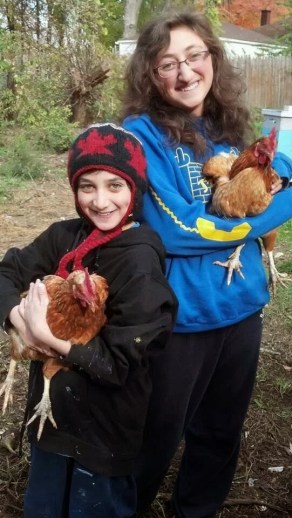
My family got out of the car and we quickly got to work. As I promised, I made myself scarce to my teen daughter. She and my son got busy with some other teens and helped build and paint bee hives and tend to the chickens.
My husband and I worked across the street planting rows of perennial flowers that would (hopefully) survive the winter and bloom again in the spring.
All the while, neighborhood folk walked up and down the street. Some said hello. Others didn’t. I wondered, as I cleared away composted grass to plant another flower, how is this helping them? How do they feel about us strangers coming into their ‘hood and making a farm? Do they like it? What business do we have being here, in their neighborhood?
I posed these questions to Scott. He works and lives right here. With a mezzuzah posted on his front door. He said the farm is a way for people to connect. Everyone around here respects the farm. And compared to burned out buildings that invite drug dealers and prostitution, a farm is a welcome change in Brightmoor. I told him how much I’ve been wanting to help out at a farm like this. I told him I could grow seedlings of vegetables for the farm over the winter. I told him I had loads of tomato cages that are looking for a good home but will have no use in suburbia.
“Stop looking. You’ve come to the right place,” he said.
My husband and I worked side by side in the afternoon October sun. I can’t remember the last time we did any volunteer work together for a place that needed so much help and nurturing. I looked across at him, a man I met when we were 16, whom I met through United Synagogue Youth.
And now, we are married almost 20 years. Now, we planted flowers and are kids were across the street playing with chickens in one of the most dangerous neighborhoods in Detroit.
We loved every minute of it and I can’t wait to come back.
Ain’t life funny? Ain’t life grand?
Related articles


Staying Close, Hanging Together – One Detroit Family stays put for seven generations
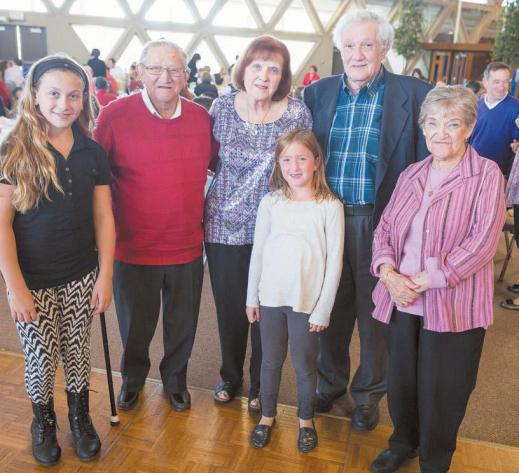
Above:
Rebecca Nodler, 10, Oak Park; Seymour Zate, West Bloomfield; Adele Nodler, Oak Park; Danielle Nodler, 6, Huntington Woods; Alvin Nodler, Oak Park; and Gladys Zate, West Bloomfield
I’ve lived in my house for nearly four months now. And for the most part, my walls are blank.
After going through the home selling and buying process, I guess I’ve grown used to the “staged” look of a house.
No clutter.
Keep it impersonal.
The seller shouldn’t display too many family photos lest the potential buyer cannot envision their own life in the house.
Every few evenings, I hear a banging sound: it’s my husband’s vain attempt to hang a few more pictures on the wall, only to have ME take them down. No. I’m not ready. I don’t want that picture there. I never liked that baby picture from SEARS in the first place. I’m going to develop more photos on Shutterfly. Big ones. I promise. That was for the old house, now we’re in a new house.
Wall arrangements have become somewhat of an obsession of mine. My blank walls have become empty canvasses I don’t want to screw up. I’ve taken out library books about decorating walls. When I watch TV shows or commercials, I find myself ignoring the dialogue of the characters but looking instead at the set. I know there are set designers who have perfectly adorned the walls with the right balance of small and large frames. More than any other decor, the stuff you hang on your walls makes your house a home.
Maybe I’m not home yet. Because a few weeks ago, I visited a house that was just that.
Adele and Alvin Nodler’s house in Oak Park, the place where I interviewed Adele and her cousins over tea and homemade cookies for an article in the Detroit Jewish News,, is not big or fancy. But it’s been their home for nearly 50 years. No designer was hired to decorate, but what it is decorated with is love. There are family photos from many generations on every possible surface.
I came away from that interview not only with a great story on the importance of keeping family ties,, but a lesson learned in how to make a house a home.
Here is just a little of their story, published in the October 17 issue of the Detroit Jewish News:
Families come in many sizes.
Then there are families like the Levins that are so large and tightly knit that they have their own anthem. And a custom-designed logo.
Last Sunday, Oct. 13, the Levin clan, with most of its 200 members residing in Metro Detroit, sang their anthem and performed an original variety show in their logo T-shirts as they celebrated the 65th anniversary of the Levin Family Club at Congregation Shaarey Zedek in Southfield.

Joshua Chynoweth, 13, of Livonia lights a candle on the anniversary cake.
“We have lots of writers and performers, but no directors,” joked Adele Levin Nodler, 72, of Oak Park, who has been treasurer of the club for 48 years.
The Levin story is familiar to many Jewish American families. They are descendants of immigrants who fled persecution in Eastern Europe and wove themselves into the fabric of American society. What is unique about the Levins is how strongly they held onto family ties and Jewish traditions for seven generations.
“Family togetherness is a legacy that was given to us by our grandparents and is one we will pass onto our grandchildren and beyond,” said Nodler, as she sat with her husband of 49 years, Alvin, brother Seymour, 81, and her cousin Gladys Zate, 87, in her Oak Park home.
The love of kin was evident on the walls and bookcases adorned with family photos from every generation.
The Levins can trace their Detroit roots back to 1905 when Adele’s father, Morris Yellen, escaped Poland at age 16 to avoid the Polish draft. Yellen changed to Levin at Ellis Island. Working for years as a baker, he saved enough money to return to Poland and bring the rest of his family to Detroit. The Levins became established bakers and grocers and had stores on Chene Street.
The family would often gather on Saturday nights after Shabbat to play cards. In 1948, those casual card games evolved into the Levin Cousin Club.
Early Detroit Memories Adele and Gladys also recall living upstairs from one another in the same big house on Elmhurst Street. Adele was the oldest of five siblings; Gladys had three sisters. It was there the cousins started writing and performing shows about the funny antics that went on in their family.
The cousins recall fond memories of celebrating Jewish holidays in Detroit.
On Simchat Torah, they danced with flags toped with apples in Beth Jacob synagogue on Pingree Street and dined at kosher restaurants on 12th Street after Shabbat.
They also remember having large family seders — as many as 75 people — at the home of their uncle, Meyer Levin.
“As a kid, you’d have to sit very still at my Uncle Meyer’s seder. If you moved, you would get a knibble, or a pinch on the cheek,” said Gladys, who recalls her mother making gefilte fish for the seder from fish she kept in her bathtub.
The pace of life — and the state of Detroit — has changed since 1948. Parts of the family live out of town. The bakery on Chene Street and the old house on Elmhurst Street are no longer there.
To compensate for the distance, Adele and her siblings and their descendants chat on a weekly Thursday teleconference call to “catch up and wish each other a good Shabbos.”
“No matter what anyone is doing, we stay committed to that call. Even my grandchildren participate, and the one thing they notice is there is a lot of laughter,” said Adele, who taught middle school in Oak Park for 30 years.
“Though we don’t see each other all the time, there is a constant feeling of togetherness because of the Jewish family traditions we have built over the years,” said Michael Nodler, 43, of Oak Park. He offers backstage support to the show with his brother, Harold Nodler, 44, of Huntington Woods.
The family show is all the more meaningful to Michael this year as his son, Joshua Nodler, 12, a seventh-grader at Norup International Middle School in Oak Park, approaches his bar mitzvah.
Joshua created a PowerPoint slide show for the evening that traces his family’s history.
The show comes every five years; every year, they meet for a summer picnic, a summer hot dog roast, Chanukah party and Purim party.
The secret to a close family, Adele advised, is never hold a grudge.
“Our parents taught us you don’t stay angry at each other,” she said.
“Yes, we had fights and disagreements.
Sometimes someone would not play fair at a family card game. But you work it out and stay close — that is what’s most important.”
Pressing Times in Michigan


We lived in Michigan for about two minutes (okay, I’m exaggerating…. 10 minutes) when people we met started talking about apples. And cider mills.
“What? You haven’t been to Franklin Mills? You HAVE to go for the doughnuts and CIDER.”
Like Blue vs. Green football. Like old-time souped up roadsters, come the fall, apples are a big part of the culture here in Michigan.
I thought I would be missing the sweet, hard crunch of my favorite fruit when I left New York. Not to worry. It seems Michiganders are just as boastful if not more than New Yorkers about their apples.
Though fourth in the nation in apple production, the state grows many varieties and nearly every supermarket sells the red, yellow and green globes picked from orchards less than 100 miles away.
Then there are the cider mills. It seems the granddaddy of them all around these parts is the Franklin Cider Mill. It is named for this tiny town in which it is located, a bucolic village that somehow dodged the suburban bullet in which it is surrounded. The mill is only open from Labor Day through Thanksgiving, so all it’s business is pressed (no pun intended) in these short months. But they do more than okay. Check out the line on a recent Sunday to get cider and Donuts:

And they have a huge press:
 For some lucky folks, like some new friends we have made, apples are no further than their own back yard,
A few Sundays ago, these friends invited us over in the early evening to press some cider. Now, they had invited us to do this twice before and we just could not fit a press into our crazy early fall schedules. But the night was crisp and cool but not too cold, so why not? We went over to hang out and learn about pressing apple cider.
Several years ago, our friends purchased a small press. After realizing how much they were into making cider, and had an ample supply from several apple trees on their property, they decided to invest in a larger press from the Happy Valley Ranch Co.

Now, after marveling at this hand-cranked, Amish-looking contraption, I thought the evening was over. It was a school night, after all. But oh NO. This was not a mere social call, we were about to get put to work! We happily obliged because we know we would be treated to the freshest cider one could gulp at the end.
In advance of our arrival, they had cleaned and cut away bruises from apples they were storing in their garage.

 This has been such an ample season of apples that they seriously don’t know where they are going to put their cars!
We started throwing the apples into a wood hopper that fed the apples through a mill fitted with some sharp teeth.

That’s me cranking some apples, the pulp getting caught into a wood bucked lined with a cheesecloth like sack. Hubby also took some turns cranking the apples. (Note that from his cap and sweatshirt, he has not changed his allegiance to Michigan teams):

Already, without even turning the crank, juice stared oozing out of the pulp to be caught below in a pitcher. Luckily, it was too cool that night for the bees:

Then, the pulp is pressed and pressed by a hand-turned crank. A whole bucket’s worth of apple pulp is compressed to the thickness of a manhole cover. The result is homemade freshly pressed cider, the best I’ve ever tasted.
I will work for cider any time and hope we’ll get invited back soon.
About Me

Kreativ Blogger

Versatile Blogger Award


 Stacy Gittleman