
Swirls of Color or Standardized Dots? Keep Arts in Schools

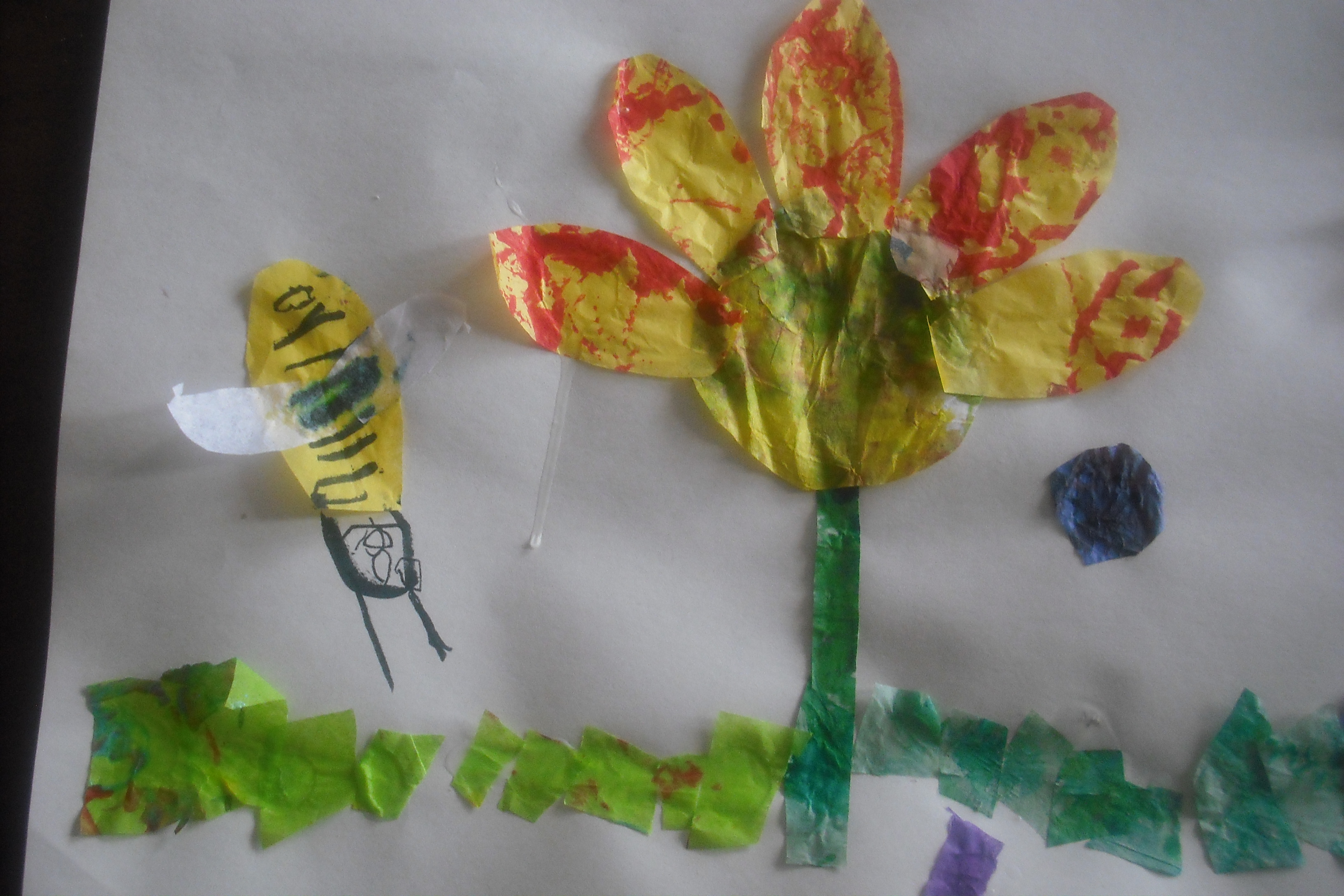
What picture inspires you more.
This?
Or this?
If public school budgets continue to shave and slash away at the arts, the black and white dots of those “No Child Left Behind” standardized tests are all that will be left of our children’s public school education. Teaching to the test leaves no room for imagination, creativity, real thinking or problem solving. What it has resulted in is burned-out stressed-out teachers and students.
This is according to an independent documentary called “Race To Nowhere” that is sparking a grassroots movement to reshape how we educate our public school students. I look forward to seeing a screening of this independent movie in Rochester, NY, at Nazareth College on April 4. The movie screening is being sponsored in part by a private Jewish day school, Hillel Community Day School.
The film challenges parents, educators, and policy makers with this question: Are we doing right by our children? Is the pressure to succeed in standardized tests really preparing our children to become capable, inspired and motivated individuals ready to tackle college or the workforce?
When school budgets get tight, the arts are the first to get cut. In fact, schools in the Rochester area are seeking to reduce some of their arts budgets by 50 percent.
Is music, art and sculpture really that expendable? Is painting, singing, and playing an instrument such a frivolous part of a child’s education that it should be considered a fluffy extra that can be easily eliminated from his academic career?
Absolutely not, according to Americans for the Arts. Young people who consistently participate in comprehensive, sequential, and rigorous arts programs are:
- 4 times more likely to be recognized for academic achievement
- 3 times more likely to be elected to class office within their schools
- 4 times more likely to participate in a math and science fair
- 3 times more likely to win an award for school attendance
- 4 times more likely to win an award for writing an essay or poem*
When was the last time your child stood at an easel and held a brush full of paint? Or perhaps, in the spirit of abandoning everything for creativity’s sake, she ditched the brush and instead joyfully found herself up to her elbows in paint, as her hands and fingers glided across the paper.
Indeed, art is messy. When was the last time you let your kid get messy at home with some paint or clay? Overheard once in a preschool hallway: “I’m so glad they paint here at school, because at home, we don’t let him do that.”
Might as well draw a dagger through a teacher’s heart.
Video games and television are not messy. But they don’t do much to fire up the brain neurons either.
Art on the other hand unlocks creativity in children that leads to story telling, pattern recognition, and understanding other cultures. It is simply the expression of life that makes life enjoyable. Art enables quiet kids to tell stories. Art calms and centers otherwise boisterious kids. It is a positive way for them to control the environment around them. A blank piece of paper or a lump of play dough can become a whole universe that they can master.
The above picture was created by a very precocious preschooler who patiently sat, cut and created a composition. Imagine what that same child can do when she gets older in an art class?
If a child is not going to be exposed to the earts in their earliest school years, then where will they get the opportunities? If arts are cut in public schools, there are private arts classes that parents can enroll their chilren in most towns and communities. But they cost money. So, cut the arts in public schools, and access to arts will only be possible to the families who can afford them.
And the rest? GThe only drawing less priveleged kids are going to do in school are the dots and circles they create on a standardized test.
Bye-bye Tar Beach, Hello Green Roof

Growing up in Brooklyn, if you couldn’t make it to the real beach on a hot summer day, all you had to do was go up to Tar Beach. Did you go to Tar Beach?
“It was really hot up there,” my mom told me on a recent visit, as she told me about how she and her friends would spend hours up on the roof using sun-reflectors even to maximize their tans. Ahh, the good old days!
Tar roofs, though hot and contributors to global warming, made great song material, though, you must admit.
The Drifters sang about the sun burning the tar up on the roof in “Under the Boardwalk” and how to forget all your cares “Up on the Roof.” Elton John sat up on his roof and kicked off some moss in “Your Song.”
Perhaps Elton should have cooled his boots for a moment and left the moss alone. Growing plants on roofs — from vegetable gardening to sophisticated sod membranes that soak up urban water runoff and cool the air — are becoming a required building material in cities like Toronto and Chicago.
I know that tar roofs are not exclusive to Brooklyn, no matter how Brooklyn-centric my point of reference may be. In fact, cities like Chicago, where new laws are in place requiring new buildings to have green roofing materials, the temperature on a tar roof can be 78 degrees hotter than that on a green roof.
Walk across any asphalt parking lot on a summer day and then walk across a green lawn. You don’t have to be a scientist writing a big fat feasibility study to understand how black top paved surfaces and roofs heat the earth and green areas have the potential to cool it.
In Rochester, NY, The Harley School is employing this technology as one long-term science project and can boast that they are the area’s first school to have a green roof. This sustainable technology will not only act as a natural insulator, keeping the school warmer in winter and cooler in summer, but it will teach its high school students about how buildings affect the environment.
The tar roofs of the past, according to environmentalists, are the bane of city living because they create urban heat islands and contribute vastly to water runoff. Rather than being just a green trend, cities such as Chicago and Toronto require roofs of new buildings to include cooling, greenhouse-gas absorbing plants.
The Harley School on Oct. 18 installed two 10 x 10 ft. plots of hearty winter grass on the roof of their building on 1981 Clover St. The school spent $2,000 for materials and also received an in-kind installation and materials donation from Zaretsky & Associates landscapers in Western New York. In order to grow a section of green roofing, school engineers had to assess if the school’s roof could withstand the additional weight of a weatherproof membrane barrier, two inches of topsoil, the weight of the growing plants, and the water they will retain. The grassy roof serves as a natural insulator and will keep the building cooler in the summer and warmer in the winter. School officials expect to reap the benefits of these initial costs within 3-10 years.
Peter Hentschke, a science teacher who will be working with Harley’s upper classmen on researching the impact of the green roof, said the project provides students with hands-on learning. The students will develop mathematical methods and equations to determine how much energy their school saves by comparing temperatures of the school’s different roofing materials. They will also calculate how water runoff is affected by the green roof.
“Rooftop plants catch rainwater and runoff that would have ultimately run into the sewer and overburden water treatment centers. The students are tracking current rainwater runoff with water gauges and will track this throughout the school year,” he said.
Chris Hartman, Harley’s social and environmental sustainability coordinator said the students are “all fired up” about learning about the green roof because it has real-world implications.
“The Harley students are really in the driver’s seat of this project. They know that it is cool to have a green roof, but the challenge will be to come up with the methodology to show how green roofs have an impact in the world around them,” said Hartman. He added that students hope to share the data from the green roof with their classmates, and perhaps local colleges such as the University of Rochester and Rochester Institute of Technology.
If we all started growing green things on our roofs, perhaps by the time these kids graduate college, our cities would from above look less like Tar Beach and more like the ancient hanging gardens of Babylonia. I wonder what songs they will inspire by then.
About Me

Kreativ Blogger

Versatile Blogger Award


 Stacy Gittleman