
“We Just Want To Live”

“It is very nice that you and your other American friends care about protecting the Arctic Circle and the polar bears against global warming. And I understand you want social justice and equal rights and the right to choose for a woman. Yes, all these things are very nice and good and important. But here in Israel, the first thing we need more than anything is security for us and our children. We just want to live. We want to go to sleep at night and not worry that Iran is building a nuclear bomb to shoot at us.”
I sat in my host family’s living room. On my 2008 educator mission to Israel I stayed with Keren, a teacher, her husband, Omer, a systems manager (or something like that), and their two young daughters. It was in the evening and Keren was upstairs putting the girls to bed in their two-level condo in Modi’in Israel.
Next to the girls bedroom, which they shared, was another room that many in Israel had if their home was built after a certain year. In their house, It is an inner room with thick, lined walls and no windows and closes with a thick door that shuts with a crank. one thick door that when shut,
The thing is, in Israel, space is tight. Square footage is expensive. Like, think close to Manhattan expensive. And although Israelis are not supposed to use this room for anything else but a safety shelter, it is often used as a room. For a home office. A playroom filled with colorful toys. An extra space to store like any other American needs, all the extra stuff that comes along with living in a consumerism society.
I was visiting Israel to teach Israeli kids a little bit about what it was like to be a Jew in America. But that evening, I was the one getting a lesson on the mindset of Israelis as I sat on the white couch with a glass of precious water – no ice – my feet resting on the cold tiled floor.
It was the spring of 2008. Israel was in the wake with its military action in Lebanon and Gaza after the kidnapping of three soldiers from 2006. In the United States, elections were heating up and most of America was fed up with the way things were going under the Bush Administration.
The economy was about to tank.
We were five years out of Bush’s “mission accomplished” announcement, where nothing seemed to get accomplished except hundreds of our soldiers getting killed or wounded. Where were the weapons of mass destruction? When would we ever see a troop draw down from Iraq? Afghanistan?
I was the Democratic Party’s dream voter. I stood, and still, stand for every issue on the Democratic ticket. Strict environmental regulations. Stricter gun control. Pro Choice. Fulfilling the legacy of Ted Kennedy’s call for universal health care.
When it came to Israel, I still believed that supporting Israel was a bipartisan issue. But in 2008, there started to be a shift that if you really wanted to support Israel, voting for a Democrat is not the way to go. I had been warned by friends and certain family and now, I was getting a plea from Omer.
Early every morning, Omer gets picked up outside his condo by a company bus to take them to the offices inside the Ben Gurion Airport. Except, that next week, after I headed back to the States, Omer would be heading out for a month of reserve duty, just as most Israeli men do, one month per year, until they are in their 50’s.
But back to the couch.
Omer did not belittle me for my then progressive beliefs, and said in a big country like the U.S., he could understand why people would back these issues. He did not tell me which way to vote, but told me who he hoped would win in no uncertain terms.
“I think Obama is a good man, but here in Israel, we really like McCain. We need a sheriff in the White House.”
Eight years later I have not forgotten Omer’s words. I wonder what he thinks of the United States now. Does he feel betrayal by American Jews, myself included, who vastly voted for Obama, once and even twice?
And now the Iran Nuclear agreement is up for vote in Congress.
Below, if you care to keep on reading, is my article from this week’s Detroit Jewish News covering the Washington Institute’s David Makovsky’s speech before Detroit’s Jewish community. He offered as balanced a perspective as possible on the Iran Deal. Although the Wall Street Journal contributing writer has written strongly against the deal, I learned later that his sponsors here asked him to give a balanced overview and not his own personal opinions.
I wonder why.
I woke to the news that Chuck Schumer (D-NY) made a statement today coming out against the deal.
Somewhere in Israel, I hope that this news has reached Omer, and that he is smiling with just a little bit of hope.
David Makovsky, director of the Project on the Middle East Peace Process of the Washington Institute for Near East Policy, mapped out the pros and cons of the Iran nuclear agreement to an audience of nearly 1,000 donors to the Jewish Federation of Metropolitan Detroit at Temple Beth El in Bloomfield Township on July 30.
Stressing the many questions that still remain on how the deal will be enforced should it be enacted, Makovsky spoke of the “atmosphere of anguish” going around Congress as it heads to a vote on the agreement.
He also emphasized the urgent need for cooperation between U.S. and Israeli intelligence and security departments.
Detroit’s Federation is one of only eight in the nation that have come down in the first week squarely against the agreement. Noting the size of the crowd, Federation President Larry Wolfe said this is a time of “deep concern, interest and anxiety within Detroit’s Jewish community.
“The Federation of Detroit needs to take a stand, particularly with their fellow Jews in Israel who feel abandoned and isolated, especially in light that with this deal, terrorist organizations such as Hamas and Hezbollah funded by Iran will be flush with cash,” Wolfe said.
“What is at stake is nothing less than the future for Jews here in Detroit, Israel and around the world.”
Professor Howard Lupovitch, director of the Cohn-Haddow Center for Judaic Studies, Wayne State University, served as moderator.
To illustrate the complexities of either being for or against the deal, Makovsky walked the audience through a hypothetical face-to-face meeting between Israeli Prime Minister Benjamin Netanyahu and President Barack Obama.
Makovsky outlined Obama’s reasoning why this is the “best possible deal” with Iran. It guarantees that Iran would be nuclear weapon-free for 15 years.
After that period, Iran could enrich uranium to weapons grade level within 12 months. Presently, Iran is three to four months away from this threshold.
The deal would also cut the number of Iran’s working centrifuges. According to Makovsky, Obama would argue that it is the best chance to move Iran into “inte grating itself into the global economy” for the general Iranian population who wants to become more Westernized.
In this imaginary exchange, Netanyahu would argue that the deal has not eliminated Iran’s nuclear threat but only managed it by acknowledging that, in 15 years, Iran will be treated like any other nation and there is nothing to stop Iran from “racing toward the bomb” when the deal expires.
Netanyahu would also ask why the U.S. and other countries involved in negotiations did not clearly outline a set of possible violations and penalties as a way of holding Iran accountable to the agreement.
Also, Netanyahu would ask how reasonable would it be to ask countries like China, Russia or France to “snap back” sanctions once they are entrenched with business dealings with Iran and are “lining their bank coffers with money from oil revenues?” Also troubling are the billions of dol lars of frozen assets that could flow back into Iran’s economy upon the agree ment’s enactment. If Iran’s top banks will have sanctions lifted against them within eight years under the deal, Makovsky said the nations involved need to develop a clear strategy of how to follow the money trail so it does not further fund terrorism in the “volcanic” Middle East.
In spite of the uncertainty, Makovsky offered hope in the fact that fractious Arab nations are moving closer to work with each other, united in their fear of a nuclear Iran. If the Arab nations can do this, so, too, should Israel and the United States, he concluded.
“My one plea is that the security and intelligence relationship between us needs to come together as soon as pos sible,” Makovsky said.
“With Israel now encircled by non state entities as governments around it break down, we cannot afford to wait until the next presidency or even another year to start collaborating. We no longer have the luxury to be angry with one another.”
Bye-bye Tar Beach, Hello Green Roof

Growing up in Brooklyn, if you couldn’t make it to the real beach on a hot summer day, all you had to do was go up to Tar Beach. Did you go to Tar Beach?
“It was really hot up there,” my mom told me on a recent visit, as she told me about how she and her friends would spend hours up on the roof using sun-reflectors even to maximize their tans. Ahh, the good old days!
Tar roofs, though hot and contributors to global warming, made great song material, though, you must admit.
The Drifters sang about the sun burning the tar up on the roof in “Under the Boardwalk” and how to forget all your cares “Up on the Roof.” Elton John sat up on his roof and kicked off some moss in “Your Song.”
Perhaps Elton should have cooled his boots for a moment and left the moss alone. Growing plants on roofs — from vegetable gardening to sophisticated sod membranes that soak up urban water runoff and cool the air — are becoming a required building material in cities like Toronto and Chicago.
I know that tar roofs are not exclusive to Brooklyn, no matter how Brooklyn-centric my point of reference may be. In fact, cities like Chicago, where new laws are in place requiring new buildings to have green roofing materials, the temperature on a tar roof can be 78 degrees hotter than that on a green roof.
Walk across any asphalt parking lot on a summer day and then walk across a green lawn. You don’t have to be a scientist writing a big fat feasibility study to understand how black top paved surfaces and roofs heat the earth and green areas have the potential to cool it.
In Rochester, NY, The Harley School is employing this technology as one long-term science project and can boast that they are the area’s first school to have a green roof. This sustainable technology will not only act as a natural insulator, keeping the school warmer in winter and cooler in summer, but it will teach its high school students about how buildings affect the environment.
The tar roofs of the past, according to environmentalists, are the bane of city living because they create urban heat islands and contribute vastly to water runoff. Rather than being just a green trend, cities such as Chicago and Toronto require roofs of new buildings to include cooling, greenhouse-gas absorbing plants.
The Harley School on Oct. 18 installed two 10 x 10 ft. plots of hearty winter grass on the roof of their building on 1981 Clover St. The school spent $2,000 for materials and also received an in-kind installation and materials donation from Zaretsky & Associates landscapers in Western New York. In order to grow a section of green roofing, school engineers had to assess if the school’s roof could withstand the additional weight of a weatherproof membrane barrier, two inches of topsoil, the weight of the growing plants, and the water they will retain. The grassy roof serves as a natural insulator and will keep the building cooler in the summer and warmer in the winter. School officials expect to reap the benefits of these initial costs within 3-10 years.
Peter Hentschke, a science teacher who will be working with Harley’s upper classmen on researching the impact of the green roof, said the project provides students with hands-on learning. The students will develop mathematical methods and equations to determine how much energy their school saves by comparing temperatures of the school’s different roofing materials. They will also calculate how water runoff is affected by the green roof.
“Rooftop plants catch rainwater and runoff that would have ultimately run into the sewer and overburden water treatment centers. The students are tracking current rainwater runoff with water gauges and will track this throughout the school year,” he said.
Chris Hartman, Harley’s social and environmental sustainability coordinator said the students are “all fired up” about learning about the green roof because it has real-world implications.
“The Harley students are really in the driver’s seat of this project. They know that it is cool to have a green roof, but the challenge will be to come up with the methodology to show how green roofs have an impact in the world around them,” said Hartman. He added that students hope to share the data from the green roof with their classmates, and perhaps local colleges such as the University of Rochester and Rochester Institute of Technology.
If we all started growing green things on our roofs, perhaps by the time these kids graduate college, our cities would from above look less like Tar Beach and more like the ancient hanging gardens of Babylonia. I wonder what songs they will inspire by then.
About Me
Kreativ Blogger

Versatile Blogger Award


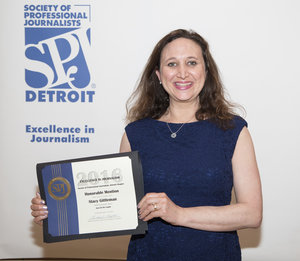
 Stacy Gittleman