
Is one life worth it?
I usually don’t like when Israel is in the news. That is because US media coverage of Israel is rarely about the medical advances of Israeli doctors, or technological breakthroughs that happen in this tiny country with the world’s most high-tech startups per capita.
Coverage is usually about Occupation. Conflict. Tit-for-tat attacks and “disproportionate acts of aggression” by Israel to her neighbors, most who are hell-bent on the destruction of the only country on the planet with a Jewish majority.
So last week, when news first surfaced about Gilad Shalit, an Israeli soldier who was kidnapped in 2006 by Hamas, I immediately thought it was bad news. The person who was telling me the potentially good news was sitting in the passenger seat of my car. She was a teacher. And she had vested interest in the outcome of one of the most unprecedented prisoner exchanges in Israeli history. Because she was Israeli.
My guest was Inbar, one person in an eight-member Israeli delegation visiting Rochester area schools, both Jewish and non-Jewish, as part of the Partnership 2Gether Education Bridge program, sponsored by the Jewish Federation of Greater Rochester.
Israeli teachers and community leaders visited both religious and secular public schools such
as Scribner Elementary School in Penfield, Webster High School; and Twelve
Corners Middle School and French Road Elementary School in Brighton. Questions
from children in younger grades included what types of sports are played and
what kids wear in Israel. High school students posed more ethical questions
about religious diversity and the current prisoner swap that unfolded each day
of the Israeli’s visit.
They stayed with hosts, both Jewish and non-Jewish.
Does it shock you that Israeli Jews, like many Americans, struggle with their own Jewish identity? Is living in Israel enough for them?
The Israelis left Rochester with an enormous appreciation of the degree at which Americans tolerate one another’s different customs, religions and different levels of observance. They hopped around in our sukkahs. They attended services in our synagogues and many of them saw women participating in religious congregational life for the first time. Women here can be rabbis. Women here in America can read from and be called to the Torah for an aliyah. Then, they went shopping.
From what our Israeli guests told me, many have chosen a purely secular life, though in Israel, all Jewish holidays are national ones. Most Israelis are tired of being dictated by the religious right, which have a very strong hold on government. But, after visiting American Jews, who try to mix traditions with modernism, they want to welcome back Jewish traditions into their lives, but on their terms. As secular as they are, the lives of Israelis, including decisions made by the Israel Defense Forces, are governed by Jewish values. One of these values is the commandment of Pidyon Shvuyim, the redemption of captives.
As the week went on, the pending release of Gilad Shalit in exchange for Arabs with known blood on their hands, weighed heavily on our guest’s minds. Was it really true? Was Gilad coming home at last? And would he be released alive?
Gilad was kept in our hearts, prayers, and classrooms all week. We read from a story that Gilad wrote when he was only 11 years old. It had been illustrated and published into a book. It has been read by children the world over as a message of peace.
In the very early hours of Oct. 18, I climbed the stairs to the guest bedroom in my attic to wake Inbar with some very good news. Gilad Shalit, 25, was home and free.
Many have questioned the logic of this lopsided swap. As TV coverage streamed the news later that day at a gym where I was working out, a fitness instructor apologized if her question sounded crass, but she asked if he was worth it.
What do you think? Is one life worth saving?
October in New York: East Hill Farm/Folk Art Guild Open House

Last Sunday morning, though I could have slept in, I woke up early. I woke up my family too. I told them we were about to take a trip into the country. No, we weren’t going through a corn Maze.No, there would be no pumpkin catapult contests. But I promised them, they would enjoy it. They were going to have a good time. Because I SAID SO!
Life has been way too hectic lately. I feel like I have barely seen my three children since late June. It seems like no sooner did my older son and daughter return from sleep-away camp and I washed all their laundry, the summer ended and so began the school grind. Homework and tests. Track meets and band practice.
But last Sunday morning, we had this glorious sunny perfect day. And we had no school and no work. I just wanted one chore-free day of me not nagging anyone spent out in the country. One day of me not badgering anyone to stop texting friends while I am talking to them or stop playing games on the computer.
So off we went.
The ride along Canandaigua Lake had the whole family, plus a friend of my son’s, singing along to “American Pie” on the radio and marveling at the colors of the trees that dotted the hills
as we whizzed past withering cornfields.

To reach our destination: the East Hill Community Supported Agriculture (CSA) Farm and Folk Art Guild in beautiful, Middlesex, NY. There, we got a chance to see where our vegetables were grown all summer.
East Hill Farm is a project of the Rochester Folk Art Guild, a nonprofit organization and community of craftspeople and farmers. Since 1967, they have grown food and produced handmade practical folk art on a 350 acre farm. East Hill Farm uses old fashioned, chemical-free, hands-on organic methods to grow fruit, vegetables, herbs, eggs, pigs, and chickens for the community and for sale through our CSA and markets.
For the past 20 weeks, our family took part in a great experiment of owning a CSA share. Each Friday since mid-May we were presented with a portion of vegetables, fruit, herbs and flowers organically and lovingly grown by a group of young entrepreneurial farmers. Whether it was spring’s excessive rains or July’s excessive heat, we shared in the farmers’ risky dance with Mother Nature.
The farm had limited cell phone service so we got a chance to sample the simpler, slower style of life. We actually got a chance to catch up, share and talk as a family. How many times are family members distracted from each other by screens: laptops, DS games, cell phones, iPods?
Well, on this day in October my teen-aged daughter actually sat and talked to me. She sat and reminisced with me about the first time she used a pottters wheel this summer at camp as we watched a master potter throw and mold a clay jar before our eyes:

How many toys, clothing, dishes do we buy that are made of cheaply made mass-produced?
At East Hill Farm, in the woodworking shop, bare-footed craftsmen showed off their lathes.

And my kids played with real wooden toys.

 Made in the USA.
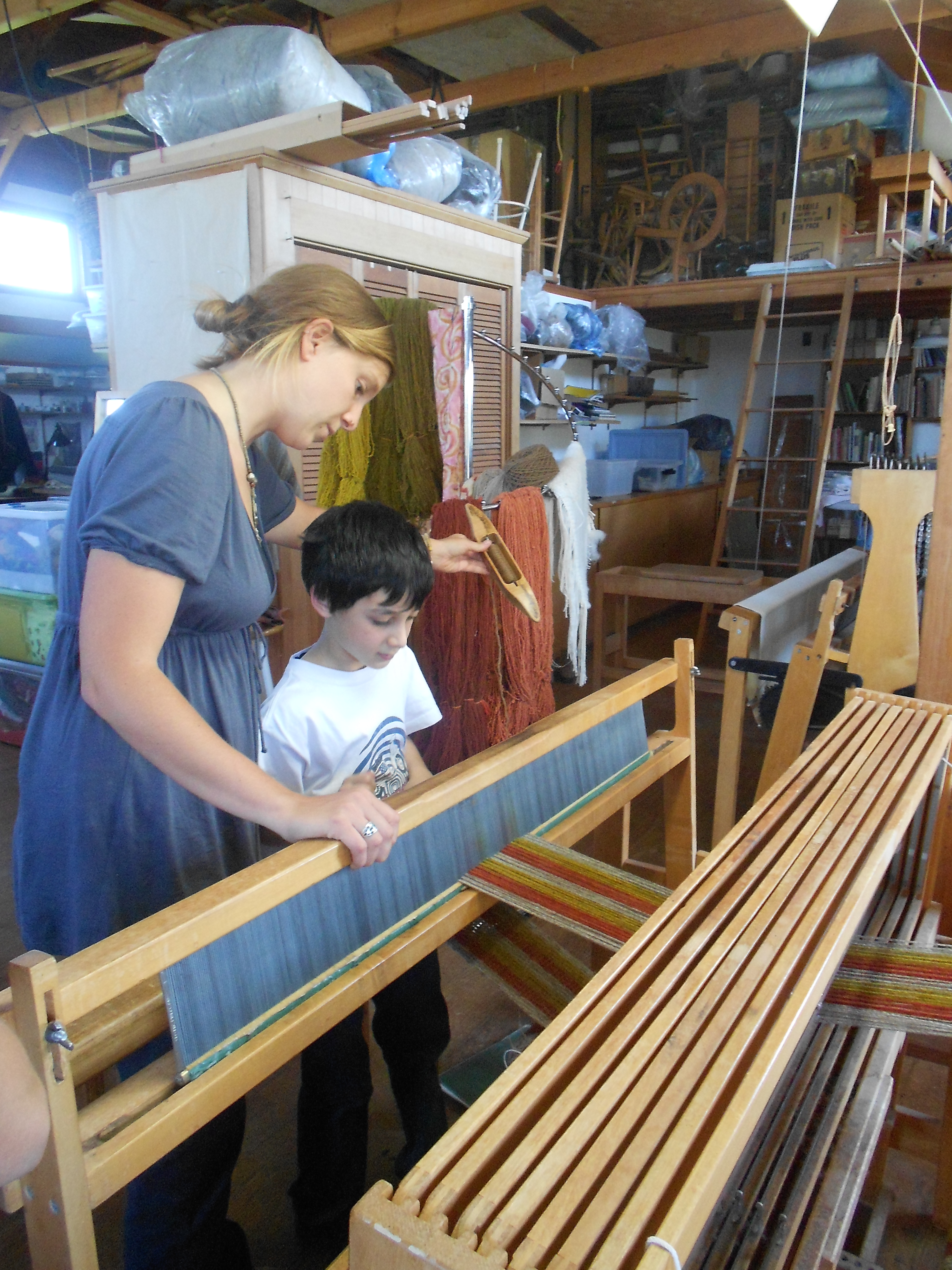
Then, in the weaver’s studio, my son got to try his hand at a loom, using wool that was dyed by an apprentice, the same young woman who brings us our week’s worth of vegetables. Thank you, East Hill Farm farmers. It’s been a great summer.
Curbing Anger, Switching to Decaf: Yom Kippur

Yom Kippur, the Day of Atonement and the holiest day on the Jewish Calendar, begins tonight at sundown. It is a day of deep self-reflection and examination. Included in the liturgy of the day is a prayer we say over and over again throughout the 25-hour fast. The Al Cheyt prayer is a laundry list of sins and transgressions that we may have committed during the year. Most of them are not against Gd. The big sins listed are not: I played golf on Saturday instead of attending synagogue; or I ate a bacon double cheeseburger at McDonald’s ……
Most of the transgressions that are found within the prayers in Yom Kippur involve what fellow human beings do and think about one another. Most of the sins involve our ill behaviour. Most of the sins involve crimes of ill speech.
I asked my Hebrew school students what wrongdoings they see in their immediate lives. And from what they told me, we live in an angry society.
- One student, while waiting in line at Wegmans, overheard a customer yelling at a cashier that she had charged her too much for an item.
- Another student, again at Wegmans, witnessed one customer chasing another customer claiming that he had hit her shopping cart with his and had not apologized.
- One kid said his dad yelled way too much
- Another hand went up and a seventh grader confessed that his mom got mad because a food server at a Bruggers Bagels informed her that they did not have the exact flavor of bagel she had requested.
Road rage. Rage against stewardesses on airplanes. Angry Birds. Let’s face it, there is way too much anger in our society.
I am no innocent in this department.
This week my family experienced an onslaught of technical difficulties. My bottom freezer would not seal properly and there was a snowstorrm of frost accumulating. I quickly blamed this in my youngest son, who often puts all his weight (well, he is only in the fifth percentile of his age group for weight) on the freezer door when looking for an ice cream treat. The frostier my freezer became, the angrier I got at my son.
My computer, a Lenovo, which really turned out to be a Lemono, had to go back in the shop,for a third time. I was getting very angry at the business that sold me this computer.
As I spent the entire Monday morning waiting for the Sears repairman to come for my freezing freezer, I could feel my anger swelling. Where was he? Why did I have to reschedule my day and wait around from 8 a.m to 12 p.m. and here it was 12 and he still had not yet arrived?
When he did come, I did not greet him as warmly as I should. But he did to me. Mike the Sears repair guy shook my hand as he humbly apologized for being stuck at another call all morning fixing a tricky washing machine. He put on plastic booties over his shoes so he would not bring extra dirt into my already messy house.
He quickly pulled all the shelving out of my freezer. Got to the bottom of the problem: too much build-up of frost around the door. My son was off the hook. Mike also remarked that he had been here before and asked how my oven was doing.
He had been to my house to repair an oven I had long replaced. He remembered me.
After cleaning out my freezer, he apologized for getting melted ice on my floor as he replaced the freezer shelving. My anger melted.
“Really, it’s all okay.” I said.
God sends signs in funny ways to help us put life in perspective. Sometimes, it’s in the form of Mike the repairman.
This year, I will pray to try once again to stop myself from jumping to angry conclusions.
Maybe curbing my caffeine habit will help. At the very least, it will prevent a caffeine withdrawal headache that is bound to hit most of us fasters by 2 p.m. tomorrow.
May your Yom Kippur Fast be one that is meaningful and anger-free.
Eating my way through the CSA: Roasted Tomatillos

 With the fall harvest approaching, my first year in subscribing to a local CSA, or community supported agriculture farm, is coming to a close. My family signed on to share a share with another family: good friends we have known through school, soccer games, and synagogue for over ten years. We decided to go in together in a CSA share as one brave experiment.
The very wet spring that gave way to a very dry hot summer created spotty conditions for the young farmers of the East Hill CSA. Buying into a CSA comes with its risks and rewards, as we were warned. But in the end, joining made me feel good that I am helping local, sustainable agriculture and like the farmers, I am taking a gamble on Mother Nature in hopes of bringing healthy food to my family’s table.
Highs of belonging to a CSA included (for us at least):
- The discovery of Kale and Kohlrabi that can be oven baked, salted and eaten like chips;
- Fresh herbs;
- A weekly sunflower or wildflower bouquet in midsummer;
- Patti pan squash;
- Bags of mixed greens for salad that include edible flowers like nasturtium
- Pints of home-grown grapes that really taste like grapes (my daughter proclaimed they tasted like grape candy). Delicious, if you can work your way around the seeds.
The lows
- Discovering that the weekly box of bounty is not all that bountiful for two families;
- Sharing one eggplant or two (very puny) sweet potatoes can be an exercise in tactical negotiations between two families (Weekly bartering included exchanges like: “You take the sweet potatoes, I insist!”; “Are you sure?”; “Yes, you take the sweet potatoes, but can I have the one cucumber”; “My kids don’t like Swiss Chard, really, you take the Swiss Chard this week …I’ll take the tomatoes…” and so on.);
- Beets. Though the beet offerings as of late are getting more plump, the tiny beets at the beginning of the season in my opinion were not worth the stained hands and countertops for their size;
But readers, as the headline of this blog post promised, this post is about Tomatillos. It’s also about using the blogosphere to find recipes for my CSA goodies.
Since I’ve been blogging, I have come to appreciate search engines. I find it interesting to learn from my blog stats what search terms draw people to my blog. For example, hundreds of people searching for “arugula” or “arugula leaf” have found their way to my blog. So, after my friends decided to bestow me with this week’s share of almost two dozen tomatillos, I returned the favor to the blogosphere by searching for Tomatillos on WordPress.
If you find that you have in your possession a lot of these late-season green, globular fruits with a papery shell, you may want to give this recipe a try for roasted tomatillo salsa that can be used for enchiladas. I found it on Angelinna’s Cottage Blog. Thank you Angelinna, whoever you are.
Will there ever be peace in the Middle East?
I thought about writing some long diatribe about how many times Israel holds out the olive branch and how the Arabs never miss an opportunity to miss an opportunity to make peace with Israel.
Then, this fell into my newly revamped Facebook feed. Enjoy. If it wasn’t so funny, it would be sad…
Finally the dreams have stopped

 When I woke up the morning on 9/12, like everyone else, I wished the whole thing was a dream.
Then, at night, images of the World Trade Center entered my dreams at least twice a month, for the next nine years.
It’s no wonder I dreamed about these iconic buildings, buildings I grew up with, beamed with pride at.
But the last time I saw them was looking out at them from my grandmother’s hospital window. It was July of 2001. Though they passed away years later, my grandparent’s health in earnest began to fail that summer. As I held her hand,I said to her “Hey, at least you have a great view of downtown. Look at the Towers. Look how beautiful they are.”
And they were on that day, across the East River. So crisp a view.
And just a few weeks before September 11, my dad had a heart attack. He did survive, to teach, to live, to continue biking and traveling, and enjoying his grandchildren. But I think it was the attacks of 9/11 that truly broke his heart.
So, is it any wonder my brain created for years images of the World Trade Center?
Sometimes in my dreams I would be falling, floating up, up, up, past desks and cubicles and giant, narrow office windows.
Other times, I’d be in an elevator, thinking, I shouldn’t be here, I need to get out of here.
In some dreams, I’d be outside, and there they were, the Twin Towers, just there, like they were a backdrop in a movie.
Or, they would appear as ghost buildings with police barricades around them. I’d walk past them and yell at them. Go away. You are gone. You shouldn’t be here any more.
Upon wakening, I wouldn’t always remember that I dreamed right away. Of course, it would hit me in the middle of my day. I’d be in the cereal aisle at the supermarket, and I would stop dead. Cold. Oh, God. I dreamed about them. I dreamed about the Towers again.
But now, 10 years later, the dreams have stopped. They stopped when Osama bin Laden was finally, justly, wiped from the face of the earth. They stopped when finally, Ground Zero was no longer just an empty, gaping hole but the beginnings of the newly emerging Freedom Tower. New York is rising again.
I know that putting a building back up cannot bring back the souls lost on 9/11, but it is my hope that this new, so carefully thought out complex of buildings and memorials can help ease the dreams and memories of so many of the families from tomorrow and onward. I wish them only the sweetest of dreams.
Can 9/11 ever be just another day? And what will I tell my students?

Making the past relevant: students at a Jewish summer camp learning about one sad event, the destruction of the Holy Temple, through the tragedy of 9/11
What a challenging day to make a first impression. On the tenth anniversary of the September 11, 2001 terrorist attacks, right around the time when the towers crumbled, I will be standing before my class of newly minted seventh graders. I will have to save face and cheerfully smile at my new students and welcome them to a new year of Jewish learning.
All the while, I know at this time I would usually be crying. All the while, I know, in truth, my students would rather be sleeping in on a Sunday morning. I’m wondering if any other Jewish educators of middle school aged children and older are feeling the way I do; about how to get through this first day.
Let’s hope I don’t lose it and get all teary-eyed in those first introductory moments about an event that happened when my new students were barely out of diapers. After all, ten years to a 13-year-old is a very long time.
I can hear the conversation in the Hebrew School carpool ride home tomorrow: “…..my new teacher, like, cried on the first day. Ewww.”
For better or worse, time does go on and obligations do not stop just because of a date. Over the years, the date of 9/11 shifted around the days of the week. There have been weddings and homecomings, meetings and business trips. Sometimes, the anniversary falls in the middle of the week. Sometimes it happens on a Tuesday, the very day of the attacks.
What do I usually do between 8:45 and 9:00 a.m. on the anniversary of 9/11? I’m usually alone. Everyone else in the family has left for school and work. I feel as I should watch the real-time replay of those horrible moments, as CNN plays it every year. Sometimes, I watch it. Most years, I hide in my laundry room in the basement and have a good cry. Then I get on with my day.
What do I usually do the first day of a new school year with my new kids? I go over expectations. Together, we make a list of class rules. I review classroom procedures and what we will be learning. Also, we have some ice breaker games to get acquainted.
Can we ignore the events of a decade ago and go on with business as usual? Talking about something as painful as 9/11 on our very first day will be a very difficult thing to do, but just as difficult to ignore. I don’t think crying in front of them, or showing the slightest tear will be an option. Not while we are still strangers.
It’s not that difficult subjects don’t arise in Hebrew school. In fact, it’s these really sensitive topics that have motivated my past students. They really open up and we have amazing conversations. (That’s what I love about the seventh grade, they never cease to surprise you on what they can handle.)
Kids in the seventh grade are ready to not to be kids anymore. After all, it’s the year of their B’nei Mitzvah, their coming of age. They want to talk and they told me last year that sheltering them does them a disservice anyway.
I remember last year, sitting on the floor with my seventh graders, discussing the Holocaust with them and how the lessons they learned from the Shoah still mean something to them today. But that discussion happened on one of the last days of school, not the first.
So, come Sunday, I’ll stick to my plan. Unless the plan needs to change. In the Talmud, the rabbis instruct to “go with the way a child wants to learn.”
So, if the topic comes up, I’ll share. I’ll tell them that a decade ago, I was in the middle of filling out my own Rosh Hashanah cards, wishing friends and family a happy New Year when the planes hit. I’ll tell them that I wrestled with the choice of sending those cards out at all, but in the end I did. Because that Rosh Hashanah, praying for the New Year seemed more important than ever before.
So if I have to scrap my whole lesson so we can gather on the floor, open up and talk about how to approach the madness and the sadness of this day, so be it.
Then, perhaps the next week, they will derive some meaning during Tefilot, or prayers.
They really will thank G-d for sustaining them and giving them the energy for waking to a new day.
They really will thank G-d for making them free and not a slave.
They really thank G-d for strenghening us with courage.
Topic #230: The meaning of the word kfajgi
I’ve been waiting for just the right time to blog about this made-up word that runs in my husband’s family. I was almost embarassed about the existence of this word but since WordPress is asking, I’m telling.
Now, kfajgi (pronounced ke-fag-ee) is a word that may have either Italian, Slavic or Yiddish origins. Let me show you how my mother and sister-in-laws use this word.
Kfajgi is used in terms of food: mostly pasta, sometimes lettuce.
For example, if you drain a pot of spaghetti and you let it sit in the colander for too long, it becomes kfajgi.
Or, if you leave lettuce in your lettuce crisper too long, and it is beyond use in a salad, getting soggy, it is kfajgi.
Perhaps, if seeing this, my mother-in-law can elaborate. Thanks for the inspiration, mom!
Post-a-Day Challenge: a story in six words
Post a day came up with a challenge to come up with a story in six words. I don’t think I’ve used so few words since I wrote a haiku in grammar school. Here goes:
Camp’s Over
Kitchen’s humming
Laundryroom ready
With friends like NPR and Egypt, who needs enemies?

 Picture this:
New Jersey is its own independent country-state, and it borders with another state – say, Pennsylvania – that has cold yet peaceful relations. On another adjacent border, let’s pretend that Delaware, is a hotbed territory for terrorist activity bent on destroying the Garden State.
You are on a chartered bus headed down from New York City to Atlantic City via the New Jersey Turnpike. You are with the guys or some girlfriends to have a little getaway to kick back for a weekend of gambling and enjoying the nightlife of and beaches of this resort town. Then, out of nowhere, your bus is ambushed by some armed terrorists who snuck in from Delaware through Pennsylvania.
They shower the bus with bullets and kill several of the passengers on board.
In defense of this bus, New Jersey military forces swoop down on the attackers and kill some of them on the spot, no question asked. But some flee across a state border, a border that is supposed to be monitored by the military of this other country to prevent terrorists from infiltrating into New Jersey. The New Jersey military pursue the fleeing terrorists and as an indirect result, some border patrol soldiers die.
Then, it is New Jersey, not the bordering state, asked to make apologies by the international community.
Does this scenario sound ridiculous? From the perspective of most Americans, of course it is. For the most part, our borders are secure and generally peaceful. And American civilians are so rarely attacked by terrorist organizations.
But Israel once again is being criticized for defending herself after tour buses headed for the resort city of Eilat were attacked by terrorists (excuse me NPR, they are not militants) from Gaza.
I first got word of these attacks through social networking: friends in Israel posted links to the news on Facebook. I listened to NPR the whole morning and not a single mention of these unprovoked attacks on civilians by a terrorist cell from Gaza that infiltrated the Israel-Sinai border Israel shares with Egypt.
Only when an Israeli airstrike into Gaza killed several members of a terrorist cell and, unfortunately, a 13-year-old boy, did NPR report the news. And, why did NPR have to use language like “Israel wasted no time retaliating” and record the sounds of people mourning for the gunmen and those killed in an Israeli airstrike at a Gaza morgue? Did NPR list the names and find relatives of Israeli victims and record their crying?
As much as I love NPR’s coverage on any other topic, such as their summer reading lists from All Books Considered, and their cooking segments with Nigella Lawson, they have boiled my blood on Israel coverage for the last time. Don’t count on my support any more.
On the other side of the word, my daughter wrote me from Camp Ramah in Canada. She said that she saw her Israeli counselors crying and comforting one another after hearing the news from Southern Israel. These Israelis were not shouting for revenge, they just hugged and consoled one another. Because no one in Israel wants violence, because any reprisal attack could involve a brother, sister, uncle, or friend who is serving in the Israeli Defense Forces. Because many of these counselors themselves just got out of the army.
Though the news from Israel is horrible, I was glad that my daughter was moved by her Israeli counselors comforting one another. It will make her connection to the Jewish state that more tangible and real. She will hopefully reunite with these Israelis on our visit to Israel in December.
Because, yes, we are still going.
About Me

Kreativ Blogger

Versatile Blogger Award


 Stacy Gittleman