
Got a Sweet Tooth and a Big Heart: Attend Camp Mak-A-Dream Benefit Oct 16 at the Somerset Collection
 Was honored to write this piece that appeared in the October 9, 2014 issue of the Detroit Jewish News. I hope I did right by the young lady featured in this story, who, attended Camp Mak-A-Dream for three summers. Catherine is now a student at Arizona State. who has become a champion for speaking out and speaking for coping with living with brain cancer.
When Catherine Blotner of West Bloomfield was 17, she underwent a risky brain surgery procedure to remove a benign yet deep and invasive brain tumor that for years was causing seizures and threatened her vision and hearing. The doctors said the surgery could cause permanent speech and cognitive loss, and even the loss of her ability to walk.
Now, Blotner is 19 and a student at Arizona State University studying family and human development. Not only did she keep her ability to speak, she is a blogger and founder of #btsm (brain tumor social media), a monthly Twitter chat open to anyone seeking resources on treating brain tumors. Neurologists and healthcare professionals seek her out for speaking engagements and conferences focused on people coping with brain illnesses. On the back of her business card: her twitter handle – @cblotner, plus a photo of an MRI of her brain.
Her mother, Ann Blotner, attributes her daughter’s confidence, coping strength, and leadership qualities in part to the summers she spent as a camper at Camp Mak-A-Dream – a free camp under the big skies of Montana for children and young adults with cancer. She has been both a camper and a counselor there, including the weeks leading up to her life- altering surgery.
“Through Camp Mak-a-Dream, Catherine has become confident and connected into a supportive network of healthcare professionals as well as a peer group who are going through similar health challenges that have changed their lives,” said Ann.
The Michigan Chapter of FRIENDS OF CAMP MAK-A-DREAM hosts its “sweet” 16th annual “Cookies n’ Dreams” fundraiser 5 to 7 p.m. Thursday, Oct. 16 at the Somerset Collection in Troy. Food, beverages, entertainment and activities for all ages will be provided throughout the evening. Admission for adults is $60; children under 17 pay their age and children 3 and under are free. For more information go to Camp Mak-A-Dream
According to Peter Grimes, the organization’s executive director, the long-standing event has attracted “eager sponsors” and area bakers donating hundreds of cookies as well as their confectionary time and expertise to the family-friendly event. The bake-off expects to draw 600 attendees and raise at least $130,000. Funds raised in Michigan pay for the camping and transportation costs for 70 children from Michigan. Grimes added that former campers like Blotner come back to volunteer as young adults and offer support to the campers through talks and workshops.
The camp was founded by Sylvia and the late Harry Granader of Beverly Hills, Mich. Granader owned several McDonald’s restaurants and founded several Michigan-area Ronald McDonald houses. He donated 87 acres of Montana ranch land to build a camp especially created for children and young adults facing life-threatening diseases such as cancer and brain tumors. The camp welcomed its first campers in 1995. Since then it has hosted more than 6000 children and young adults, offering typical camping activities such as swimming, a ropes course, archery, hiking, arts & crafts as well as a state of the art medical center, staff and volunteers to allow the campers to get cancer treatment while they are at camp.
Hadar Granader of Bloomfield Hills wishes to carry on his brother’s legacy of granting sick children a summer out in nature where “no child will feel embarrassed or laughed at because of their illness.”
“Life is especially hard for kids with cancer because they become cut off from everyday life and healthy kids have a hard time relating to them,” Granader said. “At Camp-Mak-a-Dream, children with cancer get to bond and share memories and friendships that help sustain them long after the summer is over.”
Conform or be cast inside out – – A rant on School dress codes
 The other night, we had a family outing to a very large fair. The kids rode on typical fair rides that spin you around and hurl you upside down into the air after eating typical fair fare like corn dogs and fried dough.
I am not a big ride person. At all. But I do like to people watch at carnivals and fairs. I like to see what people are wearing, or what they are not wearing enough of so everyone can see the writings or etchings that cover their arms and legs in the form of a tattoo.
At least, under those summer carnival lights, there is still somewhere left on earth for self-expression.
Today, my 5th grader came home from school. His shirt was inside out.
Did I miss the note that today in school was inside out day? It’s late May. I’m kind of done with checking homework, checking notes.
No. A teacher in school made him turn it inside out.
Why?
The shirt was “too religious.”
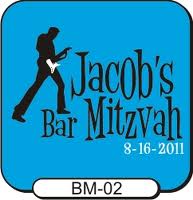
The shirt in question said: “I rocked out at xxxxxx’s Bar Mitzvah” It was black and had a guitar emblem on it hand designed by my daughter artist-in-residence. You would think that an art teacher would have admired the shirt for its individuality. But no, she in front of the whole class made my son wear his shirt inside out for the rest of the day. No one had paid any mind to my son’s shirt until he was asked to turn it inside out.
The shirt was leftover from his brother’s Bar Mitzvah.
From three years ago.
You can blame me, teach, because he has so many of that shirt in his drawers and there was probably no other shirts left because I’m a bit behind on the laundry.
Initially, I became furious that my son could not wear anything “religious.” Would a Christian kid be asked to remove a cross? A Muslim kid remove her hajib? God in heaven, I hope not.
So I called the school with my concern and calmly (okay, NOT calmly) explained the situation.
“Oh yes, kids are not supposed to wear shirts they get from Bar or Bat Mitzvahs. It makes other kids feel …. bad.”
Sorry, but I guess I never got that memo either. Because my son, and his brother and sisters, have tons of T-shirts from Bar Mitzvahs. And sports teams. And youth group weekend retreats.
In fact, if it weren’t for all those shirts they received when they worked the Bar/Bat Mitzvah circuit, why, they may have not had any clothing that school year at all!
Giving out T-shirts, or for those high-end B’nei Mitzvah parties, sweatshirts (!) has been the popular party favor for decades.
The school’s rationale is that these types of Bar/Bat mitzvah T-shirts distract the student from their academics. The school’s rationale is that this rule is there to protect the uninvited from feeling excluded.
Let’s examine how other items of clothing, or any other actions we do, may make people feel excluded. If we are really going to take inclusiveness to the highest level, perhaps school boards should consider banning the following items of apparel:
Sports or athletic clothing: Lots of kids wear varsity clothing and some may even have varsity letters. This may make the non-athletes around them feel sad or unsatisfied with themselves.
Concert T-Shirts – I remember in high school the kids who spent all their money, or got money from their parents to go the hottest tours and they would wear their T-shirts that they bought from that concert that very next day. I remember thinking how much I too would have loved to see that band and then …. I got over it.
Vacation T-Shirts: When kids from families who can afford plane tickets during peak vacation time return from Florida or their time share in the Caribbean, it makes the white, pale pasty kids who didn’t escape to somewhere warm feel very excluded.
Designer clothing – My son speaks of a classmate who he swears gets a new pair of $200 sneakers every other week. That could make anyone -ANYONE – who is not a Joneses – feel excluded.
I presented these ideas to the principal when he called me back. I asked him if, during the months of October through December, if he could make sure that there would be no showing of anything red and green, or that no one in school wears Christmas lights or ornaments as necklaces or earrings, or that no one be allowed after Christmas to wear any sweaters with reindeer or candy canes or snowflakes or fir trees on them.
Absurd? Well, it might – MIGHT – make a tiny part of the school population feel – excluded.
I asked him how much longer he wanted to continue this ridiculous conversation with me. But if the ridiculous rule were not there, we would not be having this ridiculous conversation.
Want to see the dress code rules? Here they are. Please see if you see any mention of Bar/Bat Mitzvah or any party swag in here:
14. STUDENT DRESS
District students are expected to dress, groom, and attire themselves in a manner that is not
potentially dangerous, does not distract others or disrupt education, and does not convey a
message contrary to District policy. The following are examples of dress, grooming, and attire
that may violate District policy. This should not be considered an exclusive list.
Potentially Dangerous Items:
Chains, pointed rings, metal spikes, clothing or attire restricting physical movement,
etc.
Distracting or Disruptive Items:
Clothing that exposes or draws unusual attention to breasts, buttocks, or
genitals; styles that expose undergarments; bizarre clothing, grooming or attire that
focuses attention on a student or group of students at the expense of learning, such as
nightwear or beachwear, etc. Students must wear shoes.
Contrary to District Policy:
Clothing that advertises or promotes smoking, alcohol, or the illegal use of drugs;
clothing reasonably likely to be perceived as promoting racial, ethnic, or religious
discrimination or intolerance; clothing reasonably likely to be perceived as advertising
or promoting illegal behavior; clothing reasonably likely to be perceived as obscene,
lewd, vulgar, or plainly offensive, etc.
What are we doing when we have rules that go to the extremes to coddle the middle schoolers feelings?
We do our kids no favors by not teaching them to start developing a tough skin and not to feel disappointment. Yes, have a tender heart, but start thickening that skin by age 12 or 13. So it won’t hurt so badly the first time you get rejected. By a college. Or a boy. Or a job. With that tough skin, you know it will hurt for a little. And then, you’ll go on.
Know now, starting in middle school, that even the most seemingly popular kids are frightfully insecure, and all you need in life is a few good true friends.
You don’t need everyone to be your friend. But you need to find that bunch of friends who will include you for YOU. Not because you are going to have the fanciest Bar Mitzvah in town and give out the best T-shirts.
Better to learn in middle school, that no, you won’t get invited to every party. You may or may not go to prom. But you’ll know the kids who did, because guess what, in HIGH SCHOOL, along with that expensive prom ticket, guess what you get to wear Monday in school?
A sweatshirt. Saying you went to prom.

Rite of Passage: The college tour blog posts

Howdy, people!
Yes, it’s been ages since I have written a post. But this blog post will be merely a placeholder to say, come back, I promise, I will have something to say of what my life has been like over the past few weeks.
Most of what has been occupying my family’s time is the college search for our oldest child.
This spring “break,” the family took a most unusual road trip. It did not involve going back to our hometowns. It did not involve sleeping in our childhood bedrooms and seeing extended families.
It was all about visiting colleges.
In the next few blog posts, I will be sharing our experiences of our visits to Case Western Reserve University in Cleveland, and in Pittsburgh, the contrasts between Carnegie Mellon University and the University of Pittsburgh. And, because we live in southeast Michigan, this series would not be complete without our visit to the University of Michigan in Ann Arbor.
In the next few blog posts, I will be discussing my impressions of the presentations given by each schools’ admission departments, what you can learn on an official college tour, and what you can further learn from taking a real-live student to lunch. I will also write about the “vibe” of each campus and the surrounding cultural aspects of each town.
I will also be writing about the issue of early admission, and how the Ivies and other prestigious universities continue to become even more selective in their admission process.
At that post, I would like hear from you, dear readers on the worth of a college education received at an Ivy League or other prestigious schools. Is it worth the high cost of tuition if it will open up doors for the student at the onset of graduation? Is it better to get an undergraduate education at a good public state college and then gain the prestige of attending an Ivy League for graduate school? These questions are in hot contention right now and I would love for you to chime off on that post.
So, stay tuned right here, and I promise I’ll be cranking these posts out in the days to come. And, if you are also in this stage of life with your children, feel free to comment on each post on your college searches.
Minding Those Manners on the Bar/Bat Mitzvah Circuit

Izzy Randel, 12, Scott Katz, 11, both of Farmington Hills; Matthew Brown, 12, of Franklin; Jacob Kroll, 12, of West Bloomfield; and Jessica Gordon, 11, of Farmington Hills play the family blowing out the candles at a bar mitzvah.
Minding Your Manners Young people learn the rules for sharing in their friends’ big day
Stacy Gittleman | Special to the Jewish News
PHOTOS BY JERRY ZOLYNSKY
On a typical Shabbat in any Jewish American house of worship, there is a young man or woman seated on the bimah. Dressed in a brand new suit or dress, these kids try to calm the butterflies in their stomachs before being called to the Torah for the very First time. You may think they are the only one in the building going through a rite-of-passage ritual. However, their peers sitting in the sanctuary are also enduring their own coming-of-age test as they navigate the bar/bat mitzvah ceremony and party circuit. It may be their first exposure to a formal occasion in an increasingly informal society. Bar and bat mitzvah etiquette starts with getting that invite in the mail (and responding in a prompt manner) and ends with knowing whom to thank at the end of the evening (the parents), and how many favors you are allowed to take at the end of the party (hint: one per guest). Fortunately, there are businesses like Joe Cornell Entertainment in Southfield, co-owned by sister and brother team Steve Jasgur and Rebecca Schlussel, to help these young adults learn the unwritten rules they are expected to follow.
On a Wednesday evening Hebrew school session back in February, around 35 sixth- and seventh-graders at Adat Shalom Synagogue in Farmington Hills were treated to an afternoon off from their regular studies to a 90-minute Joe Cornell Entertainment workshop. The workshop, complete with a candlelighting ceremony, cake and dancing, was a highly condensed sampling of a 12-week course offered by the company that teaches adolescents the fine points of attending a dance or other social occasion. Schlussel has been offering b’nai mitzvah etiquette for many years. Having just planned a December 2013 bar mitzvah for her own son, she now spoke through the lens of her personal experience. “When you get that invitation in the mail, find the family calendar.
As soon as you know that date is clear, you respond ‘yes’ and put the response card in the mail, or email your reply,” she instructed the students, seated around a dance floor where they would soon show off their best moves. “Your friend really wants you to come to their bar mitzvah, and the parents really have to know how much food to get — and how many napkins to order from the caterer.” I must offer you full disclosure here: In addition to being a writer, I am also the sixth-grade Hebrew school teacher at Adat Shalom. Throughout the year, I’ve watched my students mature from an energetic bunch of little kids into inquisitive, emerging young adults who demonstrate that they are prepared to do the work and studying required to become a bar or bat mitzvah.
As their teacher, I get an inside track on the mindset of the preb’nai mitzvah scene. At the start of class, a student will enthusiastically share the news with me that they received their bar/bat mitzvah date and Torah portion. Others will tell me how they recently attended a bar/bat mitzvah and to avoid getting “bored,” they actually made an effort to follow along with the service and the Torah reading. Or look up their Torah reading. This is music to a Hebrew school teacher’s ears. Continuing to focus on the ritual aspect of the b’nai mitzvah, Rabbi Rachel Shere led the students through a question-and-answer session of how to conduct oneself at Shabbat services.
She advised the students to tell their friends that it is acceptable to arrive to synagogue an hour later than indicated on the invitation. It is not acceptable to use any electronics in the building on Shabbat, so students accustomed to being constantly wired may have to arrange pick-up times with parents earlier or, at least, use their phones outside the building or in a quiet corner.
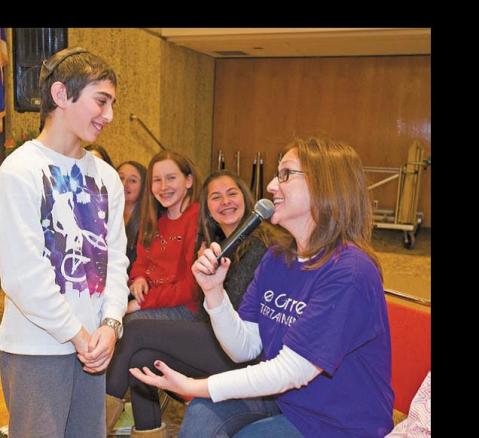
Matthew Berg, 11, of Farmington talks with Re-becca Schlussel of West
Bloomfield about the proper way to say thank you after a bar mitzvah.
“We know that cell phones are a fact of life. But on Shabbat we try to avoid these distractions as much as possible so we can pray with our community. If you must use a cell phone to contact your parents for a ride home, please be discrete about it,” Shere said. Shere added that options for “boredom” during services include taking a short break outside the sanctuary in the synagogue’s youth lounge, where there will be snacks to fend off mid-morning hunger. It is also expected of them to be gracious guests.
“Always remember to introduce yourself to the parents of your friend and thank them for inviting you to this very happy family occasion,” she said. After the more serious lessons, it was time to have some fun. Students played roles of the “bar mitzvah family,” in a mock candle ceremony and were then taught the hora and other dance moves.
According to Jasgur, dancing at a b’nai mitzvah party is not optional. “Dancing for your friend is a fun obligation that shows your friend how happy you are to celebrate with them on their big day,” Jasgur said.
At Temple Israel in West Bloomfield, Rabbi Marla Hornsten said that Joe Cornell Entertainment offered similar workshops to adolescents, and proper dress and behavior in the sanctuary are discussed in the classroom. “Most of all, I hope this is a conversation parents are having with their children long before they are dropped off for the morning service,” Hornsten said. Andre Douville, executive director of Temple Shir Shalom in West Bloomfield, said the congregation prepares the entire bar mitzvah family for the occasion with a few meetings with the clergy that start 18 months prior to the big day. At these meetings, families are encouraged to come to services in the months leading up to the bar or bat mitzvah to become familiar with services and to understand what will be expected of them.
During these meetings, a family may want to share some information on the kinds of kids who are coming to the temple for services. If there will be a large amount of non-Jewish kids, the families have the option of inserting a one or two-lined “synagogue primer” in their invitation envelope about behavior and dress expectations.
The temple has also adjusted the start time of services on Friday nights from 8 to 7:30 p.m. to accommodate sleepy middle schoolers who have been waking up early all week for school. Also, Shir Shalom will “ramp up” the number of ushers depending on the number of young guests.
“We know times are different now. We expect a level of decorum in temple, such as no cell phones and limited conversations. But kids are kids, and we know they are going to be antsy. Sometimes, you have to be a little forgiving,” Douville said.
So, to my young friends in the bar/bat mitzvah circuit, and you know who you are: Do yourself a favor. Learn how to sit in services. Take the time to follow along with your friends’ Torah reading to give them your support — after all that’s what you are there for. There will be a bagel with your name on it waiting for you at the Kiddush as your reward for good behavior.
France Can Take A Lesson in Religious Tolerance from Detroit’s Interfaith Council

On these snowy days I admit I have done way too much trolling on my Facebook news feed. One alarming video clip that came across my newsfeed was a very disturbing video of Fascists in France waving a red swastika flag, shouting Jews Out! Jews Out!
Do they have the right to march peacefully and express their views in a democratic society? Maybe. Have these French citizens forgotten the history of WWII when the Nazis themselves goose-stepped through the streets of Paris shouting the same hatred? Absolutely.
Today’s Germany would not stand for such hate marches, free speech or not. In fact, it is illegal to fly the Nazi Flag anywhere in Germany or have a Nazi rally.
I wonder, in this country which proposes to ban the wearing of any religious symbol or clothing, what they teach their children about religious tolerance.
A few weeks back, I had the honor of attending and covering a “Face to Faith” Journey to Judaism sponsored by the Interfaith Council of Greater Detroit. Sitting in the massive sanctuary of Temple Israel of West Bloomfield with 150 seventh graders, I felt right at home. And you know something, so did the kids. Even if they never set foot in a Jewish house of worship. Even if they never had a Jewish friend.
Cynics might wonder if such interfaith explorations organized by Detroit’s Interfaith Council really teach tolerance. But, after you watch the disturbing and disgusting video of Fascists marching down a street of what is supposed to be the world’s most civilized city shouting “Jews Out!” consider the alternatives.
Here is the article which ran in the Detroit Jewish News
What does a rabbi look like? To the uninitiated, a rabbi wears a long black coat, grows a long beard, and therefore must always be a man.
Temple Israel rabbis, teachers, and other volunteers at Temple Israel in West Bloomfield helped to dispel this and many other misconceptions about Judaism as they guided a diverse group of 150 seventh graders from six school districts through a “Jewish Religious Diversity Journey.” The trip was part of a series of explorations into different religions created by the Interfaith Leadership Council of Metropolitan Detroit.
According to the council’s administrator Meredith Skowronski, Religious Diversity Journeys for the past 11 years has taken young leaders – 25 handpicked students from each school district – on six trips to a different house of worship to foster understanding and a celebration of cultural differences. Participating school districts include Berkeley, Birmingham, Bloomfield Hills, Clarkston, West Bloomfield, and Walled Lake.
Gail Katz, a retired Berkeley teacher and the director of Religious Diversity Journeys, explained that the program fits in perfectly with the World Religions unit of the seventh Grade curriculum.
“The Journey only extends what they are learning beyond the textbook and the classroom,” said Katz as she mingled with the students during a morning icebreaker. “We strive to increase respect and understanding among all students.”
Rabbi Josh Bennett – who is clean-shaven and does not wear a long black coat – kicked off the formal component of the day of learning in the temple’s large sanctuary. Students, impressed by the large golden ark on the bimah, learned about the three different branches of Judaism and the belief in one God, learning Torah and the connection to Israel, which unites Jews across every level of observance
Later in the morning, groups of students took turns touring the building and listening to Rabbi Ariana Gordon explain the cycle of Jewish holidays, the complexity of having a Hebrew calendar that is both lunar and solar, and the odd phenomena this year that was “Thanksgivingkah.”
The students also visited the building’s mikvah and viewed an open Torah Scroll with Rabbi Jennifer Kaluzny.
“These trips are an invaluable lesson where kids get a hands-on learning experience and are made to feel welcome in different houses of worship,” said Kaluzny after teaching a group about how a Torah scroll is made and written.
Over a Mediterranean vegetarian lunch prepared by Mezza of West Bloomfield and sponsored by Temple Israel, students expressed their appreciation for the program, which allows them to explore other traditions and pose questions that would seem inappropriate or uncomfortable in a classroom setting.
Ben Johnston of West Hills Middle School came away from the program with a better understanding of the different branches of Judaism and the customs and holidays his Jewish friends celebrate.
“This program is important to me because we have a diverse society,” Johnston said. “We go to school with different kinds of kids, and as we get older, these are the people we’ll go to college and work with. We must have the knowledge of their backgrounds so we can be more tolerant and understanding.”

Ben Johnston, a student at West Hills Middle school, learns about the role of a mikvah in Jewish life during a Religious Diversity Journey.
Ashley Liles and Maddy Merritt, both of Sashabaw Middle School in Clarkston, do not go to school with many Jewish kids. The program allowed them to peer into a Siddur and not feel embarrassed to ask why it opens up backwards or why the letters look different than English.
 Maddy Merritt left, and Ashley Liles, right, seventh graders from Clarkston’s Sashabaw Middle school, examine Hebrew letters in the sanctuary at Temple Israel at during a Religious Diversity Journey.
The “journey” gave them a better perspective of the history and origins of the Jewish people. Not only did it widen their understanding of Jewish holidays beyond Chanukkah, but the lesson with Rabbi Gordon also gave them a broader understanding of a holiday they would otherwise only know as a “Jewish Christmas.”

Rabbi Jennifer Kaluzny of Temple Israel, West Bloomfield, displays a Torah scroll to seventh graders on a Religious Diversity Journey with the help of parent volunteer Janet Cummins of Birmingham.
Oh There’s No Place Like Homes for Thanksgivingkah
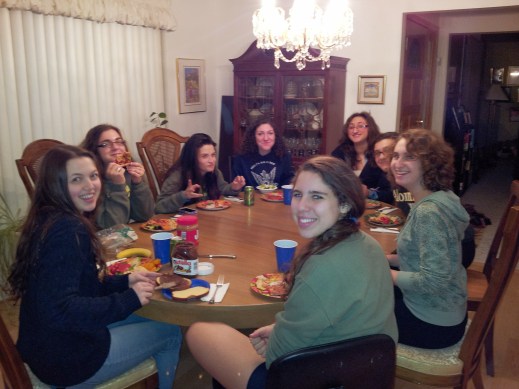
Yes. I know I really botched up the words of that song. But with the odd concurrence of Thanksgiving and the first light of Chanukah falling on the same night, and our first trip back to Rochester since departing for Detroit, my family feels like they are going through some surreal times.
Rochesterians, very well-meaning and sincere, actually said it to me:
“Welcome home!”
“Are you glad to be home?”
The word “home” was not something I expected to hear out of the mouths of my many Rochesterian friends and acquaintances I saw in the weekend leading up to Thanksgiving.
This is a homecoming of a sort. For my kids. Because after I checked off every last detail of what to pack, what to turn off and turn down in our new house. After the kids packed whatever they needed to eat and entertain themselves in the car. After the last seat belt had been clicked and the six-hour trek from Detroit to Rochester lay before us, my children said it:
“We are going home.”
Yes. Rochester is their home. Where they spent the better part of their formative years. It’s where two of three of them took their first steps and all of them lost their first teeth. It’s where their friends live who know them best. Who share some weird private jokes, shared histories, and their own strange way of talking in a fake accent.
For me, Rochester is not home. New York City is home. Or is it? I haven’t lived in the area for almost 20 years.
I am trying to make Detroit home. But it’s tough to make it home when we leave it for holidays. It’s not a home if there are no aromas of turkey and stuffing , and this year, the smell of potato latkes frying in a pan, and the sounds of grandparents, siblings and cousins hanging out in the family room. It’s just a house we live in.
Because home is where you go for the holidays. And if the majority of family do not live in your current city of residence, like the way smaller celestial bodies are drawn to larger ones in the universe, the pull is greater the other way. So home we must go.
Still, Rochester feels a lot like home now that we no longer live here. Yesterday, we spent the day in some old familiar places trying to catch up with as many people as possible. We got hugs everywhere. We are missed. And thought of. I lost track of how many hugs I gave and received. It truly was a homecoming.
But there are places you really cannot return. My youngest wanted to go into his old house. That, we told him, was off limits. He was able to peek into the downstairs family room and said he didn’t like how the new owners painted it blue.
The big kids tried to loiter in visit their old high school. To them, that was home too. They had it all planned out. They would enter the building in the morning, loaded backpacks slung on backs and blend into the stream of hundreds of other teens before the morning homeroom bell. Either in the library or cafeteria they would study and receive friends, and hugs, during their free periods.
But their old principal, who had known them since their elementary school days, apparently never forgets a face. And, knowing that these two faces had moved to Detroit, he kindly but firmly told them that new high school policy forbids non students to visit during school hours. But he gave them a valiant A for effort.
Sometimes, you really can’t go home.
The most Interesting Teens in Detroit raise $$ and awareness for Downtown

Jonah and Sophie Erlich with the “Daven Downtown” T-shirts they are
selling to help the Isaac Agree Downtown Synagogue in Detroit. (photo credit: Detroit Jewish News)
Never underestimate the impact of a school field trip.
Last spring, Sophie Erlich, 14, of Birmingham took a trip to the Isaac Agree Downtown Synagogue with
her eighth-grade classmates from Hillel Day School in Farmington Hills. There, she learned about the synagogue’s past. There, she also became inspired about contributing to Detroit’s comeback and an urban Jewish future.
This September, Sophie, now in ninth-grade at Birmingham Groves High School, and big brother, Jonah Erlich, 16, kicked off a fundraiser for the synagogue, founded in 1921, with their “Daven Downtown” T-shirt fundraising campaign. They sold more than 35 T-shirts for $36 each on their website designed by Jonah, http://www.davendowntown.com/ collections. All proceeds go directly to
help the synagogue.
Throughout the whole process, which is earning them required community
service credits for school, the teens also are learning valuable lesson in keeping inventories, marketing for nonprofit organizations on social
media and running a business.
“I am very energized about the idea of Detroit coming back,” said Sophie, who has friends with older siblings who are moving into the city. “It’s where I hope to live and work when I am an adult and out of college.” Jonah echoed his sister’s sentiments.
“If more Jewish young adults move into the city, they will need a thriving synagogue within walking distance where they can pray and just hang out with other Jews,” he said. “I would be so excited to work and live in Detroit someday.”
To create the right vibe, they asked local designer Kathy Roessner to donate her time and talents to create colorful logo with a “V” in the middle. The T-shirts, printed in Troy, are available in crew and V-neck styles and come in gray and white.
To boost sales, Jonah recruited some video-savvy classmates at Frankel Jewish Academy in West Bloomfield where he is a sophomore, as well as local leaders and Detroit entrepreneurs, to film themselves around town wearing
the T-shirts. The “world’s most interesting man,” a character from a Dos Equis beer commercial, provided
inspiration for the video’s only scripted line:
“I don’t always daven. But when I do, I daven Downtown.”
[vimeo http://vimeo.com/76662698%5D
Anna Kohn, the executive director of the Downtown Synagogue and one of only two paid staff members, said the excitement and entrepreneurship of the teens toward the synagogue proves that young people can make things
happen when they are passionate about a cause.
“We were looking for a way to merchandise, and they beat us to it,” she said. Kohn said she has used the logo
on the synagogue’s website at http://www.downtownsynagogue.org. The egalitarian Conservative synagogue’s Facebook
page has 1,000 fans. It also distributes a newsletter with a circulation of 1,600 informing congregants and the general public about weekly Shabbat services, a Thursday morning minyan and a variety of programs that provide social
outreach for Jewish urbanites and those just curious about Judaism.
The T-shirt sales have become so successful that they are on back order as the Erlich siblings, children of Craig
and Renee Erlich, wait for the next shipment. They also plan to sell the T-shirts through area synagogues and
Jewish youth groups. ■
Good-bye, blight, hello broccoli: farming in Detroit.


On a block in the Brightmoor neighborhood in Detroit, where houses once stood, a crop of fall vegetables grows, to be sold at the Eastern Market.
Almost six months into my family’s little “adventure” of living in the Detroit area, I finally brushed off my suburbia doldrums and became a tiny part of Detroit’s urban farming revolution.
Before my move, as I mourned my departure from the perennial garden I coaxed into existence for 13 years, and my rented plot in my town’s community garden, I really imagined myself venturing to help out in one of Detroit’s urban farms just as soon as I unpacked. I’ve been reading up on Detroit’s emergence into the urban farming scene ever since we made the decision to move. In recent news, Hantz Farms got the approval from the Detroit emergency council to grow a 140 acre forest in the middle of Detroit. That is 140 acres of land that is being put back into taxable use.
Before I got on my gardening gloves, though, I underestimated just how far my suburban home was from Detroit city lines. And I have to admit I had a biased fear for my own safety. I’d be a newbie with a New York State license plate and a GPS device clamped to my windshield driving into a blighted neighborhood. Can you think of a better target for a carjacking? Besides, I hadn’t a clue as who to contact to help out.
Getting stern warnings from neighbors and friends not to go downtown wasn’t helping matters either. Since moving here, I was told that I would love living in my suburban surroundings with its great schools, bike paths, lakes and shopping centers. I just wouldn’t go into Detroit.
Because no one goes into Detroit.
Too dangerous.
Too much crime.
So, for a while, I succumbed to these fears as an excuse for not getting my hands dirty digging in some Detroit dirt.
But wait a minute.
Didn’t I grow up in New York City? Where outsiders were afraid to ride the subway or walk in Central Park for fear of being mugged?
Haven’t I visited Israel numerous times in my life? And I made these visits during a war with Lebanon or at a time when the intifada raged in the West Bank?
From the urban energy and culture of New York City to my summer picking mangoes and tending the banana fields on a kibbutz In Israel, (a kibbutz that was on the border with Syria and Lebanon). Both these places have enriched my soul. and have made me the person I am today. Walking safely around my cul-de-sac suburban development with manicured landscaping is nice, but hardly anyone here actually has a real garden. Hey, my neighborhood association won’t even allow for the smallest of a garden shed.
Suburbia is nice but here, I don’t really feel like I’m part of the solution. Part of the farming revolution.
This weekend, I finally found the opportunity to volunteer. And who would give me that opportunity but an organization as comfortable and familiar to me as an old pair of sneakers: United Synagogue Youth.
Ahhh, my USY days. Best times of my life. It’s a good thing I now have teenagers of my own so I can relive these days again.
A big part of USY is social action, repairing the world, a Jewish value called Tikkun Olam. So when I found out that Motor City USY would be helping out downtown at Beaverland Farms in the Brightmoor neighborhood in Detroit, I jumped at the chance. Even though I’m no longer 16 but 45 and my knees don’t take too well to jumping that hard.
With my 16-year-old daughter, 10-year-old son and husband, we started off to the farm from suburbia to Detroit. The landscape became more urban, and then gritty and then plain ol’ rundown.
Nice, big homes and posh shopping plazas in my side of town gave way to smaller homes and then dilapidated structures with boarded windows and roofs halfway covered with blue tarp that were once someone’s home or still occupied with people just hanging on.
By the time we got to Five Mile and Telegraph, there weren’t too many open stores and those that were in business had big signs like LIQUOR or CHECK CASHING. Boarded up storefronts scrawled with writing like DUGGAN FOR MAYOR or WE STILL LOVE YOU, DETROIT. It was becoming more evident of the existence of what’s called the “nutritional desert here.” For the people who lived around here, where do they go to buy food, and food that is healthful? There are very few choices.
That is where the urban farms come in.
We rounded the corner of Five Mile and Beaverland Road in the Brightmoor neighborhood of Detroit. On 11 city lots once occupied by small houses that were so prevalent in this area to house blue-collar manufacturer workers and their families there is now a fruit orchard, rows of vegetables, and tilled, cleaned out land. Scott, the owner, grows the food here and sells the produce at neighborhood farmers markets, runs a CSA , and provides community and social outreach and educational programs for his neighbors and local schoolchildren.
My family got out of the car and we quickly got to work. As I promised, I made myself scarce to my teen daughter. She and my son got busy with some other teens and helped build and paint bee hives and tend to the chickens.
My husband and I worked across the street planting rows of perennial flowers that would (hopefully) survive the winter and bloom again in the spring.
All the while, neighborhood folk walked up and down the street. Some said hello. Others didn’t. I wondered, as I cleared away composted grass to plant another flower, how is this helping them? How do they feel about us strangers coming into their ‘hood and making a farm? Do they like it? What business do we have being here, in their neighborhood?
I posed these questions to Scott. He works and lives right here. With a mezzuzah posted on his front door. He said the farm is a way for people to connect. Everyone around here respects the farm. And compared to burned out buildings that invite drug dealers and prostitution, a farm is a welcome change in Brightmoor. I told him how much I’ve been wanting to help out at a farm like this. I told him I could grow seedlings of vegetables for the farm over the winter. I told him I had loads of tomato cages that are looking for a good home but will have no use in suburbia.
“Stop looking. You’ve come to the right place,” he said.
My husband and I worked side by side in the afternoon October sun. I can’t remember the last time we did any volunteer work together for a place that needed so much help and nurturing. I looked across at him, a man I met when we were 16, whom I met through United Synagogue Youth.
And now, we are married almost 20 years. Now, we planted flowers and are kids were across the street playing with chickens in one of the most dangerous neighborhoods in Detroit.
We loved every minute of it and I can’t wait to come back.
Ain’t life funny? Ain’t life grand?
Related articles


Dearmomanddadhiloveyoubye: Letters from Camp
It’s getting a bit late and this is a blog post I meant to write before i went away on my vacation but my printer wouldn’t scan and I had to paint stripes in my other kids’ room before he gets back from camp is summer going fast for you because it is going fast for me…
Now, if I were to write all my blog posts in this style – one devoid of sentence structure, or any clarity of thought – I wouldn’t be much of a writer. And you would absolutely be in the right for clicking away from this blog in disgust, murmuring aloud, “Where does that woman get off thinking she can write!?”
However garbled the messages may be, letters from camp are regarded as true literary works from their loving parents.
And I know my son is a writer. He has been writing funny stories for school and just for kicks as long as I can remember. Like his fifth-grade essay assignment about his first roller-coaster ride. His teacher told us that in this essay he had a great sense of voice and composition.
But, for some reason at camp, all rules learned about writing – sentence composition, transition of thoughts from one paragraph to the next, and even legible handwriting are cast aside for the sake of getting back in the game of swimming, water skiing or just plain hanging out with your bunk mates.
I’ve been inspired to share one — just one hand-written letter of several we received from our three children — by several blogs, including Letters From New Jersey, who shares the letters she writes to her children at camp, and renée a. schuls-jacobson, who is holding a hand-written letter to camp contest. Her son at camp is the judge on the best letter. Go check these blogs out, you wont’ be sorry!
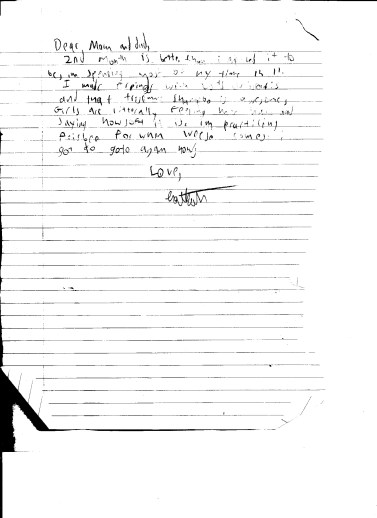
With all this blogging material on camp and letters out there, I tried to avoid the subject. Until I got the letter below. It left me in such a fit of laughter on my front lawn I just had to share it. Here it is!

What? You didn’t get all that? Can you not read?
It’s okay. I have become quite the sleuth decoding and deciphering my 15-year-old’s harried handwriting. Seriously, is there a place where they pay you for reading horrid handwriting? if so, I have found my new calling.
Just be glad that this was not written on a crag of a stone in the dark, as he claimed was the writing surface of his last letter.
And it reads, unedited for punctuation, as such:
Dear Mom and Dad
2nd month is better than I expected it to be; I am spending most of my time in (bunk) 11. I made friends with lots of Israelis and that Tresame shampoo is awesome, Girls are literally feeling my hair and saying how soft it is. I’m practicing frisbee got to go to the Aga’am (lake) bye.
Wait.
He’s actually washing his hair now?? To the point that girls, not just one girl but girl(s) in plural – want to touch his hair?
A whole year last year of nagging him to better wash his hair, of saying, not a drop of water touched your hair in that shower, how can it be CLEAN?!
And now, my son has silky soft, clean and touchable hair!
You can learn a lot from a letter from your kid at camp. I’ve learned to buy Tresame by the gallon.
You have learned that you may want to buy stock in the company which makes Tresame.
Who’s that guitarist? The Marshall Tucker Band wants to know
When my son came home from school today, he proclaimed it was “the hottest day ever” and “it should be ILLEGAL for the weather to be so hot.”
For those of you who live in more southern climates, it’s only 80 degrees here. But to a Rochester kid, this is hot.
Then he shared this interesting bit of news with me:
He was sort of “discovered” by the Marshall Tucker Band.
Really!
The scene was last week’s Rochester Lilac Festival. The Twelve Corners Middle School Jazz band, led by the wonderful Mr. Baldwin, performed for the lunch crowd. In this crowd must have been …. the Marshall Tucker Band, who was putting on a free performance that evening.[youtube http://www.youtube.com/watch?v=ipI8Ur6ylFg%5D
After this performance, in the video above, shot by a friend and another proud pappa of the baritone saxophonist, a member of the Marshall Tucker Band wanted to know who the guitar soloist was.
That would happen to be MY BOY!
Now, I still don’t want my baby to grow up to be a rock star, but at the very least, to see that ear-to-ear grin on his face, it’s worth bragging about in a blog post!
Rock on, young man, rock on.
About Me

Kreativ Blogger

Versatile Blogger Award


 Stacy Gittleman