
25 Memories of High School 25 years later


Backstage at Bye Bye Birdie
I missed it. That’s what you get for being Transplantednorth.
I missed my 25th High School reunion. Tottenville High School, Staten Island. It was just too far to go. After spending 12 hours in the car round trip last weekend taking my kids to camp, taking another 12 hour round trip back to Staten Island for my reunion the next weekend was just too much.
And, after all the messages and photos posted on Facebook in the afterglow of Tottenville ’86’s 25th reunion, I missed it more than I thought I was going to.
There are lots of people who don’t go to reunions. “I don’t do reunions,” some say. Or they say, “I keep in touch with who I want to keep in touch with. Why do I have to see a bunch of people I would never talk to back then?”
Why? Because – it might be fun. People change. And people grow up. For the most part, the cliques are gone, dismantled by spouses, jobs and kids. And, going to a reunion, you may run into someone who you hadn’t thought of in years, doesn’t mean that you didn’t share one or two memories with them in algebra or in the cafeteria.
So, if you are lucky to live close enough to where you went to high school, GO to your reunion. These are the people who knew you back when, for better or worse.
One thing I know – Back then I was good. Maybe too good. The song “Goody Two Shoes by Adam Ant?” He could have been singing it to me. And I can acknowledge the fact that yes, I was and am still a bit of a geek. I embrace that. I can laugh at that now. And look what being a geek has done for the likes of women like Tina Fey. You know she wasn’t one of the cool kids in high school.
Twenty five years later and I feel like having a late-in-life teen rebellion.
No, I am probably not the most memorable person in my high school class, or the most popular. But, when your high school class was 840 members strong, there is certainly enough wiggle room to find your own crowd. And at Tottenville, there was enough diversity to find your own stride, and for that I am forever grateful.
Now that I’m a parent, and as my daughter starts high school in the fall, I so appreciate the teachers that she has been blessed with so far in her career. And only now, as I look on the pages of our yearbook, can I start to appreciate the teachers – some great, some not so great – that we had at Tottenville.
So, here’s my list of Tottenville memories – what are some of yours?
- My ridiculous outfit my first day of school freshman year. No wonder I was bullied in Jr. High, did I not learn?
- xylem up and Floem down! Thanks to my 9th grade bio teacher, Mr. Briedenbach, the teacher who wore the bow tie. Thanks to him, I will never forget the correct terminology for a plant’s vascular system.
- How we wore big neon belts and black leggings with neon and black shirts. An attempt was made to revive the style a few years ago, but it never quite caught on.
- Mr. Levy’s physics class. In the middle of a big test, he would break up the tense mood by pulling a rubber chicken out of his desk.
- Our talented jazz musicians: Eric on drums. John, Nick, and Fred on trumpet. I wonder if they are still playing somewhere.
- The very wise beyond her years Nimmy, who was also at times very silly.
- My dad, Mr. Cooper. On Valentines Day of my senior year, I got a red rose – remember those? My heart soared thinking I had a secret admirer, and then sank when I found out it was from – Dad. THANKS DAD!!
- Mr. Ira Shatzman the ultimate Tolkien and calzone loving fan. Spending hours after school working on the yearbook and learning how to use a pica ruler in the days before desktop publishing.
- Performing in Hello, Dolly and Bye Bye Birdie. Getting fitted for hoop skirts. The all-weekend rehearsals. I’ll always think of Mr. Herbert and thank him for all the time and heart he put into those shows.
- Mr. Mass, our beatnik English teacher.
- Going to my first concert – Cyndi Lauper – with Andrew.
- Sitting in the back of Global studies class with Michelle B. I don’t remember anything I learned in the class, but I remember how Michelle made me laugh every day.
- Dissecting a sand shark with Jen in AP bio – but not before we named him first.
- Trying to be independent from my dad. Trying not to just be Mr. Cooper’s daughter. Waiting for a bus in the cold until my thighs froze Freshman year. I got smart by Senior year and took the ride in with dad every day.
- Sitting every morning before homeroom for almost four years in the cafeteria with Karen, Ilene and Stacey. We called ourselves KISS.
- Going to soccer games and wrestling matches. Watching my dad coach and treat those guys like they were his own sons.
- Sitting in Mrs. Pastrana’s spanish class the year I didn’t take lunch. Listening to her go on and on about the three-hour lunches that people take in Madrid.
- Selling Twix and Nestle Crunch Bars for prom. Eating lots of Nestle and Twix bars and wondering how I would fit in a dress for prom.
- Prom.
- The weird sculptures that hung over the entrance to the gym. The weird sculpture that sat in the courtyard, but it was not as weird as the sculpture in front of New Dorp High school.
- Trying to get to a class on the fourth floor D wing after gym, which was in the basement B wing.
- Going into the city for the first time by myself freshman year, Jen came with. Jen was only allowed to go to the city on the condition that we would ONLY go to Bloomingdale’s, but we really went to the Village. Jen, your mom isn’t online, is she?
- SING
- laughter
- friends
Wear Your Bicycle Helmet, Damn It!

Yesterday, both my sons were glum and grumpy. They were missing their big sister who had just left for sleep-a-way camp for the entire summer. My youngest simply missed her because she was his big sister. My oldest, he was just mad because HE wasn’t going to camp the whole summer.
So, to cheer them up, I cleared my day for an activity that would set us soaring and put us all in a good mood. We embarked on an extra long bicycle ride. On their bikes, they had to get along as brothers. They could not cut each other off because they would crash. The older one had to stay with the younger one and remind him about traffic rules like staying to the right of traffic, look out for parked cars, and stopping at stop signs.
Finally, after winding our way through side streets we had discovered in a previous bicycle ride. we made it to Brighton’s Buckland Park. Finally, I could let my guard down, if just a little, and feel free to let them ride in safety the park’s dirt bike trails that took us through tall bulrushes filled with red-winged blackbirds and over wooden bridges. On the paths, I didn’t have to think about a car coming up from behind them or, well YELL at them to get off their bikes and walk them across the busy intersections.
The other night, as I was drifting to sleep, came on the Late News that a 15-year-old boy had been killed while riding his bicycle. He was not wearing his helmet.The next day, my husband came home from work and let me know that the boy was the son of a man who worked at his office. When you live in a small town, the local news is very local.
Today, I also read about a woman in her 50’s who had just died from injuries she sustained while bicycling. She also was not wearing her bicycle helmet.
But, back to our joyful bicycle ride……
On our way home, I saw a kid of about 13 on his bicycle. We both came to a stop at a 4-way Stop intersection. He said “Hi” and I said “Hi” back.
Yeah, he had left the house with his bike helmet. But somewhere away from his mother’s eye – he took it off and strapped it not to his head but the handlebars of his bike.
Little did he know there are a lot of other mothers out there.
“Put on your helmet.” I said. No pussy-footing around this time, no saying “I’m sorry for being pushy” or “I hope you don’t mind saying..”
I just said it:
“Put on your hemet. A kid your age was just killed this week on his bicycle and HE was not wearing a helmet.”
Maybe another kid would have snickered and flipped me off. But all this kid said was:
“Okay.”
And the helmet went right back on his head.
IF YOU SEE SOMEONE, PARTICULARLY A KID THIS SUMMER WITHOUT A HELMET, BUTT IN AND TELL THEM TO PUT ONE ON!
Okay Campers, here is your cleanliness checklist:
In a few days, relative quiet will settle in my house as our eldest heads off for her first full summer at sleepaway camp.
In a few more weeks after that, the true peace will descend on our home as her oldest brother follows. Then, our family of five shrinks to a family of three for an entire month.
Sleepaway Camp. It’s like a child-parent sabbatical.
But kids, this is no time to slack off on basic hygiene, and I can only imagine how this all important priority in civilized life will backslide when you are out from the discerning eyes – and noses – of your parents.
I don’t know how you will manage without us, your nagging parents, to stay disease, filth, and cavity free, for the duration of your glorious summer camp experience. So for my kids and all those summer campers out there, here is a checklist:
 These are nail clippers. They will keep your nails short and trimmed. Use them. They will prevent you from accumulating too much dirt underneath your fingernails, which may result in you becoming afflicted with a parasite that may take up home in your intestines.
 These are bottles of shampoo. I have sent you up with ONE large bottle of shampoo, which is more than ample to last you the whole summer up at camp. If the shampoo bottle topples in the shower, please return it to its standing position.
You need about this much shampoo

not this much shampoo

to get the job done for an adequate cleaning.
Then, scrub.
Do not merely let the suds sit on the top of your wet head. But scrub and massage your scalp with the balls of your fingers. Then, rinse until you are squeaky.
And children who are at the age of adolescence and above, these are your armpits: 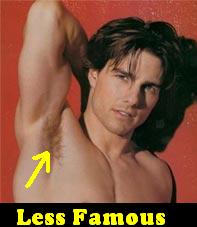
Okay, so this not your armpit but the armpit of Tom Cruise. He’s an old guy to you but ask your moms about him and the movies he was in when they were young.
You must apply deodorant to your armpits at the beginning of EACH day, no matter how much it may tickle.
You must wash your armpits BEFORE you apply the deodorant. Application of deodorant after playing sports or even GaGa in the camp rec room and after an unpleasant odor has set in is ineffective.
This is your mouth:

Now, many of you may not have this perfect smile – yet. Your teeth may be imprisoned in those metallic braces, but know this: Your parents have spent about just as much money on those teeth in your head as they spent on that summer at sleep-a-way camp. So please: Brush, floss, rinse. At least two times a day.
And for those of you with braces, NO there is no substitute for gum while at camp, at home, or otherwise.
And please drink at least one glass of milk a day.
And change your sheets at least once a week.
And…. remember we love you and will miss you like crazy.
But most of all …. Have fun!
My Dark Dances with Danger

When I was younger, there was something about a boy carrying a flashlight for me on a dark night that would always invite me to take a dance with danger.
A stroll in the evening can be peaceful, even romantic. But dangerous? Well, it might be if you are a 19-year-old volunteer breaking curfew to take a mile walk through the wilderness of Israel’s upper Galilee region with a bunch of soldiers just to get to a party.
I am a pretty cautious person. I don’t speed when I drive. I’m afraid of heights so that rules out roller coasters, sky diving, hang gliding or even trapeze flying to get a thrill. So this story of my walks through darkness may be tame in comparison to other risky ways to have fun.
My earliest memories also find me sneaking out into the dark for adventure. I was five or six. I must have been that young because my brother, four years my junior, was still in a playpen.
My family was on vacation at the Bay of Fundy in Canada. My parents had a knack for making fast friends with other families on vacation, and it happened that one such family invited us for dessert in their big Winnebago Camper one night. It was the kind of camper that kids drool over at R&V shows at the mall: complete with a kitchen and a loft perched over the driver’s cab. My parents and this other couple were sitting having coffee outside the camper, I had bunked down with the kids of this family in the loft, and my baby brother was sleeping in the playpen.
All of a sudden, the family’s oldest, a boy of about 10, said we should go for a walk in the dark because not too far away, there was an outdoor amphitheater playing a movie. And, according to this boy, my parents had given me permission to go with him.
There are reasons why you shouldn’t talk to strangers.
I remember bits of what happened next. I remember the kid, his sister and I leaving the camper, He carried a flashlight to light the way, and at one point he shined it on the ground so I could tie my flower-patterned Keds.
To get to the amphitheater, we had to cross a four lane road with a grass median. A road with trucks on it. And not a crosswalk to be seen. No lying. Now, I remember this kid stepped into the middle of the road and held out his hand to stop the traffic. Miraculously, the traffic stopped both ways, to let three kids under 10 cross the street.
I can’t remember what movie they were showing in the amphitheater, or what happened afterwards. I think I remember a part where I was crying to my parents explaining to them that they said it was okay if I went wandering in the dark to go see an outdoor movie.
Sure, any parent of a six year old would say that!
But, getting back to Israel….
The summer I was 19, I picked myself up from my comfortable American surroundings and volunteered on a collective farm or a kibbutz for a month. It was a great way to meet kids from all over Europe and to better understand Israeli culture. All on 5 shekels, or about 1 dollar a day. Plus free room and board.
In addition to the volunteers and the residents of the kibbutz, there were also a group of Israeli soldiers who did part of their military service by providing free labor to the kibbutz. They were called the Garin.
One night, some of the Garin told me and some of the other girls in my volunteer barrack that they knew of a party taking place at a nearby kibbutz. But, we would have to break our curfew and walk through some brushy wilderness to get there.
There was no real path. There had to be snakes, scorpions and other lovely things along the way, not to mention that we were right on the border with Syria and Jordan. I tried not to think about any of those things. I was with trained soldiers after all, and in addition to the flashlights to guide our way, soldiers also carried guns.
So, we walked guided by those soldiers, just kids like us really, the light of the flashlights and a thousand visible stars. We got to the party and danced with lots of other kids to songs from the Pet Shop Boys and Ska music by Madness and an Israeli Madness wannabe band called Machina.
My British barrack mates, in true British form, got very “pissed” drunk and could barely get up the next morning for our 4:30 a.m. wake up call to work the fields.
Was it dangerous? Maybe. Was it fun and would I do it all again? Definitely.
Community through a Cookbook: my Speech Before Hadassah
The other night, I was the featured speaker at the Installation Dinner of the Rochester, NY chapter of Hadassah. For those of you who wanted to know what I spoke about, here it is, all 20 spoken minutes of it, though changed slightly as I had some visual cues for some of the jokes. And some of the jokes, well, it’s a Hadassah thing, so you may not understand. Also, if you are not up on the Jewish faith, there is a LOT of jargon that you may not get, so if you want to skip this post, I will understand. But it was an honor to speak and a great evening I’ll remember for a long time.
Hadassah is an organization known throughout the world for promoting Zionism and Israel, supporting advances in medicine, and advocating Jewish education. Any art lover the world over surely knows about the Marc Chagall stained glass windows that grace the chapel in Jerusalem’s Hadassah Hospital.
But, when I think of the Rochester chapter of Hadassah, the Rochester Hadassah Cookbook immediately comes to mind.
I have to tell you, I got this cookbook by way of Berkeley California. I had just become engaged to my husband, Craig. He was in graduate school. I was – uummmmm, hanging out and enjoying the California scene!
We got the Rochester Hadassah cookbook as an engagement present by way of a grad school friend of Craig’s named Mike. Mike was born and raised in Rochester. Mike came back to California after a trip back East and presented us with this book as an engagement gift from his mother.
And I said “Oh, Rochester. That’s somewhere upstate, like near Poughkeepsie!”
At that point in my life, I had no connection to Rochester outside of this cookbook. Rochester was the furthest thing from my mind. We were living in California but that was temporary for us East Coasters. Craig would finish his PhD, and then we were moving back to New York City, center of the universe!
and that
was that.
We did move back to New York City. Well, New Jersey actually. Craig found a job in the suburbs and I also found one – in Manhattan. Complete with a three-hour round trip commute on New Jersey Transit!
I landed this great job at a growing high-tech public relations firm. It was a time when they couldn’t find people fast enough to perform quality account work for the burgeoning, brand-new high-tech industry. Ah, I miss the 90’s!
My boss was a stunning, statuesque blonde woman of 35. She had the corner office of our Park Avenue suite. To the north, her view faced uptown to Grand Central Station. To the West, she overlooked Park Avenue. She loved living the life of a single Manhattanite PR executive. However, she would tell us many times that her parents in Florida wished she would marry and give them grandchildren already. When she visited them, she instructed us to call her often on her cell phone, so her parents would see how important she was back at the office.
Sitting in my cube as a lowly – NO rising – account executive, I would imagine what it would be like to live that kind of life. Most of my co-workers were in their 20’s and single. Half their salary went to paying rent.
The other half – alcohol.
At 28, I was already the old married lady of the office, and Craig and I were starting our family.
After a few years and two kids later, we moved up to Rochester for Craig’s employment. It was then I learned that Rochester is waaaay further upstate than Poughkeepsie.
My company back in New York City still wanted me. They even offered to set up a virtual home office. But, reality set in. I was staring down at our first long Rochester winter with a one year-old and a three year-old as my only companions. I didn’t know a soul in town. Virtual office or not, I realized that building my social network here for my family would be more important than racking up more media hits for IBM. So, I politely said thanks but no thanks, and became a stay-at-home full time mom.
Stay-at-home moms rarely stay at home, as you know. Those first few years here, I spent most of my time at Wegmans, the Strong Museum of Play, and the JCC. When you’re the new mommy in town, people are very interested in getting to know you. I realized that the Jewish moms I was meeting were fulfilling the mitzvah to welcome new Jews into the community. We were invited as a family for Shabbat dinners on Friday nights and, during the week, playdates for the kids and I. I’ve heard that this courtship is called “mommy dating.”
More than a few times, I would eat something prepared by a prospective mommy friend and say,
“WOW, this is great, where did you get this recipe?”
And one woman after the next would reply, “I made it from the Rochester Hadassah cook book!”
And I would reply, “OHHHH, I have that cookbook, I’ve had it for YEARS! I think I’ll start using it now.”
The JCC opened up to me a network of great women who believed in giving their kids a Jewish education in early childhood. I’m now over the rainbow from my own kids’ preschool years and teach preschool myself. I am in forever debt to people like Tzippy Kleinberg, Andrea Paprocki and Emily Fishman at the JCC and later, Randi Fox Tabb at Keshet preschool for planting the very first seeds of Jewish knowledge for my kids. Now that I’m a preschool teacher, I see the appreciation parents show when their little ones come home singing “Shabbat Shalom – Hey” or say a bracha every time they put a cookie in their little mouths.
Becoming a new parent can be the road back to Jewish observances. In fact, a 2002 study by the Jewish Early Childhood Education Partnership described Jewish preschools as the Gateways to Jewish Life. The time to get young families rooted back into Jewish community life is when their children are between the ages of birth and three years of age.
I remember when my son Nathan was in his first year of preschool at the JCC. I had an “aha” moment – a moment you knew that the Jewish foundations you lay for your child are really sinking in – in all places but at Michael’s.
Nathan was just 2 ½. I picked him up at the J and we went schmoozing at Michael’s. From his seat in the shopping cart, he spied one of these big fake terra cotta gardening urns.
“Mommy” he said, in an angelic voice that only two and one half year olds have “They have a really big – Kiddush cup!”
By the way, Nathan is now well into his Torah studies as he becomes a Bar Mitzvah this November.
In addition to giving my children a Jewish education in their earliest years, being a stay-at-home mom afforded me the time to continue my own learning. When living in New Jersey, I admired women who could get up and read Torah on Saturday mornings or who were involved with other aspects of Jewish communal life. But my three- hour round trip commute into the city left time for little else during the week.
Why did I decide to learn to read Torah later in life? I have to confess, it’s the rush. I have to get my adrenaline rush somewhere. For one thing, I hate roller coasters. The only time I rode one was on a dare from Craig on the boardwalk in Santa Cruz, California. Craig jokingly said he would not marry me unless I rode the famed Big Dipper, a classic, rickety wooden roller coaster. As expected, I hated every second of that 60-second ride. But I guess it was a religious experience because I kept praying aloud to God to please get me off!
So, if I want to get my heart pumping, I sign up for a Torah reading.
I encourage more Jewish women to also get on this thrill ride. And don’t think, “I can’t do it because I didn’t grow up reading Torah,” because neither did I!
Growing up within my very Conservative synagogue in Staten Island, New York, boys preparing for their Bar Mitzvah were required to attend services on Saturday morning. Girls were required to go on Friday night. Girls would chant their Haftarah on Friday night and boys would be called to the Torah on Saturday morning. It was never questioned or debated if girls should have a larger role. That’s how it was.
We were taught that after our B’nei Mitzvot, boys were still required to go to shul but girls didn’t have to. Our rabbis, all Orthodox, said that girls were more spiritual by nature, thus relieving them of the obligation to attend services. They said if men were not required to go to shul, they would never go.
It’s true. Spirituality did come naturally to me. Each Friday night, I followed along with all of the melodies of Kabalat Shabbat. I never thought about the fact that after my Bat Mitzvah, I would not be asked to join a minyan if they needed a tenth, because I was not a man. I would not be asked to read from the Torah or participate in services. It made me feel as though I didn’t count, and on a certain level, as a Jewish woman, I didn’t.
That summer, my parents took our family to Israel, where I was to have a Bat Mitzvah ceremony at the Kotel! Imagine that! In my 13-year-old mind, I envisioned me chanting my Haftarah, the Kotel behind me, and all of Jerusalem listening!
Well, my actual “Bat Mitzvah” ceremony went something like this: I stood in a white blouse and a flowery skirt outside of the Kotel Plaza. I really did have a copy of my haftarah to chant. But a rabbi in a black hat from some agency handed me a siddur, and asked me to read the Shma in English.
“But, I have my Haftarah! And I can chant the Sh’ma in Hebrew,”
“That’s not necessary. You are a girl. Just read it in English.”
Tova Hartman, a lecturer in the department of gender studies and education in Bar Ilan University wrote in her book, Feminism Encounters Traditional Judaism, that living in Israel, she “knew there is no recipe or a structure on how to join Orthodoxy with feminism. In her own life, in order to give her daughters a model of religion she could live with, she had to form her own shul with a group of like-minded people, even if that meant she had to leave certain loyalties behind.”
Please don’t misunderstand me. I do have great respect for Orthodox Judaism. I admire their commitment to observing Shabbat, the hospitality they extend to guests on Saturday afternoons for lunch, and their dedication to a Jewish day school education.
I can also understand the values that Orthodoxy places on mothers as the first Jewish educators in a child’s life by being charged with creating a Jewish home. But even Blu Greenberg, author of How to Run a Traditional Jewish Household, commented in her book On Women and Judaism that “leaders of Orthodox halacha (law) must recognize that the general effect of exempting women from prayer conditions them to a negative or indifferent attitude toward prayer altogether.”
My feminist notions aside, when I became a mother, I appreciated why it is that women are not obligated to participate in time-bound mitzvot which could interfere with their tasks of mothering. But what I cannot accept is where “not obligated” evolved into “not allowed.”
My horizons on the role of women in synagogue life expanded when I moved out to California. Aside from daring me to ride roller coasters, Craig encouraged and taught me how to lead kabbalat shabbat at the Hillel at Cal Berkeley. There, the rabbi was a woman. For the first time, I heard the matriarchs mentioned next to the patriarchs in the chanting of the Amidah. Women lead services, had aliyot, and read from the Torah. This was so common, in fact, that once, a non-Jew came to our services and quietly asked, “Are men allowed to read from the Torah?”
I learned how to read Torah at age 37 thanks to a six-week adult education class led by Chazzan Martin Leubitz at Temple Beth El. On the first day of class, Chazan Leubitz informed us all that he had signed us up to read Torah in six week. That would be our final exam.
For me, I have come to realize that learning Torah is not an exercise in perfection, rather an act of participation and performing the mitzvah of studying Torah as a full-fledged member of the Jewish community.
Connections in the Jewish community, actually, would you believe a conversation in the women’s locker room at the JCC – led me to landing my column at the Rochester Democrat & Chronicle. Writing this column has been a return to my first love of newspaper writing. It has also given me a reason to set up a home office, with a corner office in my kitchen. To the south of my lavish two square-foot corner office – I have an excellent view of the piles of laundry that pile up in my family room. To the East, there are dishes in the sink and groceries to put away. Directly before me is my blank computer screen, which I must fill with 600 well written words every week.
Writing my column is like riding a bicycle up and down a series of hills. All year long. On deadline day, I pedal the hardest. I do a lot of the writing – as I did this speech, in my head, long before I sit down to my computer. I think about it at red lights, on walks, on line at Wegman’s. Writing takes a lot of rewriting, moving paragraphs around, weaving and reweaving them until every word fits into place.
It’s like that feeling you get when you untangle a necklace.
Then, I hit send. And I can finally coast downhill, for about a day. I finally pick myself up from my cushy corner office to the mundane never-ending tasks of laundry and dishes. I also take some time to get in a workout. A shabasana, the restive pose at the end of my Wednesday night yoga classes, are divine and well deserved after hitting send on my column.
Then, the search continues again. Because most of my connections are in the Jewish community, lots of people pitch me with Jewish story ideas. But, I’ve had to gently turn a lot of them away. When it comes to my personal identity, I am a Jewish American. But for the sake of the wider audience of the Democrat & Chronicle.
I’m not a Jewish reporter, I’m a reporter who is Jewish.
Between the lines of my column, however, Jewish themes can still be found. A day devoted to cleaning up our parks or collecting unwanted pharmaceuticals – those are the values of Tikkun Olam, or repairing the world. Events that speak on helping care for our seniors or events at a senior center? That is Gimilut Hasadim – acts of kindness.
So I try not to comment or cover too many events or issues that impact the Jewish community.
Except for the recent incident where some teens were caught and charged with the hate crime of burning a swastika in Brighton. On the night before Yom Hashoah, Holocaust Rememberence Day. I had to speak out on that.
After a lot of back and forth with my editors, who questioned if such a heavy topic was the right fit for the Our Towns section, they agreed to keep my words. I thank them immensely for hearing me through on this. As I stated in last week’s column, I love covering the good in our communities. There is so much bad news in our world and I’m honored to be able to bring to readers news on events where they can participate and help out their community. But suddenly, this columnist who is Jewish became a Jewish columnist and I had to speak out. Because, what do we mean, when we are saying “Never Again?”
You have to remember that when the news broke, our community was immersed in daylong Yom Hashoah observances. Included in this was a community wide program for teens: a staging of the play “What Will You Tell Your Children” written by Rochester native Jessie Atkin upon her return from a Journey for Jewish identity trip in 2005, where Jewish teens from the United States and Israel spend time together here, visiting concentration camps in Poland, and finally in Israel. I’d like to thank Jodi Beckwith for directing the play and to our Jewish education leaders for bringing the event to our children.
And how was this play received by our teens, many who never experienced anti-Semitism first hand? To give you an idea – there were about 250 kids in the room to watch the 90 minute performance. Suzie Lyons, the director of Education at Temple Brith Kodesh, noted that only 11 kids got up the whole time to use the bathroom
Have you ever been on the receiving end of hearing a racial or religious joke? Usually, the joker defends his joke by saying – it’s okay, some of my best friends are: Black or Jewish, Chinese, you fill in the ethnic group.
On a positive note, I want to bring to your attention the overwhelming response of coming together in the Jewish and wider community. The morning after the swastika was burned, the Home Acres neighborhood had a vigil attended by Brighton Town Supervisor Sandra Frankel who called it a despicable act. In last week’s editorial page, the hate crime received a “thumbs down” by the D&C. There were several letters to the editor – one jointly written by leaders in the Christian and Muslim communities – condemning the act.
.
Our Jewish youth, many who know this boy, a student at Brighton High School, are struggling. They are searching for a rationalization why he may have done this, they think – there must be a reason, There’s got to be a reasonable answer.
Seventeen is an extremely vulnerable age where friendships run thick and rule supreme. And the apparent betrayal of a friend at age 17 is painful to accept. I’m sorry, but I don’t think that this young man was considering the feelings the Jewish kids he knew when he allegedly planned to burn a swastika. Or maybe he just thought it would be okay to do this as a joke, because after all, some of his best friends were Jewish!
Both boys have pled not guilty which means that they will have another hearing in town court on May 25. This leaves us with many questions. Was this an isolated event or should we fear a wave of similar copy cat crimes? Did these boys really understand the gravity of the timing of their act or do they truly comprehend what horrors were committed under the symbol of the swastika? And if they didn’t, where are we going wrong, in our school system, in our discussions at home, that we are not telling our youth enough about that very dark chapter in human history.
To leave you on a positive note about this, I want to tell you about the group of seventh graders I had the pleasure of teaching this year at Temple Brith Kodesh. They were absolutely dreamy, I mean it! While they are not exactly enthralled about learning about the minutia of the Hebrew language, the topic of carrying on Jewish identity, especially as they face post Bne’ Mitzvah life, keeps them engaged. On the Macro level, they have a very strong sense of who they are as Jews. After the swastika incident, the debate arose in my class whether middle school trips to Washington D.C. should include a mandatory visit to the US Holocaust memorial. Some students, in light of what just happened, thought it should be a priority to visit the museum for all students – Jewish and non-Jewish. Others thought that the serious theme of this museum would overshadow what may be the first time a young student visits our nation’s capital. But it was good to see my seventh graders debating and discussing, trying to work it out. And again, not one of my students asked to leave the class to go to the bathroom, can you imagine?
So, my advice to you tonight? I guess it is to maintain a focus in your life on Jewish education, from the earliest years of our children and well into our own adulthood. While raising a family, keep a hand in your own profession, however small, and as much as your family and your own sanity can handle. Mothering is the best job of all. But don’t disappear, don’t let your own individuality get folded and lost into the lives of your husband and children, just as egg whites get folded into the batter of a Passover Sponge Cake, which a recipe can be found within the pages of the Rochester Hadassah Cookbook. Thank you for listening.
The Holocaust in Degrees of Separation
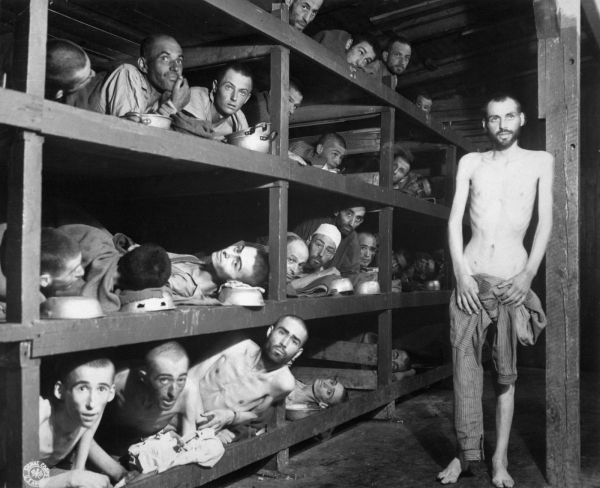
a photo of Jews, including Elie Wiesel and my friend's dad, liberated at Buchenwald
Leon Posen, a congregant from my synagogue, passed last week. He lived to the age of 94, blessed with a long life that could have been cut very short. His passing is still a sad one. Leon was a Holocaust survivor.
As the years and decades stretch away from World War II and Hitler’s war against the Jews, there are fewer people to tell first hand accounts of what happened in the ghettos and the concentration camps in Europe.
So who will bear witness in generations to come? Even if we don’t have a direct personal connection to the Holocaust, it is our turn to hear as many accounts as possible, and then tell them to the next generation. This is the only way to keep the vow of Never Again.
In Rochester, about 300 area Hebrew school kids in grades 6-12 watched their peers put on a play called “What Will You Tell Your Children” written by local playwright Jessie Atkin about her trip as a teen to the concentration camps in Poland. The play focused on the reactions of contemporary teens as they toured Auchwitz and faced anti-semitism and a general lack of understanding of Judaism at home.
I wonder if this new take on the Holocaust – telling the story second-hand and not directly from survivors’ accounts – actually disturbed,unsettled, and horrified the young audience enough to make them really remember. To make them relate. Was it too much of a softball throw in teaching the Holocaust? Is there – should there ever be — a gentle way to teach the Holocaust? How can it be unforgettable if we do not teach the inhumanity and the horror?
As the students watched the play, I watched the students. And then, I looked them as a whole – a bunch of healthy, creative, sometimes fidgety, teens and preteens. This was the same age demographic that Hitler selected for his Terezin concentration camp in Prague. A room with this many kids, multiply that number until you reach 15,000 kids. That’s how many died in Terezin, I thought. I shivered.
In my Hebrew school, we were spared nothing. My teacher, Rabbi Tzvi Berkowitz, was born in a displaced person’s camp in Cypress. The one depicted in the historical fiction novel “Exodus” by Leon Uris. He was the child of concentration camp survivors. Because of this, in our Holocaust education, we watched many horrible films shot in grainy black and white of the ghettos and camps filled with emaciated bodies. Some tortured and barely alive, some already dead.
But, still, it happened to someone else’s family, not my family, all those years ago. They were disturbing and yes, the first year I really learned about the horrors, I spent many nights curled up at the foot of my parent’s bed to sleep.
Now, I live in Rochester, a small town with an unofficial, intimate club that no one wants to belong to, yet they are proud members of it. Rochester has many Holocaust survivors whose families are now second, third and even fourth generation survivors.
It wasn’t until I had friends in this club, that I began to think: if his mother, if her grandfather didn’t survive, than this friend wouldn’t exist, or certain friends of my children would not be here.
Unlike the Yom Hashoah services of my childhood, when it seemed that everyone in my synagogue attended, it seems that Yom Hashoah services are attended mainly by those directly touched by the Holocaust, survivors and their decendants, leaders of the community, particpants in Rochester’s march of hope or our teen trip to the Holocaust museum in Washington D.C. So, going to these events, I still feel, thankfully, disconnected.
But in 2006, I had the privlelege of attending in Los Angeles the United Jewish Community’s General Assembly. That year I was the recipient of my community’s young leadership award, along with my traveling companion, Ron. Ron has the biggest heart of anyone I know, and lots of energy. An entrepreneur, he always seems to have three or four business ventures going on as well as several philanthropic projects. This is the kind of guy he is: we were stuck in an airport on the way home waiting for a delayed flight. It was late and people were crabby. Ron goes to the only remaining open store in the terminal, buys a bag of candy, and walks around, offering candy to the stranded travelers.
One part of the trip, young leadership delegates from around the world were taken to L.A.’s Museum of Tolerance. The museum, chronicles the Holocaust and current genocides in world history. Sadly, it shows visitors that vows of “Never Again” cannot ring true. In the decades since the Holocaust, there has been genocide in Cambodia, the Balkans, Rawanda, Sudan. Our docent said that the museum has been a destination of feuding gangs of LA to teach them the consequences of hate.
Further into the emotionally-charged museum, we came to the tail end of the Holocaust exhibit. There, transported from a concentration camp, in the corner of a dark room, was an actual bunk where prisioners slept, stacked three levels deep. Two to three men slept on planks on a bed the width as narrow as a twin bed. In the background, behind the bunk, was a life-sized photo, a well-known photo of survivors of Barrack 66 in Buchenwald. In this photo, is an emaciated Elie Weisel. I had seen this photo dozens of time in my life. Then, all of a sudden, Ron grabs me by the arm and points. Impossibly, my friend Ron’s face was peering out from the bunk one level above Weisel.
“Stacy!’ my friend cried, “That’s my DAD!”
And that is my degree of separation from the Holocaust. What is yours?
Post # 84: I wish I could Play Guitar
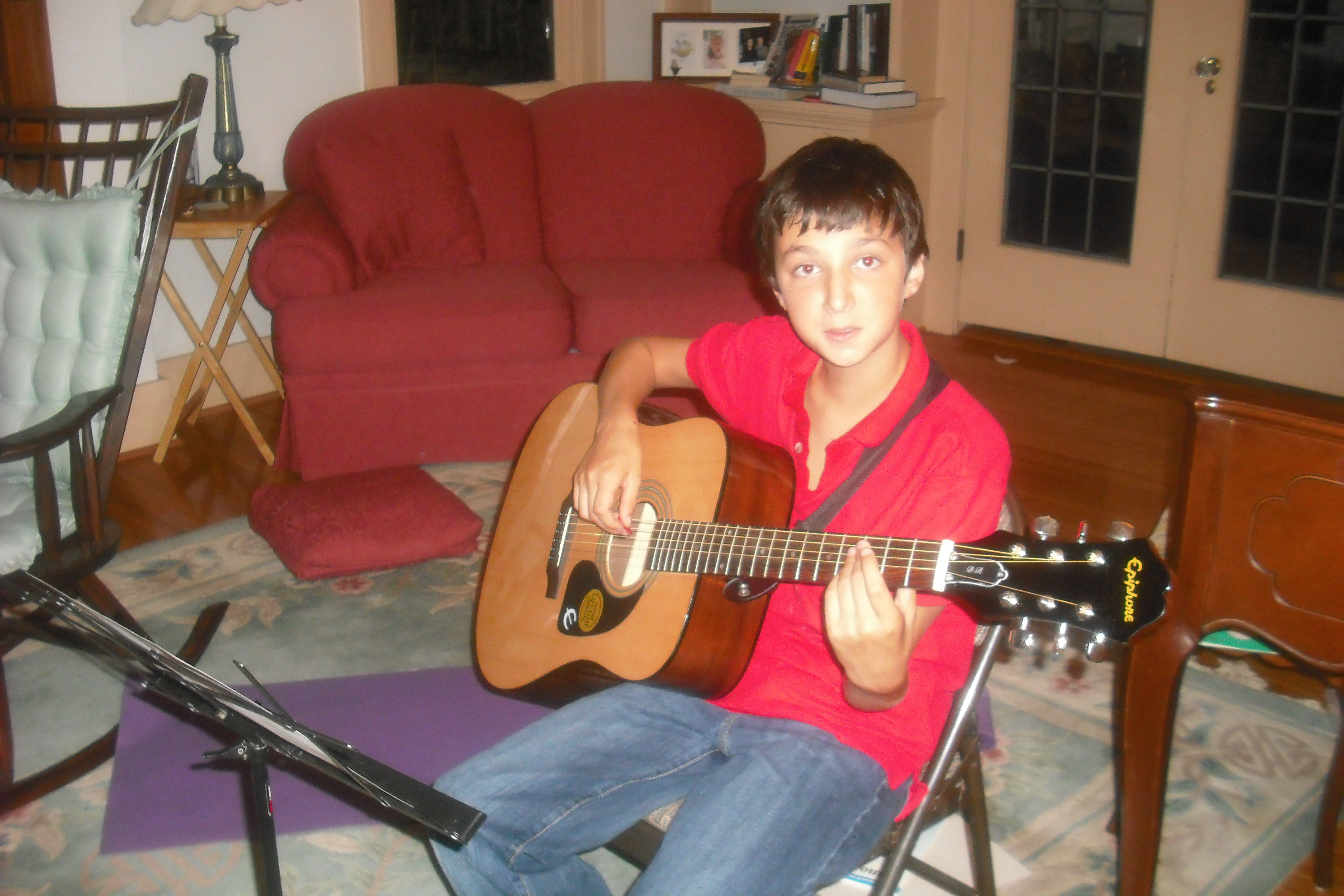
some mommies let their babies grow up to be rock stars
To play an instrument, you have to devote years to practicing scales, learning finger or bow positions, developing your lips to get just that right tone (if you play brass or woodwind), and studying theory.
You have to endure playing simple, nerdy songs like Hot Crossed Buns or Ode To Joy when what you really want to play is the latest song from The Plain White Tees. If you have an ear for music and those songs in your head don’t yet match your ability, it can be all the more frustrating.
But everyone needs to start somewhere. You can’t just pick up a guitar and instantly become Bonnie Raitt or Jimmy Paige, and we all know that playing the Guitar Hero is not the real thing.
Unless…..
What if…. what if, after hearing the opening chords of “Blackbird” by the Beatles, or “What It’s Like” by Everlast, I could just pick up a six-string, start strumming and sound just like that?
So, if I could instantly download a skill into my brain and body ala Matrix style, it would be the ability to play a mean guitar. No, not even a mean guitar. I’d be happy with knowing enough chords to be considered entertaining around a campfire.
I know the guitar is difficult. It takes more than having a garage and knowing a few chords for most to be really good at it. But playing guitar seems to be the most approachable, liberating instrument there is.
The guitar is my son Nathan’s third instrument. Back in the second grade, Nathan was gently fired by his piano teacher after less than two years of lessons. It’s not that he didn’t have an ear for music. He could plunk out a Rachmaninoff tune or the theme to Harry Potter with all its sharps and flats on one finger, but no one was going to tell him about correct hand positioning or posture at the keyboard, or what a C Major scale should sound like.
As she left our house the for last time, this demure woman in a stiff skirt and buttoned up blouse reassured me: “Don’t worry. He has the music inside him. He has to find the instrument he loves. And let him get a little older.”
Or, maybe it was the right teacher that hooks you to an instrument. Nathan is now on the threshold of his teen years. After four months of guitar lessons, Nathan is a little more receptive to taking direction from a guitar teacher than a piano teacher. But he still wants to play the guitar like Johnny Ramone. Now.
One day, Nathan comes into the kitchen.
“Mom, what does this sound like?”
Nathan breaks into a simple guitar riff, than bangs on his guitar quickly two times. As he plays, his brown eyes lock on me, eyebrows raised, mouth hanging open. An expression that reads, is this cool, or what?
“Of course I know what that is. It’s Blister in the Sun by the Violent Femmes!”
A little smile. “Yeah!”
Each week, we get treated to a mini jam session that is Nathan’s guitar lessons. Guitar teachers are a completely different animal than piano teachers.
Tuesday nights go like this: as Nathan wolfs down some dinner straight after two hours of religious school instruction, the doorbell rings. It’s Nathan’s guitar teacher. Nathan’s teacher can’t be more than 26. He works all day with at-risk youth. He has spiked short hair and a pierced tongue and one of those black plug earrings. Nathan’s guitar teacher is definitely not a piano teacher.
My husband has a very healthy, heterosexual admiration of this young man. Also a guitar-playing wannabe, he is in complete rock-star admiration as he listens to him warm up. Now, that’s what years of playing the guitar can sound like. Once a week, for 30 minutes, we have in our midst, a real guitarist who is in a real rock band.
Nathan has a long way to the top if he wants to rock and roll. But he is getting there. He can play the basic chords to Hotel California and I can slowly sing each bar, as he searches for the next chord, as I make dinner. And, he knows – of course – a standard blues riff. And Louie Louie. And Tequila!
I still have to nudge him to practice what his teacher actually wants him to practice, which is Amazing Grace. And I have to wonder: Did Jimi Hendrix’s mother have to nudge him to practice? Or Eddie van Halen’s mom? Or .. did Eric Clapton’s mom bug him about cutting his nails before playing?
Probably not. But they probably didn’t want to play the guitar as badly as I do.
A Fashion Statement I Regret Making

As I write this, I am watching the academy awards. No, my biggest fashion blunder thankfully wasn’t televised, nor was it as bad as Bjork’s Swan dress from 2001. But, in a time when one should try to act as cool as possible – the first day of high school – I truly missed the mark.
My 25th high school reunion is coming up. Now, I don’t remember what I wore my very last day as a high school student, but I sure remember what I wore the first day.
No, the picture below is not actually my legs. Thankfully, I dont think there is a photograph to document my first day of Freshman year of high school.
My mom had just started a subscription of Seventeen Magazine for me. The preppy look was totally “in” for the fall, according to Seventeen’s big, thick back-to-school August issue. Maybe if you went to a prep school in New Hampshire, but back in Staten Island, not so much.
So there I was, high school freshman, which is cause enough to get egged or suffer a head full of shaving cream the first day of high school. But no, I had to draw further attention to myself with khaki knickers, argyle socks and penny loafers.
I just got it all wrong.
A Fashion Statement I regret Making
As I write this, I am watching the academy awards. No, my biggest fashion blunder thankfully wasn’t televised, nor was it as bad as Bjork’s Swan dress from 2001. But, in a time when one should try to act as cool as possible – the first day of high school – I truly missed the mark.
My 25th high school reunion is coming up. Now, I don’t remember what I wore my very last day as a high school student, but I sure remember what I wore the first day.
No, the picture below is not actually my legs. Thankfully, I dont think there is a photograph to document my first day of Freshman year of high school.
My mom had just started a subscription of Seventeen Magazine for me. The preppy look was totally “in” for the fall, according to Seventeen’s big, thick back-to-school August issue. Maybe if you went to a prep school in New Hampshire, but back in Staten Island, not so much.
So there I was, high school freshman, which is cause enough to get egged or suffer a head full of shaving cream the first day of high school. But no, I had to draw further attention to myself with khaki knickers, argyle socks and penny loafers.
I just got it all wrong.
About Me
Kreativ Blogger

Versatile Blogger Award


 Stacy Gittleman