
Bats in the Belfry: The educational conclusion
 After you are told by the Batman in the middle of the night that you may have a bat colony in your attic, sleep does not come easy.
In my last blog post, I wrote about the night we were visited by a bat. There was a bat in our house. We saw it one minute and it flitted to an unknown location the next.
If you live up in the cold North like I do, and have not had the sufficient funds to replace every charming leaky window in your 77-year-old home, then you are familiar with the practice of wrapping your windows in shrink plastic for insulation. On The Night of the Bat, the wind outside howled, causing the plastic wrap on our bedroom wrinkle and crinkle. Of course, I mistook every wrinkle and crinkle for the wings of a bat and shot straight up in bed every 10 minutes throughout the night. I’d never wanted morning to come so badly.
Have you ever had a bat loose in your house in the middle of the night? I later learned that we were not alone in this experience. Bats seem to be a common occurance in older, charming homes. Bats are the one uncharming feature that the realtor leaves off the charming English Tudor house listing.
We shared this story the next day with many of our friends. One couple we know, who are avid campers, said when a bat swooshed over their heads in bed one night, they didn’t hesitate to pitch a tent over their bed to get a good night’s sleep.
I’ll have to remember that for the next time.
Morning finally came. I probably slept for two hours at best and my nerves were fried when my husband woke me to tell me about his discovery.
“You have to see this, I found the bat!”
He led me to our living room and I think I hid my head in his shoulder all the way down the stairs. Behind the honeycomb shades, up by the ceiling, there was a small shadow. Suddenly, this terrifying creature of the night seemed harmless. Even vulnerable. I quickly put on my boots and ran outside to get a better look.
Between the living room window and the shade, our winged intruder hung upside down and was fast asleep. I have to admit, swaddled in its pale grey wings, this small bat, the same creature that terrorized me, looked pretty cute.
A few hours later the Batman came for a visit. No, it wasn’t the Dark Knight or Caped Crusader of comic book fame. Just a guy with a five o’clock shadow at 10 a.m. wearing a red and black lumberjack flanel and jeans ripped through the knee.
He asked if our kids were around because they might like to see the bat up close and personal.
My fearless children ran down the stairs in their slippers to watch what became their own private wildlife demonstration. The Batman put on heavy gloves, produced a coffee can with holes cut in its lid, and gently removed the bat from our window shade. It was tiny, it was frightened, and now, in the capable hands of the Batman, it would be released into the wild.
As much as we love nature and wildlife, we resolved to keep these creatures out of our house for good. And no, upon further inpsection, we did not have a colony of bats in our attic.
What we did have was a lot of holes and cracks. Bats have a very flexible skeleton and can slip into a crevice the size of a matchbox. The Batman’s price for bat removal: $50. The Batman’s asking price for bat proofing my home: $1300.
After recovering from the sticker shock, we then called in another local hero: Leroy. Leroy is one of those guys that everyone knows by first name only and his name gets passed around by all the neighbors. For half the Batman’s asking price, he batproofed our home and gave me a full education on how you know if a bat is in your home.
1. Evidence of guano, or bat poop in your attic. Enough said here.
2. Look at places like attic louvers, where the chimney joins the house, and gable ends of your house structure itself. To my shock, I could put my eye between chimmney in our attic and the house frame and SEE outside. So this is where the critters were getting in. Leroy then used foam insulation and sealed up the gap like this:
 Keep in mind that sealing the opening must be done while also leaving for a way for bats to exit without re-entering the space. In an ingenious use of pantyhose, Leroy created a contraption that allowed a one-way exit for any bats that may have remained in our attic. If the openings are blocked during the daylight hours, the bats would have been sealed inside with the rest of the family.
I am happy to report that this story happened seven years ago and this house is clean of its bats. All the children are healthy rabies-free and none foam at the mouth. I wish you a bat-free winter and remember — bats really are harmless for the most part and want nothing to do with you, or your hair.
The only thing our society needs to fear – bedbugs!
Good night.
The Bats in My Belfry: Part I
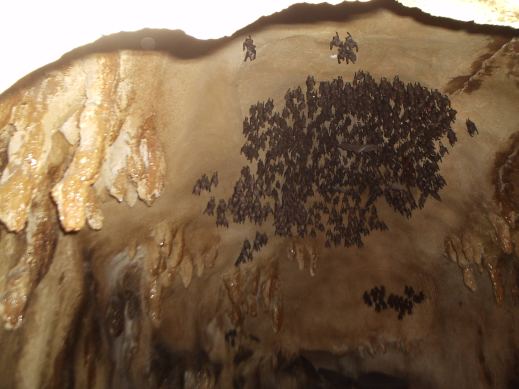

Could there be a colony of bats in your attic?
Since this is the Season of the Witch and all things creepy, it’s time to share a scary, true story with a very educational ending. This story is about bats … and the Batman.
I love our old house. We live in a 1920’s English Tudor with all the old-world English Tudor charm. This charm includes leaded glass windows that are beautiful yet leak in the cold Rochester winter drafts, and copper plumbing that offers enough water pressure to either take a shower OR run the washing machine, but not both at the same time.
It also features a walk-up, half-finished attic, with its own bedroom/bathroom suite and a claw foot tub in the bathroom. This is where all our guests spend the night.
I greatly respect and appreciate bats. I love that the average bat can consume 1,000 mosquitos per night, and how they use sonar to get around, and I love the children’s story Stellaluna.
I even worry about how white-nose syndrome is decimating bat populations in northeast. On October 28, the U.S. Fish and Wildlife Service posted new white-nose syndrome decontamination protocols and supporting documentation for cavers.
I want bats to have disease-free homes and be fruitful and multiply, just as long as their home is outside my home.
This is the part where things get scary.
One Saturday night, my husband and I were doing what we do on most Saturday nights: we were lying in bed watching Saturday Night Live. As you can see we do not get out much and that is why I blog for excitement.
We were nearly dozing off between the opening monologue and the musical guest when we thought we saw something fly by our bedroom door.
“Did you see that?”
“Wha….” my husband was nearly asleep…
“Um, did we close Charlie’s cage before we went to bed?” I asked, hopefully.
At the time, our daughter had a sweet green parakeet named Charlie. I desperately convinced myself that it was Charlie that just flew down the hall. Charlie got out, yup.
Please let that winged thing be Charlie.
We went to our daughter’s bedroom. Charlie the parakeet was safe in his cage, door closed. But something was still flying in the hall. Something with a wingspan far larger than your average parakeet.
We could now safely say we had a bat in our house.
I ran screaming into the bathroom in our bedroom. My brave husband threw a towel over his head and went to pursue the winged rodent with our bed sheet.
Then, like that, it disappeared.
The only thing worse than having a bat in your house is knowing there is a bat in your house but not knowing where it is.
With towels over our heads, my husband and I crept down to the kitchen to get the telephone book to search for someone, anyone, to help us. We dialed the town animal control hotline only to learn their hours were from 10-4 on Tuesdays and Thursdays. The outgoing message said to call 911 in an animal-related emergency.
Was this an emergency? SURE! There could be a rabid bat attacking us at any moment!
So my fingers shakily punched 911 and I alerted the local police that I had three sleeping children, including a 7-month-infant, and a bat was loose in my house.
In minutes, the police were at our door. Remember, this is Brighton, and not Staten Island, where years earlier I waited 45 minutes for police to arrive after calling about girls trying to break into my house to beat me up with a very different bat.
The friendly policeman came and humoured us by shining a flashlight all around the kids’ bedrooms and our living room, but found no bat.
“He probably found somewhere to hide. Bats are really shy and wherever he is, he will stay there till morning,” he reassured us.
This left me no comfort, and I scanned the Yellow Pages for more help after he left. By this time it was around 12:45 a.m.
Then, I found him. An ad for the Batman. From our bedroom, I called the number, figuring I would leave a message and someone would call me in the morning. Instead, to my surprise, I heard a low mysterious voice after a few rings.
“Hello?
“Um, are you — the Bat Man?”
“Yes, I am the Bat Man, how can I help you?”
I immediately apologized for calling at such a late hour, only to be answered with the Batman’s strange response.
“No need for apologies. This is usually the time when the calls come.”
Okaaayy. I told him the situation, and then he told me that this could wait until morning, that bats were very shy, want nothing to do with humans, and he would be by in the morning.
Oh, but one more thing, he said. There was a good possibility that if we found one bat, chances are there were not one – but a colony of bats in our attic.
A colony?
With that the Batman bid me goodnight.
Nighty night and sleep tight. Stay tuned for the conculsion of this bat tale.
The Stinger and the Honey, and the Bitter and the Sweet
 Preschool teachers have the honor of experiencing many sweet firsts in a very young child’s life. For some of them, it is the first time they are being cared for by someone other than a parent or a relative, and we are honored to earn their trust and love. As a preschool teacher, you may also witness the first time a child stands at an easel, brandishing one, sometimes two paintbrushes, to combine blue and yellow to make a green, refrigerator-worthy masterpiece.
And even still, you can be with a child the first time they go potty in a place that isn’t in their own home.
Unfortunately, there are a few bitter firsts that come up from time to time. Today, a little boy in was stung in the classroom while he was building blocks with his friends. The bee entered the classroom most likely through our open window on this warm October day. I am sure that bee did not want to be in the classroom, just as much as the children (and teachers) wanted it out of the classroom.
But our little student indeed got stung. At first he bawled and held up his finger, so we quickly checked for a stinger (no stinger), checked for visible signs of an allergic reaction (because you never know if a child is allergic to bee stings until they are stung), and ran his finger under a stream of cold water. A few minutes went by before we realized that he had been stung a second time, this time with the stinger in tact, on the back of his neck.
He cried for his mom as we removed the stinger, iced his neck, and tried to soothe him. At the same time, we had to keep seven other kids happy and calm, so we called in another teacher for reinforcement.
Then a very unexpectedly sweet thing happened. I must interrupt my story to tell you that we were pretty late in setting up for snack before the whole sting operation went down. It had been raining all week and this was the first day we had a chance to play outside. By the time we returned to the classroom after an extended time playing outdoors, snacktime was overdue.
Have you been around three and four-year-old children waiting for a snack?
But these little people did not complain their snack was late. One by one, they went over to their stung friend, who was now sucking his thumb sitting on my co-teacher’s lap, and gave him a hug to feel better. The boy calmed down, and was completely recovered within the next ten minutes thanks to the healing magic of crackers and juice.
Do you recall the first time you were stung by a bee? I hope that it was not too unpleasant a memory and it didn’t give you hives or require an epipen shot or a trip to the emergency room.
Over snack, I told my friend the very first time I was stung:
I was about seven and a wasp and I collided as I ran from my back yard to my front stoop. Right on my neck, just like my little friend.
I remember me screaming and my grandfather picking me up and carrying me to the backyard, where my mother quickly applied some ice – and a pumice made of salt and meat tenderizer.
After the surprise and the shock, I was actually pretty insulted that a bee – a creature of the natural world that I loved – would sting me. Didn’t the bee love me back, I asked my parents and grandparents through the tears?
The impression the boy took away from this story, as told by his mom was that Morah Stacy (that’s me — Morah is teacher in Hebrew) doesn’t like bees.
My little friend, that’s just not true at all.
It took me a while – deacades perhaps — to get over my fear and develop an appreciation and love of bees. I’m not saying I will become a beekeeper, like many people are doing these days to thwart off the devastation of bee colony collapse. It’s just that since I have become an avid gardener, I am content to work right beside those bees happily buzzing and collecting nectar and pollen for their hives.
And I’ve come to appreciate how much we rely on these creatures for our food and think how scary it is that in recent years, the US bee populations have decreased by almost 40 percent. And as much as my little students are afraid of bees, it’s scarier to think about what will happen to their world and future without them.
There is a famous Israeli folk song that in English goes: like the bee that brings the honey, needs a stinger to compete, so our children learn to use the bitter with the sweet.
Next time you go to swat a bee, please think twice.
How a Sukkah is like a Christmas tree
 Okay, so the headline of this post might shock and offend some, but please let me explain my bold statement.
Growing up in a predominantly Italian neighborhood in Staten Island, as the Chanukkah song from Adam Sandler song goes, I was the only kid on the block without a Christmas tree. Our neighbors invited my family over for cake and tree decorating and we in turn invited them on Chanukkah to light our menorah, spin a dreidel and eat fried potato latkes.
Even back then I understood that Christmas was a big holiday, and Chanukkah was a minor Jewish one. But Christmas trees still left me with a feeling of being on the outside, my nose pressed to the frosted window.
A menorah, no matter how big, even the ones that the Chabad Lubavich movement lights, just can’t compete with the smell of fresh pine, the twinkling lights and the tinsel to a Jewish kid on Staten Island. I even had my secret Christmas tree fantasies. If I ever had a Christmas tree, it would be simple: just candy canes and white lights would hang off the branches of the Christmas tree of my dreams. And it would only be in my dreams, because I knew very well that there is no such thing as a Chanukkah bush.
I did have childhood associations with Sukkot, the eight-day autumn festival of Booths, because of Hebrew school. I made the standard paper sukkah chains and ate within the large sukkah of my synagogue. In fact, the first time I was ever asked on a date was in a sukkah. It was in the seventh grade and a classmate asked me to go roller skating at Skate Odyesy as our teacher, on Orthodox rabbi, continually shushed us as he attempted to recite kiddush, the blessing over the grape juice.
But because my family didn’t build a sukkah of our own, the holiday still felt remote to me. I didn’t have a sukkah to eat my bowl of breakfast cereal in, or sleep in.
Now, in adulthood, my family enjoys putting up a sukkah every autmn, and we have done so for eleven years. And because we have a family sukkah, I can now say why this celebration, one of the major holidays on the Jewish calendar, blows that overblown attention we give to that other holiday in December right out of the water. Why? Because a sukkah fulfills the Jewish Americans’ need to decorate a large, religious object with branches and lights and have social gatherings within or around it.
Sukkot is known in Hebrew as one of the “three legs” of Jewish holidays, one of the three times of the year when the ancient Israelites were commanded to make a pilgrimage by foot to Jerusalem. Imagine Israelites building one of these temporary huts and sleeping in their fields under a harvest moon.
This same harvest moon shines through the roof of our family sukkah on the first few nights as we feast and sing. After a month of self scrutiny, asking for forgiveness, and finally, fasting on Yom Kippur, sitting within the walls of a sukkah is like getting a hug from God and feeling His forgiveness, as one Chabad rabbi in my college years so eloquently explained it.
In my neighborhood, Sukkot is all around us. As we are finishing up our meal of brisket and sweet potatoes, our neighbor, an Orthodox rabbi, is starting his meal with his family within their sukkah. We can hear his voice as he joyfully sings the kiddush as we clear off our table. This is followed by the clanking of plates and the laughter of his grandchildren as they dine. This coming outside to eat, either in these formal meals or sukkah hopping later in the week may be the last chance we get before the long Rochester winter, makes our neighborhood just feel more neighborly.
How is a sukkah not like a Christmas tree? For one thing, Jews are commanded by God in Torah to build one to remind us of the booths that the Israelites lived in during their wandering in the desert after we were freed from Egypt. Plain and simple, it’s a mitzvah just to sit in a sukkah. I still don’t understand if there is a religious connection between a tree and the birth of Jesus, but I’d be happy to learn how this tradition got started.
So, now that it is December, I still admire Christmas trees, but with a knowledge and experience that the Jewish people have our time of year for our big celebrations with something to decorate and gather in. Come this Christmas, don’t feel bad for the Jewish people who have no Christmas tree. Instead, feel bad for the Jewish people who have not yet built, or ate, or slept, or dwelt in a Sukkah, back in September.
A Most Peculiar Pumpkin
“I want to grow pumpkins this summer!” said my youngest son.
And so we did. Inside, in the spring, we started a pumpkin seed, which would in the summer turn into Toby’s pumpkin patch.
Knowing that from this seed would grow an incredibly long, invasive vine, I gave this vine carte blanche and let it take over one quarter of my tiny garden plot. And the vine grew, and wandered. Huge pumpkin blossoms bloomed, bees visited them and rested inside. But none of these blossoms turned into pumpkins.
Except this one:

This pumpkin will never become a jack-o-lantern. I would hack through the plastic fencing to free the pumpkin as it grew, but I think the pumpkin took care of that. It may become a pumpkin pie, but it might be too tough and stringy. So, I guess, the only thing our only pumpkin of the year will give us is a good laugh.

Season of Repentance, or…. Happy 5771
I was first aware it was the Hebrew month of Elul as we drove through Atlantic City on our way out to dinner. I was with my husband, his sisters and their husbands for a grown-up night out to dinner while my in-laws watched 10 of their grandchildren back at the beach house. The moon was rising over the intercostal waters between the mainland and the barrier islands of the New Jersey shore. It was full and red and a signal that it was just a little over two weeks before the new Jewish Year.
In Hebrew calendar cycle, the moon is always full on the 15th of the month, so I knew from that red moon rising over casinos and billboards promising everyone a good time, that we were at the halfway point of the month of introspection and spiritual preparation. A strange place I know to start getting all introspective and spiritual, but a wave of regret passed over me because I had yet to think about the new year. I had yet to hear the sound of the ram’s horn, or the shofar, that is supposed to wake up Jews out of their sleepy summertime complacency and think about repentance and self-improvement.
In contrast with January 1, I consider this New Year truly the new year, even though to most of the world, the calendar will still read the same year for a few more months. But think of the physical changes that are take place right now: the summer is over, the days grow shorter, a new school year begins. The heat is leaving the air. In fact, on our way to Slichot services this evening, I wished I had worn a heavier sweater. Funny thing is, just yesterday, it was so hot I wished I had a nearby pool to jump into.
These changes seem far more apparent than the new year in January. In Rochester, it will be just as ice-cold on December 31 as it will be on January 1.
Slicha – Excuse me. Slichot – pardon us, are some of the translations from the Hebrew.
In Judaism, Slichot – this little known and sparsely attended service — occurs on the Saturday night immediately preceding Rosh Hashanah. It serves as a warm-up to the big show that are the services of Rosh Hashanah. Slichot includes a sampling of prayers that we will recite just days away, including the confession of our transgressions.
Now, in Judaism, there is no direct translation for the word sin. The Hebrew word chet means to “miss the mark.” It assumes that we tried to to the right thing, but for whatever reason, we went astray and failed. The season of repentance is our chance to get us back on the right path.
At services, my rabbi suggested to his congregants to make a list of all the places we missed the mark this year. And, like the liturgy of the High Holidays, I know he doesn’t mean “I’m sorry I ate a bacon double cheeseburger” or “I’m sorry I went to the movies on Friday night instead of having Shabbat dinner.”
No, the list of transgressions we need to make for ourselves in the season of repentence is much more personal, much more interpersonal.
So here goes my list:
- I’ve yelled. I’ve yelled at my kids for not cleaning up after themselves.
- I’ve yelled at my husband. Even worse, I’ve spoken to my husband in harsh tones and unkind words
- I’ve drawn too many quick conclusions of others. I’ve assumed the worst in people instead of giving them the benefit of the doubt.
- I’ve ignored or lost touch with friends, neighbors and family who may have needed my help.
- I’ve talked too much when I should have been listening. I’ve made too much talk about me when I should have asked more about you.
- I’ve held grudges
- I’ve shown indifference
- I’ve let my emotions get the better of me
For all these things, I will ask not of God to forgive me, but I will have to ask forgiveness of the people I may have hurt. For all these things, please this year make me a better mother, a better friend, a better wife, daughter. And a better teacher.
To all those who observe, a sweet, healthy new year!
SET? No! SET? No! And other games with the family
 I married into a family that plays games. And they like to play the games only late into the night, say, after 10:30, when we have put our kids to bed and my brain starts to rapidly shut down.
The setting for these games is usually at a family gathering, such as the beach house we rented this summer for a week at the Jersey Shore with 8 adults and 10 kids ranging from age 13 to my niece who just turned one, figured out how to walk while we vacationed, and likes to scream – a lot.
More on that in another post. Maybe.
Have you ever played SET? This is a game that, according to the manufacturer works both sides of the brain: left brain logical skills and right brain spatial skills opening up pathways to creativity. In plain English, you are dealt cards with squiggles and diamonds or ovals, red, purple or green, striped, outlined or filled in. There are one, two or three shapes to a card. When you find three cards with all the same characteristics, or all different, you have a SET.
That’s if you can get a SET before your daughter finds one, or your sister-in-law, a MIT and Columbia graduate, finds one. For me, I just stare at those cards until I can’t see straight. I just can’t compute fast enough. My daughter is apparently *extremely* good at SET, she played it all the time at camp, as pictured above. We talked as her pile of SETs nearly toppled over. I didn’t have a SET to my name.
“Who did you play SET with?” I ask her.
“Anyone who would play with me,” she replied.
Then, after a pause, she added, “but after a while, no one wanted to play with me anymore.”
Then there’s Boggle. Have you ever watched an episode of King of the Hill, where the mother enters the Texas all-state Boggle championship? Well, she couldn’t hold a candle to my husband’s sisters and parents Boggle skills. This is cut-throat, take ’em to the ground no mercy Boggle, as most games are played in the family.
Last time we played Boggle was at a holiday gathering at my in-law’s house out in Long Island. The Boggle board is shaken, and someone runs over to the microwave to set the timer for 3 minutes, 10 seconds. That is because someone long ago lost the sand timer and the family on principle has not replaced it with a new one. So the 10 extra seconds allows time for that one player who has to set the microwave to run back to the chair at the kitchen table and pick up their pencil. Ten seconds are up, then it’s time to GO!
My husband and his sisters write furiously, as a novelist would if he broke through writer’s block in a chapter of a novel. My brothers-in-law and I, the folks who married into this clan, jot down a word or two and then look up at each other for a second, shrug and give one another sympathetic looks.
My mother-in-law never really plays. She says she’s just going to knit or watch TV. Until we sense that she is standing over us, looking over our shoulders. After we go around and cancel each other’s HEES or HAWS, or PAWS, my mother in law finds the one eight-letter word on the board. Like SQUEALED.
My husband says that games are good healthy fun. But losing all the time is just no fun and that’s why when it is time for gametime with the in-laws, I’m going to start curling up with a BOOK.
What I hate about being Transplanted North
This post is for anyone who has been taken care of by a relative, or anyone who changed plans or dropped every other responsibility in one’s life to take care of a loved one. So, I guess you can say this post is for everyone.
A transplant never really cuts all roots from where it first sprouted. Tendrils and shoots wind and twist back over states, oceans and continents, especially if the bulk of the transplant’s family still lives where they were originally planted. And sometimes, the parent plant can pull on those roots pretty hard.
Last week, my family had its plans tremendously and suddenly altered. It was to be a perfect summer week spent in Western New York: my parents were coming up to visit! We were going to explore Canandaigua, hike some local trails, visit the Rochester Public Market, check out a museum. Then, my folks were to take my youngest son back with them to Staten Island for a week of fun in New York City.
The day before their planned arrival, I worked at getting the upstairs room ready and poured through magazines looking for the perfect summer recipes.
You know that saying, Man makes plans, God laughs?
The day before the visit, I got the call from my dad from the emergency room. Through a weak signal, I could make out that my mom was having terrible pains in her abdomen, and that she needed emergency surgery. My mom was in pain and my dad sounded scared. And I, the transplant, was about 400 miles away.
If you have ever received a call like this, you know how your mind reels. What to do? Wait it out? Leave immediately? Fly? Drive? And what about kids? Do you take them along for the ride, and if you do, how can you be a help out a loved one in the hospital with kids in tow? No, that won’t work.
So calls have to be made, favors have to be asked to watch kids from people who never have to ask favors from us transplants. Why? Because of all their family – their support network – lives in town.
Luckily, summer schedules found two of my kids still away at sleep-a-way camp and my youngest in day camp. Luckily, I have an amazing and supportive husband who booked me a flight to JFK, a friend here who drove me to the airport, a wonderful father-in-law who picked me up from the airport – with a packed lunch even – drove me to the hospital and waited with my dad and brother while my mom had her operation.
And, most luckily, as scary as this whole ordeal was, this operation saved my mother’s life. And it taught me that people – family – manage to come together to make everything alright. Through the waiting, I spent time alone with my brother and dad in a way that I haven’t since I was 17 years old. No spouses, no kids, just the three of us, waiting and talking.
Through my mom’s recovery, I cooked meals and spent time with my sister-in-law. And when the week turned into the weekend, I was reunited with my husband and Toby in Staten Island. In my childhood bedroom, I read him a bedtime story, but not before bedtime was interrupted by a surprise fireworks show from a nearby beach that could be seen out my window.
People ask me how I can still consider myself a transplant after living in Rochester for ten years. After ten years of living “up here, you should be used to it,” they say. But, ten years can still considered as being a pioneer in the woods compared to five generations of my family’s roots in New York City.
Why do I hate being a transplant? This week, now that I’m home – or back- or wherever I am – was a fine example of why.
Carrying In, Not Carrying Out – The Trashing of our Parks

can people not pick up after themselves? Even on a nature trail?
I was glad to see that there exists a blog category such as a rant. This blog should have been a rave, but I will woefully have to rant instead.
I spent a beautiful day last weekend with my husband and our youngest child at Stony Brook State Park in New York, just north of Corning. If you have been to this park, you know what a treasure it is. If you have ever been to Watkins Glen State Park, near Ithaca, you have had a similar experience. But, at Watkins Glen, there is absolutely no going in the water, as inviting as the water looks. It’s too rough. The current there would pound anyone to a pulp.
But Stony Brook State Park features a gently sloped, rambling stream that invites you in to make your way through its swirls, try out its natural water slides, stand under its gently cascading falls. All around you this brook over the centuries has carved out a ravine which is now lush with forest and ferns. And, there is also a parallel trail to the brook for those who want to stay dry.
One would think that any visitor would hold a place like this, or any park, state or national, in high regard, to keep it clean and pristine.
Not so.
The first disgusting thing I found in Stony Brook was an empty pack of cigarettes floating in the water. Gross as it sounds, I snatched it up and put it in the pocket of my cargo shorts. Those pockets were meant to hold stuff, and if I could put them to use by carrying out some litter, all the better.
Then, I passed a few water bottles, sitting empty on a slab of stone, abandoned by their consumers. I shoved them in my son’s backpack. I got a complaint from my husband when I added to my litter collection a crushed empty can of Coors Lite.
After picking up this my next piece of trash out of the brook, that public service announcement came to mind, the one from the 1970’s when I was a kid, that Native American crying that one tear. He has to be long dead and gone, but he is most likely still crying in his grave by the looks of things.
This item of litter did not please my husband.
“Don’t do that, then our backpack will smell like beer! They have people to pick up….”
“Really????” I snapped, annoyed that he was annoyed with me picking up litter rather than annoyed that someone broke the hiker’s rule of littering!
The truth is, there are no people to pick up after us along the trail. You bring a water bottle on the trail, YOU bring it out of the park with you when you are finished! You need a cold one as you watch the waters bubble over the smooth stones, YOU don’t smash it and leave it there for someone to pick it up.
The thing that bugged me also was the NUMBER of bottles and cans I saw in this beautiful place and the NUMBER of people I saw just walking past it.
But the most disgusting bit of abandoned refuse, I must say, was the dirty diaper. Crammed into the crevice of a rock, a rock I almost used as a place to hold on to on a slippery stretch of brook.
Well, I had to draw the line there.
People, pick up after yourselves when you go hiking! Do you need a reminder of the hiker credo: Take nothing but photographs, leave nothing but footprints!
And, if you are hiking, and you see something fouling up the surrounding natural beauty, PICK IT UP!! Imagine how much cleaner our nation’s parks would be if we picked up one or two pieces of trash along the way.
Happy trails.
Traversing The Swiss Family Robinson – and use of the “A” Word – with my six-year-old
 Time magazine’s July 22 cover story was “The case Against Summer Vacation,” an article that posed the argument that our romanticized notion of summer vacation can be blamed on Tom Sawyer and is merely the remnant of our vanished agrarian society. Kids had off in the summer hundreds of years ago because Ma and Pa needed them to work the fields. Now, enriched summer vacations are a privilege only bestowed to the middle and upper class, while inner-city kids run the risk of summer learning loss if they spend too much inside with TV and video games.
I know how lucky we are that we can afford – barely – to send our kids to summer camp. It’s not just kids in lower economic brackets who tend to veg out before the plasma god in the summer. At the beginning of the summer, I feel it is my parental duty to program every art project, play date and forced nature hike. What happens if I take the laissez-faire approach? Let’s just say I wish I had a quarter for every time I scream “TURN THE TV OFF!”
I know that kids can backslide during months of summer slacking. So I have really tried to get my kids into summer reading. I’ve enlisted them in our local library’s summer reading programs. I don’t know if my kids are reading while away at summer camp, but I know that my 11-year-old son voraciously plowed through four books before he packed up and left for sleep-a-way camp. My teen daughter? She put up a bit of resistance to reading this summer. I will attempt to get her bit by the literacy bug before the summer is through. Her school does have required reading book lists, after all, it’s not mom that wants her to read, it’s SCHOOL!
While the big kids are at their heavily-programmed, up-at-dawn sleep-a-way camp, my youngest child gets to be an only child for one solid month. That means mom and dad are all his. With all this quality one-on-one bed-time reading time on our hands, I figured we would tackle a classic. No Captain Underpants for us! With visions of climbing that immense artificial treehouse at Disney World and bowls made of coconut shells dancing in my head, Toby and I cashed in a 10-month gift card at Barnes & Noble and bought The Swiss Family Robinson.
We get through a chapter each night. The language, let’s just say, was far more complex back then. I checked the year Swiss Family Robinson was written. 1812.
“I believe there was a war that year,” my husband jokingly said.
Yes. This book is almost 200 years old. And some of the sentences were as heavy as the sugar canes that Fritz and Father carried on their shoulders on their Voyage of Discovery in Chapter Three.
I’ll give you examples of how I offer my son modern interpretation as I read along.
“I awoke my wife, and we consulted together as to the occupations we should engage in.”
I woke up my wife, and we talked and made a to-do list of all the jobs we needed to get done for the day.
“When we had gone about two leagues…”
After walking two miles
“we entered a wood situated a little further from the sea…took out some provisions and refreshed ourselves.”
We went into a forest located further from the sea, got out some snacks and refreshments.
At one point, my son asked me to read the book exactly as it was written. Three sentences later, he again asked for my interpretation and complained, “mom, I have no idea what you are talking about!”
But, he urged me to read on. We got to the chapter about rescuing the animals off of the shipwreck, and the challenge faced by the father and the oldest son.
I read,”What a difficulty in making it! and how could we induce”
umm.. make
“a cow”
a cow
“a sow”
a pig
“and an ass”
…….ummm, a donkey
“either to get upon a raft, or when there , to remain motionless and quiet?”
At that point, my young son stopped me.
“Wait, Wait! Moooooom, you changed that word, the word for donkey!! You were going to say one word, but you said “donkey.” Does this book have — the A word — in it??” He had deliciously naughty grin on his face, both dimples showing. Reading a 200-year-old book cannot be all that boring if you might catch your mom saying the “A” word, after all.
Tonight, Chapter Seven: Second Journey of Discovery Performed by the Mother of the Family. I can’t wait.
About Me

Kreativ Blogger

Versatile Blogger Award


 Stacy Gittleman