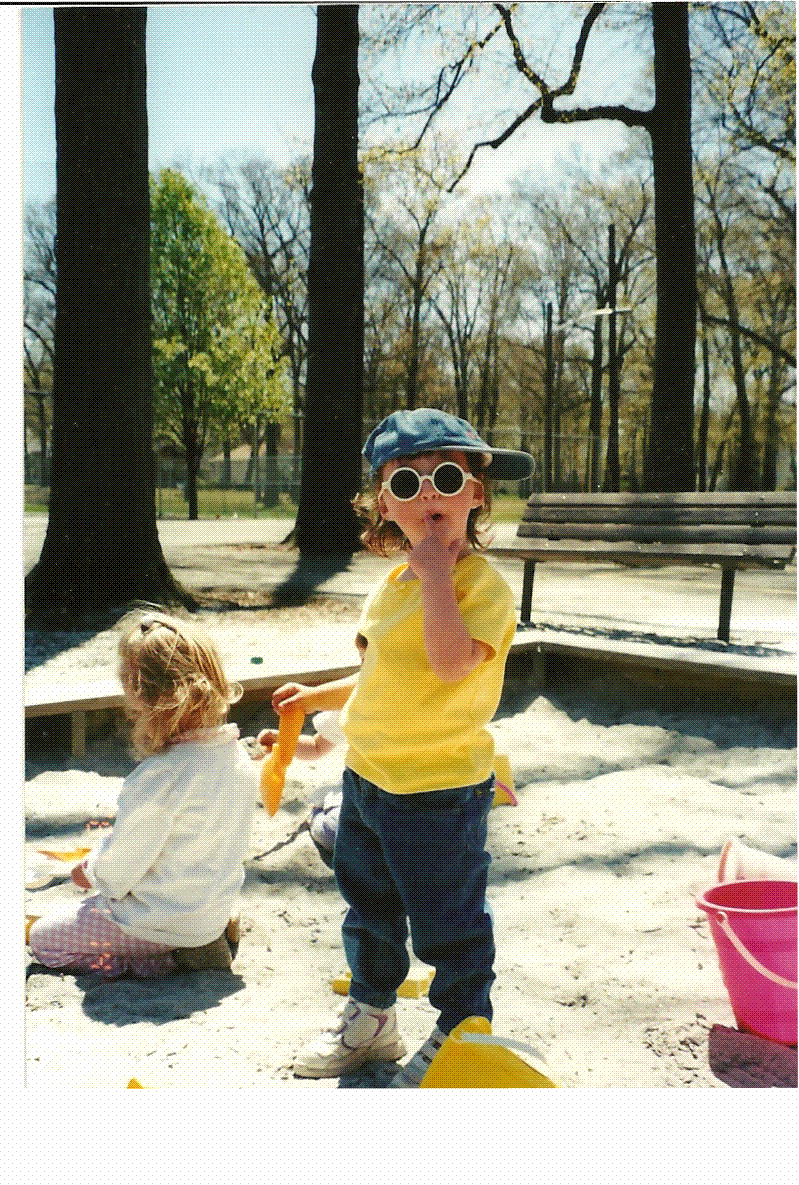
Conversations with Playground Princesses
Today in Western New York it was one of those first spring days when it felt like spring – warm spring – was really here for good. Not only was no jacket required, but you could actually venture outside and feel gentle warmth and not bitter cold on bare arms and legs.
So, as soon as all our little students arrived at school, we raced outside to the playground.
Among the chirping of the robins was the falsetto operatic voices of some of our three and four-year-old girls. They sang as they followed each other up and down the play equipment, down the slide and through the tunnel.
I had to ask what they were playing.
“It’s Princess Day!” One of them said.
So, what is on the agenda of Princess Day?
“We stayed in bed all morning, went on an acorn hunt, scrubbed the floor, went to the ball, and then we went to sleep.”
… .. Not bad. It’s all in a day’s work for the playground princesses.
The endangered “average” child. My thoughts on Race to Nowhere

I started the evening at Rochester’s screening of the documentary “The Race to Nowhere” as a columnist hunting for my next big topic. Would this movie light a big enough spark to generate action in the towns I cover? Would this mobilize parents to put an end to the endless hours of homework?
The screening of this independent documentary was widely anticipated in Rochester. For weeks, as in the rest of the nation, Rochesterians have faced the grim news of deep cuts to school budgets. Increased class sizes. Cuts to Advanced Placement classes. Cuts to arts education, even at Rochester’s prestigious School of The Arts.
But this film was not about budget cuts. Or maybe it is. Maybe, the stories in this movie are the direct results of the mess our nation’s education system finds itself. Race to Nowhere is the product of cuts to funding in education: too many teachers forced to teach to the test, classes stripped away of anything creative, kids stripped away of their zest for life and the excitement of learning, replaced by the constant pressure to churn, absorb and perform.
Even though I got my ticket in advance, finding a seat was a challenge. The lecture hall at Nazareth College was packed. But still more educators, students and community members filed in to see a film that is sparking heated discussions and stirring people to act and rethink the cost of constantly pushing our children to always excel, always succeed and NEVER take it easy. We are pushing them fast, according to the movie, to cheating, burnout, stress-related illnesses, and in the most extreme case, suicide.
The film, as our moderator cautioned, did take a very narrow focus on only the most stressed-out kids and teachers. I did not see any joy in these kids lives, and there had to be some point where these kids had a chance to kick back and enjoy, or maybe even once come home and bubble about something they learned in school.
I’m relieved to say that my kids still come home excited about at least some of the learning they do. How can you not get excited about creating a silent screen script as a way to learn about the 1920’s or learning about Beluga whales?
But, as I watched the movie, I felt the tension slowly rise in my throat. I got emotionally caught up in the struggles of the kids and parents on the screen. My thoughts drifted to my own three kids, aged 14, 12 and 7:
……About a month ago, my daughter came home from school “stressed” that she only got an 86 in her latest math test. Only.
My daughter is in the 8th grade in the Brighton Central School District in the Rochester Area. It is one of the most competitive in the country. She’s been enrolled in accelerated math and science ever since the fifth grade.
And my illustrious academic math career? I was never a good math student. I write. There are brilliant mathematicians and engineers who can barely weave together a paragraph. This is because we are wired differently, and that is okay.
So, I am pretty certain that in my New York City Public school, math classes were created for left-brained students like me. Just to shove enough math credits down our gullet to graduate.
So, hearing my daughter say “I only got an 86” in an advanced math class, evoked little sympathy from mom. But, she wasn’t looking for sympathy. She was truly stressed.
“I HAVE to get AT least a 91 or higher in my next test, or else I’m out of the accelerated math program.” Her emphasis was on “test” and not on learning a theory, or learning how to solve a problem.
I posed the possibility of failure to my brilliant daughter: “There may come a time in your academic life when you, no matter how hard you studied, might get a low grade on a test. A really low grade. What would happen, if you actually failed a test?”
“Fail?! No way. I’m never failing a test. Ever.” And she went back upstairs to study.
“Race To Nowhere” also talked about the overemphasis on Advanced Placement classes. My daughter is already talking about taking Advanced Placement classes at age 14. This is something that I didn’t think about until I was a junior in high school. I took AP English classes and AP biology classes because I was genuinely interested in them and wanted to take them. How it looked on a college application was only the second reason why I took them.
And for my daughter? It’s as if the last few months of eighth grade are already history. Onto looking good for the college application. Onto the next thing.
..My son, a sixth grader, comes home to discuss the Civil Rights Movement and the book, The Watsons go to Birmingham. He also threw himself into his optional science project and studied how airplanes fly. He is a voracious reader and absorbs books from authors like Stephen King, James Patterson, and Anthony Horowitz. With all this reading, he is capable of making excellent inferences and insights in class discussions. He is also in accelerated math and never throws his hands up in frustration because he doesn’t understand something.
Nathan’s downfall is that sometimes his completed homework fails to make it from his backpack, down the hallway, and into the teacher’s inbox. So, often, he is graded on missing homework assignments instead of his actual ability to think and solve problems while he is in class. And, like the movie pointed out to me, my nightly conversations with Nathan are not about what he learned, but what he has for homework, and did he do it, and can I see it? And our nights usually end up with him yelling at me to get off his back.
Lastly, the movie touched upon our society’s never-ending need to one-up our friends, family and neighbors with how much material wealth we gain. Making money is the whole reason for working so hard in school, for accepting acceptance from only the top colleges, so one can be gainfully employed and making a LOT of money. That is success.
At seven, my youngest already understands this.
“Mom, are you successful?”
I think about this. I am happily married and have three healthy, beautiful though somewhat kooky children. I have three jobs that touch a lot of people’s lives in my community, though none pay enough that I could actually independently support myself. But, I have been there for my husband so he could be successful. In turn, for his success, I can be home for my kids after school to take them wherever they need to go: be it Bar Mitzvah lessons or orthodontist appointments.
But I know what my son is getting at…
“Let’s face it mom. The “Jonses” are both doctors and they have a pool and a hot tub and a really big house. And we don’t have a pool. And our house is not as big as theirs. So, they are more successful than you are.”
So, I ended the night not a trailblazing reporter, but a weepy parent with knots in my stomach. I was too much in a rush to get home to my kids, NOT to ask them about their homework, or what they got on their latest test, but to give them a hug and tell them to find time to enjoy life while they are still kids living under my roof.
Post # 84: I wish I could Play Guitar

some mommies let their babies grow up to be rock stars
To play an instrument, you have to devote years to practicing scales, learning finger or bow positions, developing your lips to get just that right tone (if you play brass or woodwind), and studying theory.
You have to endure playing simple, nerdy songs like Hot Crossed Buns or Ode To Joy when what you really want to play is the latest song from The Plain White Tees. If you have an ear for music and those songs in your head don’t yet match your ability, it can be all the more frustrating.
But everyone needs to start somewhere. You can’t just pick up a guitar and instantly become Bonnie Raitt or Jimmy Paige, and we all know that playing the Guitar Hero is not the real thing.
Unless…..
What if…. what if, after hearing the opening chords of “Blackbird” by the Beatles, or “What It’s Like” by Everlast, I could just pick up a six-string, start strumming and sound just like that?
So, if I could instantly download a skill into my brain and body ala Matrix style, it would be the ability to play a mean guitar. No, not even a mean guitar. I’d be happy with knowing enough chords to be considered entertaining around a campfire.
I know the guitar is difficult. It takes more than having a garage and knowing a few chords for most to be really good at it. But playing guitar seems to be the most approachable, liberating instrument there is.
The guitar is my son Nathan’s third instrument. Back in the second grade, Nathan was gently fired by his piano teacher after less than two years of lessons. It’s not that he didn’t have an ear for music. He could plunk out a Rachmaninoff tune or the theme to Harry Potter with all its sharps and flats on one finger, but no one was going to tell him about correct hand positioning or posture at the keyboard, or what a C Major scale should sound like.
As she left our house the for last time, this demure woman in a stiff skirt and buttoned up blouse reassured me: “Don’t worry. He has the music inside him. He has to find the instrument he loves. And let him get a little older.”
Or, maybe it was the right teacher that hooks you to an instrument. Nathan is now on the threshold of his teen years. After four months of guitar lessons, Nathan is a little more receptive to taking direction from a guitar teacher than a piano teacher. But he still wants to play the guitar like Johnny Ramone. Now.
One day, Nathan comes into the kitchen.
“Mom, what does this sound like?”
Nathan breaks into a simple guitar riff, than bangs on his guitar quickly two times. As he plays, his brown eyes lock on me, eyebrows raised, mouth hanging open. An expression that reads, is this cool, or what?
“Of course I know what that is. It’s Blister in the Sun by the Violent Femmes!”
A little smile. “Yeah!”
Each week, we get treated to a mini jam session that is Nathan’s guitar lessons. Guitar teachers are a completely different animal than piano teachers.
Tuesday nights go like this: as Nathan wolfs down some dinner straight after two hours of religious school instruction, the doorbell rings. It’s Nathan’s guitar teacher. Nathan’s teacher can’t be more than 26. He works all day with at-risk youth. He has spiked short hair and a pierced tongue and one of those black plug earrings. Nathan’s guitar teacher is definitely not a piano teacher.
My husband has a very healthy, heterosexual admiration of this young man. Also a guitar-playing wannabe, he is in complete rock-star admiration as he listens to him warm up. Now, that’s what years of playing the guitar can sound like. Once a week, for 30 minutes, we have in our midst, a real guitarist who is in a real rock band.
Nathan has a long way to the top if he wants to rock and roll. But he is getting there. He can play the basic chords to Hotel California and I can slowly sing each bar, as he searches for the next chord, as I make dinner. And, he knows – of course – a standard blues riff. And Louie Louie. And Tequila!
I still have to nudge him to practice what his teacher actually wants him to practice, which is Amazing Grace. And I have to wonder: Did Jimi Hendrix’s mother have to nudge him to practice? Or Eddie van Halen’s mom? Or .. did Eric Clapton’s mom bug him about cutting his nails before playing?
Probably not. But they probably didn’t want to play the guitar as badly as I do.
Swirls of Color or Standardized Dots? Keep Arts in Schools

What picture inspires you more.
This?
Or this?

If public school budgets continue to shave and slash away at the arts, the black and white dots of those “No Child Left Behind” standardized tests are all that will be left of our children’s public school education. Teaching to the test leaves no room for imagination, creativity, real thinking or problem solving. What it has resulted in is burned-out stressed-out teachers and students.
This is according to an independent documentary called “Race To Nowhere” that is sparking a grassroots movement to reshape how we educate our public school students. I look forward to seeing a screening of this independent movie in Rochester, NY, at Nazareth College on April 4. The movie screening is being sponsored in part by a private Jewish day school, Hillel Community Day School.
The film challenges parents, educators, and policy makers with this question: Are we doing right by our children? Is the pressure to succeed in standardized tests really preparing our children to become capable, inspired and motivated individuals ready to tackle college or the workforce?
When school budgets get tight, the arts are the first to get cut. In fact, schools in the Rochester area are seeking to reduce some of their arts budgets by 50 percent.
Is music, art and sculpture really that expendable? Is painting, singing, and playing an instrument such a frivolous part of a child’s education that it should be considered a fluffy extra that can be easily eliminated from his academic career?
Absolutely not, according to Americans for the Arts. Young people who consistently participate in comprehensive, sequential, and rigorous arts programs are:
- 4 times more likely to be recognized for academic achievement
- 3 times more likely to be elected to class office within their schools
- 4 times more likely to participate in a math and science fair
- 3 times more likely to win an award for school attendance
- 4 times more likely to win an award for writing an essay or poem*
When was the last time your child stood at an easel and held a brush full of paint? Or perhaps, in the spirit of abandoning everything for creativity’s sake, she ditched the brush and instead joyfully found herself up to her elbows in paint, as her hands and fingers glided across the paper.
Indeed, art is messy. When was the last time you let your kid get messy at home with some paint or clay? Overheard once in a preschool hallway: “I’m so glad they paint here at school, because at home, we don’t let him do that.”
Might as well draw a dagger through a teacher’s heart.
Video games and television are not messy. But they don’t do much to fire up the brain neurons either.
Art on the other hand unlocks creativity in children that leads to story telling, pattern recognition, and understanding other cultures. It is simply the expression of life that makes life enjoyable. Art enables quiet kids to tell stories. Art calms and centers otherwise boisterious kids. It is a positive way for them to control the environment around them. A blank piece of paper or a lump of play dough can become a whole universe that they can master.
The above picture was created by a very precocious preschooler who patiently sat, cut and created a composition. Imagine what that same child can do when she gets older in an art class?
If a child is not going to be exposed to the earts in their earliest school years, then where will they get the opportunities? If arts are cut in public schools, there are private arts classes that parents can enroll their chilren in most towns and communities. But they cost money. So, cut the arts in public schools, and access to arts will only be possible to the families who can afford them.
And the rest? GThe only drawing less priveleged kids are going to do in school are the dots and circles they create on a standardized test.
Under the Purim Moon in Israel – 2008

It was just St. Patrick’s Day in America this week. I couldn’t help but notice all the people decked out in green, so publicly and outwardly showing their Irish pride. People were wearing the green and donning shamrocks in schools and restaurants and supermarkets.
Strangely enough, this visible expression of pride in one’s ethnic identity reminded me of the revelry and costumes of the people of Israel as they celebrate Purim. Purim is a story of kings, queens, and villans. A holiday of reversals. A holiday of masks, costumes, and feasting. And like St. Patrick’s Day, there is some drinking involved too!
In America, Jewish holiday celebrations take place mainly inside synagogues and Jewish community centers. But in Israel, the planet’s only country with a Jewish majority, all Jewish holidays spill onto the streets and shops. And Purim in Israel is one big nationwide party. A party celebrating a victory over wickedness that could hold true today. There was a wicked man in Persia back then that we defeated. There is a wicked man in modern-day Persia, or Iran now. Both of these men pledged to destroy the Jewish people. One wicked man defeated. Many more to go.
What could have been a day of great sadness for the Jews turned out to be a day of great joy. And, we are commanded to be joyous, intoxicated even, on Purim. So drunk in fact, that on Purim in Israel there are special parades called Ad Lo Yada, meaning in English, “That you Shouldn’t know,” meaning on Purim you should be so happy (drunk) you should not be able to distinguish between Mordechi or Haman (boooooo!). Friend or Foe.
Last night I looked up and saw the Supermoon. While this moon was indeed one of the fullest full moons I had ever seen, it did not surprise me that there was a full moon. Purim, always falls under a full moon in March. Or, more precisely, the 15 of the Hebrew month of Adar.
As I gazed at this body of luminescence, I took a deep sigh and reminisced about where I saw it three years ago. 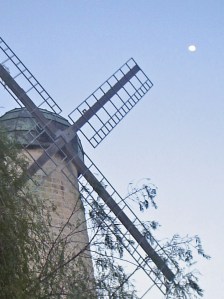 This was the moon I saw hovering over Jerusalem’s Yemin Moshe neighborhood. Okay, from my amateur photo, it was not as big as the supermoon, but it was special all the same.
I thought about all I saw and ate and felt when I was in Israel. I thought about the people who opened their homes and families to me who hardly knew me. I thought about waving the American flag in a Purim Parade and listening to the cheers from the people along the route. I thought about the traffic jam I got caught in. The reason for the traffic jam? Israelis were clogging the streets because they were delivering baskets of Purim food to their neighbors. That’s the kind of country Israel is – one big family.
Then, I caught a bit of CNN’s Piers Morgan’s interview with Israel’s Prime Minister Benjamin Netanyahu. During commercial breaks, the same old images were shown to the world of Israel: The Kotel, The Dome of the Rock.
Excuse me, Piers, but you were in Israel during PURIM!
Are these tired images all you really can show about Israel? Must Israel always be covered with conflict in the backdrop? If you got out on the streets of Tel Aviv or Modi’in or Jerusalem, if you could do one sidebar story, you would have wandered the streets and been treated to the following faces:

Halvah for sale for the Purim Feast

my friend's brother, decked out for Purim, celebrating with a feast at his home

teen girls dressing up and having fun in Tel Aviv

mom and kids wait for bus outside of old city, Jerusalem
Will showing these images make Israelis seem just too normal, too human for media coverage? Would it portray Israel too much for what Israelis are, a people who love to live, who love to celebrate?
Until the media in America show photos like this of Israel, I’ll just have to share my own. And I’ll be taking more. Because we just booked our next trip for this December. Even though it is the first day of spring, I can’t believe I’m saying this, but I can’t wait until the winter.
It’s March Madness … Baby!
 My husband is a really big college basketball fan. Make that a Syracuse Orange basketball fan. I can watch a game but I refuse to get so emotionally invested in a team. And I admire, but I admit feel intimidated by, women who are big sports fans. I cannot understand my husband’s addiction to checking scores and talking stats the same way he cannot understand my addiction to watching news coverage of natural disasters – or checking my blog stats. But we have lived with our differences for over 17 years now. And, to prove that love rules above all were married on March 12, smack in the middle of March Madness.
I should have known what I was getting into back when we were dating. I remember going over to his house when he was home from grad school. It seemed his whole extended family was over to watch a Syracuse basketball game. I was not allowed to talk until the commercial breaks. I remember going to some Cal basketball games with his grad school buddies when we lived out in California. Back when Jason Kidd was their Center. He and his friends talked basketball stats the whole way home on the BART. They may as well have been speaking in Chinese, I didn’t understand any of it.
How does my husband want to leave this world? He has told me that when his time comes, and I hope that’s 100 years from now, it will most likely be in his Lazy Boy chair watching Syracuse play UConn in double overtime during the NCAA tournament.
Ever since graduate school, he and his lab buddies, no matter what corner of the country they live in, keep a bracket going this time of year over a small wager. Now, I don’t remember him being concerned about his bracket picks at our wedding. I don’t think he had a small transistor radio in his ear as we stood under the chuppah, or wedding canopy. And among our vows was one where he vowed that during our Maui honeymoon, he would not stay in our honeymoon suite watching the games. I’m just kidding.
Except one.
His alma mater, the University of Pennsylvania played against Nebraska that year and we watched that one game over Mai Tais by the poolside bar. It was the one game he said he really wanted to watch. Who was I to say no to my new husband’s one sports diversion – no obsession – on our honeymoon?
Years have gone by and I still don’t share this passion for watching sports. I just don’t understand how he can get so completely riveted in a game that in the scheme of the world will not change his life. Except maybe for the few dollars he will win on his grad school bracket.
But I do enjoy watching my husband watching these games. I will even tolerate him flipping between one of my shows so he can check the score.
To give you an idea of the excessive celebration that goes on around here during March Madness … our first child was born in December. You do the math.
Did you see any U.S. news coverage on the massacre in Israel?
I know it’s been a busy news week.
In Japan, an earthquake, tsunami and now a possible nuclear meltdown. I know that newsrooms are shrinking and international news bureaus are disappearing. But, still there was time and a news hole big enough to give coverage to March Madness, the unrest in Libya and a story on NPR of a man who returned to Calcutta to take care of his aging mother.
But what about covering the murders of five Israeli family members, including three small children who were murdered in their sleep? Nothing.
There only seems to be a need to cover Israel in the media when Israel faces worldwide condemnation for building an apartment building in Jerusalem. And the coverage of this apparent terrorist attack? Nothing. And the worldwide reaction? Silence. Why is this?
Here is a photo the surviving members of this family wanted the world to see. It is a brutal photo.

I was listening to the news and not one second of coverage was devoted to this story. Not on CNN. Or NPR. Not that I heard. Correct me if I am wrong, but did any American news outlet pick up this story?
I’ve been a newsaper columnist for over a year. Can you please spring for some business cards?
 Some exciting news in my tiny little newspaper career. I have new towns to cover! One of them is Webster, NY. Their town motto: “Webster, where life is worth living.” Webster is 20 minutes from my house. And in the Rochester area, that may as well be another planet. So off I went last night to explore my new town, which rests on the shores of Lake Ontario.
I was invited to a mixer held by the Webster Chamber of Commerce. It was held at the town’s local branch of HSBC Bank It was hopping! Only 20 people registered in advance, but the headcount was over 60, according to the event organizer.
So many great people in one room to meet, introduce myself to and dig up new story ideas.
Until one embarrassing question came up. And it came up time and time again each time I circulated the room.
“Can I have your business card?”
“Errr, well, to tell you the truth, I don’t have a business card, but the paper is working on it!”
So, instead I came home with a stack of business cards which I will now send out my contact information, with a link to my column.
Yes, it was embarrassing, and perhaps a bit penny wise and pound foolish of the newspaper for not providing me with a business card after doing this column for over a year now. When I meet new people, unless I carry around a copy of my latest column with my mugshot on it, where is the proof that I really am who I say I am?
My editors should know how I delight in writing each column, and they know I do it for a paltry sum of money. They should know how my spine tingled just walking into a real, live newsroom when I met with my editors this week. They should know that someone from the Webster chamber said to me “heck, send me your information and I’ll cough up the $20 to make you a set of business cards.”
Even in this age of Blackberries and social networking, there is still a viable reason for carrying a business card when one is doing real networking.
So, kind businesspeople of Webster, thank you for trusting me when I said who I said I was. And I will be getting my box of those old-school business cards any day. I promise.
A Fashion Statement I Regret Making

As I write this, I am watching the academy awards. No, my biggest fashion blunder thankfully wasn’t televised, nor was it as bad as Bjork’s Swan dress from 2001. But, in a time when one should try to act as cool as possible – the first day of high school – I truly missed the mark.
My 25th high school reunion is coming up. Now, I don’t remember what I wore my very last day as a high school student, but I sure remember what I wore the first day.
No, the picture below is not actually my legs. Thankfully, I dont think there is a photograph to document my first day of Freshman year of high school.
My mom had just started a subscription of Seventeen Magazine for me. The preppy look was totally “in” for the fall, according to Seventeen’s big, thick back-to-school August issue. Maybe if you went to a prep school in New Hampshire, but back in Staten Island, not so much.
So there I was, high school freshman, which is cause enough to get egged or suffer a head full of shaving cream the first day of high school. But no, I had to draw further attention to myself with khaki knickers, argyle socks and penny loafers.
I just got it all wrong.
About Me
Kreativ Blogger

Versatile Blogger Award


 Stacy Gittleman