
The Holocaust in Degrees of Separation
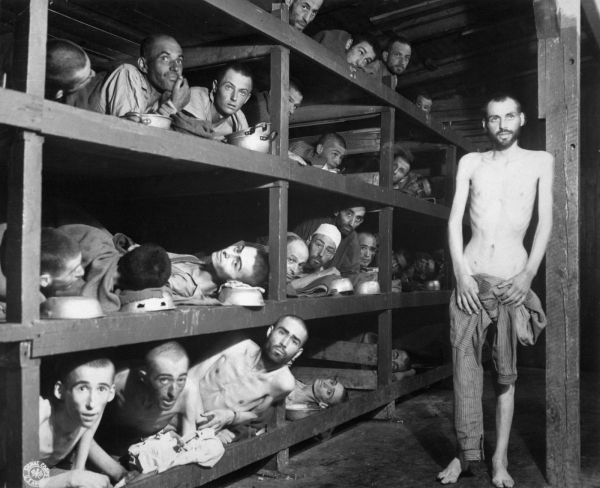
a photo of Jews, including Elie Wiesel and my friend's dad, liberated at Buchenwald
Leon Posen, a congregant from my synagogue, passed last week. He lived to the age of 94, blessed with a long life that could have been cut very short. His passing is still a sad one. Leon was a Holocaust survivor.
As the years and decades stretch away from World War II and Hitler’s war against the Jews, there are fewer people to tell first hand accounts of what happened in the ghettos and the concentration camps in Europe.
So who will bear witness in generations to come? Even if we don’t have a direct personal connection to the Holocaust, it is our turn to hear as many accounts as possible, and then tell them to the next generation. This is the only way to keep the vow of Never Again.
In Rochester, about 300 area Hebrew school kids in grades 6-12 watched their peers put on a play called “What Will You Tell Your Children” written by local playwright Jessie Atkin about her trip as a teen to the concentration camps in Poland. The play focused on the reactions of contemporary teens as they toured Auchwitz and faced anti-semitism and a general lack of understanding of Judaism at home.
I wonder if this new take on the Holocaust – telling the story second-hand and not directly from survivors’ accounts – actually disturbed,unsettled, and horrified the young audience enough to make them really remember. To make them relate. Was it too much of a softball throw in teaching the Holocaust? Is there – should there ever be — a gentle way to teach the Holocaust? How can it be unforgettable if we do not teach the inhumanity and the horror?
As the students watched the play, I watched the students. And then, I looked them as a whole – a bunch of healthy, creative, sometimes fidgety, teens and preteens. This was the same age demographic that Hitler selected for his Terezin concentration camp in Prague. A room with this many kids, multiply that number until you reach 15,000 kids. That’s how many died in Terezin, I thought. I shivered.
In my Hebrew school, we were spared nothing. My teacher, Rabbi Tzvi Berkowitz, was born in a displaced person’s camp in Cypress. The one depicted in the historical fiction novel “Exodus” by Leon Uris. He was the child of concentration camp survivors. Because of this, in our Holocaust education, we watched many horrible films shot in grainy black and white of the ghettos and camps filled with emaciated bodies. Some tortured and barely alive, some already dead.
But, still, it happened to someone else’s family, not my family, all those years ago. They were disturbing and yes, the first year I really learned about the horrors, I spent many nights curled up at the foot of my parent’s bed to sleep.
Now, I live in Rochester, a small town with an unofficial, intimate club that no one wants to belong to, yet they are proud members of it. Rochester has many Holocaust survivors whose families are now second, third and even fourth generation survivors.
It wasn’t until I had friends in this club, that I began to think: if his mother, if her grandfather didn’t survive, than this friend wouldn’t exist, or certain friends of my children would not be here.
Unlike the Yom Hashoah services of my childhood, when it seemed that everyone in my synagogue attended, it seems that Yom Hashoah services are attended mainly by those directly touched by the Holocaust, survivors and their decendants, leaders of the community, particpants in Rochester’s march of hope or our teen trip to the Holocaust museum in Washington D.C. So, going to these events, I still feel, thankfully, disconnected.
But in 2006, I had the privlelege of attending in Los Angeles the United Jewish Community’s General Assembly. That year I was the recipient of my community’s young leadership award, along with my traveling companion, Ron. Ron has the biggest heart of anyone I know, and lots of energy. An entrepreneur, he always seems to have three or four business ventures going on as well as several philanthropic projects. This is the kind of guy he is: we were stuck in an airport on the way home waiting for a delayed flight. It was late and people were crabby. Ron goes to the only remaining open store in the terminal, buys a bag of candy, and walks around, offering candy to the stranded travelers.
One part of the trip, young leadership delegates from around the world were taken to L.A.’s Museum of Tolerance. The museum, chronicles the Holocaust and current genocides in world history. Sadly, it shows visitors that vows of “Never Again” cannot ring true. In the decades since the Holocaust, there has been genocide in Cambodia, the Balkans, Rawanda, Sudan. Our docent said that the museum has been a destination of feuding gangs of LA to teach them the consequences of hate.
Further into the emotionally-charged museum, we came to the tail end of the Holocaust exhibit. There, transported from a concentration camp, in the corner of a dark room, was an actual bunk where prisioners slept, stacked three levels deep. Two to three men slept on planks on a bed the width as narrow as a twin bed. In the background, behind the bunk, was a life-sized photo, a well-known photo of survivors of Barrack 66 in Buchenwald. In this photo, is an emaciated Elie Weisel. I had seen this photo dozens of time in my life. Then, all of a sudden, Ron grabs me by the arm and points. Impossibly, my friend Ron’s face was peering out from the bunk one level above Weisel.
“Stacy!’ my friend cried, “That’s my DAD!”
And that is my degree of separation from the Holocaust. What is yours?
The endangered “average” child. My thoughts on Race to Nowhere

I started the evening at Rochester’s screening of the documentary “The Race to Nowhere” as a columnist hunting for my next big topic. Would this movie light a big enough spark to generate action in the towns I cover? Would this mobilize parents to put an end to the endless hours of homework?
The screening of this independent documentary was widely anticipated in Rochester. For weeks, as in the rest of the nation, Rochesterians have faced the grim news of deep cuts to school budgets. Increased class sizes. Cuts to Advanced Placement classes. Cuts to arts education, even at Rochester’s prestigious School of The Arts.
But this film was not about budget cuts. Or maybe it is. Maybe, the stories in this movie are the direct results of the mess our nation’s education system finds itself. Race to Nowhere is the product of cuts to funding in education: too many teachers forced to teach to the test, classes stripped away of anything creative, kids stripped away of their zest for life and the excitement of learning, replaced by the constant pressure to churn, absorb and perform.
Even though I got my ticket in advance, finding a seat was a challenge. The lecture hall at Nazareth College was packed. But still more educators, students and community members filed in to see a film that is sparking heated discussions and stirring people to act and rethink the cost of constantly pushing our children to always excel, always succeed and NEVER take it easy. We are pushing them fast, according to the movie, to cheating, burnout, stress-related illnesses, and in the most extreme case, suicide.
The film, as our moderator cautioned, did take a very narrow focus on only the most stressed-out kids and teachers. I did not see any joy in these kids lives, and there had to be some point where these kids had a chance to kick back and enjoy, or maybe even once come home and bubble about something they learned in school.
I’m relieved to say that my kids still come home excited about at least some of the learning they do. How can you not get excited about creating a silent screen script as a way to learn about the 1920’s or learning about Beluga whales?
But, as I watched the movie, I felt the tension slowly rise in my throat. I got emotionally caught up in the struggles of the kids and parents on the screen. My thoughts drifted to my own three kids, aged 14, 12 and 7:
……About a month ago, my daughter came home from school “stressed” that she only got an 86 in her latest math test. Only.
My daughter is in the 8th grade in the Brighton Central School District in the Rochester Area. It is one of the most competitive in the country. She’s been enrolled in accelerated math and science ever since the fifth grade.
And my illustrious academic math career? I was never a good math student. I write. There are brilliant mathematicians and engineers who can barely weave together a paragraph. This is because we are wired differently, and that is okay.
So, I am pretty certain that in my New York City Public school, math classes were created for left-brained students like me. Just to shove enough math credits down our gullet to graduate.
So, hearing my daughter say “I only got an 86” in an advanced math class, evoked little sympathy from mom. But, she wasn’t looking for sympathy. She was truly stressed.
“I HAVE to get AT least a 91 or higher in my next test, or else I’m out of the accelerated math program.” Her emphasis was on “test” and not on learning a theory, or learning how to solve a problem.
I posed the possibility of failure to my brilliant daughter: “There may come a time in your academic life when you, no matter how hard you studied, might get a low grade on a test. A really low grade. What would happen, if you actually failed a test?”
“Fail?! No way. I’m never failing a test. Ever.” And she went back upstairs to study.
“Race To Nowhere” also talked about the overemphasis on Advanced Placement classes. My daughter is already talking about taking Advanced Placement classes at age 14. This is something that I didn’t think about until I was a junior in high school. I took AP English classes and AP biology classes because I was genuinely interested in them and wanted to take them. How it looked on a college application was only the second reason why I took them.
And for my daughter? It’s as if the last few months of eighth grade are already history. Onto looking good for the college application. Onto the next thing.
..My son, a sixth grader, comes home to discuss the Civil Rights Movement and the book, The Watsons go to Birmingham. He also threw himself into his optional science project and studied how airplanes fly. He is a voracious reader and absorbs books from authors like Stephen King, James Patterson, and Anthony Horowitz. With all this reading, he is capable of making excellent inferences and insights in class discussions. He is also in accelerated math and never throws his hands up in frustration because he doesn’t understand something.
Nathan’s downfall is that sometimes his completed homework fails to make it from his backpack, down the hallway, and into the teacher’s inbox. So, often, he is graded on missing homework assignments instead of his actual ability to think and solve problems while he is in class. And, like the movie pointed out to me, my nightly conversations with Nathan are not about what he learned, but what he has for homework, and did he do it, and can I see it? And our nights usually end up with him yelling at me to get off his back.
Lastly, the movie touched upon our society’s never-ending need to one-up our friends, family and neighbors with how much material wealth we gain. Making money is the whole reason for working so hard in school, for accepting acceptance from only the top colleges, so one can be gainfully employed and making a LOT of money. That is success.
At seven, my youngest already understands this.
“Mom, are you successful?”
I think about this. I am happily married and have three healthy, beautiful though somewhat kooky children. I have three jobs that touch a lot of people’s lives in my community, though none pay enough that I could actually independently support myself. But, I have been there for my husband so he could be successful. In turn, for his success, I can be home for my kids after school to take them wherever they need to go: be it Bar Mitzvah lessons or orthodontist appointments.
But I know what my son is getting at…
“Let’s face it mom. The “Jonses” are both doctors and they have a pool and a hot tub and a really big house. And we don’t have a pool. And our house is not as big as theirs. So, they are more successful than you are.”
So, I ended the night not a trailblazing reporter, but a weepy parent with knots in my stomach. I was too much in a rush to get home to my kids, NOT to ask them about their homework, or what they got on their latest test, but to give them a hug and tell them to find time to enjoy life while they are still kids living under my roof.
Sisters are Doing it For Themselves – but we can do better

Women, we need your voice and leadership in Judaism
To my dear readers,
This blog post focuses on synagogue life inside Conservative Judaism. If you follow a different faith and don’t wish to read on and get bogged down in all the Jewish lingo, I will completely understand. But, if you want to read on and offer your point of view on women participation in religious life, Jewish or not, read on and chime in with your comments.
Last Saturday afternoon, after many warm hugs and handshakes on a job well done, and a shot of chocolate schnapps over a Kiddush lunch with my volunteer co-chair, I finally breathed a sigh of relief.
I co-chaired Sisterhood Shabbat at my synagogue as part of a nationwide celebration of women and women participating in synagogue life. The service went splendidly with many firsts for our congregation: The first part of the service was led by our congregation’s first woman rabbi. During the Torah service, the Torah was capably lifted by a woman who is a weightlifting fitness instructor. My co-chair and I felt a great sense of accomplishment that we had risen to the challenge to find a woman to lead every part of the service. Every woman who volunteered rose to the occasion as well and did their parts beautifully.
What troubles me is who will lead in the years and decades to come.
My concern over the last few months as I helped put this service together was on two fronts:
- The sparse feeling that I get when I see the increasingly empty blue seats week after week indicates the dwindling number of families who take the time to be with their community on Shabbat mornings. I get a little concerned about the future of my synagogue and the future of Conservative Judaism as a whole.
- I also was troubled by the number of women who I approached to participate who were not comfortable leading services or not comfortable with their knowledge of Hebrew. Among those who politely said no to participating were Jewish educators themselves. This level of discomfort, the scarcity of women who are comfortable enough to lead services, comes after nearly two decades of the Conservative movement counting women in a minyan and allowing full participation in synagogue life.
Sisters, we have to do better. If we truly want to see egalitarian Judaism survive and flourish, if we have the privilege of being counted in a minyan, than we owe it to ourselves and our daughters to push out of our comfort levels and learn to lead.
Is this a challenge? Of course it is. But it is not impossible. Look how far women have come.
- Don’t be afraid of not being comfortable leading services. We all need to start somewhere. Know that however you do, your community deeply appreciates that you participated in this mitzvah, or good deed, of leading your community.
- There are so many resources available for learning. If enough people voice interest and commitment, synagogues will happily create classes or sessions with our clergy. I didn’t learn to read Torah until I was 38 years old. Why? Because when I was a kid, girls “didn’t have to” learn Torah. But I knew even as a child that I would someday learn.
- If you are more comfortable learning at home and are tech savvy, there are online programs galore to help. For example, Siddur Audio walks you through nearly every page of the Siddur Sim Shalom prayerbook of the Conservative Judaism movement. You can even download mp3 clips and listen to them on your iPod to learn.
Lastly, don’t be afraid of making mistakes or screwing up. Or the butterflies in your stomach. I get nervous – complete with sweaty palms – nearly every time I read Torah. I often say to myself right before I read, why am I putting myself through this? But I know why I do it: it’s good for the community, and reading Torah is really good for your brain!
But it is not an exercise in perfection, rather an act in participation, because if you falter, there are people right beside you who are there to help. That is why it is called a kehilah kedosha – a holy community.
Feeling out of my League in the Company of Great Jewish Women
I’m going to start by saying this, bluntly: If I was making money — real money — it would be good for the Jews.
What I do now – educate the next generation of the Jewish community – is still good for the Jews. But, to be honest, it is still not as appreciated as a donation of the green stuff. I couldn’t help feel it this week when I attended a community fundraiser.
Now, I don’t play the lottery, I don’t gamble and I don’t believe in any get-rich-quick schemes. But, oh, if I were a rich girl, I would be so good at it. I would give a good part of it away.
But I’m not, and I can safely bet that with my liberal arts degree and my inability to get a career in public relations back on track after a decade raising our three children, I never will be.
I am happily, yet vastly, underemployed. I work three jobs: two in Jewish education, one in my originally intended field of journalism. And, waking up to the news this morning on National Public Radio, that companies are no longer hiring the long-term unemployed or underemployed, it looks like this will be my status for some time to come, if maybe for good.
I guess that, being a graduate of Rutgers University’s Douglas College, I was supposed to be a liberated, financially independent woman by now. I still feel I must make my own money.
My dear husband constantly reminds me that what I do – teaching the Aleph Bet and all the holidays and traditions to Jewish children – is an invaluable service to my community. He also reminds me that without me to raise our children full-time, his career could never have ascended to what it is now.
Even so, I can’t help but look at my own net worth. If not for my husband’s income, my three jobs wouldn’t even put me at the poverty line.
This post may seem controversial to some and may get me in a bit of trouble. And I do so appreciate the power of women’s philanthropy and the generosity of the many women in my community who are of means, who are generous and who can wear the pins to show it.
But, I am sure I can speak for my fellow Jewish educators, and especially Jewish early childhood educators, our contributions, if you had to value them in the form of a monetary gift to the Jewish community, are vastly overlooked.
According to the Jewish Early Childhood Early Education Initiative, today’s Jewish preschools are more than places that care for young children during the day – they are becoming centers to engage and re-engage children and their families in Jewish communal life. Attracting and retaining educators to the field is critical. But, it is highly unlikely to attract and retain the best and the brightest with the current compensation packages. Early care and education has not been acknowledged as a part of the larger educational system in the United States. As such, early childhood teachers and caregivers are among the lowest-paying of all occupations (Barnett 2003).
But, meanwhile, back at the fundraiser… there I was, in the company of almost 300 women at my community’s major fundraiser for Jewish Women’s Philanthropy. I have greatly benefitted from being actively involved in my Jewish community. I have co-chaired committees. learned about event planning and the power of women’s philanthropy.
In 2006 I received my community’s young leadership award from the Jewish Federation. I have attended the General Assembly of United Jewish Communities, thanks to my federation. And for my work teaching older children in afternoon religious school, I was sent on a Jewish educator’s trip to Israel thanks to the Jewish Federation. The Jewish community, on a macro level, does its best to make Jewish educators feel valued.
And yet, I felt I could barely keep up in the chit-chat at the table. I had not been to Amalfi Coast, had not sent my kids on a leadership program to Austrailia. I couldn’t seem to make myself say, “wow, that must be expensive,” or “that is out of our budget, I’m afraid.”
Okay, I get it. It was a fundraiser and the point was to raise funds. But, as I looked around the room, at the diamonds and all the bling-bling, I couldn’t help but ask myself, “What am I doing here?”
Many women attending the event, by way of their husband’s occupation or their own professions, were significant donors. If the message of the evening was being powerful through donating one’s own money or a woman making a gift in their own name, presumably with their own money, the message of the evening left me feeling, well, powerless.
I enjoy going to these events because you get to hear from powerful Jewish women – news commentators, columnists, brilliant comedians, prominent Rebbetzins, (rabbi’s wives.) In past years they taught me how we need to teach Israeli culture to our children to make them feel connected to Israel. That if you shed a tear while you are praying you are doing it the right way. That, although children may show resistance to Hebrew school, parents must stand firm and make sure their child receives a Jewish education.
Each year, I left inspired, given tools to further my Jewish involvement.
And this year? There was no mention of parenting Jewish kids. Israel — not even the singing of the Hatikva — was hardly mentioned – except a five day trip to the Jewish State this spring at a cost that is most likely out of my league as well.
The take away I got, and which I think other women felt of the speaker’s underlying message – is that if one marries a rich investment banker — you too can give millions away to the causes you care about.
As a Jewish educator who is not married to an investment banker, I’m sorry, ma’am, there was not much I could take away from your lesson. So, I will keep doing what I have been doing, for now, which is to make big gifts through every Hebrew word I teach, and every Jewish song I sing in the classroom.
For whatever it’s worth.
Sorry Yemen, your mail bombs didn’t stop the Global Day of Jewish Learning

Chef Tal Renan cooks up vegetarian food - just like he made for Oprah
The foiled Yemen plot to bomb synagogues in Chicago occurred so closely to two occasions on the Jewish calendar – one historic and one contemporary – you have to wonder if the timing was planned or if it was an eerie coincidence. Had some terrorist in Yemen checked a calendar to see if something important was coming up on the calendar within the global Jewish community?What if the terrorists from Yemen did intentionally plan the bombing of Jewish institutions one week before the Global Day of Jewish Learning, which was planned in 350 communities around the world? What if it had succeeded, as terror plots did against Jewish institutions in Mumbai, Buenos Aires, and Casablanca?In the spirit of this learning event that celebrated asking Big Questions, I’ll add mine: If the Yemen bombing had succeeded, would Jewish learning and teaching on November 7th still had happened?Thankfully, this time, we will never know. This past weekend, synagogues and Jewish community centers all over the world were brimming with people listening, speaking, dancing, drumming, and of course eating, in a Jewish way. The Global Day of Jewish learning was held in honor of an esteemed Jerusalem Rabbi, who on this day will finish five decades of work interpreting the Talmud, a sacred book of Jewish commentary, making it accessible and more understandable to today’s Jews. So no, in honor of this milestone that took a half-century to reach, we weren’t staying home on account of a package. We were ready to learn and tackle questions, in my community and others, like
-
What is Jewish Mysticism?
-
Why do Jewish holidays happen late or early, but never on time?
-
How can God be both loving and mysterious?
And, in my household….
-
When will the newest version of Shalom Sesame Come out?
In my community, we came out to listen to keynote speaker Rabbi Lawrence Kushner, author many books, including I’m God and You’re Not, wich was released this Fall We learned about Jewish vegetarian cooking from Chef Tal Ronen, who has cooked for Oprah Winfrey and the Dali Lama. Our kids learned Krav Maga, the Israeli martial arts, and explored Psalm 150 through drumming with percussionist Mike Mason.A separate track was offered for area Jewish educators, where we learned to fascinate our students with the art of storytelling, how to weave the narrative of Israel into any lesson, and how to excite and engage Jewish kids who, let’s be honest, may not be thrilled about coming to Hebrew School in the first place.The second occurrence on the Jewish calendar so close to these planned bombs from Yemen will be commemorated tomorrow. On November 9, 1938, the Nazis unfurled Kristalnacht, their own terror campaign, on the Jews of Germany. On the Night of Broken Glass, 1,350 Jewish synagogues were burnt to the ground or destroyed; over 91 Jews were killed; 30,000 Jews were thrown into concentration camps; 7,000 Jewish businesses were destroyed; and thousands of Jewish homes were ransacked. It was the beginning of the end of European Jewry in the 20th Century.It may seem like a date that is far in the past, but in light of the foiled attacks from Yemen, it brings it all too close to home.One thing that did keep the 600,000 Jews of Los Angeles away from their day of Jewish Learning was poor planning. Unfortunately, the LA Day of Jewish Learning was cancelled because of low enrollment. Why? A long-held community day of good deeds (mitzvot) was planned for the same day and the community just couldn’t compete with itself.Someone wasn’t checking their calendars.
About Me
Kreativ Blogger

Versatile Blogger Award


 Stacy Gittleman