
African Burial Ground, Lower Manhattan
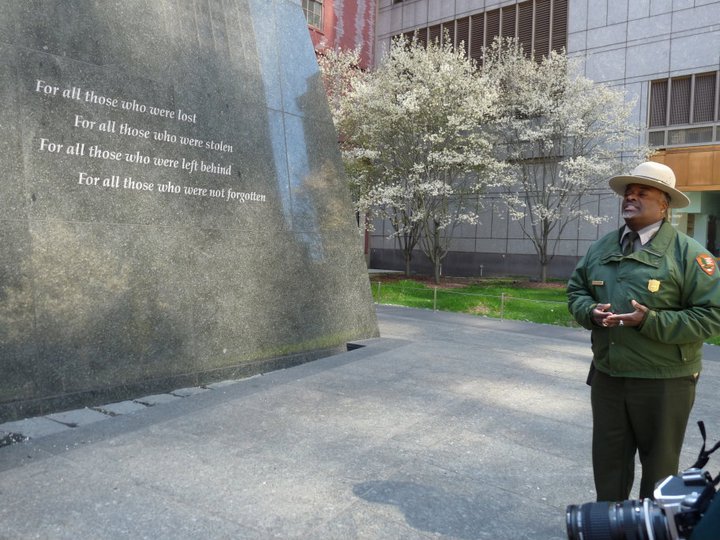
Ranger Doug at the African Burial Ground Monument in Lower Manhattan
This summer, play tourist in your own city.
And if you are one of those native New Yorkers that scoff at tourist traps like the Empire State Building or the Statue of Liberty, there is a relatively new attraction just north of City Hall that after one visit will change the way you will think about the American history you learned back in your school days. As we approach Juneteenth, a little known holiday that celebrates the emancipation of the last slaves of our nation, it’s worth a visit.
This spring on a visit back to New York City, my family went to the African Burial Ground National Monument and we all got a brush-up course on American history.
From what I remember about my public grade school education, slavery was taught like this:
- Africans were captured from their native lands.
- There was a very harsh, inhumane passage over the Atlantic where slaves chained together in the hulls of ships.
- Southerners owned slaves to work in the cotton fields and in their master’s homes.
- Northerners didn’t own slaves.
- Blacks were treated as slaves in the South so they tried to escape to the North, to places like New York City where they could be free
My kids were disappointed that the indoor museum was closed that day. However, the outdoor African Burial Ground National Monument Memorial was open, as it is daily from 9a.m. until 5p.m. except for all Federal holidays.
The burial site, used by African slaves from 1626 through the late 1700’s, was discovered only 21 years ago, when the federal government broke ground for a new building on 290 Broadway. Because archeologists uncovered the remains of 419 individual bodies of all age groups, it is regarded as one of the most important archeological findings of the 20th Century. In all, it was the final resting place for 15,000 Africans and their descendants It was the only place where Africans could be buried in the city.
The plans for the building were modified to accommodate a museum and a 6.1 acre monument that was opened to the public in 2007.
On the first approach to the memorial from Broadway, a grassy patch of ground with partially raised holds the remains of those 419 slaves. The grassy area gives way to a path marked by bricks and marble that spirals downward to what used to be the street level of the New York – or New Amsterdam – centuries ago.

The Circle of the Diaspora includes symbols that represent the African cultures from where the slaves were taken
The walls were marked by strange symbols and dates.
In the middle of this spiral is a map of the world that marks each native land where slaves were taken.
My kids, aged 14, 12 and seven, wandered around the site exploring. Finally, my youngest mustered up the courage to ask the Ranger what this place was all about.
All it took was that one simple question. Ranger Doug – Doug Maslenberg — brought the history of this place to life. In a narrative presentation that was no less fervent than sermon delivered like gospel at a Baptist church, Ranger Doug went into great detail to tell us about the lives of the slaves who were found buried at this very site. Through his booming voice, he brought the suffering of those people back. He spoke of the horrors of the middle passage on those ships, represented at the memorial by the 24-foot Ancestral Libation chamber:

Reminiscent of a ship's hold, the interior is a place for individual reflection.
He spoke of the bones of children that had been bent under the weight of carrying bricks and buckets of water too heavy for their bodies to withstand. Bones of men that contained evidence of whippings.
Ranger Doug looked directly into our eyes, almost a bit too long. Any preconceived notion that I had about a slave-free New York City was obliterated under Ranger Doug’s stare.
Back at home in Rochester – a city with its own past link to Abolition and Emancipation – my kids and I wanted to learn more. So we picked up a historical novel called Chains by Laurie Halse Anderson. This young adult novel, a 2008 National Book Award finalist, follows the life of an African slave girl in New York City during the Revolutionary war.
Thank you, Ranger Doug, I’m glad we asked.
Country Mouse Visits City Mouse


we haven't changed in 20 years, we're still dancing!
The title of this post is somewhat inaccurate. Because Rochester is not the country, it is a city. But it is not New York City. And calling this post “Former City Mouse living in Small City visits Big City Mouse,” just doesn’t have the same ring to it.
Whenever I go back “home” to the New York Metro area, I make my best effort to try to break away from both sides of the family to see at least one friend from my past life. This is not easy. There is first the six to seven-hour drive back to New York, crammed with kids and DVDs and suitcases, snacks and backpacks. Then the juggling of arrangements with two families. Attempting to see friends who are flung all over the Metro area further complicates the logistics. Sometimes, when I come in, I don’t bother to get in touch with old friends. It’s not that I don’t want to see people, it is just a recipe for disappointment.
But in the end, spending time with old friends is what my soul needs most. Even if the visit lasts no more than an hour or two.
So there I was this Passover, rushing out the door of my in-law’s house to catch a Long Island Railroad train meet a friend for lunch in the city.
Back before I was Transpantednorth, public transportation was a way of life. Now, we go most places by car and the only public transportation my kids know is the school bus.
What great material public transportation provides for the writer: people watching, eavesdropping. Time to think. Even on this trip, I had a great conversation with an older, retired CUNY professor about a Wall Street Journal article that discussed plans to turn the area around the Flatrion Building on 23rd St. into the country’s next high-tech “Silicon Alley.” That conversation led into a talk about the architect Frank Gehry with the professor and a mom sitting next to him who was taking her kids into the city to see The Adams Family on Broadway.
Sitting on a train affords you the opportunity to strike up such conversations with strangers. Would the same topics come up in the produce aisle at Wegmans? Probably not.
And after the LIRR, it was onto the NYC Subway. Ah, the subway! To this day, I always have a Metro Card somewhere in my wallet, though I am nowhere within commuting distance to even 242nd Street, the northernmost subway station. And, if I did still commute by subway, I am sure it would get old very fast. I now only ride a few times a year and it sends me reeling in nostalgia. Even the dank smell of the subway air, combined with the sounds of a musician playing a steel drum for a few coins or bills right there on the platform, makes me want to jump and scream for joy “Hey New York! I’m HOME!” And, if I know most New Yorkers, my outburst would barely bat a glance of attention. A true New Yorker rarely looks up from his newspaper — or now, his smartphone.
Nearly two hours later, I finally arrived at my friend’s apartment, the friend who had after so many years working and struggling had finally arrived as a true Upper West Side Manhattanite. She lives in a beautiful doorman apartment with her new husband and their blended family. My college friend, the one who got nasty looks from our professor because she could not stop turning around to talk to me in class, the one who I helped kill a cockroach the size of a Volkswagen Beetle with a bottle of hairspray in her first Manhattan studio, now has a corner living room with a wrap-around curtain of glass that offers views of Broadway, Lincoln Center and a front row seat to the Macy’s Thanksgiving Day Parade. I am so proud.
Old friends like this can go for months at a time without speaking, but can pick up right where they left off. The last time I saw city mouse was December 2009 at my daughter’s Bat Mitzvah. The time before that was the summer before at her second wedding. Needless to say, we didn’t have much time at either of these occasions to catch up. But we sure did dance!
So this time? We sat in at her table that overlooked upper Broadway, drank some red wine from Spain and ate – Matzah Lasagna. Okay, the last part did not sound all that glamorous so what else could we eat?
We talked. We talked about work and not working, kids who had crushes on Justin Beiber and kids who melted their $300 transition eyeglasses (more on that in another post).
Before I knew it, it was time to catch the train back to Long Island. So, she walked me back to the 72nd station. On the way, we strolled in her Upper West Side neighborhood, a neighborhood that could have been mine, maybe with a similar career track, if I would have been her roomate all those years ago instead of following my heart out to California. We walked through the Lincoln Center Plaza where she proudly pointed out the new patch of grass. This may be very exciting to city dwellers, but us country mice get to play in grass whenever we want!
We passed her old apartment building on W72nd street and also saw her very first apartment building, the one with the cockroach, the one I almost moved into almost 20 years earlier.
And on the train ride back to suburbia, staring at the stillframes the train makes of unsuspecting children playing in yards or workers unloading trucks onto loading docks, I wondered what life could have been like if I lived it as a Big City Mouse.
Happy Year of the Rabbit

My brother and I at Ko Shing Rice Shoppe's Grand Opening, circa 1977
Growing up, all roads led to Chinatown.
My family went into “the city” a lot. That is what Manhattan is called, even if you lived in one of New York City’s outer boroughs, as we did. We could be uptown at the Museum of Natural History, at Madison Square Garden catching the Ringling Bros. & Barnum & Bailey Circus or the Ice Capades, or schmoozing on the Lower East Side. But when we got hungry, we ended our day in the city in Chinatown.
And most of the time, we ate at the same restaurant: The Ko Shing Rice Shoppe.
The Ko Shing Rice Shoppe was located right across the street from the brand-new Confucius Tower apartment buildings. Its dining room was sparsely decorated with wood panels and mirrored walls and plain tables and chairs. It was not a tourist spot so it did not have the usual Chinese kitsch of gongs, pagoda-sloped ceilings or dragon tapestries on the walls.
What it had was great food.
My grandfather knew the owner from many years before. He worked nights at the New York Daily News for over 50 years. His lunch break was around 3:00 a.m. Over the years, he became a regular at one of these all-night Chinese kitchens that operated out of a midtown basement. There, he met Lee. One day, or night, Lee said he was opening up his own restaurant in Chinatown and wanted my grandfather’s whole family to be there for the celebration.
That is where the above picture is from. I was about nine, so my brother was only five. We were the only non-Asian family there among the celebrants, and we were treated to plate after plate of chicken & cashews, crab, bowls of winter melon soup and other delicacies.
From that age on, until my 20’s that was the restaurant of my family’s choice, above Italian food, above Kosher Deli, it was Chinese food that was our exotic cuisine of preference. Chinese food is as inextricably linked to my identity as Matzah Ball soup and gifelte fish.
So, on day outings to the city, we would get there at an odd hour: 3:30 or 4 o clock. The restaurant would be all but empty except for our family: my parents and my brother, my grandparents, and friends who would meet us there, locally and from out-of-town.
In the back at a huge round table, the cook staff would be chopping mountains of Bok Choy and broccoli in advance of the evening rush. My grandfather would take us into the kitchen to say hi to Lee and the chefs. Then we would order, my grandfather would order for the whole family not bothering to even look at the menu. He would just ask Lee to make us a dish of this and a plate of that, always with extra ginger and garlic at my grandmother’s request.
If the waiters had time, they would patiently instruct my brother and I how to use chopsticks. We would have to eventually abandon our practice and resign to use our forks when my mom and grandmother said we were taking too long in our attempts to pick up every individual grain of rice.
After dinner, it was still early in the evening. No matter the weather, summer or winter, we would walk through the narrow streets of the heart of Chinatown. And before vegetarianism or veganism was hip, my grandmother was the first person to introduce me to tofu. After dinner, she would have to make a stop at the Tofu factory to bring some home.
The Ko Shing Rice Shoppe was a place where we held our family birthday parties. My mom’s 40th. My grandfather’s 65th. I even found myself there with my grandfather after the funeral of my paternal grandmother, with whom I did not have a relationship.
But on the ride home, seeing that I was a bit glum, my grandpa found our way somehow from the funeral home in Westchester to the Ko Shing Rice Shoppe. We talked over the events of the day over steaming cups of tea and a dish of beef lo mein.
I don’t know if the Ko Shing Rice Shoppe still exists. I went back to Chinatown on a recent visit but didn’t have the heart to walk the street where it was, in case it was boarded up or another restaurant had taken its place.
In young adulthood, visits to another Chinatown – this time in San Francisco – were a highlight of my newlywed life when my husband and I lived in Berkeley, Calif. We ate at San Francisco’s famous house of NanKing, where lines would snake around the corner during the Chinese New Year to sit in a crammed dining room and feast on sizzling plates of vegetables drenched in the most incredible hoisin sauce I have ever tasted. In the evening, we squeezed into the crowds for a view of the parade, complete with Chinese Dragon dances, drumming bands, and marshall arts demonstrations.
Now I live in a town without a Chinatown. But there are still some good family owned Chinese restaurants in Rochester, like Golden Dynasty and Chen’s. My diet has changed from consuming everything to only sticking to vegetarian items. But still, on Chinese New years, my children delight in the traditions of getting a dollar in an envelope and opening up fortunes.
Have a great New Year!
The Picture that Always Makes me Laugh
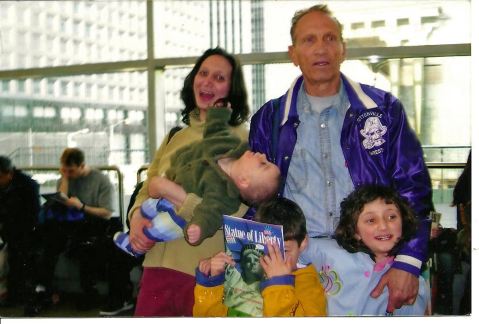
This gallery contains 1 photo.
I guess I love this picture because it is so in the moment. It is not the ideal photo of what you would think of as the perfect family outing to the Statue of Liberty. It is perfect, though , because it captures the reality of the chaos of daily life with three kids:
Remembering John – and James
 Today marks the 30th anniversary of John Lennon’s death.
That day also ended my childhood and woke me up to the harsh realities of the world, realities that couldn’t be imagined away.
On December 8, 1980, I was in the 7th grade. I can’t remember when I started listening to the Beatles. My cousins were into them, and one of them won the Rubber Soul album (yes, not a CD, or a mp3 download, but a vinyl LP) from 101 CBS FM. When playing cards or games at his grandmother’s apartment in Coney Island, if you made a move against him, he would break into lyrics from the song You Can’t Do That – “I told you before — nooooo, you can’t to that!”
So I was well familiar with the Beatles by age 12, though maybe not who the individual Beatles were, or what John Lennon was all about.
I had just received my first radio alarm clock and my radio was tuned to an AM station 77 ABC – with Don Imus in the morning. Don Imus spoofed everything and was always reporting fake news. So when I woke up on that dark December morning and heard that John Lennon was rushed to the hospital for a gunshot wound to the chest, I thought he might be joking. Sure, Imus, I thought, as I went downstairs to get my breakfast.
Then I went down to the kitchen and saw the news on TV – the pictures of Yoko Ono on her knees by the Emergency Room entrance and the announcement that John Lennon was dead.
That day also brings me thoughts of a classmate from the 7th grade. His name was James. I had a bit of a crush on James, though back then, in the brutality of junior high school, liking the wrong boy could get you teased to no end.
James was not exactly what other girls in the class thought of as cool or cute. He didn’t dress cool or act cool. He had thick unruly hair and thick glasses.
But what James had going for him in my book was that he was SMART. Ahead-of-his-time smart.
For a seventh grader, he was certainly up on his politics. After all, what other seventh grader could write poetry that included references to Mohammed Ali as Cassius Clay or Ted Kennedy and the Chappaquiddick incident? What other seventh grader could argue with our social studies in defense of Richard Nixon when most of us barely knew what Watergate was at age 12? James made Nixon impersonations all the time. And he drew great political cartoons. His other idols: Walter Cronkite and Dan Rather of CBS News, a network where he swore he would someday be gainfully employed.
If James was born 20 years too late and had a fascination with the 60’s, his favorite band was of course – the Beatles. So on the morning of December 9, when the world found out that John Lennon was dead, there was an announcement in home room to observe a moment of silence for the slain musician.
At that moment, James did another mature thing that could have a seventh-grade boy drawn and quartered. He cried. Right at his desk, right there in front of everyone.
Now, remember I had a crush on James, who didn’t seem to care that I existed. Who made fun of me about as much as anyone else in the seventh grade. But I couldn’t bear to see him cry. So, seeing that he had no tissue, I got up out of my chair (which I think was against home room rules), crossed the room, put my hand on his shoulder, and offered him one.
“I’m so sorry,” I said.
He looked at me, took my tissue, and thanked me.
It truly was a Wonder Years moment that still remains an entry in my adolescent diary.
And now, 30 years later? I still miss John Lennon and wonder what more music he could have given us, what more he could have taught his son.
Now: my own kids love the Beatles. They sing and listen to their music. They have been to Strawberry Fields and have stood outside the Dakota.
Now: For a fifth grade biography project, Nathan, who is now 12, found a book in the young adult section of the library that ironically was published three months before Lennon’s death. To accompany the book report, we made a milk-jug headed John Lennon puppet, complete with the signature round framed glasses, long wavy hair and a New York T-Shirt. Nathan’s playing the guitar now, and I’m sure It Won’t Be Long until he will be asking for a Beatles song book.
And James? Last time I saw James – in person – was at an SAT prep class held at Wagner College back when we were in High School. The class was held at the student union, and one day, a Beatles cover band was playing in the cafe. James had a great time singing along.
I have seen James since, but on TV: James is a news correspondent: though on FOX, not CBS.
A lesson in art and New York City appreciation
 Seeing New York City through my daughter’s eyes is quite refreshing. She loves the pizza, the culture, and the excitement, She was blown away by the hip-hop performers that flipped and jumped through a crowded uptown train. I also wondered, how did they do that without kicking anyone in the face and when do they find an empty car to practice?
And now, just like me, she loves the Metropolitan Museum of Art. As they get bigger, I want to expose my children to as much as possible of the city where I was born and raised. Good and bad. The culture definitely falls into the good column. I’d like to thank my parents, who for one summer, took my brother and I to a different museum in New York City every weekend. Even if my brother gaped at the nude paintings and sculptures.
I’d like to thank them for staying in New York City while so many other of their friends have moved away to Florida.
I’m also thankful for art history professors who sent us to the Met to see works of art up close and personal before we wrote our final papers on them. Visiting a building that contains so many masterpieces, seeing the actual brushwork, standing before a painting exactly where the artist once stood gave me an appreciation of color, line and composition that stays with me to this day.
It’s been 15 years since I have made a pilgrimage to the Metropolitan Museum of Art, a place that feels (I hate to say it) as sacred to me as the inside of a house of worship. It has been way too long. So off we went to the Met: my mom, Jolie and I.
At some point, surrounded by Picasso, I switched my cell phone off. This was holy ground and should be treated as such.
I watched Jolie work her way through the Picasso exhibit, then allowed her to pull me this way and that through European Baroque furniture, Greek and Roman sculpture, all the while looking for the next work of art to take in and all the while wishing she had taken her sketch book. And asking when would be the next time we would return to another day at the Met.
A switch has been turned on inside Jolie to love all that is great and cultural about New York City. But she could do without the noise, the smells, and the crowds. There was a bit of a learning curve with using her Metro card in the subway.
She has yet to understand that putting up with the city’s unpleasantries as they hang on to their claim to living in the Big Apple is what give New Yorkers their character. For her, she wouldn’t trade the relative peace and quiet of Rochester for the center-of-the-universe qualities of New York City. It is turning out to be a nice place to visit but she wouldn’t want to live there. It’s just not where she is from.
Rochester, in all fairness, with all of your wonderful quality of life aspects, your great suburban school districts, incredibly affordable housing and 10 minute commutes to anywhere, you are not New York City.
Yes, I have come to appreciate Rochester’s cultural treasures, like the Memorial Art Gallery, the Eastman House, and the eclectic Artisan Works. But nothing compares to the treasures that dirty, crowded, noisy New York City holds. When I describe any of Rochester’s “tourist attractions” to friends back in New York City, I always preface it with “for a city of its size, Rochester has …..”
The MAG can never be the Met, and that’s okay. It is 10 minutes from my house, contains wonderful sculpture gardens and amazing traveling exhibits of Monet, Degas, and O’Keeffe since I have lived in Rochester. It has free parking.
NYC friends and family: I love and miss you all very much in the months and years I do not see you and the few precious days I visit with you over lunch or a holiday meal while living up North. But I have decided that when visiting NYC, I need to start playing the tourist instead of spending much of my time in living rooms. Please try not to be offended and try to understand, and make plans to come along with me to a visit to the Met or MOMA next time I’m in town.
About Me
Kreativ Blogger

Versatile Blogger Award


 Stacy Gittleman