
Everything’s Coming Up .. too soon


This gallery contains 11 photos.
The warmth in March, and everything that goes with it is coming at us all too soon. The last few days of March have behaved normally, reminding Rochesterians what a Rochester March should really feel like. Sunny but raw. Windy and cold. But last week’s weather was the talk of the town here in Ra-cha-cha. […]
I’m Not From Here. But I’m getting There.
Last night I went to a professional women’s networking event sponsored by the Jewish Community Federation. Local TV reporter Rachel Barnhart was the guest speaker. A young journalist with great passion and conviction, she spoke of her struggles early in her career and how proud she is to be working and covering news in the town in which she was born and raised.
Here are some things I loved learning about this homegrown reporter:
- She stands by her convictions. In high school, she was suspended because she refused to stop publishing her own underground newspaper.
- After sending in her first demo tape to land a broadcasting job, a veteran in the broadcasting business “ripped her to shreds” in an interview. Instead of getting discouraged, she was thankful for the helpful criticsm, took all suggestions into consideration and moved on.
- Later in her career, she fought a non-compete clause in her contract at Channel 8 and then landed a job at WHAM, where after a year working as a web producer, she paid her dues and was back on the air for the 6 pm newscast.
- She was the first local reporter from upstate New York to scoop the story that then-Rochester mayor would run as Lieutenant Governor with Andrew Cuomo. She picked herself and a camera crew and drove through the night to be at a press conference in the NY Metro area to be the first in the Rochester area to get the story – all on a hunch.
- Even though there are bigger media markets out there, Rachel is proud to be covering her hometown because she passionately believes in its revitalization, thank you very much!
- It is with this faith in Rochester that Rachel has built quite a local following. A journalist of the digital generation, she has harnessed the power of social networking and has 7,000 Twitter followers and counting. Including yours truly.
As a transplant, one thing Ms. Bernhart said ratttled me. On bringing in talent from those who are not from the area, she said that it makes sense for the Rochester media market to hire native Rochesterians. Who better knows the area, its people than those who grew up here? Out of town editors and writers just “don’t get” Rochester.
Perhaps this is true. Rochester is a very tightly-knit town. If you have no relations here that can be traced back one or two generations, you are pretty much an outsider. I’m not the only transplant to Rochester who has felt that it is hard to break into social and professional circles that were forged in grammar school. This is a big contrast from big cities where new people come and go and work their way in all the time. Like they do in my hometown of New York City.
Is it not my fault that I needed to go with my husband to Rochester when he landed a job here? Did we need to go where he could make a living? Where we could have money for food and clothing and to send our kids to a nice summer sleep-away-camp?
True, the initial connection my family has in Rochester is this is the place where my husband found a great job. But, this connection is often not enough for us trailing spouses.
Here is how, after 12 years of living in a town other than my hometown, I know I am almost “home” both geographically and professionally:
- I don’t get lost anymore and know the difference between 390, 590 and 490.
- I’m comfortable telling people I’m “from” Rochester when away on vacation. And when I start to say, “but I’m originally from…” I stop and let it go.
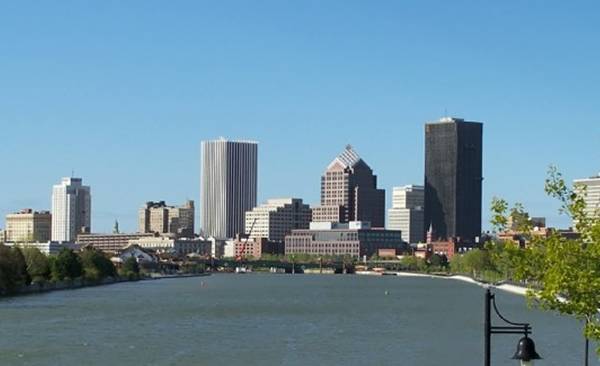
- I have grown to marvel at the clean lines of the Rochester City skyline. Sure, it’s not the New York City skyline, but it has a really cool bridge. And I personally know the civil engineer who designed it.
- My husband is home by six nearly every night. He has a 20 minute, traffic-free commute. In how many cities can you say that?
- When our friends “back home” tell us of their struggles to get their kids into the best private schools, we proudly boast about the great public schools in Rochester’s suburbs.
- I have yet to land a full-time job, but for the last two years, I have been bestowed the opportunity to meet all sorts of great interesting people through my column in the Democrat & Chronicle.
When I accepted writing this column, my editor at the time gave me some great advice: this is the chicken and waffle dinner column. It’s all about community.
This column will never win me the Pulitzer. It in no way matches the ambitions of my 22-year-old self fresh out of college. In fact, most of my journalism professors would raise their eyebrows at the stuff I write about. It’s not hard-hitting journalism. In fact, you can call it fluff, and I’d be cool with that.
However, my writing makes a difference. Greyhounds have been adopted. People have found support as they battle illnesses like cancer, Parkinson’s and Crohn’s disease because of events I’ve plugged in my column. Bikes have been donated and refurbished for the poor by local Rotary clubs and donations of food have been dropped off at area food pantries. It’s the good news column in an industry that is mostly filled with bad news.
It doesn’t really pay much monetarily. I get the payback when little old ladies stop me in synagogue or at Starbucks or in the supermarket to say how much they enjoy reading my column.
For me, that’s the time I get the feeling that I am finally home. For me, for now, that’s enough.
What to do when you are the “not-quite-Out-of-Town guests?”


semi-finals at a Bat Mitzvah Hula Hoop Contest. How long can she spin 12 hoops at once?
To anyone reading this who lives in a BIG metro area like Los Angeles, New York City, Toronto…. let me ask you this:
If you are invited to a wedding/Bar Mitzvah/christening/fill-in-the-blank life occasion across town with a religious service in the morning and party at night,do you get a hotel room for the weekend?
I didn’t think so.
If you are the planner of a big life event occasion and invite many out-of-town guests, do you pull out all the stops in providing them with extra special treatment: (reserve a block of hotel rooms, extra dinners and brunches, goodie bags in their hotel rooms)?
Of course you do, they are the out-of-towners!
This past weekend, my whole family was invited to the Bat Mitzvah of a friend my son made in Camp Ramah. My daughter is friends with the girl’s sister, and our two families have developed this great Camp Ramah connection over the years. We were very honored to be invited to this happy occasion as a family. There are too many sad occasions in life that we juggle our lives to attend,so why not do a little schlepping for the happy ones?
As a kid growing up in Staten Island, I remember going to weddings and bar mitzvahs, and later on youth group dances “out on the Island” – in this case Long Island. My dad had a special name for this stretch of suburbia that juts out into the Atlantic Ocean. It didn’t matter where your destination was on the Island. Any trip from SI to LI was to a place called “all the way out” on the Island.
I remember the traffic as we traveled and my dads angry muttering at the wheel. There was traffic on the Belt. The BQE. The LIE. And the GCP. (If you don’t know what these stand for, you are not from NYC.) It would take what seemed hours to get anywhere. And still does.
In reality, the distance in miles was only 40 miles or so, but it was the traffic that made the journey take hours. But never did my parents think about getting a hotel room or consider staying overnight. Because LI was still considered “in town.” I remember drowsy drives back to the other island, Staten Island, when my brother and I would fall asleep in the back in our party clothes, my parents singing doo-wop oldies tunes to their heart’s content in the front seat.
Drive over an hour in the New York Metro Area, you are still in the New York Metro area.
Drive over an hour in Rochester, you are in Buffalo
So, at the beginning of the weekend, when we parted with friends at a Friday night dinner and announced to our Rochester friends we were headed to Buffalo for a Bat Mitzvah, they actually said to us “Have a nice trip!”
When you are transplantednorth, traveling an hour to go for a visit is nothing. Staying at a hotel overnight was out of the question.But the question remained, how were we going to pull this day off?
The day came with logistical challenges. We left our house very early Saturday morning to get to the synagogue in Buffalo**. We had to pack two extra sets of clothes for each family member, one casual outfit for hanging around the hotel, and then more formal attire for the evening party. Plus bathing suits because the kids were invited to swim in the hotel pool, so that meant toiletries too, but where to shower?
When we got to Buffalo, we sat through a very nice warm service and at the luncheon reception, known as the kiddush, we made fast friends with several couples who all were from out-of-town to bring their children, also campers, to celebrate their friends’ Bat Mitzvah. I told them we were “from” Rochester, but as conversations went on, our native accents revealed themselves.
As we relaxed that afternoon in the hotel lobby, one of the dads spoke up and asked my husband and I: “You didn’t grow up in Rochester, did you? Where are you really from?”
That night, after eating and dancing to the sounds provided by a DJ company called the Bar Mitzvah Boys – who are from Rochester – we didn’t get home until 1 a.m. For my husband and I, it was now our turn to stay awake and sing while the kids slept in the back all the way home.
**Yes, we drive on Shabbat. Conservative Judaism has a decree that allows one to drive if it is to worship at a synagogue. There was some irony to all this, because once we arrived in Buffalo, we had nowhere to go and nothing to do but read and chat with some real “out-of-town” guests who invited us to spend the afternoon at their hotel. So, we did drive, but in the end had a very relaxing Shabbat.
Sorting through cans of food at Foodlink and layoffs at Kodak
Last week, my family got a very small taste of what it would be like to live with food instability.
But not really.
Our refrigerator was on the frizz for a week because of some delays with repairs. For one week, my family had no reliable source of refrigeration. We used the snow and the sporadic cold of this very mild winter to keep our milk and produce fresh.
For a few days, it was like camping. But after a while, it was no fun having to go out into the snow and cold every time a member of the family wanted a drink of orange juice
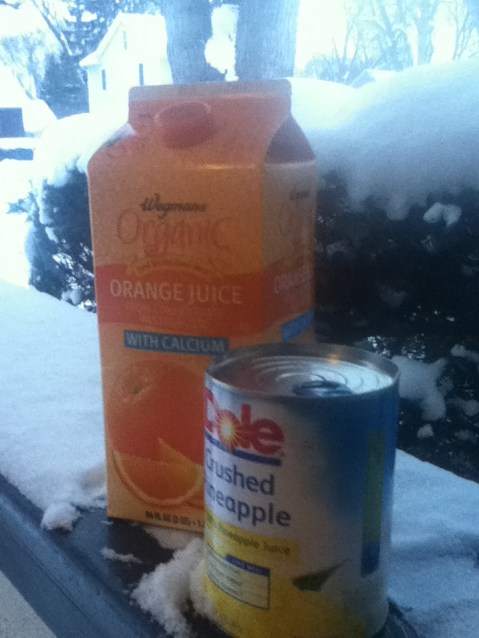
or a pat of butter.

It was demeaning and demoralizing to live like this. Milk and eggs spoiled. Lots of food had to be tossed. As bad as it was, I realized this was for my family a temporary problem.
After all, we still had money. We could keep our food stability because we could – and did- go out for every meal for a few days.
But for many in Monroe County, food instability is a very real thing.
In Monroe County, where Kodak is bankrupt and has for the last decade shed thousands of blue and white collar jobs, food instability is increasing.
Last year, The Children’s Agenda in a report called Decade in Decline that found that
- Children attending pre-K classes are on the rise
- 96 percent of the county’s children have health insurance
- the number of children found with high levels of lead in their blood dropped by 80 percent
However:
- 22 percent of the county’s children live in poverty.
- 44 percent of children in Monroe county in grades K-6 receive free and reduced lunch in public schools
- 2,494 families in the county were placed in homeless shelters in 2009, up from 1,566 in 1999
There are many in our midst who live with real food instability every day. Kids who live in homes where they may not get much on the weekends after receving food assistance at school all week.
This week, over Februrary break, my kids and I got a better understanding of what it takes to keep people out of food instability and on the road to self sufficiency by volunteering at a vast food distribution center serving the poor by distributing this food to hundreds of food pantries within 10 counties in Western New York.
Together with a few of their friends, we worked a shift at Rochester’s Foodlink in their brand new facility in the northwest part of the city. Foodlink is a food distribution center that provides food and meal assistance to agencies and food pantries in 10 counties in Western New York. The new location moved operations from four floors in a warehouse near Corn Hill to one on Mt. Read Blvd. No longer did millions of pounds of food need to be carted up and down in a 100-year-old elevator. Just across the highway from Foodlink’s new digs are the huge but emptying buildings and factories of Kodak, the company that was once the backbone of our city.
Foodlink is a great place to volunteer. In fact, thousands of people in Rochester volunteer each year to help end food instability within the 10 county area that Foodlink services. In fact, it is so good at the efficient way it mobilizes its volunteers to distribute food to the hungry and to lead the hungry and poor onto paths of nutritious self-reliance, it was named by the New York State Commission for National and Community Service to:
- help individual volunteers find service opportunities with local non-profit agencies within the region;
- support the development of an on-line statewide network of volunteer opportunities;
- measure the local impact of volunteer activity to share through a formal New York-specific study;
- deliver training and technical assistance to support local volunteer organization
This is my second time volunteering at Foodlink with my kids. The volunteer coordinators are friendly and have a great hands-on training program to teach volunteers like us how to sort through and rescue the many truckloads of food donations they receive from private and corporate donors like Wegmans Food Markets.
Some rules on sorting food:
- Food that has an expiration date that is older than six months must be disposed.
- Cans with bulges or dents with sharp edges or any dents around seams or lids must be disposed.
- No baby food can be accepted. Not even sealed and labeled. It was painful to put baby food jars and formula on the discard pile. But we were assured that is why the state has a WIC (women, infants and children) program to assist mothers with young babies.
- Nonperishable food bags with tears in an inner plastic lining must be disposed.
Finally, volunteers must be at least eight years old. This qualified my youngest, who loves sorting things in general and said he “had the best time and could sort food all day long”.
My older kids and their friends were having a good time too. How fun is taking off food from a moving conveyor belt, after all?


The hardest item I had to put on the discard pile was a torn 20 pound bag of sushi-grade rice. I knew that had to be expensive and it was probably okay. But I knew that sushi rice is not cheap and it nearly killed me to have to toss it.
“Believe me, it kills us all the time, we see food like this all the time we have to toss,” one of the workers told me.
But not all this really goes to waste. Much of the canned food is taken from its metal containers and composted and used at local farms. Food waste is also used by another local business and converted into clean-burning ethanol.
How close are we to food instability? The news of Kodak’s demise make all of us here in Rochester a bit shaky.
As a friend and I sorted food, she told me some very hard news. Within that impersonal number of 3,000 to 4,000 people to lose their jobs in the latest round of Kodak layoffs was her boyfriend. He spent most of his adult life working there.
Suddenly, the joyful energy I was feeling felt as crushed as some of the many dented cans we were tossing away.
The Edge of January

We have had the wimpiest winter in Rochester, NY in anyone’s memory. Being the transplant that I am, I asked lifelong Rochesterians if they can remember a January where they could go outside with just a sweater. A January where the temperatures barely went below freezing. They can’t.
But this warm winter seems no less longer then the cold snowy ones. It’s just dull. There are no bragging rights when you are stuck with a wimpy winter.
There is just the weak light. The sun is runny in the sky, like a pale broken egg yolk in a pan: 
There is no point to winter in Western New York if you can’t tell people elsewhere how you had to remove snow off your roof with a roof rake for fear of it caving in or have icicles hanging off the eaves of your house the height of a professional basketball player.
It’s just not winter if you can’t build your own igloo on the front lawn: 
 we have not yet experienced any significant storms or accumulations.
The official snowfall count for the season: 18.9 inches.
How much snow should have normally fallen by now? 55.7 inches.
In years past, it was if we were living in a snow globe.
It would snow a few inches every day for weeks at a time.
But not this winter. Everyone is missing the snow:
- Up on Lake Ontario, the Webster Ridge runner snowmobiling club has had to suspend its season because off lack of snow.
- My daughter’s youth group trip to go snow tubing was cancelled.
- My daughter also joined the high school cross country ski team this winter. At best, she has skied on the slushy man-made snow at Bristol Mountain. At worst, her team has spent the winter jogging outside or practicing on roller skis.
Ironically, in one of the few strong winter systems that passed through, our school district cancelled all sport practices, including cross-country skiing. Imagine that, ski practice was cancelled on account of SNOW!
But last night we were hit with several bands of fast moving lake-effect snow squalls. One particularly strong squall showed off its wintry moxy with a show of snow thunder and lightening that is completely out of place in the middle of winter.
Now, this is more like it:

Courageous Transplants
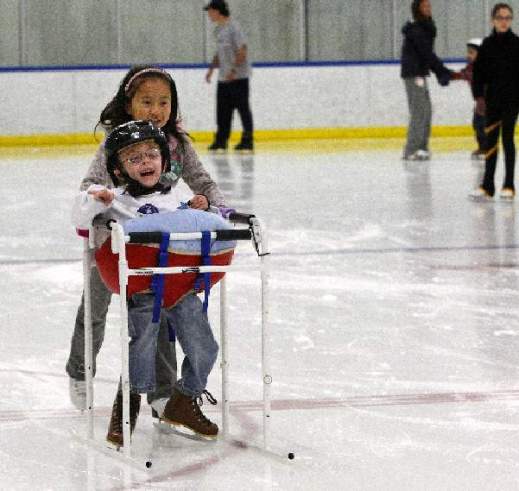

Bryson gets help from his cousin. Photo by Kris. J. Murante/D&C Staff Photographer
A few weeks ago, I had the pleasure of meeting two transplants to Rochester from North Carolina and one all the way from Taiwan.
They came to be nearer to lifesaving healthcare resources. They came here for family and for love.
These transplants found all that in Rochester. What they also found was a community on ice.
Before I share their story, think about something you’ve complained about today.
Maybe you had an ache in your back. Or the winter weather makes you not want to get out of bed. Or your co-workers, siblings, roommates, spouse, etc., is driving you crazy. Keep your problems. You really don’t have any problems. Instead, count those blessings.
Thank you to Amanda, the courageous single mom of Bryson. Thank you for calling me to make sure I had everything for my story while Bryson was once again in the ICU. Amanda was apologizing to me for not keeping in touch.
When I told her not to worry and how instead how sorry I was that Bryson was back in the ICU because of complications related to his CP, she just said – “That’s okay. That’s just how it is.”
I saw Amanda and Bryson about a week later at a routine checkup for my son’s asthma. Amanda gave me a quick hello, thanked me again and said she had to run, she had six other doctors appointments for Bryson.
Sadly, Bryson died about under two years from the time this piece was published in the Democrat and Chronicle. I am glad I was able to have written this to preserve his memory.
There is a little ritual performed by Gliding Stars students each time they take to the ice at the Webster Ice Arena. Each skater is escorted onto the ice with one or two volunteers as a straight line forms across the center of the rink. Some stand independently while others use the support of walkers and arm braces. At the cue of their skating instructor, they chant a cheer: “Can we skate? Yes we can!”
With the help of his family, friends and the larger community in Webster, this can-do spirit lives within the tiny body of 6-year-old skater Bryson Sparrin.
Bryson, of Webster, was born prematurely at 27 weeks with cerebral palsy. In 2010, he contracted hydrocephalus, or fluid on the brain, and had to have shunts placed within his brain to relieve the pressure. Already coping with speech delays caused by cerebral palsy, the shunts further curtailed his speech development. He can carry on a conversation and express himself with short sentences, gestures and with the help of an iPad application.
In spite of it all, Bryson wants to be like any other boy his age. Getting on the ice with Gliding Stars is one more way Bryson feels like the rest of his peers.
Gliding Stars was started in Buffalo in 1994 by a figure skater who wanted to make the sport accessible to people with physical, mental or emotional challenges. The Rochester Chapter, which meets weekly in Webster, currently enrolls 35 skaters and meets each Sunday afternoon from November through April. The season culminates with a choreographed ice show where the students can show off their moves.
According to Rochester Gliding Stars co-coordinator Christie Leszczynski, also of Webster, ice skating provides Bryson and other disabled children with many benefits. Physically, it helps strengthen muscles and improve stability. Children who are otherwise confined to wheelchairs or have limited ability to walk get a great sense of freedom when their legs can glide over the ice. Emotionally, skating and making friends through the program boost the child’s self-esteem.
It costs $700 for each child to skate to cover insurance, equipment and renting ice rink time. Gliding Stars makes the program as financially accessible as possible to students by charging them only $140 per season. The rest of the tuition is offset by grants, community fundraisers and the dedication of volunteers.
As a skating instructor, Leszczynski modifies skating moves to match students’ capabilities. Some children master basic skills such as alternating feet and skating in a circle with a group, while others learn basic figure skating moves like spins and jumps.
The Sparrins moved to Webster in 2010 from Ashville, N.C. Here, they discovered a welcoming community, support from family and a dedicated team of 10 doctors at Golisano Children’s Hospital at Strong to treat Bryson.
When one of the doctors recommended that Bryson try out Gliding Stars, his mother was initially hesitant.
“I first thought, ‘There is no way Bryson can ice skate.’ But the first time he tried it out, I saw a huge smile on his face. Now, skating and being with friends on the ice is the thing he looks forward to most each week,” said Amanda Sparrin, a single mother.
Bryson gets around in a powered wheelchair. He is unable to stand or walk on his own. But because of specially designed ice skates and a walker with a sling seat provided by Gliding Stars, Bryson can skate. His beaming smile shows the sense of satisfaction that brings.
Accompanying Bryson on the ice is his cousin, 9year-old Ruby Salamone, a fourth-grader at Schlegel Road Elementary School.
Ruby, who was adopted from Taiwan by Amanda’s sister in October 2010, came to the ice with her own challenges of adjusting to a new family, a new country and a new language.
The skater-volunteer relationship has been mutually beneficial for Bryson and Ruby. Bryson looks up to his new cousin as a role model, and Ruby gains self-confidence at being able to help her cousin while making new friends, said Amanda.
“Ruby really understands Bryson’s nonverbal cues. When they are on the ice, she monitors his mood to help him feel successful. Having that family connection of his cousin skating with him every week is a big bonus in Bryson’s skating. They really love each other,” said Amanda.
After spending the first 86 days of Bryson’s life in the Neonatal Intensive Care Unit, Amanda knows the ins and outs of what it takes to care for premature babies. When Bryson was released from the NICU, Amanda had to be trained how to change Bryson’s feeding tube, operate a breathing machine and manage his seizures.
Amanda said she remains in close contact with the nurses who cared for Bryson. Now, to make that support come “full circle,” she is studying at Monroe Community College and hopes to work as an NICU nurse to care for premature babies and their parents.
“For those parents now dealing with babies in the NICU who are living through those first days knowing their child has a life-altering disability — I lived that. I know what they are going through, and I want to become a nurse because I can
give them hope,” said Amanda.
I’m routing for this Science Mom: Vote for her today!
Every now and again, I get a story idea in my inbox that just cannot wait a week until it is published in my column. In our age of overtesting our children to the point of desparation where they even cheat on college entrance examinations, here is a story of Melissa Gertner.
Melissa is a mom who was inspired by her son’s curiosity to solve problems by tinkering with old machine parts in his basement to start an after school club called FIRST LEGO® League that lights the spark of science and technology in tween and teen-aged kids in Victor, NY.
She is competing for a scholarship to win $10,000 for the Victor school district to continue and grow the LEGO program for years to come in Victor.
Here is her story. Vote for her at this link
A Mom and a STEM Advocate

I never liked science. Or math. Technology scares me. So, you must wonder, how could I have helped connect others to science, technology, engineering and math? I am not a teacher. Or an engineer. I can barely balance my checkbook. Still you wonder…
The answer is simple. I am a mom and an advocate. My son is endlessly curious and creative. He is always inventing things in the basement, taking machines apart to see how they work, reading about the way our world works, drawing his plans, bringing them to life, making a mess, starting all over again. Every day. All day. And he inspires me. To provide opportunities for him and others like him to find their very special and immensely valuable place our world.
So, two and a half years ago, with the guidance of the Victor Intermediate School, another devoted mom and I started the Victor Intermediate School FIRST LEGO League (VIS FLL) Club, a 3 year after-school pilot program designed to capture students’ interest in science, technology and engineering. The program offers hands-on real–world learning experiences that reach beyond the traditional classroom.
In our first year, we served 26 4th graders in a non-competitive format. In 2010, we took six teams of 43 4th and 5th graders to qualifiers. Three of those teams advanced to the Regional Championship. This year we will serve 80 students, including six teams of 5th and 6th graders attending the qualifiers in November and six teams of 4th and 5th graders participating in a non-competitive season starting in January 2012.
How did I find my way to this program you ask. Well, three years ago, I had the privilege of coaching my son’s Jr. FIRST LEGO® League team. Little did I know, I had embarked upon the journey of a lifetime. Somewhere along the way, perhaps when I saw the pride in the faces of my son and his teammates at their show and share event or the incredible ideas they generated or the solutions these 8 year olds developed, I was hooked and committed to providing a continuum of science and engineering opportunities to as many students as I could possibly embrace.
Since that time, I have coached his FLL team for two more consecutive years, been a co-coordinator for the club in the off-season and am currently the coordinator of the VIS FLL Club. I have also actively helped other teams get started in our region by sharing information, resources and encouragement.
I continue to be inspired by the imagination, ideas, teamwork and passion these kids generate. Not only do our students participate in community events and competitions, they also mentor local students and others throughout our region, and spread the word about how exciting science and engineering can be. As much as I am helping to connect all these kids with science, technology and engineering experiences, they are the true connectors, connecting me with the best of myself and the best of themselves with our world.
Pareve Pumpkin Pie


photo found on marthastewartliving website
Everyone in my nuclear family loves LOVES pumpkin pie. And for only the second time in 12 years, my pumpkin-pie eating little family of five will not be going over the NY Thruway and through any tunnels or bridges to New York City. Nope, as much as we love seeing the family and sitting in 10 hours of traffic, this year, we are staying put.
When you are Transplantednorth, there are some disadvantages of being a nuclear family in a town where it seems you are surrounded by friends who all have extended family in town. Come holidays like Thanksgiving, you once again become the disappearing transplant.
I’m not complaining, really. This was my choice to stay “home.” But can a place be home where there are no extended family within 300 miles? The rest of the year, Rochester indeed feels like home. Come holidays, without aunts, uncles cousins and grandparents around, it can feel like how the Ingalls family must have felt on the wild, windblown frontier.
But this is a story about pareve pumpkin pie.
One small advantage of staying put (okay my kids will think a big advantage) is that at our Thanksgiving table, we’ll have pumpkin pie.
As much as she has tried to like it, my mom does not like anything pumpkin. My kids, however, can’t get enough of the orange stuff. I put it in breads, waffles and pancakes. I even made a pumpkin challah just so I can make pumpkin challah stuffing.
But, most of you know that pumpkin pie calls for milk, cream, condensed milk, or some other dairy ingredient. This poses a challenge to Jewish families like ours who observe the dietary laws of keeping kosher.
There are ways to get around the dairy dilemma by finding pareve ingredients.
What is pareve? Not many know. It is so esoteric, the word does not appear in the WordPress spellcheck.
It’s a term meaning food that is neither meat or dairy. It’s neutral. Like Switzerland. Does it taste as creamy and delicious as real cream? No. But, I’d rather have an imitation dairy dessert any day than serving a Tofurky at my Thanksgiving feast!
Here is the recipe. I based it on a recipe used from Martha Stewart Living, I just replaced the dairy ingredients with some stuff called Coffee Rich, found in the frozen section of most grocery stores. For those of you in upstate New York, I found this chemical-laden substance at Tops, and not Wegmans this year. But I still love you, Wegmans.
All-purpose flour, for surface
- Pate Brisee for Traditional Pumpkin Pie
- 1 can (15 ounces) solid-pack pumpkin
- 3/4 cup packed light-brown sugar
- 1 tablespoon cornstarch
- 1/2 teaspoon coarse salt
- 3/4 teaspoon ground cinnamon
- 3/4 teaspoon ground ginger
- 1/4 teaspoon freshly grated nutmeg
- 1 teaspoon pure vanilla extract
- 3 large eggs
- 1 Cup Pareve Nondairy Creamer, like Coffee Rich
- Ground cloves
- Whipped cream, for serving
Directions
- Preheat oven to 375 degrees.
On a lightly floured surface, roll pate brisee disk 1/8 inch thick, then cut into a 16-inch circle. Fit circle into a 9-inch deep-dish pie dish, leaving a 1-inch overhang. Fold edges under. Shape large, loose half circles at edge of dough, then fold into a wavelike pattern to create a fluted edge. Prick bottom of dough all over with a fork. Freeze for 15 minutes.Cut a circle of parchment, at least 16 inches wide, and fit into pie shell. Fill with pie weights or dried beans. – Buy a premade Pareve piecrust. Bake until edges of crust begin to turn gold, about 15 minutes. Transfer to a wire rack, and let cool.- Meanwhile, whisk pumpkin, sugar, cornstarch, salt, cinnamon, ginger, nutmeg, vanilla, eggs, creamer, and a pinch of cloves in a large bowl.
- Reduce oven temperature to 325 degrees. Transfer pie dish to a rimmed baking sheet, and pour pumpkin mixture into cooled crust. Bake until center is set but still a bit wobbly, 50 to 55 minutes. (If crust browns too quickly, tent edges with a strip of foil folded in half lengthwise.) Let cool in pie dish on a wire rack. Refrigerate until well chilled, at least 6 hours (preferably overnight.
Happy Thanksgiving!
My name is transplantednorth and I blog for the trees
 The other morning I phoned my sister-in-law in northern New Jersey. I needed to know her Hebrew name for an honor she was receiving for the morning service at my son’s Bar Mitzvah, now only days away.
Now, I should have known this, and certainly my husband should have known his sister’s Hebrew name, but we didn’t.
I called her cell phone a few days ago after 8:45 in the morning. With four kids in school, she had to be up. She is always on the go. Instead, a very groggy voice answered.
“It’s Malka”
“Who’s Malka?”
“I am. That’s my Hebrew name.”
Oh, of course, that’s why I was calling. But why did she sound so tired?
“Why arent’ you up? Don’t you have kids to get to school?” Fool that I was, with the glorious November day outside, and the fact that Western New York again survived the latest storm to hit the east coast unscathed, I was not thinking about how bad things were back in the NYC/NJ Metro area. The now-dubbed Halloween snowstorm had turned the streets of parts of New Jersey into what looked like a war zone. With downed trees and downed power lines, it was even too dangerous to go trick-or-treating.
“I’m sleeping at a friend’s house. We have no power and no heat.”
She sounded so sad. She still had no power after two days. The kids had no school for two days straight. But the one thing that seemed to make her the saddest was:
“You should see my block. We lost so many big, beautiful trees.”
It takes decades for a tree to really mature. I know because I live on a street with huge Sugar Maples that look like this: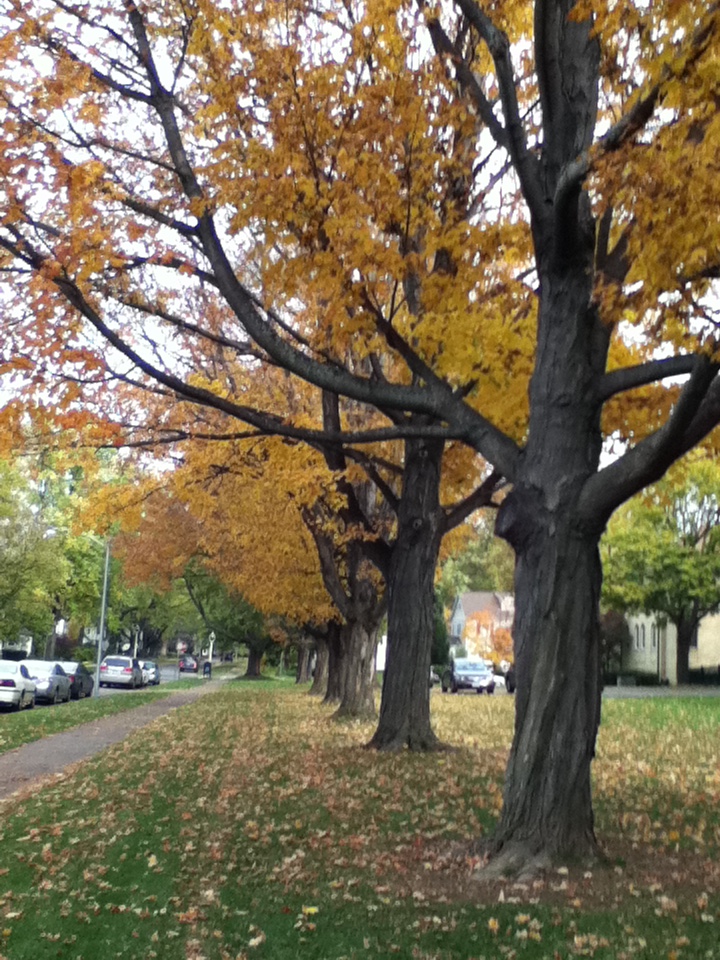
In the winter, when the snow is wet and heavy enough to put a coat of sugar on every last branch and twig, my street looks like this:
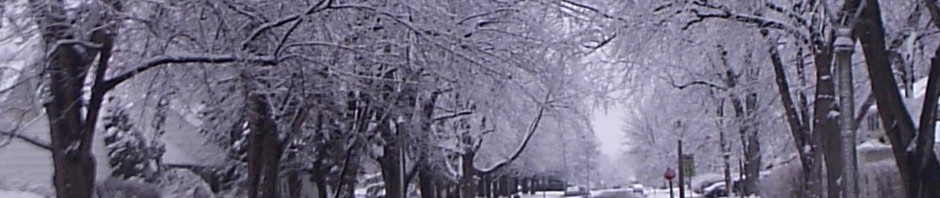
Sadly, even trees don’t last forever.
The snow-laden trees above were planted because they were fast-growing trees for Rochester’s first suburban development. They are now almost 90 years old.
Trees planted closely to houses are dangerous when they age and begin to rot from the inside out. Last weekend, our neighbors took down one of these trees. The bottom trunk was this big:
 This tree saw 90 years of changes of seasons, survived ice storms and blizzards. It saw generations of school children off on their first day of school. It was a home to birds and squirrels who played in its branches. But it lived out its days and succumbed to “crotch rot” of all things. Now, where its branches once stretched out, there is a whole punched into the sky where it once stood.
When snows fall heavy before the leaves drop, trees come down before they get a chance to live out their days. Back in New York City, Central Park lost 1,000 trees; trees that were just beginning to peak in their fall splendor of color. Trees that were planted generations ago so that we may enjoy them.
The other week, my son got a gift from a relative in honor of his Bar Mitzvah. In the true Jewish tradition, a ring of trees had been planted in his name in Israel. It’s a good thing we are headed there this winter to water them!
Now after this devistating storm that cancelled trick-or-treating and felled countless trees close to home, it seems like New York City needs new trees just as much as the land of milk and honey. The Central Park Conservancy is now asking for donations to restore its tree population.
Do you have a favorite tree? How would you feel if it were destroyed or it had to come down? Or, did you lose a tree to the Halloween storm? If so, I am sorry for your loss. Why don’t you write about it here?
On your Face or In its Case:Rules for Keeping Eyeglasses

 This is a response to a column written by Pam Sherman, that fellow Staten Island native and current Rochesterian Suburban Outlaw. In the latest installment of her new weekly column in the Democrat & Chronicle, she spoke of the high price of getting just that right look in designer eyeglasses. I have yet to plunk down a swimming-pool’s worth of money for my family’s frames, but Pam, I think I am on my way.
Early this spring, my son, daughter and I were all due for eye check-ups. Unfortunately, my husband’s company had just canceled our family vision plan. So, I knew this would prove to be an expensive, but necessary excursion. After all, you have to see.
Unlike Mrs. Sherman, who feels that her glasses define who she is, I have a bad habit of not wearing my glasses as much as I should. Like right now. I don’t need my glasses to see, just to tweak things ever so slightly into clarity.
When I do wear my far-sighted glasses, I think ahhhh, those blurry green blobs on the trees are leaves with sharp edges!
Or when I wear my near-sighted glasses, I think wow, thesse letters do look more crisp.
Do I have bi-focals? Not yet. I’m not ready to accept that my eyes, like the rest of me, are aging.
But my kids, who have inherited their dad’s bad eyesight, cannot function without their frames. My daughter is good with her glasses. Nathan and I abuse them.
First: the sequel to I Melted My Kid’s Halloween Candy: My Son Melted his Transition Lenses. My son has given me full consent to write this blog, just as he had fun writing about the melted Halloween candy. He has been blessed with an enormous sense of humor.
When my 12-year-old son has his mind set on something, say, a foolish experiment or fulfilling a “I wonder what will happen if I do this” curiosity, nothing, no amount of warnings, will sway him from his path.
In the three years he has been wearing glasses, he has bent them out of shape in wrestling matches with his brother and broken them in frisbee games with friends. In spite of my constant badgering hiim with my mantra: On your face or in its case, glasses have been found on the bathroom floor after a shower or hanging from the lamp of his bed.
But he promised, promised this time would be different. If I get him transition lenses for the summer. I thought, why not: I’ll get him the transition lenses.
I’m a fool.
I opted for gettiing a less expensive pair of frames (less here meaning they were still $190) and put the money into the transitions. Total for his eyeglasses and exam: over $300. In all, my bank account was about $1,200 lighter for the three of us to have glasses. To see.
Now, I mentioned it was the early spring. In Rochester. If you can find me a bright sunny day in March in Rochester, I’ll show you a Congress that can get things done in Washington, but that’s another story…
But, cloudy days be damned. My son was going to make his transition lenses change from clear to tinted the minute we exited from the eyeglass retailer. Even if he had to hold it up to the vanity mirror in the front seat of my SUV.
“Nathan, you CANNOT do that to your brand new glasses!” Regaining my composure and trying to appreciate his curious, impulsive nature, I explained that the sun would soon return to Rochester, and then his lenses would change. Until then, he would have to wait.
The next day…
I get a call from the school nurse’s office.
“Mrs. Gittleman, this is the nurse at school. Your son is very upset. Please try not to be upset, but he held his glasses up to the lamp at one of the reading tables in the library and, well.. he may need new glasses now.”
One part of me, a small part, was quite impressed with my son’s determination and ingenuity. But, the rest of me was very upset indeed. Three hundred Fifty dollars and less than 24 hours later with new glasses, and he had burned a whole right through the lens. In the dead center of the lens. When I took him back to the optometrist, the sales people took a collected gasp in horror, as they looked at their destroyed work. Yes, I got him new frames. No, he won’t get transition lenses until he is paying his own rent in the distant future.
So no, this has not been a good year for eyeglasses in my family. And as I put on my new near-sighted glasses that I’ve had to replace because I’ve lost that pair I bought in March, I promise to follow the mantra that I preach to my own son.
On my face, or in their case.
About Me
Kreativ Blogger

Versatile Blogger Award


 Stacy Gittleman