
The Great Hamantaschen/Latke Debate Comes to Detroit
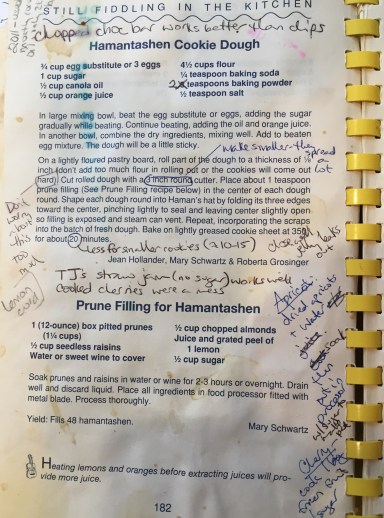
My friend and fellow Congregant won the Latke Hamantaschen Debate for Hamantaschen lovers everywhere. Thank you for the mention!

Instead of a sermon, we made the congregation laugh.
Last Shabbat morning, I participated in a mock debate on the relative merits of latkes versus hamantaschen.
 I skip the prune filling. The notes reflect many years of experimentation.
I proudly defended the cookie, while our rabbi argued in favor of potato pancakes. In our small congregation, the debate was well-received – a dose of fun at the end of a long week.
If you’re wondering who won… Of course it was the hamantaschen. I mean, is there even any real contest?
Want to see what we both had to say? Here is the text of the debate.
Chag Sameach!
From Darkness Into Light – Chanukkah in the D

I’ve only lived in Detroit for 17 months. And let’s face it, I don’t really live in Detroit. I live in the suburbs. Because that’s – if you are fortunate – where you live to raise a family and find good schools. And I know there are many who are not fortunate.
Things indeed are changing in Detroit. This week it emerged from bankruptcy and full control was given back to Mayor Duggan and the city council. Still, the schools are in dire straights. Buses rarely run for those who have no cars in the Motor City. And one in four kids in Michigan live in poverty.
But this article is about light. Lights are coming back on in the city streets faster than anticipated. Every day, 200 blighted houses are demolished to make way for new neighborhoods, a new start. Businesses in downtown are cropping up. And yes, Jewish life in the D is getting stronger.
Here is my latest piece in the Detroit Jewish News about the upcoming Detroit community Chanukkah celebration. I only wish I could go.
Happy Chanukkah to those who celebrate. And to all, let’s banish the darkness in this world with light.
Darkness To Light
 As Detroit emerges from the darkness of bankruptcy into the light of regrowth, this year’s fourth annual “Menorah in the D” celebration — starting at 5:30 p.m. Tuesday, Dec. 16, at Campus Martius — holds particular significance.
Organizers of the Chanukah event see it not only as a celebration of the victory of the Maccabees, but a victory as well for the people of Detroit.
Menorah in the D is hosted annually by The Shul of West Bloomfield, Chabad in the D and in partnership with the Jewish Federation of Metropolitan Detroit’s NextGEN Detroit division, with support from Quicken Loans and other sponsors. This year, Mayor Mike Duggan will participate in the lighting ceremony along with other government officials.
Everything about the event is pure Detroit, including the 26-foot menorah designed and built by artists Erik and Israel Nordin of the Detroit Design Center in Corktown and complimentary snacks provided by local businesses.
For international flare, the celebration also features a live performance by the Israeli band SoulFarm. There will also be strolling jugglers and acrobats, roasting marshmallows and an opportunity to pose with the Paws, the mascot for the Detroit Tigers.
Event organizers are recruiting “MacaDees” to volunteer for the event. They are needed to direct foot traffic, help with children’s arts and crafts or serve complimentary hot cider from Blake’s Orchard & Cider Mill, soup from Chef Cari Kosher Catering and other goodies from Bake Station and Whole Foods. Volunteer by signing up at http://www.menorahinthed.com.
Sarah Snider, community outreach associate for NextGEN Detroit, said that when she was growing up here she could never picture a time when such a celebration could happen Downtown.
Volunteer teams are being set up from throughout the community, including groups from Tamarack Camps, Frankel Jewish Academy and the Camp Ramah Fellows.
“I never had friends or family who lived in Detroit,” said Snider, recalling how her grandparents moved from Detroit to the suburbs. Now she knows quite a few friends in their 20s who are living in the city. “Now, I am so excited to see the changes happening Downtown.”
Darien Sherman of Bloomfield Hills, a Ramah fellow, is looking forward to an evening celebrating with the entire Detroit Jewish community.
“It shows we can take the message of Chanukah, of rebuilding and rededicating, to rebuilding a city that so many of us are attached to and is a part of our lives in so many ways,” Sherman said. “We are not only commemorating the victory of the Macabees, but also for all of Detroit’s Jewish community to be strong and united.”
Sherman added that following the lighting activities, there will be additional celebration time for the 21-and-over crowd as NEXTGen will organize some pub visits that evening around Downtown.
Making A Statement
Celebrating the miracle of Chanukah publicly is also important this year in light of the rise in anti-Semitism in Europe and the United States, said Rabbi Yisroel Pinson of Chabad of Greater Downtown Detroit.
He said that after centuries of persecution in Europe, Jews forewent the Talmudic custom of lighting the menorah visibly. Only in the last 40 years, with Chabad’s leadership in holding outdoor menorah lightings, has global Jewry taken the mitzvah back out into the public. This year, in spite of the rise of European anti-Semitism, he said the public lightings will continue as a sign of Jewish pride.
“In Detroit as well as in many cities throughout the world, celebrating Chanukah is back where it belongs — in the public square,” said Pinson, a French native. He remembers politicians participating in public menorah lightings in his hometown of Nice, France, and, therefore, showing their “public endorsement of our right to be Jewish publicly.”
Pinson said the Chanukah festivities this year are also nicely timed around the first anniversary of the opening of the Chabad center in Detroit. Since it opened on Dec. 4, 2013, it has been a “nonstop” center for Jewish living and learning for the small but growing number of Jews who are moving back Downtown, he said.
“We are proudly one of the fastest-growing Chabad centers in the country,” he said.
“Chanukah holds the message that the combined small actions of every individual — the ones who come Downtown to shop or dine to support the small business owners — are all making a contribution to the rededication of Detroit.”
For ease of transportation, there will be a round-trip bus available from The Shul, 6890 W. Maple Road, West Bloomfield, subsidized by The Shul and the Friendship Circle. Fee is $5 per person. Contact The Shul office at (248) 788-4000 to make a reservation.
After The Flood – Grief, then Grattitude

It’s been a while since I’ve blogged purely for blogging’s sake. Writing and teaching more for pay will do that.
Here is my cover story from this week’s Detroit Jewish News. Thank you for my new community for allowing me into your lives to listen and record your stories as you overcome from this summer’s rains:
After The Flood

If Daniella HarPaz Mechnikov of Huntington Woods could write some Twitter-style hashtags about her feelings during the months following this summer’s floods, they would be #perspective and #gratitude.
Just two years ago, Thanksgiving 2012 was the last she would spend with her mother, who died in early 2013. In comparison, the sadness caused by this summer’s floods — timed just before her daughter’s bat mitzvah — was minor. Most people had a mourning period for their soggy basements and possessions, but realize it is time to move on.
“In the weeks after the flood, the flood was all anyone talked about,” Mechnikov said. “At the summer soccer games, the main topics of conversation in Huntington Woods were ‘How much water did you have?’ ‘Did FEMA help you?’ and ‘How long did it take you to find a contractor?’ Now, we are trying to put the flood behind us. We had a few bad months, but now we are trying to shake it off.”
In her home, the basement is restored with new drywall, paint and carpeting. Mechnikov was thankful to have taken out a sewage backup rider on the family’s home insurance policy, which helped pay for the damage. Their hot water heater is hanging on, and the big screen television in the basement was saved because it was placed on a high shelf. There is no longer a comfortable couch on which to watch it, but replacing it is not a high priority for the family now.
Throughout the neighborhoods in Oak Park and Huntington Woods, this sentiment of putting things in perspective during the Thanksgiving season repeats itself. Belongings, even as precious as journals kept over a lifetime or sacred prayer books, are just material possessions. Most residents express gratefulness that few lives were lost or injuries occurred because of the rising waters.
Help Was There
Many express their gratitude for the strong showing of coordinated financial and emotional support provided by local and out-of-town Jewish agencies.
Shaindle Braunstein, chief administrative officer of Jewish Family Service in West Bloomfield, said in the weeks following the mid-August floods, the agency received hundreds of calls and assisted 309 families victimized by the flood — 253 of which had never before contacted JFS for help.

According to Braunstein, JFS distributed $700,000 in grants to families who needed to clean and remediate their basements and replace furnaces and appliances, and also emotional support in helping overwhelmed families — sometimes with 10 or more members — sift through the paperwork they needed to file with FEMA or insurance agencies.
Art Van Furniture also played a role in donating furniture.
Kathy Moran of Detroit’s Focus:Hope, the organization responsible for coordinating the company’s donated furniture distribution across multiple relief agencies, such as JFS and the American Red Cross, said the company donated 300 sofas, 225 dressers, 100 carpets and 150 mattresses to deserving households.
She said Art Van Furniture “went above and beyond” in its generosity when it additionally donated 150 bookshelves for children’s basement bedrooms so children could once again rebuild their home libraries.
JFS was thankful not only for its existing local infrastructure, but also for the added efforts of out-of-town Jewish agencies such as NECHAMA, based in Minneapolis, Minn., which had boots on the ground through October and cleaned 250 houses; and IsraAID: The Israel Forum for International Humanitarian Aid.
“Because of our everyday, business-as-usual infrastructure and coordination with partnering agencies such as the JCC in Oak Park and the Jewish Federation of Metropolitan Detroit, families knew how and when to reach us when the floods made the situation far from business as usual,” said Daniel Trudeau of JFS. “Grassroots organizations like Chessed, NECHAMA and IsraAID were instrumental in reaching those most heavily affected to get the word out of how to get help.”
Braunstein said the grassroots organization Chessed was an “invaluable” partner in reaching out to the Orthodox community in Oak Park and identifying needs. Many have large families who use their basements as prime living and sleeping quarters. Not only did they help in the distribution of furniture donations from Art Van, but also in coordinating donations of household goods from as far away as Cleveland and Chicago.
Hebrew Free Loan also offered assistance by approving a total of $290,000 in loans, according to executive director David Contorer. He said his agency did everything possible to expedite 43 loans for families in need of basement restorations and new furnaces and hot water heaters.
“We sped up our approval process by 50 percent,” Contorer said. “We knew there was an urgency to clean out basements because it was an immediate health issue, and getting these no-strings-attached dollars to clients was very important.”

Families Coped
One family that benefitted from JFS services was the Goldsteins of Oak Park. Channie and Yitz Goldstein have eight children, and they both work. They were not receiving assistance of any kind from JFS before the flood. Three children have bedrooms in the basement. Yitz, a computer analyst, also uses the basement as office space.
Channie Goldstein, a teacher, expressed gratitude that when the floods started, it was during the day and no children were asleep in the basement. In fact, she said all her teen-age boys were home at the time and when the basement began to flood, they acted quickly to retrieve as much as possible to the first floor. The family’s computers, the washer and dryer, and some other important belongings were hauled up the steps.
Outside, Goldstein said neighbors kept running out of their houses asking each other if they had water in their basements.
“When we all realized we all were flooded, there was nothing left to do but watch the water rise inch by inch,” she said. “My little ones were frightened and upset as they watched their toys floating in the basement.”
She added that it could have been worse — it was just water, not raw sewage as faced by others in neighboring areas, such as Huntington Woods.
The Goldsteins tried to do as much of the clean-up work and repairs themselves, following expert basement remediation guidelines from NECHAMA in how to rip out waterlogged walls and floors and taking all the recommended precautions to prevent the growth of mold.
However, the cost of repairing their basement and replacing what had been lost came on “too fast and all at once.” Goldstein said her family received minimal support from FEMA and the cost of the damages were not completely covered by their insurance.

In the months following the flood, the Goldstein household is slowly getting back to normal. After a few weeks of sleeping in the living and dining rooms, her sons were able to return to their basement bedrooms — albeit half finished — in time to use the upstairs space for Rosh Hashanah.
The entire experience made Goldstein very aware of just “how quickly life can change from everything being OK to finding yourself in crisis mode.” She and her family are extremely thankful and comforted to know she could count on the support of JFS and its partnering agencies “when we fell.”
“Everyone on the block was supporting each other — whether you needed an extra bottle of bleach, another mop or just a hug of support. We came through this experience learning that we can help each other and that we, in turn, can help others who were hit much worse than ourselves.”
Repairing and starting fresh after the flood has its bright spots. Rabbi Robert Gamer said that his sons are enjoying the new, waterproof epoxy floor that was recently installed in the basement of his family home in Huntington Woods.
“They think it is really cool because it glows in the dark,” Gamer said. “They are just glad to have a functional play space again, even though the walls are not back up.”
In the weeks after the flood, Gamer spent time not only tending to his own home but providing hospitality and rallying the community together for barbecues and Shabbat dinners. Gamer’s congregation, Beth Shalom in Oak Park, served as a host home for the eight IsraAID volunteers who worked tirelessly for almost three weeks cleaning out neighborhood basements. The Gamer family showed their gratitude to the Israeli volunteers by having them all over at their home for a Shabbat dinner.
“We had some fantastic conversations about Jewish faith and philosophy, and what it is like to be a Jew living in the United States versus being Israeli,” Gamer said. “Plus, one of the volunteers is a professional soccer player and he loved kicking a ball around with my kids after dinner.”

Now that winter is setting in, Gamer is thankful to be able to clear out his garage of all his shuffled basement belongings so both family cars can fit inside. He is thankful for the surprising speed at which FEMA handled his own personal flood claim. Most of all, all the things his family lost were “just material possessions,” as he sadly recalled the death of a congregant caused by the storm.
“In spite of how bad it was, more lives could have been lost. When you look back at the pictures of 14-foot swells of water under highway overpasses, you realize how thankful we should be that there wasn’t even more loss of life.”
By Stacy Gittleman, Contributing Writer
Where Jesus Walked: Via Dolorosa, Jerusalem
The Supreme court is about to rule on Jerusalem’s status. If Israel loses control of the Old City, Christians will no longer be able to safely visit the Church of the Holy Sepulcher. For that matter, without the presence of the IDF, no one’s safety in the Old City can be guaranteed.

In Judaism, if Israel is the Jewish state, then Jerusalem is Judaism’ holiest city and its eternal united capital. But it is also holy to all faiths. As recognition of this, ever since Israel reunified Jerusalem after capturing it from the Jordanians after the 1967 Six-Day War, it has made sure that all of Jerusalem’s religious sites are open, safe and accessible to all religions.
This is why though I am a practicing Jew and a Jewish educator, for one of my first post-Israel posts, I wanted to show you the walk of the Via Dolorosa. As you look at these photos, keep in mind how preserved and maintained are these stations. Keep in mind that my family walked the streets of the Old City safe and without fear because of the constant present of the Israeli Defense Forces. Keep in mind that all religious sites in Jerusalem are open…
View original post 29 more words
Music Man Auditions Today and Tomorrow, West Hills Middle School

There is just one place that can light my face!
Follow the link below for details, see you there!
Identity. In Italy.

This summer, my husband and I celebrated our 20th year of marriage with our first European vacation. In the cold clutches of the polar vortex, we asked ourselves, what is the one European city known to be one of the world’s most romantic destinations?
Why, Paris, of course!
Gleefully, we dreamt of a Paris vacation. In the evenings, we played a Paris Jazz Café station on Spotify. Without a single semester of French between the two of us, we spoke sweet nothings to each other in fake Parisian accents.
I dug out my college art history textbooks and plotted my visit to the Louvre.
Then we checked in with the news coming out of France, and our dreams crumbled like a stale baguette.
Anti-Semitism in France has been on a steady incline in recent years, even before Hamas’ most recent war with Israel. In 2012, a survey conducted by the Anti-Defamation League revealed that 40 percent of approximately 1,200 French Jews said they avoided wearing Jewish identifiers such as kippot or Jewish stars. For me, all it took was one YouTube video filmed on Jan. 26 with throngs of protesters repeatedly shouting “Jews Out” through the streets of Paris, to rethink our plans.
So, forget Paris. We instead spent 10 memorable days in Italy touring Tuscany,
 Venice,
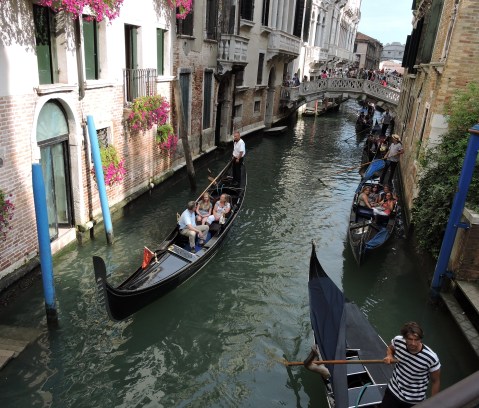

and Florence

eating fresh pasta

 and gelato and drinking wine.

Italy was far from a consolation prize to France.
However, all that wine did not cloud my awareness that war was still raging in Israel (my daughter spent the summer in Israel), and anti-Semitism was all around us in Europe. Still, I refused to be afraid to be outwardly Jewish. In the Jewish ghetto of Venice, I purchased a star of David made of Murano glass and wore it for the duration of my trip.
In Italy, an appreciation for Judaism’s contributions to humanity on the surface outweighed any animosity towards the Jews. An orchestra in Venice’s St. Mark’s square played Klezmer music.
 In Florence, tourists wait on line for hours to see Michelangelo’s David, the boy would be king of ancient Israel.
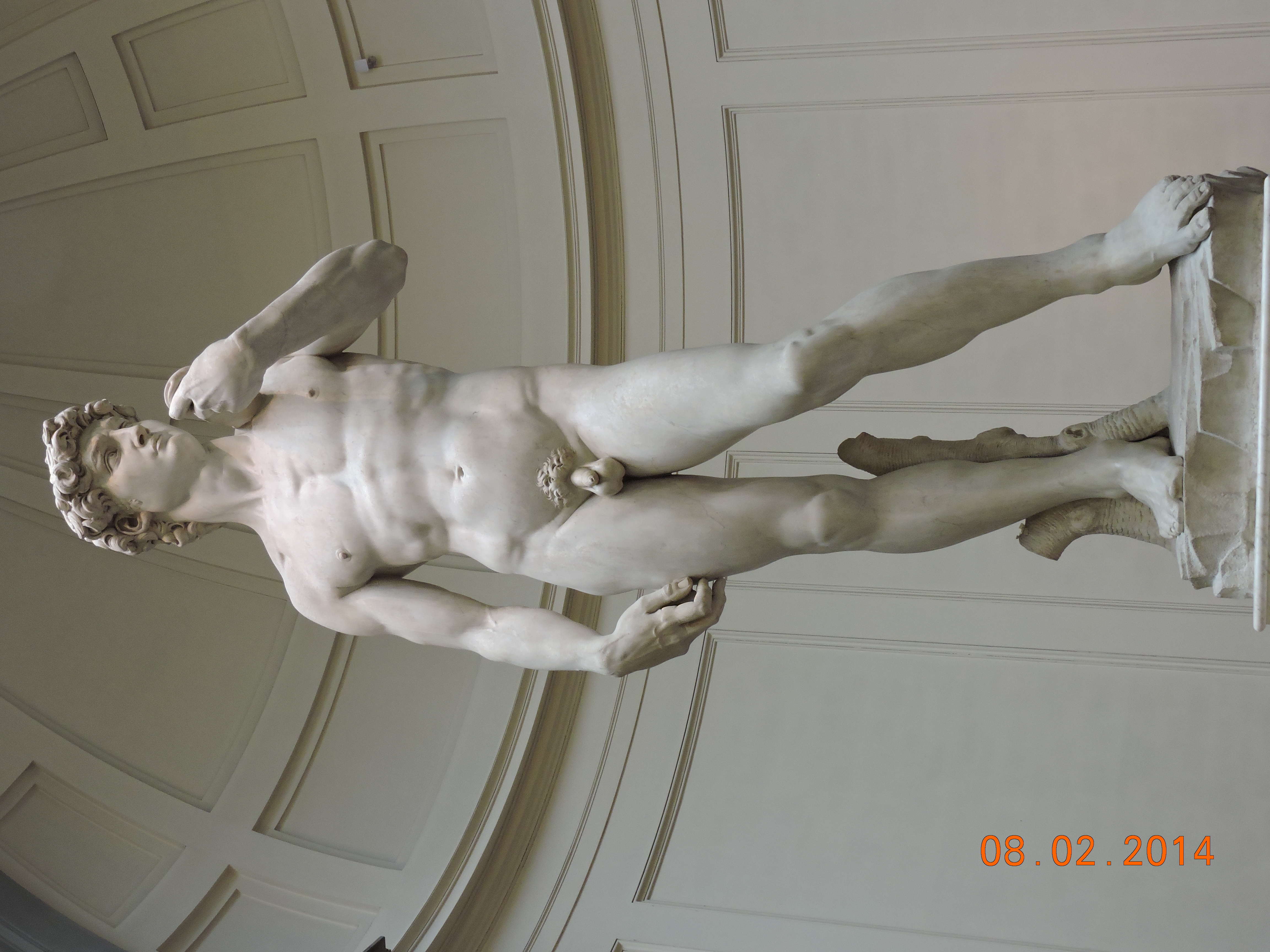
I know he is made of stone, but I can’t help having a crush on David.
Dear Fellow Liberals: I’m Done Apologizing for Israel
May Gd bless and protect your son, and thank him for me for protecting MY daughter while she was there all summer. I’m done apologizing too. Liberalism and unwavering support for Israel need not be two separate things.
Summer in Israel: a self-portrait

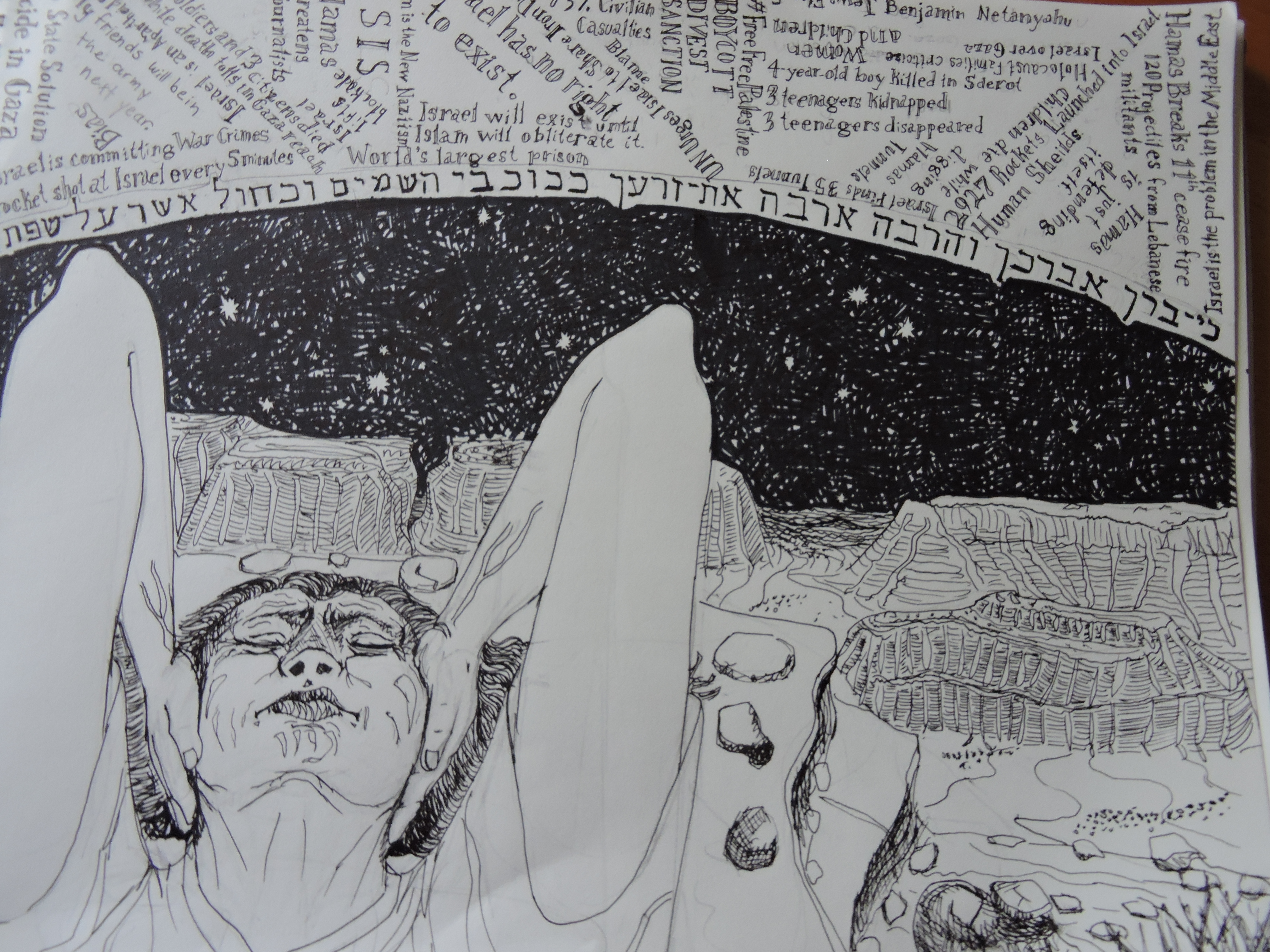
The Hebrew written in the black and white portrait above is from Genesis 22:17: 17 I will surely bless you, and I will surely multiply your offspring as the stars of heaven and as the sand that is on the seashore. And your offspring shall possess the gate of his[a] enemies
The words above are headlines from this summer.
The rest I will leave to the viewer’s interpretation. Look at this portrait. What do you see? Leave your comments below.
The Tragedy of the Palestinians
yes, you can feel sorry for the Palestinians, but they have chosen their leadership poorly and this is the result. If you need to place blame for civilian deaths and injuries, place it squarely on the terrorist organization that is Hamas.

The United Nations reports that 177 Palestinians have been killed since Operation Protective Edge began a week ago. A quarter of the victims have been children. Palestinian medical sources say that some 1,280 people have been wounded.
All of this is a tragedy. It did not have to happen. Two sisters aged 13 and 11 were seriously injured by shrapnel in a village close to Beersheba earlier today.
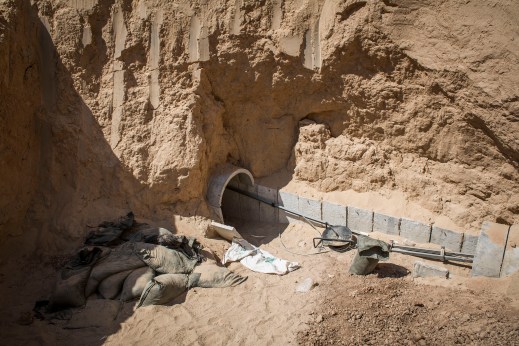
Of course the numbers hurt on our side are considerably lower than those on the Palestinian side. We build bomb shelters and reinforced rooms in which our families can hide when Hamas fires rockets at an innocent population. By contrast, Hamas uses civilians as human shields and prefers to use the concrete at its disposal to build massive tunnels into Israeli territory in an attempt to infiltrate villages and kibbutzim close to the border for the purpose of murdering and kidnapping.
Some misguided…
View original post 125 more words
About Me

Kreativ Blogger

Versatile Blogger Award


 Stacy Gittleman