
First Photo Challenge for 2013: Resolved

Happy New Year!
now, if you could hear me say this to you from behind my stuffed nose it would sound more like “Habby Dew Year.”
I have yet to have a healthy day in 2013.
Before I can start on this year’s goals: decluttering and cleaning my home to get it ready to sell, going to the gym at least three times per week, I resolve to get HEALTHY!
That’s why my answer to this photo challenge is this:

This is a bowl of eucalyptus leaves I pulled off a bouquet recently purchased at Trader Joes. I mixed it with some dried lavender from this year’s garden, plus some Kosher salt. I poured boiling water over it and voila! A home spa remedy that will hopefully relieve my misery.
Before I do anything else this year, I resolve to get healthy again!
Where is it Dangerous? Where is it safe? It’s all about perspective.
the first time I posted this the photo was not visible

“Isn’t it scary living in America?”
“Are you not afraid of getting shot from those crazy people who have guns?”
At the time I was asked this question, I was on a chartered tour bus.
In Israel.
It was the summer of 1989. I spent part of that summer picking mangoes and tending the banana fields in a Northern Israeli kibbutz.
1989 was the year the first Arab uprising, or intifada, raged in the West Bank and the Gaza strip. A few weeks before my arrival in Israel, Arab terrorists ambushed a Jerusalem-bound tour bus off a winding mountain road. Fourteen tourists were killed.
That’s the kind of Israeli news that reaches American media. Still, at 19, I ventured off for my adventure in Israel. Alone.
1989 was also the year of a horrific schoolyard shooting in Stockton, California.
That’s the kind of American news that reaches Israeli media.
View original post 536 more words
Where is it Dangerous? Where is it safe? It’s all about perspective.
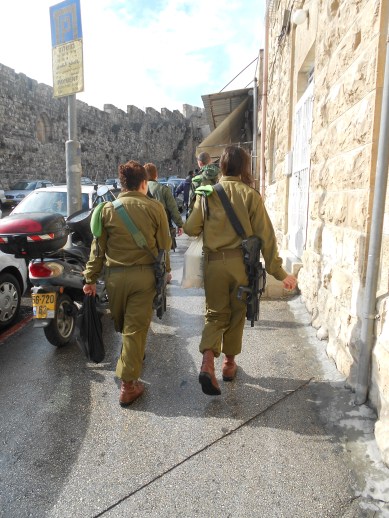
In Israel, where all Israelis learn to shoot a gun during their service in the Israel Defense Forces, civilian ownership of most guns is strictly prohibited, and ownership of assault weapons is banned. The result: 2008 total firearms deaths in Israel: 143. Number of 2007 total gun-related deaths in United States: 31,224.
“Isn’t it scary living in America?”
“Are you not afraid of getting shot from those crazy people who have guns?”
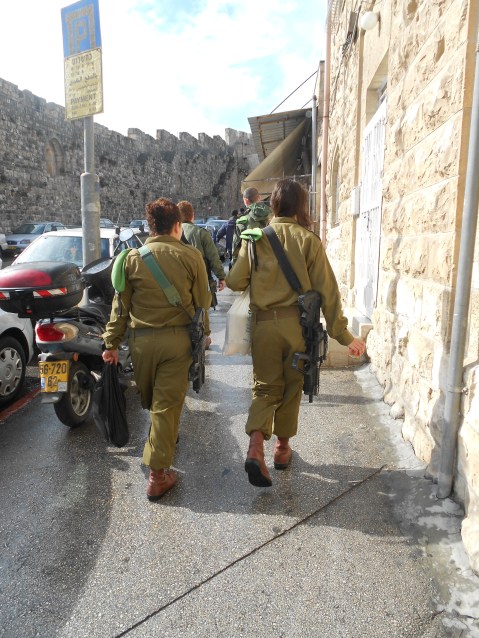
At the time I was asked this question, I was on a chartered tour bus.
In Israel.
It was the summer of 1989. I spent part of that summer picking mangoes and tending the banana fields in a Northern Israeli kibbutz.
1989 was the year the first Arab uprising, or intifada, raged in the West Bank and the Gaza strip. A few weeks before my arrival in Israel, Arab terrorists ambushed a Jerusalem-bound tour bus off a winding mountain road. Fourteen tourists were killed.
That’s the kind of Israeli news that reaches American media. Still, at 19, I ventured off for my adventure in Israel. Alone.
1989 was also the year of a horrific schoolyard shooting in Stockton, California.
That’s the kind of American news that reaches Israeli media.
My questioner was a young Israeli man, around my age at the time, 19 or 20, who was serving in the Israeli army. There were many Israelis like him on our day trip to the Ein Gedi Oasis near the Dead Sea.
He was part of a unit called the Garin Tzabar. The Garin Tzabar spend part of their two (for girls) or three (for boys) year service to the country in military duty, and part of their service helping out Israel’s kibbutz economy.
I can’t remember if, in the fields, or on that trip to Ein Gedi, my soldier co-volunteers carried guns with them. But if they did, the sight of a young man or woman with an assault rifle slung across their back would seem perfectly natural.
Nearly 25 years later, now after the horrific shooting in Newtown, Conn., I can’t get this question out of my head:
Is it scary living in America?
Yes. Yes, I guess it is.
This question, of where is safe, or will I be safe, surely crossed the minds of several families in my community who will be traveling to Israel for the first time this December.
Just one month ago, as Israel faced another barrage of missile attacks from Gaza during Operation Pillar of Defense, these families were considering cancelling their trip. Because, in the mind of the typical American, a trip to Israel may not be safe.
Is it ironic that it was in Israel where I felt the most safe? Because there were soldiers, highly trained soldiers who went through strict psychological checks before they were trained on how to use a weapon, ever-present everywhere?
I felt safe in Israel when my bag was checked before I entered a supermarket.
I felt safe in my four trips to Israel when my bag was checked and x-rayed before entering a school where I visited.
Do I feel safe in America with our 2nd Amendment twisted to such a way that one can buy as much weapons and arsenal as they want at a West Virginia Gun show and buy bullets online?
The day of the Newtown shooting, before I had any knowledge of it, I went to pick my nine-year old up at school after a half-day dismissal.
Innocently thinking I had reached the office entrance to pick up some more bus passes, I entered the school through the wrong door.
I walked through the hallways full of children zipping up jackets and lugging backpacks.
No one stopped me.
Yesterday, when I went to pick up my son from school, there were big red signs slapped onto the doors of the school.
STOP
THIS DOOR WILL NOT OPEN UNTIL 3:10.
NO ONE ALLOWED ENTRANCE PRIOR TO 3:10.
IF YOU NEED TO PICK YOUR CHILD UP EARLIER,
GO TO MAIN ENTRANCE.
Promptly at 3:10, a slight woman, with a weary look on her face that showed how much the Newtown shooting had hit home, came to open the door for the waiting parents.
Did this sign make me feel safer?
Did this woman, no taller than 5’2″, opening the door to this now-secure school make me feel any safer?
Where is it safe? It’s all about perspective.
My Sandy Project for Staten Island
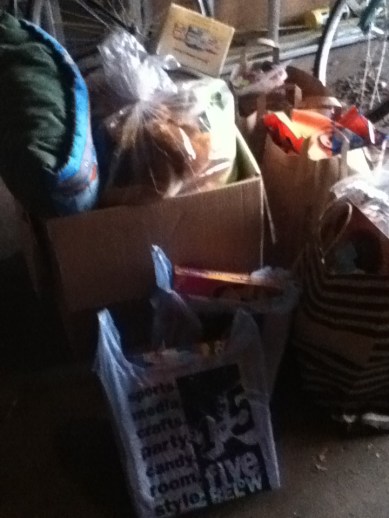
![IMG_0764[1]](https://stacylynngittleman.com/wp-content/uploads/2012/12/img_07641.jpg?w=479) Kids love their stuff. Their toys, their blankies, books and games.
Kids love their stuff. Their toys, their blankies, books and games.
Imagine being a kid, who, on top of losing all your favorite stuff, you’ve lost your home too.
Imagine being a mom trying to cope with all that loss. And at the same time, trying to get through all that red tape of filing claims with insurance companies and FEMA.
A few small things, delivered from up north, just might brighten your day. Even if it’s just a new bottle of berry red nail polish.
A few weeks ago, Susan Bernstein, Director of Education for Temple Beth El in Rochester, told me she had been in touch with an old friend in Staten Island. That friend, David Sorkin, happens to be Director of the Bernikow Jewish Community Center in Staten Island.
The two are collecting “stuff” – books, toys, crafts, games, and other small luxuries – for those who have lost everything on Staten Island. The “stuff” will be distributed to hundreds of clients of the JCC now living in shelters throughout Staten Island. These families, some of them living on the brink of poverty even before the storm, just need some sense of normalcy. It’s not much. Toys, books and beauty products may be just a small diversion as these families grapple with long-term struggle of rebuilding their lives and homes.
The only challenge – Rochester and Staten Island are about 350 miles apart.
Susan then asked my husband and I if we had room in our car to drive the donations to Staten Island.
Now, packing a family of five for a car trip is no small task. The family SUV will be crammed with suitcases, bookbags, snacks for the road, and don’t forget my son’s guitar. Then, there are those growing bodies that used to fit so compactly in an infant seat. Those ever-growing lanky teen and tween legs have taken up the room we once used to stow away all the extras.
No, I have no room in my car. But I’ll happily take all the stuff anyway. Happily.
There is all the room in my heart for my ravished hometown, Staten Island. I have seen the photos and have been following any speck of news from my hometown.
I can’t wait to go home. I know that seeing the devastation with my own eyes is going to be really hard.
In my phone conversation with Sorkin, he asked me to imagine a 4-foot storm surge reaching all the way up to Hylan Blvd. My brain just can’t process. All those businesses, many of them still not up and running.
Since Sandy hit, all I have wanted to do was go home and help.
So, I thank Susan for getting this project started with the JCC of Staten Island. I thank my rabbi, Sara Friedson-King, for letting me make an appeal to the congregation during Shabbat morning services. And I thank my Temple Beth El family for all the donations that will truly make someone’s day a bit brighter.
So far, in addition to the donations in the above photo, there is also an entire barrel of donations waiting for me at synagogue.
I’m putting a hitch on the family car. Renting a U-Haul. Where there is a will there is a way.
Staten Island, don’t worry, I’m coming home to help.
The Words of Serving Soldiers: The Griffin Theater’s Letters Home Visits Rochester

Here is my piece that ran in the October 28, 2012 Living section of the Democrat & Chronicle:
For a soldier deployed in Iraq, a good day is a slow one spent on the base, learning to squeak out a tune on an old violin in the company of Iraqi and Kurdish soldiers. For a soldier deployed in Afghanistan, a horrible day is one spent in full battle, watching your commanding lieutenant dying on the ground from a gunshot wound to the gut.
It is this wide range of wartime moments, pulled from the letters written by soldiers who fought, or are still fighting, that are the building blocks of the play Letters Home. Written for the stage in 2007 by Chicago’s William Massolia, the award-winning play makes its Rochester debut at 7 p.m. Friday in the Nazareth College Arts Center.
Letters Home is a series of dramatic monologues set against a backdrop of photos and video taken directly from soldiers’ blogs and websites. It aims to shed a non-political light on the everyday life of soldiers in an 11-year war that still goes on today although few Americans feel directly affected by its impact. Massolia hopes to expose his audiences to the toll this war has taken on thousands of their fellow citizens.
“As we move on to more than a decade since the start of the war, it is becoming part of our history while still being fought in the present. I hope the play gives people with little connections to the military a better understanding of what it means to serve one’s country during wartime,” Massolia, the artistic director and founder of Chicago’s Griffin Theatre Company, said in a phone interview while his cast ran through a technical rehearsal for an Atlanta performance.
Massolia and actor Michael Bartz, 24, of Chicago, who plays several roles in the traveling production, say reception to the play varies depending on how many audience members are part of military families.
In one scene, he plays Sgt. Jeremy Lussi, who wrote that the most gratifying part of serving in the war was cheering local children with gifts as simple as a pen or a piece of candy.
In another scene, Bartz plays Sgt. Cory Mracek, who died on Jan. 27, 2004, just eight days after arriving in Iraq. In Mracek’s letters, he repeatedly asks his family why he has not heard from them. Across the stage, an actress playing Cory’s mother is wrenched with guilt, knowing her son never received the letters she sent before he died.
Bartz says he knows when there are military families in the audience. Even if he cannot see their faces in the darkness, he can hear their reactions.
“During a performance, you can hear the sobs, and it definitely gets to me while I’m up on stage,” says Bartz, who has a friend who lost both legs in Iraq. In such moments on stage, and in post-performance conversations with those who have lost loved ones in battle, “you can feel their pride and pain.”
Ryan Flynn and Claude Jordy, combat veterans in their late 20s who are now Nazareth College students, are not sure they will see the play. The material, they say, may hit too close to home.
Jordy keeps the letters he wrote in Iraq and Afghanistan in a shoebox. He does not reread them, but says it is a comfort to have them because they are a part of his history. After he graduates, the native Texan hopes to become a college history professor specializing in American military history.
During an 18-month deployment in Nazaria, Iraq, Jordy was so focused on his mission as a sergeant in the U.S. Army 1st Cavalry Division, he could almost forget “that the other side of the world still turned.” One day, he received a letter from his parents with a picture of his little sister. Her arm was in a cast. Only through that letter was he updated of little details such as a sister’s broken arm back home in Texas.
“The longer you are deployed (over there), you start forgetting the reason why you are there in the first place,” he says. “Those letters from home remind you why.”
While the veteran soldiers said they often wrote home about the long stretches of doldrums they faced, they rarely went into detail about the conditions they endured or the battles they witnessed.
“Every soldier has a different experience. Each of us had different ways of coping. I can’t speak for all soldiers, but when I wrote home, I never wanted to worry my family about the things I saw,” says Flynn, a native of Rochester who is studying information technology.
Flynn and Jordy say Letters Home is a good idea if it sheds light on what a soldier must cope with while at war. Perhaps it can also lead to an understanding of what they go through as they transition back to civilian life as students.
Nazareth College has 63 veterans enrolled as students this year. That number is expected to double next year, says Jeremy Bagley, coordinator of veteran student enrollment and support services at the school. Bagley is a vital resource to student veterans, helping them get special grants for tuition and fees and internships with vet-friendly businesses and organizations. Bagley also provides veterans who are students with assistance in areas such as figuring out complicated financial aid packages or talking about the difficulties of transitioning from the military to a classroom setting.
Now that he is a student, Flynn says he has had to “lighten up” to adjust to the college campus culture.
“It took me a year to relax and adjust to campus standards. The urgency to hand in a paper on time is just not as intense as combat urgency,” says Flynn.
A Woman with Roots Firmly Planted in the Good Food Movement
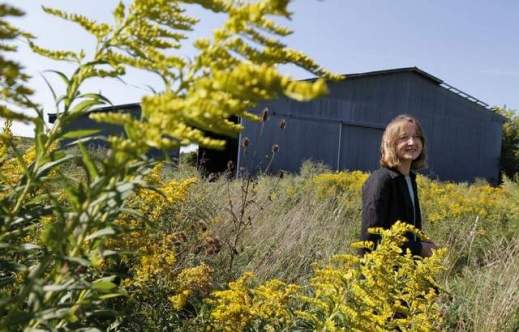
Sue Gardner Smith, manager of the Brighton and South Wedge farmers markets, stands with a old abandoned barn along Westfall Road in Brighton. The barn is part of a site proposed as the Brighton Farm and Farmers Market expansion and renovation project. / SHAWN DOWD//staff photographer
Perhaps it is no coincidence that a woman with a surname derived from an old French word meaning “gardener” would become a grass-roots champion of the sustainable and organic food movement in Brighton.
With humble determination, Sue Gardner Smith turned her activism into a career in managing farmers markets — first in the South Wedge neighborhood of the city and now in Brighton.
Gardner Smith was the oldest of seven children growing up on a 70-acre farm in Wayne County that had been in her family for a century. She remembers walking through its cherry orchards with her father and tending to the family garden with her mother and siblings.
Being the oldest in a large family, Gardner Smith developed the nurturing traits of a “mother hen” by cooking meals and caring for her younger siblings. In her early culinary experimentation, some dishes were tastier than others. Even into adulthood, she still gets teased by her siblings at her first attempts in the kitchen.
“When I was nine, I came up with a dish called chipped beef on toast. It was wretched. … I have to say that my cooking and tastes have improved vastly since then,” said Gardner Smith, who now prefers making dishes like ricotta cheese and onions stuffed into Swiss chard leaves she grows at her 10-foot by 10-foot plot in the Brighton community garden, a project also under her charge.
In her experiences of living in cities abroad and in the United States, nothing unites people more than food. She has shopped for fresh produce in the open-air markets and dined in the cafes in the plazas of Brussels. In London, there was the tavern and pub culture, “neutral” places where local neighbors could gather for a meal and a drink at the end of the day.
During her 15 years living in the San Francisco Bay area, she visited restaurants like Chez Panisse and markets such as the Berkeley Bowl, where the air buzzed with a sense of what she called “food energy.”
“It’s not just about eating. It’s how people gather at markets to socialize and catch up with neighbors as they shop. It’s the sounds of local musicians playing among the produce stands. I have long felt that Brighton should have this kind of gathering place, and I’m glad to watch its success,” she said.
Since 2008, the market held each Sunday in the Brighton High School parking lot from May through October is a testament of Brighton’s desire for high-quality and locally grown food. One thing Gardner Smith admits is that from a short-term perspective, eating organic and local is a bit costlier. Also, a recent Stanford University study recently concluded that organic food is no more nutritional than conventionally grown food.
However, she believes these factors will not curb the organic, locavore trend. This is because people are starting to put values on reducing their carbon footprint and the use of harmful pesticides, and developing a direct and trusting relationship between the grower and the producer at local markets.
“The study missed the point and had too narrow a focus. When you buy local and organic, you develop a sense of trust with the farmer, and you are also helping to support the local economy,” she said.
In addition to buying locally produced food, Brighton residents also expressed a desire to get their own hands dirty in avegetable garden of their own. In 2009, the creation of a community garden in Brighton seemed like the next step.
“It seemed like an obvious sister project to the market,” said Gardner Smith, who with a committee helped build a fence and a gate system around 100 10-foot by 10-foot plots on Westfall Road by the historic Groos house. Outside of a few stubborn groundhogs that managed to breach the fence, Brighton residents have enjoyed the bounty of their harvests.
Now that the shorter days and cooler nights of autumn are here, it is time for Gardner Smith and the other Brighton gardeners to put their plots to rest for the winter. But that doesn’t mean that plans for coming years will be put into hibernation.
Her ambitions for future years include using funds from a $250,000 state grant awarded to the town to preserve a farmhouse, a barn and some of the farmland on Westfall Road. The proposed project aims to create a permanent location for the farmers market and an expansion to the community garden with educational opportunities for schoolchildren to learn more about agriculture.
“Not only is my job rewarding, it’s also a lot of fun. I’ve met so many wonderful people in Brighton who are committed to this meaningful work that really has made a difference.”
Indeed, Sue Gardner Smith’s name suits her well.
Hooray For Back-to-School Meet the Tester Night!
For six years, I have walked the life of a middle schooler at my children’s curriculum nights.
Some years, my husband and I conquered and divided, splitting up the night walking the walk when we had a sixth and an eighth grader. Last night we walked through my son’s eighth grade day by visiting each class in periods boiled down into 10 minute snippets.
In years past, teachers with a twinkle in their eye would discuss the actual curriculum they covered in addition to how to get in touch with them and where to find the latest assignments online. In past years, teachers used their precious 10 minutes to explain why they are passionate about teaching their subject to our children, something to which they have dedicated their life’s work. They went on about how they would rev up our child to learn about the Industrial Revolution, or get them juiced up about geometry.
They talked about TEACHING. Plain and simple.
Last night, something was different. Last night, it seemed that the teachers in my beloved school district had been bitten by the dreaded TEACH TO THE TEST zombie.
With each class I visited with my husband, the evening was not about the curriculum, but making the grade. How much homework and classroom work counted toward the grade and most of all, how much those tests counted towards the grade. Suddenly, the school district that I have loved for its emphasis on academic excellence was more about how teachers were qualified to help our kids get the best grades possible.
Are academic excellence and excellent grades the same thing? Am I out of line for feeling this way? After all, I live in one of the toughest and highly rated school districts in the country, right? The going should be tough, it SHOULD be about performance and grades, right?
Now, I know. This is school. This is hard work that’s being asked of my child and I am glad my child is being challenged, but I want teachers to challenge my kids to learn, not to feel pressure and anxiety about taking tests.
Maybe our teachers are not to blame for this shift in emphasis.
What scared me about last night is I had a feeling that suddenly in my district, the teachers seem like they are under the testing gun more than in years past. The teachers seem now to want our children to succeed not for their own sake of LEARNING, but to show their own accountability for how well our children perform on tests and labs so they can keep their jobs. Teaching jobs are hard to come by these days, that I understand and appreciate.
After last night, I gained a better handle as to why teachers in Chicago are striking. I got an even better handle on why the movie “The Race to Nowhere” needed to be made.
Perhaps the class with the most soul sucking sound was my child’s math class. A cold fish of a woman with mousey brown hair prattled on about maintaining not a PASSING grade in this almost double-accelerated class, but a 85-90 percent grade to stay in the class. The word assessment came from her mouth almost two dozen times. Not once did she talk about how she was going to teach to me this most difficult subject to GET my kid and the kids of others EXCITED enough to learn and get this grade. I suddenly felt like a middle school student all over again in math, anxiously waiting for the bell to ring so could BOLT!
After math was technology, the final class of the evening. I had had it. All I wanted to do was blow this class off, not caring if I would get a detention for cutting. All I wanted to do was to go home and crawl under the covers, thanking the Lord I was no longer a middle school student.
So glad I stuck around.
Waiting for us outside his classroom was my son’s tech teacher.
“You coming in? Excellent!” He beamed.
I won’t say his name, but this man talked about his life. He talked about growing up in his dad’s auto mechanic shop and how he fiddled with car engines. In this class, they were going to MAKE and DESIGN stuff! Grow hydroponic plants! Use design and mechanic techniques that required precision and discipline to make a product! Yes, there would be homework and tests, but these benchmarks took a back seat to the teacher’s EXCITEMENT about what he was going to teach to our children.
So glad I didn’t cut your class, Mr. Tech teacher.
After we got home, I guess you can say I was in a crummy mood. I argued with my husband as we lay in bed about my seemingly bad-ass negative attitude about middle school. On a whole, weren’t the teachers lovely and didn’t they convey to us what our son would learn that year? My husband. I love him because he is the glass half full kind of guy. Yes, maybe.
I finally fell asleep. Only to be woken by my eighth grade son at 2 a.m. His throat was killing him and he had a cough that sounded like a sick seal. Felt his head. No fever.
“Honey, you sound sick, and if you feel this way this morning, we are going to the doctor.”
“NO MOM! I CANNOT MISS SCHOOL. EVER!! I’LL MISS TOO MUCH.”
“Okay, how about coming home after school and missing track practice. You need your rest.”
“NO MOM! I CANNOT MISS PRACTICE. EVER!! I WON’T QUALIFY FOR A MEET.”
Those last two sentences, fear-filled sentences about missing even a day of school, even an HOUR of school to go to the doctor, confirmed my feelings about curriculum night.
I gave him a cough drop and a kiss on his head and sent him to bed. But I can’t say that I slept well.
A Funny Thing about Blog Stats


I don’t really get bogged down about checking my blog stats.
I really could care less about how many eyeballs come to visit my blog or which country they reside.
Okay.
I lie.
Blog stats keep me from going to bed at night and get me up and going every morning.
Lately, the tag words that lead people to my blog the most are “kosher” and “kosher meat”
In fact, in the last 30 days, searches like “kosher,” “kosher beef,” and “kosher meat cuts” led 227 people to my blog.
It’s all very flattering, folks, but I’m no expert here.
Although I follow kosher dietary laws to some extent – I have a kosher home and stick to a vegetarian diet at non-kosher restaurants – I’m no guru on kosher certification or laws of kashrut. Leave that to the experts like Kosher Maven, Los Angeles Kosher Restaurants and here is a whole list of kosher bloggers I found on Pragmaticattic.
But still, the Kosher hits keep coming.
Additionally, thanks to WordPress’ mapping feature that lets you check out where in the world the hits are coming from, many of my hits are coming from countries where I bet hardly anyone keeps kosher.
Like:
The United Arab Emirates
Pakistan
Indonesia
Syria
So, what do I think about this? Maybe – just maybe, people are reaching across the blogosphere to reach across the Muslim/Jewish divide. Maybe, as we approach 9/11, blogging can dispel the myth we build up about each other. Maybe, there are people in Muslim-dominant countries who really want to find out who and what Jews really are. Maybe we can find common ground, at least in a gastronomic way.
What interesting trends have you unearthed in your blogging statistics?
Two Transplants embrace the Wabi-Sabi-ishness of Rochester in Gallery Opening

One grew up among the tea plantations of the Darjeeling region of India
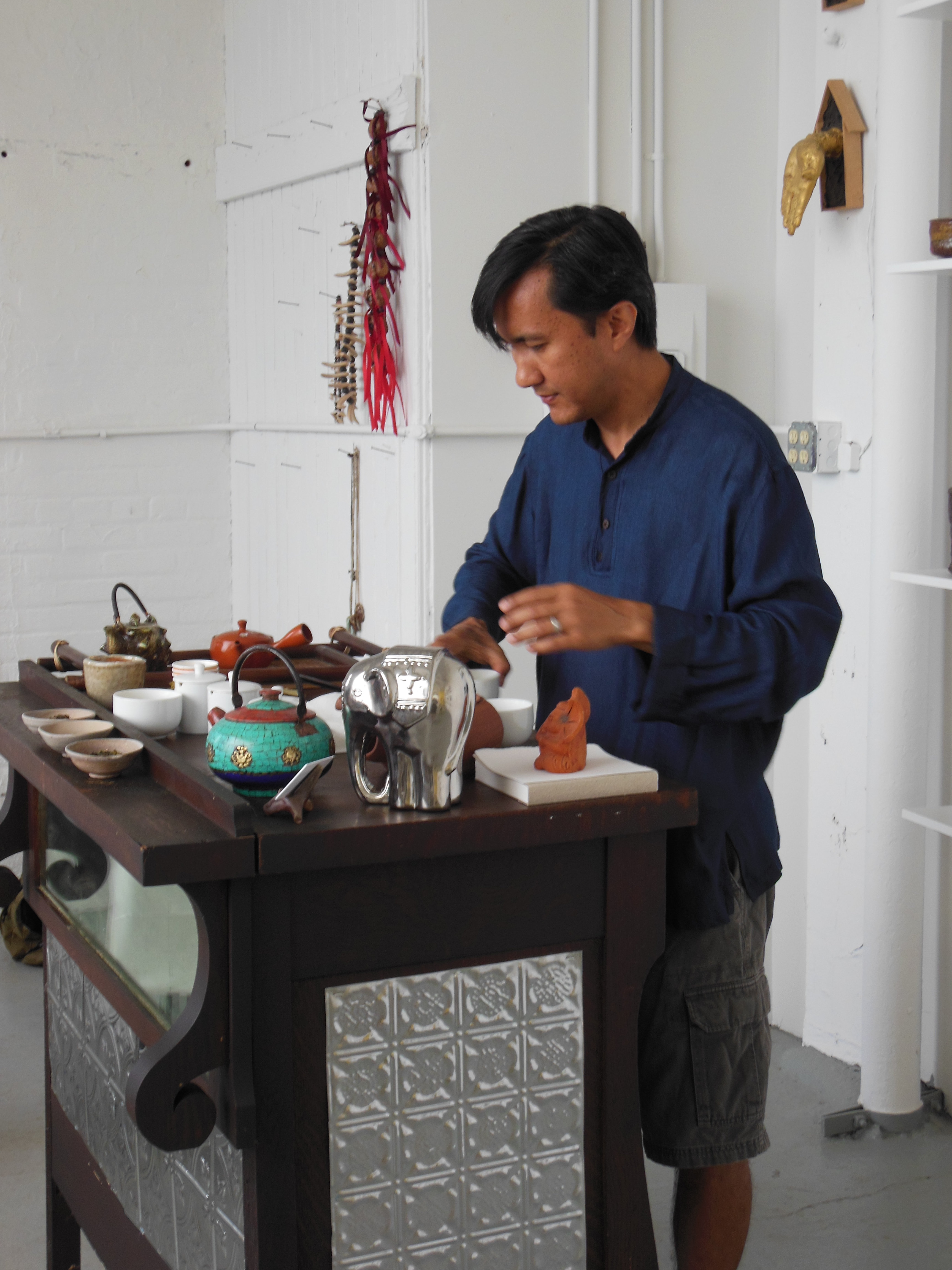
The other grew up in the progressive urbanism of Austin, Texas. 
One was raised in Buddhist teachings. The other came to Buddhism in his teens.
One way or another, they found themselves in Rochester.
This Friday, come check out their shared venture in the Kuma-Gama Clay Studio and Tea Bar.
Over a glass of freshly brewed hibiscus iced tea, I had the opportunity to interview them both.
Here is their full story which I profiled them in the Democrat & Chronicle:
Within Japanese culture is the aesthetic of Wabi-Sabi.
Rooted in Buddhism, this philosophy draws attention and appreciation to life’s everyday simplicities. It asks the follower to seek out beauty in unobvious places, such as the gnarled and twisted texture of a tree branch or the irregular jaggedness of a stone.
In many ways, Rochester is a Wabi-Sabi city, says potter Cody Kroll, making it the perfect place to create his imperfectly shaped sculpture and Japanese tea ware.
“Rochester is … not perfect, and it is unfinished,” says Kroll, an Austin, Texas, native. “That’s the way I make art, by always keeping in mind that nothing is perfect and nothing is permanent.”
Kroll was working out of a small studio in the Hungerford Building and selling his work on etsy.com.
While online, he met Niraj Lama, a native of the Darjeeling region of India, who was selling his Happy Earth Tea online. Lama is a newcomer to Rochester, and when the two realized they lived in the same city, they met in person and a business venture began.
They will open Kuma-Gama Clay Studio and Happy Earth Tea Bar in a larger space, Suite 228, in the Hungerford, 1115 Main St., during First Friday this week.
Kroll’s work will be on display, and Lama will provide a history of tea, as well as tastings.
Kroll’s interest in Japanese culture came early in his life. His grandfather was a Marine stationed in Japan and brought him some pottery. Kroll studied fine arts at Eastern Kentucky University and State University of New York at Buffalo. He has been influenced by 16th-century and modern Japanese glazing techniques from artists such as Kanzaki Shiho and Suzuki Tomio.
In the spartan space of the Kuma-Gama Clay Studio, light streams through industrial glass block windows onto whitewashed walls. From outside, one can hear the clank and whistle of a passing train on the railroad tracks behind the building. Cinderblocks support a shelving system of wooden boards that display Kroll’s creations.
On these shelves, the visitor shouldn’t go looking for a matching tea set of identical cups fashioned with traditional scenes.
In his own primitive “impressionistic” style, Kroll strives to capture the fleetingness of a single moment on the surface of his earth-toned works, sometimes in a glaze that seemed to be fired in a kiln while it was still dripping, sometimes in unglazed parts of a piece that capture his fingerprints.
Though each piece is a one-of-a-kind creation, when a few are assembled, they suggest an eclectic harmony and the ideal vessels for a formal Japanese tea ceremony or the enjoyment of a single cup of tea.
Kroll says because Japan is an island nation, each has its own distinct style and uses resources found nearby. So too does Kroll, who only uses locally dug clays, such as what is found at the bottom of the pond of the Folk Art Guild of Rochester in Middlesex, Yates County. The glazes Kroll uses are made from ash taken from wood-fired ovens of local restaurants.
Everything about Kuma-Gama Clay Studio takes sustainability into consideration. The Hungerford Building has been repurposed from an old fruit-packing plant to a place where local artists work and live. Tea is served from an old piece of furniture found outside the hallway in the studio. It was refurbished into a tea bar and adorned with polished tin ceiling tiles also found in the building.
When Kroll moved to Buffalo in the early 2000s to earn his master’s degree, he thought all of New York would resemble Manhattan. He says he has grown to appreciate Rochester’s artistic and cultural riches and its potential to grow as a creative hub.
“To me, Rochester is what Austin was 25 years ago — a nice, yet-to-be discovered city along a river. I actually like that Rochester is a little depressed,” says Kroll, referring to the Buddhist outlook of accepting the high and low phases of life and knowing that each will pass.
While Kroll’s art is based on appreciating imperfections, Lama’s craft in making the perfect cup of tea depends on the precision of timing, water temperature and the cut of leaf.
Growing up in the foothills of the Himalayas, covered with tea plantations, Lama was raised in a culture of tea. In the country that is the world’s biggest consumer of the beverage, tea was part of everyday life. Though Lama worked as a journalist in India, the tea import business keeps him connected to his homeland.
“Tea nourishes the soul. It takes some time and patience to calm down to enjoy the subtleties of the flavors of tea. While coffee delivers that jolt to get you through the day, tea offers the drinker a tranquil alertness,” Lama says.
Together, Kroll and Lama hope to foster a “tea society” at the studio, where tea lovers and those simply curious about tea can learn about tea ceremony traditions and the art of making the beverage.
Kroll and Lama see the repurposing of the Hungerford Building as symbolic to the revitalization of Rochester. Just as Lama’s tea is a symbol of welcoming hospitality in his culture, so it has been with the “open, welcoming” nature of the people he has met in Rochester since moving here with his wife and two small children just 18 months ago.
“Rochester to me as an outsider has been a very gentle, welcoming place,” Lama says
Bring Back Shame and Judgement: It’s a good thing.

Have you seen it?
The video of foul mouthed-middle schoolers speaking foul things not to each other, but to an elderly bus monitor?
Cursing at her? Calling her fat? Touching *touching* her stomach and calling her fat — while she sat helpless, perhaps terrified? This painful video was ten minutes long. This went on for ten minutes.
All the anti-bullying talk. All the anti-bullying this and that. And NO ONE stood up and stopped the bullies!!
And how could the bus driver allow this to go on?
I interviewed a teacher here who is a historian, the keeper and cuurator of a one-roomed school house in Penfield.
Back in those days, kids who were bad, got the switch. At the very least, they were sent to the corner with a dunce cap. There really wasn’t much wiggle room or putting up with bullshit from students.
I’m really fed up with the assinine actions of some of the “minors” in my town:
A year ago, a kid named Luke Buckett and a few of his friends burned a swastika in my town, and they got off because “they didn’t know what it was and didn’t know it was hurtful to people. They were 17.
In Rochester, about four high schools have been severely vandalized by seniors as a “prank.”
Enough!
Now, we can no longer harshly punish kids. We can’t shame them publicly or make them feel badly about their actions. It might damage their psyche.
It’s hard-working teachers who get disciplined for trying to dicipline kids. But what do you do when kids act so abhorrently, knowing they would be filmed, like this:
http://www.youtube.com/watch?v=bJ9n8JQJy2c
So, what should be the proper punishment for these kids? Here are some of my recommendations:
Riding the bus is a privelege. Make these kids walk to school from now on. And it gets cold in Rochester.
Give this poor woman and all expenses paid vacation to wherever she wants. And make the parents of these entitled brats pay for it.
I just can’t hold back on this one. Call me judgemental and harsh. Go ahead.
About Me
Kreativ Blogger

Versatile Blogger Award


 Stacy Gittleman