
A Man with a Map. A Woman with a Bottle. Couple work for Rwanda’s Future.
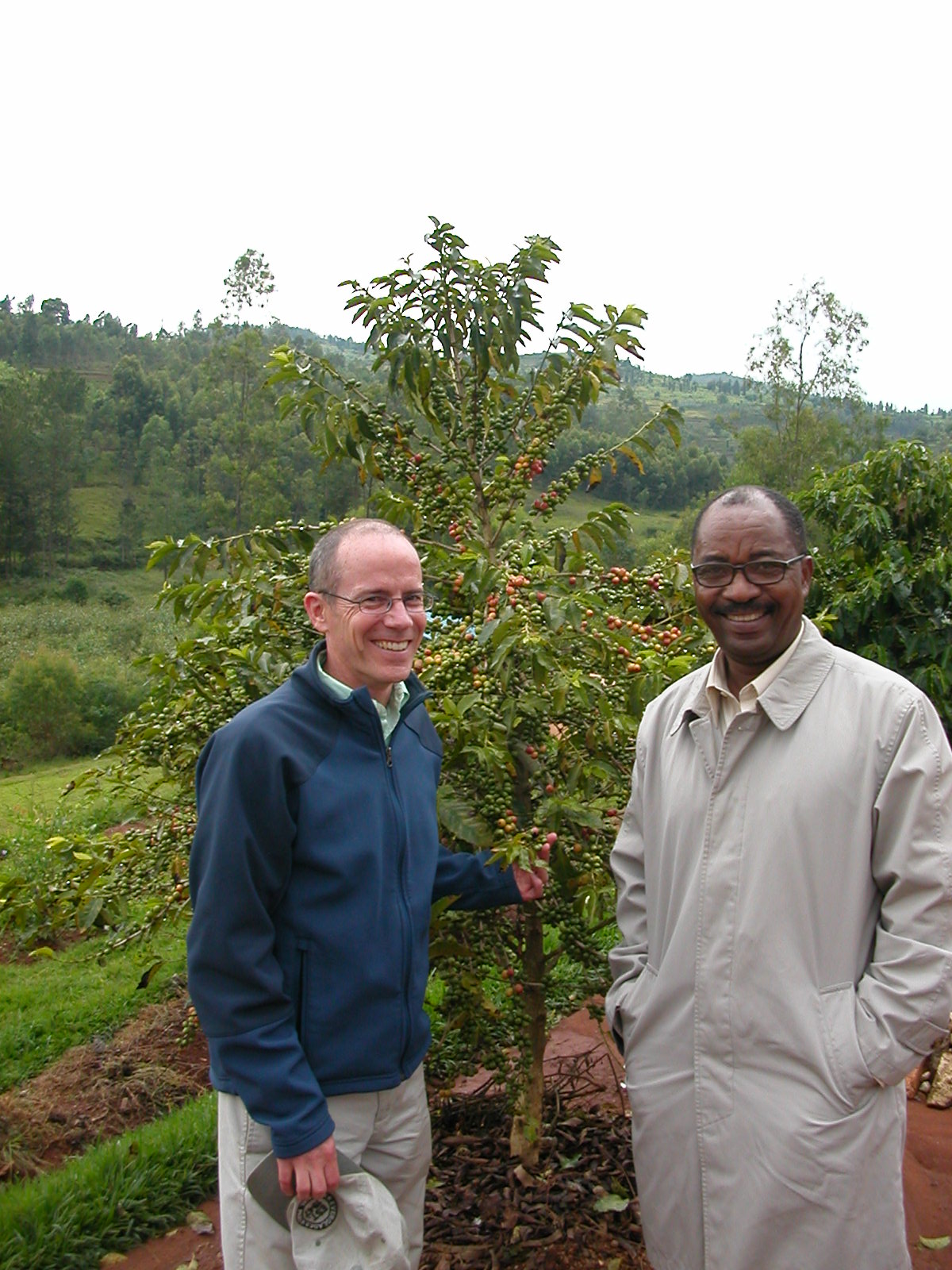
Tony Vodacek, left and, Manasse Mbonye, the provost of the University of Rwanda and a former RIT professor, inspect a coffee plant in Rwanda.
Sometimes, the constraints of print media causes editors and writers to make painful cuts to stories. I had a wonderful conversation with Ann Vodacek, my Brighton neighbor and wife of RIT professor Tony Vodacek about a simple solution that is being used to solve a pervasive problem in Rwanda – using plain water bottles to help purify drinking water with the power of the sun. For space sake, it had to be cut from the print version of my story in the Democrat & Chronicle. I thank both the Vodaceks for all their help with this piece and wish them luck as their work with Rwanda evolves.
Here is the full version of the story.
Tony Vodacek knows his way around a map.
The Brighton resident grew up in Wisconsin and spent summers navigating state and national parks on family camping trips. His wife, Ann Vodacek, describes him as a person who possesses a built-in global positioning system that comes in handy when taking family vacations with their three children in the Adirondacks.
While some people find going to new places disorienting, just hand Vodacek, a Rochester Institute of Technology associate professor, a map and he can locate his destination “in seconds.”
“I never have to ask for directions,” he said.
Throughout his life, Vodacek had an intense interest in maps and the information they reveal. This passion led him to a career in a field called remote sensing, which is the science of obtaining information about geographical areas from a distance, typically from aircraft or satellites.
Vodacek likes to keep and display maps that directly relate to his work. Posted on the door of his office at the Chester F. Carlson Center for Imaging Science at RIT is a relief map of the tiny African country of Rwanda. There are also photos from his last visit and labels from bags of coffee that represent one of Rwanda’s chief exports.
Vodacek’s friendship with former Brighton resident and RIT astrophysics professor Manasse Mbonye has evolved into a partnership between American and Rwandan academics who seek to advance this African country by providing its people with the knowledge to grow an information infrastructure and ultimately improve the way the water and land are used to create a stable economy.
Mbonye arrived in America as a Rwandan refugee child in the 1960s. After decades of living in America, he returned to Rwanda this year to accept a position as director of academics at the National University of Rwanda.
During his five visits to Rwanda — his most recent trek took place earlier this year — Vodacek met with Mbonye and many government dignitaries, and listened to their visionary optimism for Rwanda. The Rwandan people are trying to reconcile with their recent past and seek to advance this landlocked country with few natural resources by boosting its technology infrastructure and agricultural practices.
“Rwanda is striving to become self-reliant. It no longer wishes to be sustained by institutions like the World Bank. Mbonye said there is no other way for Rwanda (to succeed) except through education. The alternative to this is a dark path that has already been traversed,” said Vodacek, referring to the genocide in the mid-1990s where tribal divisions led to the deaths of nearly 1 million Rwandans.
Now, Vodacek is leading a multi-disciplinary international team of scientists and graduate students — backed with a $350,000 grant from the John D. and Catherine T. MacArthur Foundation — on a two-year survey of the Lake Kivu system in Rwanda to collect scientific measurements to learn how human activity is threatening biodiversity. Vodacek and his graduate students will study satellite data collected over 40 years to unlock the story of this lake that rests among volcanoes and a mountain gorilla reserve, a lake that one day might erupt from volcanic activity to cause a natural disaster.
“Just like meteorologists use satellite data to forecast weather changes, I use remote sensing to forecast environmental changes,” said Vodacek.
If Rwanda is going to be a technologically advanced country, it is going to need more power. This power can be found at the bottom of Lake Kivu. The lake’s depth is 1,574 feet with fresh water above and saltier, denser water resting on the bottom. The saltwater and sediment at the bottom of the lake trap large reserves of carbon dioxide and methane, sort of the way gas is trapped in an uncorked champagne bottle. For now, the waters are calm. But according to geological studies taken from layers of lake sediment, the lake is overdue for a phenomenon called “turning over.”
Geological studies have found that about every 1,000 years, underwater disruptions in the bottom of Lake Kivu — such as a volcano or an earthquake — caused the denser, gas-laden waters to rise to the surface and release large amounts of carbon dioxide and methane into the valley.
Those releases can be deadly. Vodacek pointed to an incident in Cameroon, where in 1986, a plume of carbon dioxide escaped from Lake Nios and suffocated 1,500 people while they slept.
If such a disruption would happen now, two million people living in the area would be at risk of suffocation. Possibly adding to the mix of disruption to the water is human activity like farming and deforestation. It is here where Vodacek’s research will be applied to see if human intervention might be another reason why gas pressure builds at the bottom of the lake.
Another man-made event that was evident in satellite images was the 1994 genocide. Photographs from space showed forested land in Rwanda that had nearly disappeared as fires were started and displaced people cut down wood for fuel during and after the genocide.
Whether or not human intervention will cause Lake Kivu to release noxious gasses, Vodacek did not need a satellite image to see evidence of deforestation around the lake due to farming practices and the burning of forests during Rwanda’s civil war.
As Vodacek drove along the shores of Lake Kivu, it was also easy to see just how hard it is to farm in a country that hardly has any flat land.
“People are trying to scratch out a living as subsistence farmers on deforested mountains. It looked like some of the farmland was nearly vertical in some areas,” observed Vodacek.
After decades of losing trees, the Rwandan government is studying ways to reforest its land. Remote sensing can help the country explore its options as it weighs the needs of growing food on farmed land versus protecting land and water quality by replanting trees. Should reforestation be widespread and allow for intermittent areas of farmland, or should some tracts of land be densely developed leaving other parts to turn over back to nature? Remote sensing over time can help study these scenarios and answer these questions.
“I’m excited to see what patterns and changes that will come about as Rwanda moves to reforest its land. This is all a very long term experiment and we are only at the beginning of it,” said Vodacek.
In any case, planting more native trees can only improve the quality of the water in Lake Kivu. Deforestation coupled with farming causes soil erosion, nutrient depletion and water runoff into the lake. These practices make for poor drinking water quality leading to water borne diseases especially among Rwandan’s children. It is this issue that has caught the attention of Vodacek’s wife, Ann.
A social worker by trade, Ann is in the beginning phases of working with Rwandans she has met through her husband’s work to improve drinking water by a method called Solar Water Disinfection, or SODIS. Used successfully in other countries like Kenya and India, it is a method as simple as killing harmful bacteria in drinking water by filling up plastic water bottles and leaving them to sit in the sun for six hours.
It’s that simple. The hard part, according to Ann, is gaining the trust and changing the habits of rural villagers.
Ann listened to the frustrations of a young Rwandan doctor who spent time in the United States to complete his residency.
“Rwandans who are studying medicine are trying to go back to their villages and teach mothers that it is not normal for children to suffer from swollen bellies or diarrhea. But it is going to take trust and some education for villagers to change this way of thinking,” said Ann. Improved health among Rwandan villagers can only lead to overall quality of life for the whole country, she added.
The Edge of January

We have had the wimpiest winter in Rochester, NY in anyone’s memory. Being the transplant that I am, I asked lifelong Rochesterians if they can remember a January where they could go outside with just a sweater. A January where the temperatures barely went below freezing. They can’t.
But this warm winter seems no less longer then the cold snowy ones. It’s just dull. There are no bragging rights when you are stuck with a wimpy winter.
There is just the weak light. The sun is runny in the sky, like a pale broken egg yolk in a pan: 
There is no point to winter in Western New York if you can’t tell people elsewhere how you had to remove snow off your roof with a roof rake for fear of it caving in or have icicles hanging off the eaves of your house the height of a professional basketball player.
It’s just not winter if you can’t build your own igloo on the front lawn: 
 we have not yet experienced any significant storms or accumulations.
The official snowfall count for the season: 18.9 inches.
How much snow should have normally fallen by now? 55.7 inches.
In years past, it was if we were living in a snow globe.
It would snow a few inches every day for weeks at a time.
But not this winter. Everyone is missing the snow:
- Up on Lake Ontario, the Webster Ridge runner snowmobiling club has had to suspend its season because off lack of snow.
- My daughter’s youth group trip to go snow tubing was cancelled.
- My daughter also joined the high school cross country ski team this winter. At best, she has skied on the slushy man-made snow at Bristol Mountain. At worst, her team has spent the winter jogging outside or practicing on roller skis.
Ironically, in one of the few strong winter systems that passed through, our school district cancelled all sport practices, including cross-country skiing. Imagine that, ski practice was cancelled on account of SNOW!
But last night we were hit with several bands of fast moving lake-effect snow squalls. One particularly strong squall showed off its wintry moxy with a show of snow thunder and lightening that is completely out of place in the middle of winter.
Now, this is more like it:

My name is transplantednorth and I blog for the trees
 The other morning I phoned my sister-in-law in northern New Jersey. I needed to know her Hebrew name for an honor she was receiving for the morning service at my son’s Bar Mitzvah, now only days away.
Now, I should have known this, and certainly my husband should have known his sister’s Hebrew name, but we didn’t.
I called her cell phone a few days ago after 8:45 in the morning. With four kids in school, she had to be up. She is always on the go. Instead, a very groggy voice answered.
“It’s Malka”
“Who’s Malka?”
“I am. That’s my Hebrew name.”
Oh, of course, that’s why I was calling. But why did she sound so tired?
“Why arent’ you up? Don’t you have kids to get to school?” Fool that I was, with the glorious November day outside, and the fact that Western New York again survived the latest storm to hit the east coast unscathed, I was not thinking about how bad things were back in the NYC/NJ Metro area. The now-dubbed Halloween snowstorm had turned the streets of parts of New Jersey into what looked like a war zone. With downed trees and downed power lines, it was even too dangerous to go trick-or-treating.
“I’m sleeping at a friend’s house. We have no power and no heat.”
She sounded so sad. She still had no power after two days. The kids had no school for two days straight. But the one thing that seemed to make her the saddest was:
“You should see my block. We lost so many big, beautiful trees.”
It takes decades for a tree to really mature. I know because I live on a street with huge Sugar Maples that look like this: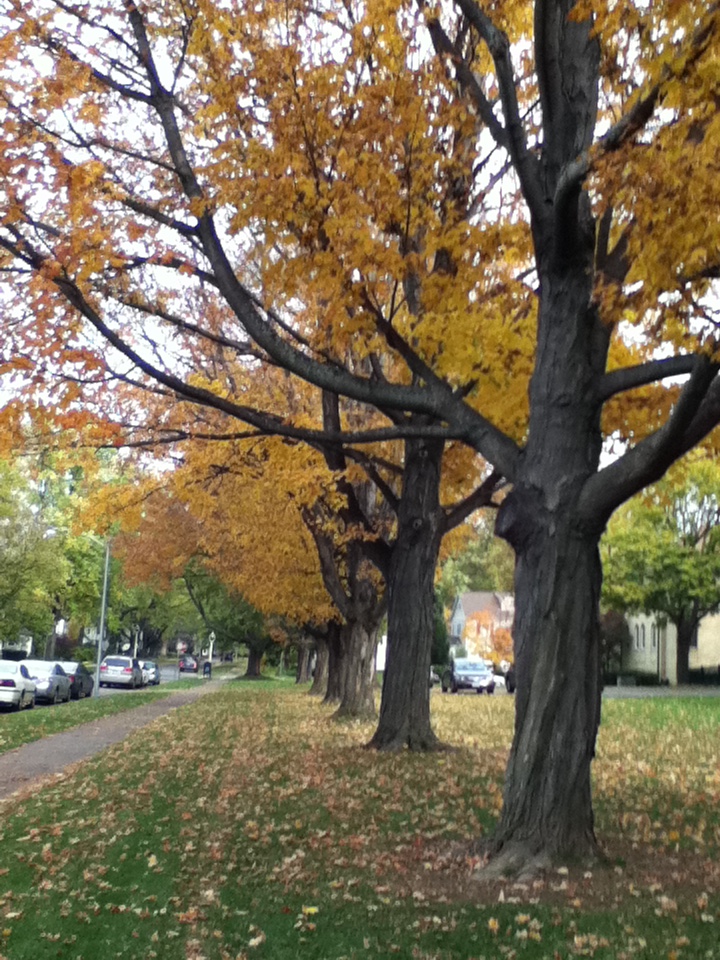
In the winter, when the snow is wet and heavy enough to put a coat of sugar on every last branch and twig, my street looks like this:
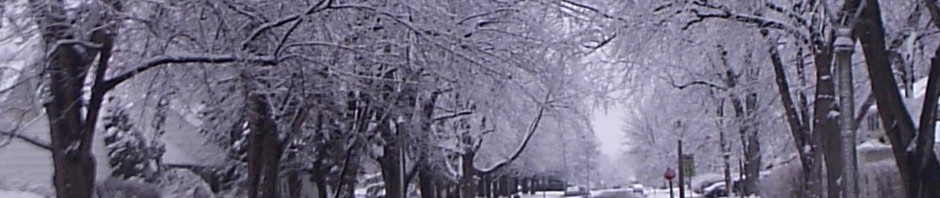
Sadly, even trees don’t last forever.
The snow-laden trees above were planted because they were fast-growing trees for Rochester’s first suburban development. They are now almost 90 years old.
Trees planted closely to houses are dangerous when they age and begin to rot from the inside out. Last weekend, our neighbors took down one of these trees. The bottom trunk was this big:
 This tree saw 90 years of changes of seasons, survived ice storms and blizzards. It saw generations of school children off on their first day of school. It was a home to birds and squirrels who played in its branches. But it lived out its days and succumbed to “crotch rot” of all things. Now, where its branches once stretched out, there is a whole punched into the sky where it once stood.
When snows fall heavy before the leaves drop, trees come down before they get a chance to live out their days. Back in New York City, Central Park lost 1,000 trees; trees that were just beginning to peak in their fall splendor of color. Trees that were planted generations ago so that we may enjoy them.
The other week, my son got a gift from a relative in honor of his Bar Mitzvah. In the true Jewish tradition, a ring of trees had been planted in his name in Israel. It’s a good thing we are headed there this winter to water them!
Now after this devistating storm that cancelled trick-or-treating and felled countless trees close to home, it seems like New York City needs new trees just as much as the land of milk and honey. The Central Park Conservancy is now asking for donations to restore its tree population.
Do you have a favorite tree? How would you feel if it were destroyed or it had to come down? Or, did you lose a tree to the Halloween storm? If so, I am sorry for your loss. Why don’t you write about it here?
A backlog of blogs
Okay.
So, so much for Post-a-day.
These days, I’m lucky if I can post-a-month.
But I have so many ideas to write about but working, parenting, track, baseball and concert season are getting in the way. So is that chocolate milk that my son just spilled on the kitchen floor.
So, before I have to be in two directions at once, here are some topics I have been meaning to blog about. You pick what I should tackle first:
- More Love Letters: This time, the ones I found between my grandparents before they were married.
- The Robin who made a nest in our front shrub.
- The African Burial Ground in downtown Manhattan
- Transitions from childhood to teen-dom
- What we saw at Ground Zero
Gotta go and watch my youngest play ball!
Like a Walk in Highland Park


every year, the entrance bed of the park is filled with pansies
It’s been a cold dark week. The news nationally, while triumphant, stirred up a lot of questions and decade-old images. What is closure anyway?
Locally, a hate crime has been committed in our town. Our high schoolers are wrestling with the news that this action was allegedly committed by someone they consider a close friend.
But, yesterday the sun finally came out. May is nature’s reward to Rochesterians for sticking it out through the long winter.
So, to forget it all, I took a walk in Rochester’s Highland Park. This park is known for its vast lilac collection – one of the nation’s largest. And with it, Rochester hosts one of its most popular festivals.
So, before the crowds, and the vendors selling fry bread and fried artichokes and – fried everything arrive. I took a walk in Highland Park and snapped the following photographs:

the earliest lilacs are just starting to bloombut the trees along the path were burstinga field of daffodilsI walked past a grove of magnoliasuntil I reached the reservoir and enjoyed this view
Bye-bye Tar Beach, Hello Green Roof

Growing up in Brooklyn, if you couldn’t make it to the real beach on a hot summer day, all you had to do was go up to Tar Beach. Did you go to Tar Beach?
“It was really hot up there,” my mom told me on a recent visit, as she told me about how she and her friends would spend hours up on the roof using sun-reflectors even to maximize their tans. Ahh, the good old days!
Tar roofs, though hot and contributors to global warming, made great song material, though, you must admit.
The Drifters sang about the sun burning the tar up on the roof in “Under the Boardwalk” and how to forget all your cares “Up on the Roof.” Elton John sat up on his roof and kicked off some moss in “Your Song.”
Perhaps Elton should have cooled his boots for a moment and left the moss alone. Growing plants on roofs — from vegetable gardening to sophisticated sod membranes that soak up urban water runoff and cool the air — are becoming a required building material in cities like Toronto and Chicago.
I know that tar roofs are not exclusive to Brooklyn, no matter how Brooklyn-centric my point of reference may be. In fact, cities like Chicago, where new laws are in place requiring new buildings to have green roofing materials, the temperature on a tar roof can be 78 degrees hotter than that on a green roof.
Walk across any asphalt parking lot on a summer day and then walk across a green lawn. You don’t have to be a scientist writing a big fat feasibility study to understand how black top paved surfaces and roofs heat the earth and green areas have the potential to cool it.
In Rochester, NY, The Harley School is employing this technology as one long-term science project and can boast that they are the area’s first school to have a green roof. This sustainable technology will not only act as a natural insulator, keeping the school warmer in winter and cooler in summer, but it will teach its high school students about how buildings affect the environment.
The tar roofs of the past, according to environmentalists, are the bane of city living because they create urban heat islands and contribute vastly to water runoff. Rather than being just a green trend, cities such as Chicago and Toronto require roofs of new buildings to include cooling, greenhouse-gas absorbing plants.
The Harley School on Oct. 18 installed two 10 x 10 ft. plots of hearty winter grass on the roof of their building on 1981 Clover St. The school spent $2,000 for materials and also received an in-kind installation and materials donation from Zaretsky & Associates landscapers in Western New York. In order to grow a section of green roofing, school engineers had to assess if the school’s roof could withstand the additional weight of a weatherproof membrane barrier, two inches of topsoil, the weight of the growing plants, and the water they will retain. The grassy roof serves as a natural insulator and will keep the building cooler in the summer and warmer in the winter. School officials expect to reap the benefits of these initial costs within 3-10 years.
Peter Hentschke, a science teacher who will be working with Harley’s upper classmen on researching the impact of the green roof, said the project provides students with hands-on learning. The students will develop mathematical methods and equations to determine how much energy their school saves by comparing temperatures of the school’s different roofing materials. They will also calculate how water runoff is affected by the green roof.
“Rooftop plants catch rainwater and runoff that would have ultimately run into the sewer and overburden water treatment centers. The students are tracking current rainwater runoff with water gauges and will track this throughout the school year,” he said.
Chris Hartman, Harley’s social and environmental sustainability coordinator said the students are “all fired up” about learning about the green roof because it has real-world implications.
“The Harley students are really in the driver’s seat of this project. They know that it is cool to have a green roof, but the challenge will be to come up with the methodology to show how green roofs have an impact in the world around them,” said Hartman. He added that students hope to share the data from the green roof with their classmates, and perhaps local colleges such as the University of Rochester and Rochester Institute of Technology.
If we all started growing green things on our roofs, perhaps by the time these kids graduate college, our cities would from above look less like Tar Beach and more like the ancient hanging gardens of Babylonia. I wonder what songs they will inspire by then.
Bats in the Belfry: The educational conclusion
 After you are told by the Batman in the middle of the night that you may have a bat colony in your attic, sleep does not come easy.
In my last blog post, I wrote about the night we were visited by a bat. There was a bat in our house. We saw it one minute and it flitted to an unknown location the next.
If you live up in the cold North like I do, and have not had the sufficient funds to replace every charming leaky window in your 77-year-old home, then you are familiar with the practice of wrapping your windows in shrink plastic for insulation. On The Night of the Bat, the wind outside howled, causing the plastic wrap on our bedroom wrinkle and crinkle. Of course, I mistook every wrinkle and crinkle for the wings of a bat and shot straight up in bed every 10 minutes throughout the night. I’d never wanted morning to come so badly.
Have you ever had a bat loose in your house in the middle of the night? I later learned that we were not alone in this experience. Bats seem to be a common occurance in older, charming homes. Bats are the one uncharming feature that the realtor leaves off the charming English Tudor house listing.
We shared this story the next day with many of our friends. One couple we know, who are avid campers, said when a bat swooshed over their heads in bed one night, they didn’t hesitate to pitch a tent over their bed to get a good night’s sleep.
I’ll have to remember that for the next time.
Morning finally came. I probably slept for two hours at best and my nerves were fried when my husband woke me to tell me about his discovery.
“You have to see this, I found the bat!”
He led me to our living room and I think I hid my head in his shoulder all the way down the stairs. Behind the honeycomb shades, up by the ceiling, there was a small shadow. Suddenly, this terrifying creature of the night seemed harmless. Even vulnerable. I quickly put on my boots and ran outside to get a better look.
Between the living room window and the shade, our winged intruder hung upside down and was fast asleep. I have to admit, swaddled in its pale grey wings, this small bat, the same creature that terrorized me, looked pretty cute.
A few hours later the Batman came for a visit. No, it wasn’t the Dark Knight or Caped Crusader of comic book fame. Just a guy with a five o’clock shadow at 10 a.m. wearing a red and black lumberjack flanel and jeans ripped through the knee.
He asked if our kids were around because they might like to see the bat up close and personal.
My fearless children ran down the stairs in their slippers to watch what became their own private wildlife demonstration. The Batman put on heavy gloves, produced a coffee can with holes cut in its lid, and gently removed the bat from our window shade. It was tiny, it was frightened, and now, in the capable hands of the Batman, it would be released into the wild.
As much as we love nature and wildlife, we resolved to keep these creatures out of our house for good. And no, upon further inpsection, we did not have a colony of bats in our attic.
What we did have was a lot of holes and cracks. Bats have a very flexible skeleton and can slip into a crevice the size of a matchbox. The Batman’s price for bat removal: $50. The Batman’s asking price for bat proofing my home: $1300.
After recovering from the sticker shock, we then called in another local hero: Leroy. Leroy is one of those guys that everyone knows by first name only and his name gets passed around by all the neighbors. For half the Batman’s asking price, he batproofed our home and gave me a full education on how you know if a bat is in your home.
1. Evidence of guano, or bat poop in your attic. Enough said here.
2. Look at places like attic louvers, where the chimney joins the house, and gable ends of your house structure itself. To my shock, I could put my eye between chimmney in our attic and the house frame and SEE outside. So this is where the critters were getting in. Leroy then used foam insulation and sealed up the gap like this:
 Keep in mind that sealing the opening must be done while also leaving for a way for bats to exit without re-entering the space. In an ingenious use of pantyhose, Leroy created a contraption that allowed a one-way exit for any bats that may have remained in our attic. If the openings are blocked during the daylight hours, the bats would have been sealed inside with the rest of the family.
I am happy to report that this story happened seven years ago and this house is clean of its bats. All the children are healthy rabies-free and none foam at the mouth. I wish you a bat-free winter and remember — bats really are harmless for the most part and want nothing to do with you, or your hair.
The only thing our society needs to fear – bedbugs!
Good night.
The Bats in My Belfry: Part I
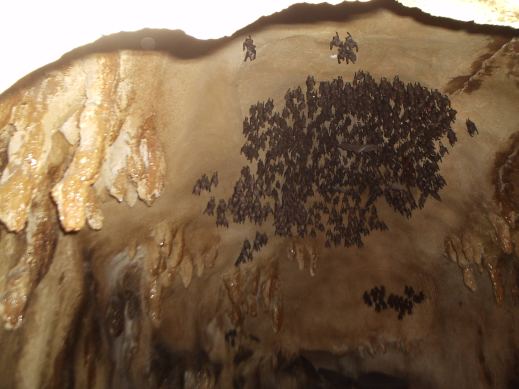

Could there be a colony of bats in your attic?
Since this is the Season of the Witch and all things creepy, it’s time to share a scary, true story with a very educational ending. This story is about bats … and the Batman.
I love our old house. We live in a 1920’s English Tudor with all the old-world English Tudor charm. This charm includes leaded glass windows that are beautiful yet leak in the cold Rochester winter drafts, and copper plumbing that offers enough water pressure to either take a shower OR run the washing machine, but not both at the same time.
It also features a walk-up, half-finished attic, with its own bedroom/bathroom suite and a claw foot tub in the bathroom. This is where all our guests spend the night.
I greatly respect and appreciate bats. I love that the average bat can consume 1,000 mosquitos per night, and how they use sonar to get around, and I love the children’s story Stellaluna.
I even worry about how white-nose syndrome is decimating bat populations in northeast. On October 28, the U.S. Fish and Wildlife Service posted new white-nose syndrome decontamination protocols and supporting documentation for cavers.
I want bats to have disease-free homes and be fruitful and multiply, just as long as their home is outside my home.
This is the part where things get scary.
One Saturday night, my husband and I were doing what we do on most Saturday nights: we were lying in bed watching Saturday Night Live. As you can see we do not get out much and that is why I blog for excitement.
We were nearly dozing off between the opening monologue and the musical guest when we thought we saw something fly by our bedroom door.
“Did you see that?”
“Wha….” my husband was nearly asleep…
“Um, did we close Charlie’s cage before we went to bed?” I asked, hopefully.
At the time, our daughter had a sweet green parakeet named Charlie. I desperately convinced myself that it was Charlie that just flew down the hall. Charlie got out, yup.
Please let that winged thing be Charlie.
We went to our daughter’s bedroom. Charlie the parakeet was safe in his cage, door closed. But something was still flying in the hall. Something with a wingspan far larger than your average parakeet.
We could now safely say we had a bat in our house.
I ran screaming into the bathroom in our bedroom. My brave husband threw a towel over his head and went to pursue the winged rodent with our bed sheet.
Then, like that, it disappeared.
The only thing worse than having a bat in your house is knowing there is a bat in your house but not knowing where it is.
With towels over our heads, my husband and I crept down to the kitchen to get the telephone book to search for someone, anyone, to help us. We dialed the town animal control hotline only to learn their hours were from 10-4 on Tuesdays and Thursdays. The outgoing message said to call 911 in an animal-related emergency.
Was this an emergency? SURE! There could be a rabid bat attacking us at any moment!
So my fingers shakily punched 911 and I alerted the local police that I had three sleeping children, including a 7-month-infant, and a bat was loose in my house.
In minutes, the police were at our door. Remember, this is Brighton, and not Staten Island, where years earlier I waited 45 minutes for police to arrive after calling about girls trying to break into my house to beat me up with a very different bat.
The friendly policeman came and humoured us by shining a flashlight all around the kids’ bedrooms and our living room, but found no bat.
“He probably found somewhere to hide. Bats are really shy and wherever he is, he will stay there till morning,” he reassured us.
This left me no comfort, and I scanned the Yellow Pages for more help after he left. By this time it was around 12:45 a.m.
Then, I found him. An ad for the Batman. From our bedroom, I called the number, figuring I would leave a message and someone would call me in the morning. Instead, to my surprise, I heard a low mysterious voice after a few rings.
“Hello?
“Um, are you — the Bat Man?”
“Yes, I am the Bat Man, how can I help you?”
I immediately apologized for calling at such a late hour, only to be answered with the Batman’s strange response.
“No need for apologies. This is usually the time when the calls come.”
Okaaayy. I told him the situation, and then he told me that this could wait until morning, that bats were very shy, want nothing to do with humans, and he would be by in the morning.
Oh, but one more thing, he said. There was a good possibility that if we found one bat, chances are there were not one – but a colony of bats in our attic.
A colony?
With that the Batman bid me goodnight.
Nighty night and sleep tight. Stay tuned for the conculsion of this bat tale.
Take a Walk USA!
I love watching the Olympics, especially when our country is competing. I just love shouting USA! USA! from the comfort of my living room when our athletes come out on top.
Aside from our elite Olympians, our population as a whole is in no way in contention for winning a gold medal when it comes to our walking habits.
A recent study by the University of Tennessee was covered by ABC and said that only 8 percent of all errands and daily routines in the US are done by walking. The average Japanese citizen takes 7,168 steps a day. Australians take 9,695 steps per day. And for the average American sloth who has become accustomed to drive-ins for fast food, coffee, and pharmacy pick ups? We only walk an average of 5,117 steps a day. Not much to cheer about.
This week, my town, as part of its green initiative, sponsored Curb Your Car Week. ColorBrightonGreen.org, a non-profit organization that educates residents and businesses on global climate change, this week sponsored Curb Your Car Week Oct. 3-9. Brighton residents and others in the area were encouraged to register at www.colorbrightongreen.org and pledge a few days – or a whole week – to driving less.
If you didn’t register yet, it’s not too late! Log in and register any time this week you did not take your car to run an errand or walk to work or school.
Last spring, 184 Brighton and Rochester residents participated in the same event and logged in the miles that they walked, biked, bussed or carpooled. The results: participants saved 3,819 pounds of greenhouse gas emissions from spewing into the air.
Now I know, I am spoiled. All my kids either walk or take the bus to school. I know most of you have a hellish commute from the suburbs to the downtown of wherever you live.
I live only seven- tenths of a mile from my job teaching preschoolers. If I am organized in the morning, I can get out the door on time to enjoy a healthy walk through a beautiful neighborhood that backs into a wooded grove and a reservoir.
Even when it’s not Curb Your Car Week, I like to hoof it to work. So I thought it was no skin off my back when I made the pledge to walk or bike this week for at least three days.
But it’s not easy being green. The toughest part switching from my car to my feet is coordination.
I mean, I admit: I’m not much of an athlete, but I can put one foot in front of the other. But then, there’s the stuff that accompanies all of us to work. We want our coffee cups. If I’m walking I have to have my iPod. And I don’t know about you, but I seldomly go to work empty-handed. I am usually lugging many books and art materials back and forth to work.
And teachers take strange, cumbersome things to school -especially preschool – that don’t make for an easy stroll. For example, I didn’t walk to work today because carrying a small wash basin that I would later use in the morning for a science/art project did not seem like my idea of a good time.
So far this week, I walked to work twice. When I signed up for Curb Your Car Week, the sun shone and the skies were blue. And this week, well, it rained so much the week should have been called Curb your Ark Week.
But I did not lose my resolve. I donned a raincoat and found my umbrella. I dug my rainboots out of the closet and headed out into the cool air. And while I walked, I really was working and working out. I gathered fallen leaves and acorns for an art project. I thought about what toys I would put out while I blasted Viva la Vida into my ears. I had time to pet the yellow lab who waits for me in his driveway. I had time to process and transition between home and work. And when I got to work, I was a little wet, but relaxed, happy and energized.
Come on, America, let’s show the Australians and Japanese who is still No. 1!
If you want to boost your health and that of the planet’s, take your own Curb Your Car challenge and pledge to drive less. Take that walk to the bank or the library or the Starbucks and say hi to some neighbors on the way. Until the snows come to Rochester, even after this week, I will be walking uphill to work. Both ways.
Carrying In, Not Carrying Out – The Trashing of our Parks

can people not pick up after themselves? Even on a nature trail?
I was glad to see that there exists a blog category such as a rant. This blog should have been a rave, but I will woefully have to rant instead.
I spent a beautiful day last weekend with my husband and our youngest child at Stony Brook State Park in New York, just north of Corning. If you have been to this park, you know what a treasure it is. If you have ever been to Watkins Glen State Park, near Ithaca, you have had a similar experience. But, at Watkins Glen, there is absolutely no going in the water, as inviting as the water looks. It’s too rough. The current there would pound anyone to a pulp.
But Stony Brook State Park features a gently sloped, rambling stream that invites you in to make your way through its swirls, try out its natural water slides, stand under its gently cascading falls. All around you this brook over the centuries has carved out a ravine which is now lush with forest and ferns. And, there is also a parallel trail to the brook for those who want to stay dry.
One would think that any visitor would hold a place like this, or any park, state or national, in high regard, to keep it clean and pristine.
Not so.
The first disgusting thing I found in Stony Brook was an empty pack of cigarettes floating in the water. Gross as it sounds, I snatched it up and put it in the pocket of my cargo shorts. Those pockets were meant to hold stuff, and if I could put them to use by carrying out some litter, all the better.
Then, I passed a few water bottles, sitting empty on a slab of stone, abandoned by their consumers. I shoved them in my son’s backpack. I got a complaint from my husband when I added to my litter collection a crushed empty can of Coors Lite.
After picking up this my next piece of trash out of the brook, that public service announcement came to mind, the one from the 1970’s when I was a kid, that Native American crying that one tear. He has to be long dead and gone, but he is most likely still crying in his grave by the looks of things.
This item of litter did not please my husband.
“Don’t do that, then our backpack will smell like beer! They have people to pick up….”
“Really????” I snapped, annoyed that he was annoyed with me picking up litter rather than annoyed that someone broke the hiker’s rule of littering!
The truth is, there are no people to pick up after us along the trail. You bring a water bottle on the trail, YOU bring it out of the park with you when you are finished! You need a cold one as you watch the waters bubble over the smooth stones, YOU don’t smash it and leave it there for someone to pick it up.
The thing that bugged me also was the NUMBER of bottles and cans I saw in this beautiful place and the NUMBER of people I saw just walking past it.
But the most disgusting bit of abandoned refuse, I must say, was the dirty diaper. Crammed into the crevice of a rock, a rock I almost used as a place to hold on to on a slippery stretch of brook.
Well, I had to draw the line there.
People, pick up after yourselves when you go hiking! Do you need a reminder of the hiker credo: Take nothing but photographs, leave nothing but footprints!
And, if you are hiking, and you see something fouling up the surrounding natural beauty, PICK IT UP!! Imagine how much cleaner our nation’s parks would be if we picked up one or two pieces of trash along the way.
Happy trails.
About Me

Kreativ Blogger

Versatile Blogger Award


 Stacy Gittleman