
Under the Purim Moon in Israel – 2008
It was just St. Patrick’s Day in America this week. I couldn’t help but notice all the people decked out in green, so publicly and outwardly showing their Irish pride. People were wearing the green and donning shamrocks in schools and restaurants and supermarkets.
Strangely enough, this visible expression of pride in one’s ethnic identity reminded me of the revelry and costumes of the people of Israel as they celebrate Purim. Purim is a story of kings, queens, and villans. A holiday of reversals. A holiday of masks, costumes, and feasting. And like St. Patrick’s Day, there is some drinking involved too!
In America, Jewish holiday celebrations take place mainly inside synagogues and Jewish community centers. But in Israel, the planet’s only country with a Jewish majority, all Jewish holidays spill onto the streets and shops. And Purim in Israel is one big nationwide party. A party celebrating a victory over wickedness that could hold true today. There was a wicked man in Persia back then that we defeated. There is a wicked man in modern-day Persia, or Iran now. Both of these men pledged to destroy the Jewish people. One wicked man defeated. Many more to go.
What could have been a day of great sadness for the Jews turned out to be a day of great joy. And, we are commanded to be joyous, intoxicated even, on Purim. So drunk in fact, that on Purim in Israel there are special parades called Ad Lo Yada, meaning in English, “That you Shouldn’t know,” meaning on Purim you should be so happy (drunk) you should not be able to distinguish between Mordechi or Haman (boooooo!). Friend or Foe.
Last night I looked up and saw the Supermoon. While this moon was indeed one of the fullest full moons I had ever seen, it did not surprise me that there was a full moon. Purim, always falls under a full moon in March. Or, more precisely, the 15 of the Hebrew month of Adar.
As I gazed at this body of luminescence, I took a deep sigh and reminisced about where I saw it three years ago. 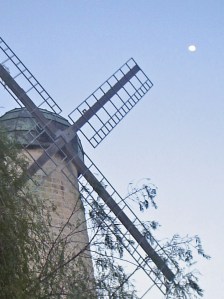 This was the moon I saw hovering over Jerusalem’s Yemin Moshe neighborhood. Okay, from my amateur photo, it was not as big as the supermoon, but it was special all the same.
I thought about all I saw and ate and felt when I was in Israel. I thought about the people who opened their homes and families to me who hardly knew me. I thought about waving the American flag in a Purim Parade and listening to the cheers from the people along the route. I thought about the traffic jam I got caught in. The reason for the traffic jam? Israelis were clogging the streets because they were delivering baskets of Purim food to their neighbors. That’s the kind of country Israel is – one big family.
Then, I caught a bit of CNN’s Piers Morgan’s interview with Israel’s Prime Minister Benjamin Netanyahu. During commercial breaks, the same old images were shown to the world of Israel: The Kotel, The Dome of the Rock.
Excuse me, Piers, but you were in Israel during PURIM!
Are these tired images all you really can show about Israel? Must Israel always be covered with conflict in the backdrop? If you got out on the streets of Tel Aviv or Modi’in or Jerusalem, if you could do one sidebar story, you would have wandered the streets and been treated to the following faces:

Halvah for sale for the Purim Feast

my friend's brother, decked out for Purim, celebrating with a feast at his home

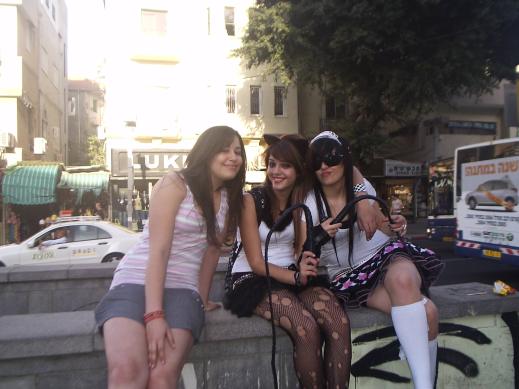
teen girls dressing up and having fun in Tel Aviv

mom and kids wait for bus outside of old city, Jerusalem
Will showing these images make Israelis seem just too normal, too human for media coverage? Would it portray Israel too much for what Israelis are, a people who love to live, who love to celebrate?
Until the media in America show photos like this of Israel, I’ll just have to share my own. And I’ll be taking more. Because we just booked our next trip for this December. Even though it is the first day of spring, I can’t believe I’m saying this, but I can’t wait until the winter.
Happy Year of the Rabbit

My brother and I at Ko Shing Rice Shoppe's Grand Opening, circa 1977
Growing up, all roads led to Chinatown.
My family went into “the city” a lot. That is what Manhattan is called, even if you lived in one of New York City’s outer boroughs, as we did. We could be uptown at the Museum of Natural History, at Madison Square Garden catching the Ringling Bros. & Barnum & Bailey Circus or the Ice Capades, or schmoozing on the Lower East Side. But when we got hungry, we ended our day in the city in Chinatown.
And most of the time, we ate at the same restaurant: The Ko Shing Rice Shoppe.
The Ko Shing Rice Shoppe was located right across the street from the brand-new Confucius Tower apartment buildings. Its dining room was sparsely decorated with wood panels and mirrored walls and plain tables and chairs. It was not a tourist spot so it did not have the usual Chinese kitsch of gongs, pagoda-sloped ceilings or dragon tapestries on the walls.
What it had was great food.
My grandfather knew the owner from many years before. He worked nights at the New York Daily News for over 50 years. His lunch break was around 3:00 a.m. Over the years, he became a regular at one of these all-night Chinese kitchens that operated out of a midtown basement. There, he met Lee. One day, or night, Lee said he was opening up his own restaurant in Chinatown and wanted my grandfather’s whole family to be there for the celebration.
That is where the above picture is from. I was about nine, so my brother was only five. We were the only non-Asian family there among the celebrants, and we were treated to plate after plate of chicken & cashews, crab, bowls of winter melon soup and other delicacies.
From that age on, until my 20’s that was the restaurant of my family’s choice, above Italian food, above Kosher Deli, it was Chinese food that was our exotic cuisine of preference. Chinese food is as inextricably linked to my identity as Matzah Ball soup and gifelte fish.
So, on day outings to the city, we would get there at an odd hour: 3:30 or 4 o clock. The restaurant would be all but empty except for our family: my parents and my brother, my grandparents, and friends who would meet us there, locally and from out-of-town.
In the back at a huge round table, the cook staff would be chopping mountains of Bok Choy and broccoli in advance of the evening rush. My grandfather would take us into the kitchen to say hi to Lee and the chefs. Then we would order, my grandfather would order for the whole family not bothering to even look at the menu. He would just ask Lee to make us a dish of this and a plate of that, always with extra ginger and garlic at my grandmother’s request.
If the waiters had time, they would patiently instruct my brother and I how to use chopsticks. We would have to eventually abandon our practice and resign to use our forks when my mom and grandmother said we were taking too long in our attempts to pick up every individual grain of rice.
After dinner, it was still early in the evening. No matter the weather, summer or winter, we would walk through the narrow streets of the heart of Chinatown. And before vegetarianism or veganism was hip, my grandmother was the first person to introduce me to tofu. After dinner, she would have to make a stop at the Tofu factory to bring some home.
The Ko Shing Rice Shoppe was a place where we held our family birthday parties. My mom’s 40th. My grandfather’s 65th. I even found myself there with my grandfather after the funeral of my paternal grandmother, with whom I did not have a relationship.
But on the ride home, seeing that I was a bit glum, my grandpa found our way somehow from the funeral home in Westchester to the Ko Shing Rice Shoppe. We talked over the events of the day over steaming cups of tea and a dish of beef lo mein.
I don’t know if the Ko Shing Rice Shoppe still exists. I went back to Chinatown on a recent visit but didn’t have the heart to walk the street where it was, in case it was boarded up or another restaurant had taken its place.
In young adulthood, visits to another Chinatown – this time in San Francisco – were a highlight of my newlywed life when my husband and I lived in Berkeley, Calif. We ate at San Francisco’s famous house of NanKing, where lines would snake around the corner during the Chinese New Year to sit in a crammed dining room and feast on sizzling plates of vegetables drenched in the most incredible hoisin sauce I have ever tasted. In the evening, we squeezed into the crowds for a view of the parade, complete with Chinese Dragon dances, drumming bands, and marshall arts demonstrations.
Now I live in a town without a Chinatown. But there are still some good family owned Chinese restaurants in Rochester, like Golden Dynasty and Chen’s. My diet has changed from consuming everything to only sticking to vegetarian items. But still, on Chinese New years, my children delight in the traditions of getting a dollar in an envelope and opening up fortunes.
Have a great New Year!
A Small Chanukkah Miracle at Checkout Aisle Number Eight


“Are you doing anything special this Hanukkah?”
I guess Steve the check-out cashier figured out I was Jewish. After all, from my grocery cart, I unloaded a bag of potatoes, onions, some Chanukkah napkins, blue and white M&Ms and a box of beeswax candles.
“Not much,” I replied. “Just going to my son’s band concert tonight, and then down to New York City for a family occasion.” I didn’t want to say it was for a Bat Mitzvah. That’s just too complicated if you don’t know what a Bat Mitzvah is.
“Ooooh, New York City! That’s where they seriously get into Chanukkah! I mean, the big menorah displays, and the food — the matzah ball soup! Even in the diners, they make French toast out of challah down in New York City,” he went on.
Now, you don’t have to be Jewish to love matzah ball soup or challah French toast. And, I am pretty sure, you can get challah French toast up here in Rochester.
But the sentimentality in his voice towards matzah ball soup, the way he so dreamily spoke of the menorahs as he scanned my clementines and sweet Mayan onions, I had to ask:
“Um, are you Jewish?”
Now, this is not a question I would ask a complete stranger. But around this time of year, when the enormity of Christmas seeps into every crevice of the American landscape, Jews have this desire to connect to one other, to stick together. Judaism as a topic of conversation is a subject that would be avoided by the most disenfranchised, unaffiliated Jew for most of the year. But talking about one’s Jewish identity in the face of Christmastime, is, like a plate of freshly fried potato latkes, on the table and up for grabs.
At any other time of year, a suburban housewife and a 20something college kid working in a grocery store wouldn’t openly discuss being Jewish. But that night, right before the lighting of the first Chanukkah candle, amidst the Christmas Muzak playing and the Christmas tree displays twinkling, it felt like the right time.
As he carefully bagged my groceries with the expertise only possessed by a Wegmans employee, Steven continued to tell me his plans for the Festival of Lights.
“Yeah, there’s this Chanukkah celebration thing going on at the University of Rochester tonight. From – you know – Hillel? I think I might check it out. I haven’t gone to many Hillel events, but I think I should check it out.”
“Good for you!” I replied. This did my heart good. I told him that I worked for the Hillel – the organization that supports Jewish life on college campuses around the world – a number of years back. With so many negative statistics out there pointing out the demise of Jewish practice among today’s young American Jews, Steven telling me of his plans to do something Jewish, to be with other Jews that night, just made me feel all warm inside.
Chanukkah is such a small holiday in importance on the Jewish calendar. But it celebrates something so big – the world’s first fight for religious freedom. It was the first time a people – though meek and small – said NO to an occupying power. Judah Maccabee and his brothers were the first who had the chutzpah — the balls, if you will — to say, NO! We will not stop being Jewish. We will not stop teaching our children how to be Jewish. You can put up statues of your idols, you can outlaw Jewish practice, you can threaten us, but we will survive.
And survive we did, and we have, in spite of history. And in spite of the dreary outlook for the American Jewish landscape, Steven, the college kid who worked at Wegmans, was going to go out of his way to celebrate Chanukkah, to celebrate being Jewish.
Happy Chanukkah to Steven and to all who celebrate freedom.
Feeling out of my League in the Company of Great Jewish Women
I’m going to start by saying this, bluntly: If I was making money — real money — it would be good for the Jews.
What I do now – educate the next generation of the Jewish community – is still good for the Jews. But, to be honest, it is still not as appreciated as a donation of the green stuff. I couldn’t help feel it this week when I attended a community fundraiser.
Now, I don’t play the lottery, I don’t gamble and I don’t believe in any get-rich-quick schemes. But, oh, if I were a rich girl, I would be so good at it. I would give a good part of it away.
But I’m not, and I can safely bet that with my liberal arts degree and my inability to get a career in public relations back on track after a decade raising our three children, I never will be.
I am happily, yet vastly, underemployed. I work three jobs: two in Jewish education, one in my originally intended field of journalism. And, waking up to the news this morning on National Public Radio, that companies are no longer hiring the long-term unemployed or underemployed, it looks like this will be my status for some time to come, if maybe for good.
I guess that, being a graduate of Rutgers University’s Douglas College, I was supposed to be a liberated, financially independent woman by now. I still feel I must make my own money.
My dear husband constantly reminds me that what I do – teaching the Aleph Bet and all the holidays and traditions to Jewish children – is an invaluable service to my community. He also reminds me that without me to raise our children full-time, his career could never have ascended to what it is now.
Even so, I can’t help but look at my own net worth. If not for my husband’s income, my three jobs wouldn’t even put me at the poverty line.
This post may seem controversial to some and may get me in a bit of trouble. And I do so appreciate the power of women’s philanthropy and the generosity of the many women in my community who are of means, who are generous and who can wear the pins to show it.
But, I am sure I can speak for my fellow Jewish educators, and especially Jewish early childhood educators, our contributions, if you had to value them in the form of a monetary gift to the Jewish community, are vastly overlooked.
According to the Jewish Early Childhood Early Education Initiative, today’s Jewish preschools are more than places that care for young children during the day – they are becoming centers to engage and re-engage children and their families in Jewish communal life. Attracting and retaining educators to the field is critical. But, it is highly unlikely to attract and retain the best and the brightest with the current compensation packages. Early care and education has not been acknowledged as a part of the larger educational system in the United States. As such, early childhood teachers and caregivers are among the lowest-paying of all occupations (Barnett 2003).
But, meanwhile, back at the fundraiser… there I was, in the company of almost 300 women at my community’s major fundraiser for Jewish Women’s Philanthropy. I have greatly benefitted from being actively involved in my Jewish community. I have co-chaired committees. learned about event planning and the power of women’s philanthropy.
In 2006 I received my community’s young leadership award from the Jewish Federation. I have attended the General Assembly of United Jewish Communities, thanks to my federation. And for my work teaching older children in afternoon religious school, I was sent on a Jewish educator’s trip to Israel thanks to the Jewish Federation. The Jewish community, on a macro level, does its best to make Jewish educators feel valued.
And yet, I felt I could barely keep up in the chit-chat at the table. I had not been to Amalfi Coast, had not sent my kids on a leadership program to Austrailia. I couldn’t seem to make myself say, “wow, that must be expensive,” or “that is out of our budget, I’m afraid.”
Okay, I get it. It was a fundraiser and the point was to raise funds. But, as I looked around the room, at the diamonds and all the bling-bling, I couldn’t help but ask myself, “What am I doing here?”
Many women attending the event, by way of their husband’s occupation or their own professions, were significant donors. If the message of the evening was being powerful through donating one’s own money or a woman making a gift in their own name, presumably with their own money, the message of the evening left me feeling, well, powerless.
I enjoy going to these events because you get to hear from powerful Jewish women – news commentators, columnists, brilliant comedians, prominent Rebbetzins, (rabbi’s wives.) In past years they taught me how we need to teach Israeli culture to our children to make them feel connected to Israel. That if you shed a tear while you are praying you are doing it the right way. That, although children may show resistance to Hebrew school, parents must stand firm and make sure their child receives a Jewish education.
Each year, I left inspired, given tools to further my Jewish involvement.
And this year? There was no mention of parenting Jewish kids. Israel — not even the singing of the Hatikva — was hardly mentioned – except a five day trip to the Jewish State this spring at a cost that is most likely out of my league as well.
The take away I got, and which I think other women felt of the speaker’s underlying message – is that if one marries a rich investment banker — you too can give millions away to the causes you care about.
As a Jewish educator who is not married to an investment banker, I’m sorry, ma’am, there was not much I could take away from your lesson. So, I will keep doing what I have been doing, for now, which is to make big gifts through every Hebrew word I teach, and every Jewish song I sing in the classroom.
For whatever it’s worth.
Sorry Yemen, your mail bombs didn’t stop the Global Day of Jewish Learning

Chef Tal Renan cooks up vegetarian food - just like he made for Oprah
The foiled Yemen plot to bomb synagogues in Chicago occurred so closely to two occasions on the Jewish calendar – one historic and one contemporary – you have to wonder if the timing was planned or if it was an eerie coincidence. Had some terrorist in Yemen checked a calendar to see if something important was coming up on the calendar within the global Jewish community?What if the terrorists from Yemen did intentionally plan the bombing of Jewish institutions one week before the Global Day of Jewish Learning, which was planned in 350 communities around the world? What if it had succeeded, as terror plots did against Jewish institutions in Mumbai, Buenos Aires, and Casablanca?In the spirit of this learning event that celebrated asking Big Questions, I’ll add mine: If the Yemen bombing had succeeded, would Jewish learning and teaching on November 7th still had happened?Thankfully, this time, we will never know. This past weekend, synagogues and Jewish community centers all over the world were brimming with people listening, speaking, dancing, drumming, and of course eating, in a Jewish way. The Global Day of Jewish learning was held in honor of an esteemed Jerusalem Rabbi, who on this day will finish five decades of work interpreting the Talmud, a sacred book of Jewish commentary, making it accessible and more understandable to today’s Jews. So no, in honor of this milestone that took a half-century to reach, we weren’t staying home on account of a package. We were ready to learn and tackle questions, in my community and others, like
-
What is Jewish Mysticism?
-
Why do Jewish holidays happen late or early, but never on time?
-
How can God be both loving and mysterious?
And, in my household….
-
When will the newest version of Shalom Sesame Come out?
In my community, we came out to listen to keynote speaker Rabbi Lawrence Kushner, author many books, including I’m God and You’re Not, wich was released this Fall We learned about Jewish vegetarian cooking from Chef Tal Ronen, who has cooked for Oprah Winfrey and the Dali Lama. Our kids learned Krav Maga, the Israeli martial arts, and explored Psalm 150 through drumming with percussionist Mike Mason.A separate track was offered for area Jewish educators, where we learned to fascinate our students with the art of storytelling, how to weave the narrative of Israel into any lesson, and how to excite and engage Jewish kids who, let’s be honest, may not be thrilled about coming to Hebrew School in the first place.The second occurrence on the Jewish calendar so close to these planned bombs from Yemen will be commemorated tomorrow. On November 9, 1938, the Nazis unfurled Kristalnacht, their own terror campaign, on the Jews of Germany. On the Night of Broken Glass, 1,350 Jewish synagogues were burnt to the ground or destroyed; over 91 Jews were killed; 30,000 Jews were thrown into concentration camps; 7,000 Jewish businesses were destroyed; and thousands of Jewish homes were ransacked. It was the beginning of the end of European Jewry in the 20th Century.It may seem like a date that is far in the past, but in light of the foiled attacks from Yemen, it brings it all too close to home.One thing that did keep the 600,000 Jews of Los Angeles away from their day of Jewish Learning was poor planning. Unfortunately, the LA Day of Jewish Learning was cancelled because of low enrollment. Why? A long-held community day of good deeds (mitzvot) was planned for the same day and the community just couldn’t compete with itself.Someone wasn’t checking their calendars.
What’s a Nice Jewish Girl to do about Halloween?
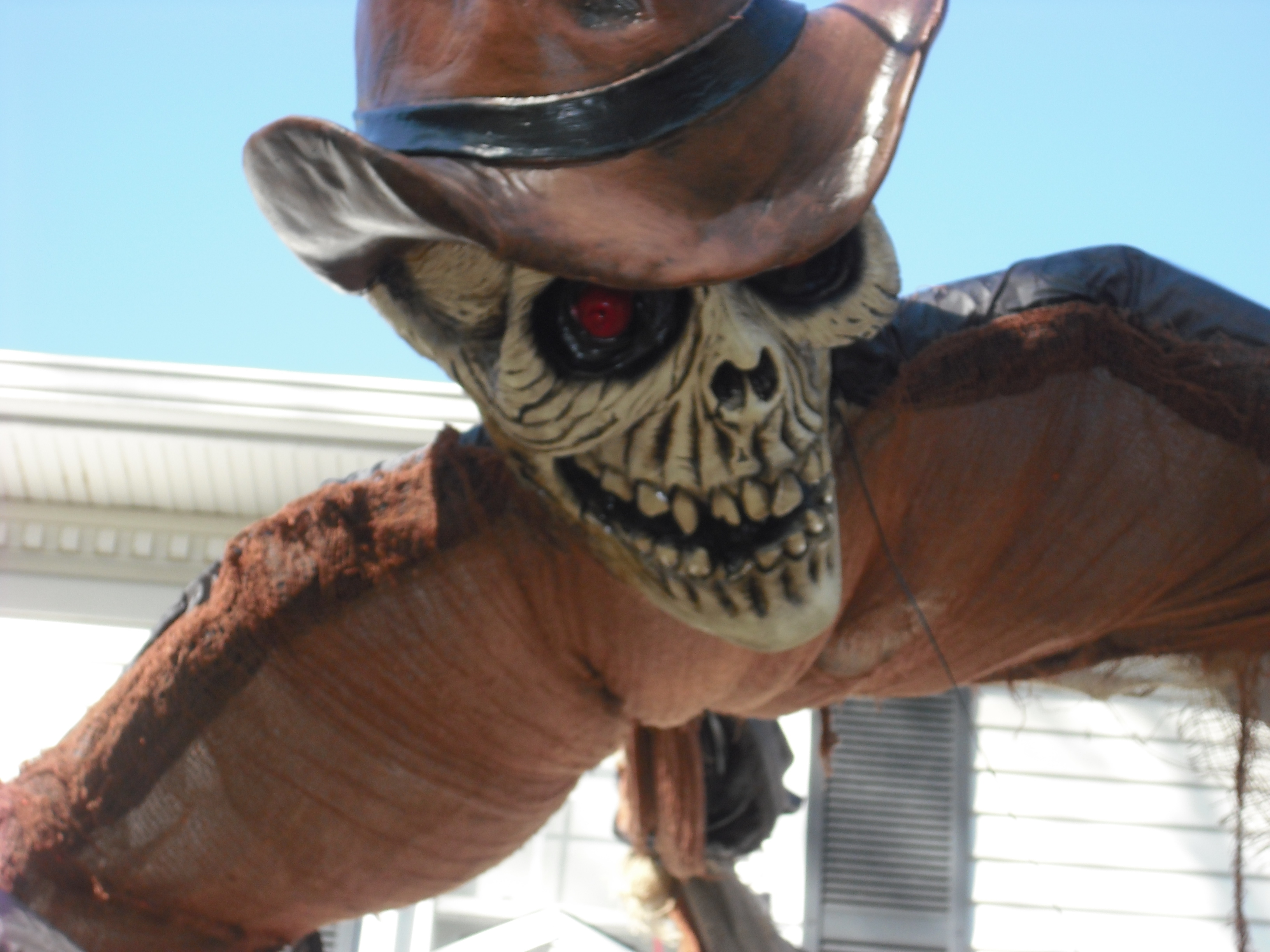
Some of my neighbors really get into decorating for Halloween
My birthday falls in late October. I will not disclose my age, and those of you who know me know what that number is. Unless a birthday is one that ends in a 0 or a 5, birthdays at this stage of life are no big deal.
But think back to when you were a kid. Those were the days when one counted down the days to their birthday party. And if you were lucky enough to be born on the cusp of the Scorpio sign, birthday parties were all about Halloween. Late October babies have a built-in costumed, candy-corn flavored theme that is perfectly gift wrapped with a giant fake spiderweb and grooves to the music of a Monster Mash soundtrack.
Each year, even up through high school, I celebrated my birthday with a costume party. On my seventh or eighth birthday, my grandmother transformed herself into a gypsy storyteller to the delight of all my costumed friends. My parents and grandparents even staged special effects, complete with a charmed stuffed snake to rise out of a wicker basket with the help of an invisible fishing wire.
All through childhood, my mother and grandmother were the master costume makers. My mom said that when she was growing up in her Bensonhurst, Brooklyn apartment, my grandmother would dress up as a witch and concoct costumes for every kid in the building.
And when it was my turn to dress up, mom and grandma could make me into anything I wanted because they both knew their way around a sewing machine. Pity my own children this time of year. I cook, I bake, I garden, I teach, I read Torah, but I cannot even decently hem a pair of pants.
I wanted to be a sunflower one year: mom made me a sunflower. And then scarecrow, and Indian Princess, and even a hairdryer. And my final Halloween birthday party, I made a really convincing Boy George.
Halloween birthday parties, trick-or-treating and getting candy went on happily and innocently until the seventh grade. That year, Halloween fell out on a Tuesday which was afternoon Hebrew School.
Hebrew School started at 4:30 and let out around 6 p.m. Through Chumash (bible) lessons, you could feel the tension in the class start to bubble like a witch’s cauldron: we were missing out on prime trick-or-treating time! We realized that by the time we got home, scarfed down some dinner and put on our costumes, maybe we could collect half a pillowcase worth of candy if we were lucky. But we had a plan.
“Rabbi,” one of our classmates sweetly inquired, “Can we get out of Hebrew School early today so we can go trick-or-treating?”
“Yeladim!” He shouted, saying the Hebrew word for children. “Jewish children should not celebrate Halloween. It is NOT a Jewish Holiday! If you want to dress up and have fun, we can do that later in the year, on Purim.”
In unison, the entire class gasped in disbelief. Up till this point, we were all completely unaware that Halloween could have other meanings besides dressing up, running around the neighborhood and getting candy. And, in the streets of Staten Island, we didn’t exactly live in a part of the world where Purim, a costume-filled Jewish holiday in the spring, was universally celebrated.
We were not deterred that night, or any year after, from our right as American kids to trick-or-treat. Okay, Halloween is not a Jewish holiday. In fact, I knew even back then that Halloween must have some Christian implications, because all the parochial school kids I knew in my neighborhood had off Nov. 1 for All Saint’s Day.
Halloween must be okay because my grandmother, the most Jewish lady I knew, still loved Halloween. One year, my grandparents went to Greenwich Village to see the famous Halloween parade. My grandmother had a blast and made friends with everyone, including “all the nice young men dressed up in the most elaborate costumes” who offered her a chair along the parade route.
My Yiddishe grandma, the one who made gifilte fish from scratch and sang me Jewish songs, found delight in hanging out in the Village with the drag queens on Halloween!
I always wanted to go into the Village for Halloween, but it wasn’t until my grandparents raved about it did I got the nerve to go to one of the best places in the country to celebrate on Oct. 31.
I spent two Halloweens in the Village in my 20’s, although I didn’t wear a costume. Then, out in San Francisco’s Castro district, I dressed as Mona Lisa in a frame and my beloved dressed as the Mad Hatter. People sang “Mona Lisa” to me. A few people even got the Elton John reference and sang a few bars of that song with us. The streets got crowded, and my frame did get entangled with other costumes, but it was all in good fun.
Those were some of the most memorable nights of my life. More than the candy, as young adult I saw Halloween as a time when people can express themselves and become someone else for just one night. Halloween costumes break down barriers between strangers. But beneath the costumes and candy, the darker messages that lurk below are just plain not Jewish.
I still love Halloween and my heart is tied to the Halloween memories of my childhood. But Halloween has shifted lower on my priority list.
After a month of putting energies into the Jewish fall holidays I mentioned in a recent blog post, I have little desire to turn my front lawn into a graveyard or put together a costume with a hot glue gun.
But we still carve our pumpkin. And I still let my kids go trick-or-treating. But they well understand and love that come spring, we will be busy making hamantashen cookies and baskets of food for friends and neighbors for the Jewish holiday of Purim. In that way, they learn that Purim, when you walk around the neighborhood giving treats, is in essence the exact opposite of Halloween’s tradition of going around the neighborhood begging for treats.
Am I sending my Jewish children mixed messages? Maybe. Will I someday, because of Jewish observance, let go of Halloween go altogether? Perhaps.
But in the meantime, it’s still fun to walk the neighborhood’s darkened streets, check out the glow in the dark decorations, and maybe get a little scared.
A Blessing and a Curse: Israeli advocacy though Social Networking
How do you connect to a country that is oceans and languages away? In the 21st Century, where can you go to have conversations with or show positive visual images of a country that has been dear to the Jewish soul for more than 2,000 years but the mainstream media continues to portray it as a human rights violator?
The best way to connect with Israel and meet Israelis is to make a visit. Or maybe two. Or live there for a while. Or, maybe move there. But, in the meantime, there is the blessing and the curse of connecting with Israelis and standing up for Israel through social networking.
There are about 13.5 million Jews in the world, give or take depending on who you ask. About half live in the United States, and 6.5 million live in Israel. Both these countries embrace democracy, diversity, religious freedom. In spite of these similarities, time, distance, and language barriers keep the world’s largest Jewish populations from feeling truly connected. Most Jewish Americans know little about modern Israeli life, history or politics. And Israeli counterparts, only know of America from what they see in their media.
Last summer, the Maurice and Marilyn Cohen Center for Jewish Studies at Brandeis University published a study called “Still Connected: American Jewish Attitudes About Israel,” The study, conducted in response to media coverage of the Gaza flotilla incident, found that participants aged 45 and under had less of a connected feeling to Israel.
If the Jewish people want to see continuity into future generations and a strong connection to Israel, it’s time that Jews in Israel and Jews in America start talking to each other and the best way is social networking.
In the 1980’s connecting with Israel seemed like a no-brainer. Many Jewish families during this time took a trip to Israel the year a child became a Bar or Bat Mitzvah. You toured the country with your family and had a ceremony either at the Western Wall or at the top of Masada. These were moments in Jewish family life that forged strong Jewish identities. If you couldn’t make it the year of your Bar or Bat Mitzvah, perhaps a trip during high school was in your plans, or a semester or year abroad in Israel.
Then came the intifadas of 1989 and 2000. Along with the death and the terror came the fear and doubt among American Jews how they felt connected to Israel based on what they saw on the news. Reports of terrorist attacks within Israel in 2000 saw tourism to the Jewish state plummet.
I taught Hebrew school to sixth graders that year who told me you had to be “crazy” to want to visit Israel. I asked parents during a family education program if they had anything to share with the students on how they felt about Israel or if they had memories of trips to Israel and I was met with blank stares.
So how to you teach Israel to children who may see Israel as nothing more than a tiny spec on the worldwide map? Again, the answer is through social networking.
I have been a Hebrew School teacher for almost 10 years and have used sites like Facebook, Twitter and YouTube to teach kids young and old about the daily ongoings of Israeli citizens. I have shown my littlest students on YouTube how families in Israel celebrate Tu B’shvat, the New Year of the Trees by singing the same songs we sang in our classroom. For my older students, I downloaded a video on the many faces and places of Israel set to pop song “New Soul” by Israeli singer Yael Naim.
The Internet provides a podium – to stand up for Israel but also provides an equal podium for those to wish to delegitimize the Jewish state. The flotilla that attempted to breach Israel’s blockade around the Gaza Strip launched hundreds of anti and pro Israel Facebook groups, including one I joined, called The Truth about Israel’s Defensive Actions Against the Flotilla The group aims to be online ambassadors to Israel, where supporters of Israel around the world, Jewish or not, can start discussions or point out the way Israel is being covered in the media.
In recent years, I had the opportunity to develop partnerships with Israeli teachers by both visiting and living with Israelis and hosting Israeli visitors to America.
I documented my trip in this video set to the background music of popular Israeli musicians such as The Idan Raichel Project and Shlomo Artzi, who also have Facebook pages. I wanted to show my students and members of my local Jewish community the beauty of Israel and everyday life in this tiny, diverse country. Take a look below:
“
Another time I empowered social networking to support Israel was during Operation Cast Lead, or Israel’s war on Gaza. During this time, many hateful comments were posted to the photos I posted from Israel on Facebook’s pro-Israel groups. I used discussion boards to request that a typical Israeli write back to me to explain to my 7th grade students what it was like to be in Israel during this time. I got a response from a young man living in Ashdod, not far from the Gaza strip. He was discharged from serving in the IDF from an ankle injury and was happy to help out my cause. In perfect English, he composed a letter to my seventh graders what it was like for he and his family to live under a daily barrage of missiles from Gaza. The email put a personal touch to the headlines that winter and sparked my students desire to make cards for Israeli soldiers.
These are just a few of the many ways ordinary people can stand up for Israel. What can you do?
The Stinger and the Honey, and the Bitter and the Sweet
 Preschool teachers have the honor of experiencing many sweet firsts in a very young child’s life. For some of them, it is the first time they are being cared for by someone other than a parent or a relative, and we are honored to earn their trust and love. As a preschool teacher, you may also witness the first time a child stands at an easel, brandishing one, sometimes two paintbrushes, to combine blue and yellow to make a green, refrigerator-worthy masterpiece.
And even still, you can be with a child the first time they go potty in a place that isn’t in their own home.
Unfortunately, there are a few bitter firsts that come up from time to time. Today, a little boy in was stung in the classroom while he was building blocks with his friends. The bee entered the classroom most likely through our open window on this warm October day. I am sure that bee did not want to be in the classroom, just as much as the children (and teachers) wanted it out of the classroom.
But our little student indeed got stung. At first he bawled and held up his finger, so we quickly checked for a stinger (no stinger), checked for visible signs of an allergic reaction (because you never know if a child is allergic to bee stings until they are stung), and ran his finger under a stream of cold water. A few minutes went by before we realized that he had been stung a second time, this time with the stinger in tact, on the back of his neck.
He cried for his mom as we removed the stinger, iced his neck, and tried to soothe him. At the same time, we had to keep seven other kids happy and calm, so we called in another teacher for reinforcement.
Then a very unexpectedly sweet thing happened. I must interrupt my story to tell you that we were pretty late in setting up for snack before the whole sting operation went down. It had been raining all week and this was the first day we had a chance to play outside. By the time we returned to the classroom after an extended time playing outdoors, snacktime was overdue.
Have you been around three and four-year-old children waiting for a snack?
But these little people did not complain their snack was late. One by one, they went over to their stung friend, who was now sucking his thumb sitting on my co-teacher’s lap, and gave him a hug to feel better. The boy calmed down, and was completely recovered within the next ten minutes thanks to the healing magic of crackers and juice.
Do you recall the first time you were stung by a bee? I hope that it was not too unpleasant a memory and it didn’t give you hives or require an epipen shot or a trip to the emergency room.
Over snack, I told my friend the very first time I was stung:
I was about seven and a wasp and I collided as I ran from my back yard to my front stoop. Right on my neck, just like my little friend.
I remember me screaming and my grandfather picking me up and carrying me to the backyard, where my mother quickly applied some ice – and a pumice made of salt and meat tenderizer.
After the surprise and the shock, I was actually pretty insulted that a bee – a creature of the natural world that I loved – would sting me. Didn’t the bee love me back, I asked my parents and grandparents through the tears?
The impression the boy took away from this story, as told by his mom was that Morah Stacy (that’s me — Morah is teacher in Hebrew) doesn’t like bees.
My little friend, that’s just not true at all.
It took me a while – deacades perhaps — to get over my fear and develop an appreciation and love of bees. I’m not saying I will become a beekeeper, like many people are doing these days to thwart off the devastation of bee colony collapse. It’s just that since I have become an avid gardener, I am content to work right beside those bees happily buzzing and collecting nectar and pollen for their hives.
And I’ve come to appreciate how much we rely on these creatures for our food and think how scary it is that in recent years, the US bee populations have decreased by almost 40 percent. And as much as my little students are afraid of bees, it’s scarier to think about what will happen to their world and future without them.
There is a famous Israeli folk song that in English goes: like the bee that brings the honey, needs a stinger to compete, so our children learn to use the bitter with the sweet.
Next time you go to swat a bee, please think twice.
How a Sukkah is like a Christmas tree
 Okay, so the headline of this post might shock and offend some, but please let me explain my bold statement.
Growing up in a predominantly Italian neighborhood in Staten Island, as the Chanukkah song from Adam Sandler song goes, I was the only kid on the block without a Christmas tree. Our neighbors invited my family over for cake and tree decorating and we in turn invited them on Chanukkah to light our menorah, spin a dreidel and eat fried potato latkes.
Even back then I understood that Christmas was a big holiday, and Chanukkah was a minor Jewish one. But Christmas trees still left me with a feeling of being on the outside, my nose pressed to the frosted window.
A menorah, no matter how big, even the ones that the Chabad Lubavich movement lights, just can’t compete with the smell of fresh pine, the twinkling lights and the tinsel to a Jewish kid on Staten Island. I even had my secret Christmas tree fantasies. If I ever had a Christmas tree, it would be simple: just candy canes and white lights would hang off the branches of the Christmas tree of my dreams. And it would only be in my dreams, because I knew very well that there is no such thing as a Chanukkah bush.
I did have childhood associations with Sukkot, the eight-day autumn festival of Booths, because of Hebrew school. I made the standard paper sukkah chains and ate within the large sukkah of my synagogue. In fact, the first time I was ever asked on a date was in a sukkah. It was in the seventh grade and a classmate asked me to go roller skating at Skate Odyesy as our teacher, on Orthodox rabbi, continually shushed us as he attempted to recite kiddush, the blessing over the grape juice.
But because my family didn’t build a sukkah of our own, the holiday still felt remote to me. I didn’t have a sukkah to eat my bowl of breakfast cereal in, or sleep in.
Now, in adulthood, my family enjoys putting up a sukkah every autmn, and we have done so for eleven years. And because we have a family sukkah, I can now say why this celebration, one of the major holidays on the Jewish calendar, blows that overblown attention we give to that other holiday in December right out of the water. Why? Because a sukkah fulfills the Jewish Americans’ need to decorate a large, religious object with branches and lights and have social gatherings within or around it.
Sukkot is known in Hebrew as one of the “three legs” of Jewish holidays, one of the three times of the year when the ancient Israelites were commanded to make a pilgrimage by foot to Jerusalem. Imagine Israelites building one of these temporary huts and sleeping in their fields under a harvest moon.
This same harvest moon shines through the roof of our family sukkah on the first few nights as we feast and sing. After a month of self scrutiny, asking for forgiveness, and finally, fasting on Yom Kippur, sitting within the walls of a sukkah is like getting a hug from God and feeling His forgiveness, as one Chabad rabbi in my college years so eloquently explained it.
In my neighborhood, Sukkot is all around us. As we are finishing up our meal of brisket and sweet potatoes, our neighbor, an Orthodox rabbi, is starting his meal with his family within their sukkah. We can hear his voice as he joyfully sings the kiddush as we clear off our table. This is followed by the clanking of plates and the laughter of his grandchildren as they dine. This coming outside to eat, either in these formal meals or sukkah hopping later in the week may be the last chance we get before the long Rochester winter, makes our neighborhood just feel more neighborly.
How is a sukkah not like a Christmas tree? For one thing, Jews are commanded by God in Torah to build one to remind us of the booths that the Israelites lived in during their wandering in the desert after we were freed from Egypt. Plain and simple, it’s a mitzvah just to sit in a sukkah. I still don’t understand if there is a religious connection between a tree and the birth of Jesus, but I’d be happy to learn how this tradition got started.
So, now that it is December, I still admire Christmas trees, but with a knowledge and experience that the Jewish people have our time of year for our big celebrations with something to decorate and gather in. Come this Christmas, don’t feel bad for the Jewish people who have no Christmas tree. Instead, feel bad for the Jewish people who have not yet built, or ate, or slept, or dwelt in a Sukkah, back in September.
Season of Repentance, or…. Happy 5771
I was first aware it was the Hebrew month of Elul as we drove through Atlantic City on our way out to dinner. I was with my husband, his sisters and their husbands for a grown-up night out to dinner while my in-laws watched 10 of their grandchildren back at the beach house. The moon was rising over the intercostal waters between the mainland and the barrier islands of the New Jersey shore. It was full and red and a signal that it was just a little over two weeks before the new Jewish Year.
In Hebrew calendar cycle, the moon is always full on the 15th of the month, so I knew from that red moon rising over casinos and billboards promising everyone a good time, that we were at the halfway point of the month of introspection and spiritual preparation. A strange place I know to start getting all introspective and spiritual, but a wave of regret passed over me because I had yet to think about the new year. I had yet to hear the sound of the ram’s horn, or the shofar, that is supposed to wake up Jews out of their sleepy summertime complacency and think about repentance and self-improvement.
In contrast with January 1, I consider this New Year truly the new year, even though to most of the world, the calendar will still read the same year for a few more months. But think of the physical changes that are take place right now: the summer is over, the days grow shorter, a new school year begins. The heat is leaving the air. In fact, on our way to Slichot services this evening, I wished I had worn a heavier sweater. Funny thing is, just yesterday, it was so hot I wished I had a nearby pool to jump into.
These changes seem far more apparent than the new year in January. In Rochester, it will be just as ice-cold on December 31 as it will be on January 1.
Slicha – Excuse me. Slichot – pardon us, are some of the translations from the Hebrew.
In Judaism, Slichot – this little known and sparsely attended service — occurs on the Saturday night immediately preceding Rosh Hashanah. It serves as a warm-up to the big show that are the services of Rosh Hashanah. Slichot includes a sampling of prayers that we will recite just days away, including the confession of our transgressions.
Now, in Judaism, there is no direct translation for the word sin. The Hebrew word chet means to “miss the mark.” It assumes that we tried to to the right thing, but for whatever reason, we went astray and failed. The season of repentance is our chance to get us back on the right path.
At services, my rabbi suggested to his congregants to make a list of all the places we missed the mark this year. And, like the liturgy of the High Holidays, I know he doesn’t mean “I’m sorry I ate a bacon double cheeseburger” or “I’m sorry I went to the movies on Friday night instead of having Shabbat dinner.”
No, the list of transgressions we need to make for ourselves in the season of repentence is much more personal, much more interpersonal.
So here goes my list:
- I’ve yelled. I’ve yelled at my kids for not cleaning up after themselves.
- I’ve yelled at my husband. Even worse, I’ve spoken to my husband in harsh tones and unkind words
- I’ve drawn too many quick conclusions of others. I’ve assumed the worst in people instead of giving them the benefit of the doubt.
- I’ve ignored or lost touch with friends, neighbors and family who may have needed my help.
- I’ve talked too much when I should have been listening. I’ve made too much talk about me when I should have asked more about you.
- I’ve held grudges
- I’ve shown indifference
- I’ve let my emotions get the better of me
For all these things, I will ask not of God to forgive me, but I will have to ask forgiveness of the people I may have hurt. For all these things, please this year make me a better mother, a better friend, a better wife, daughter. And a better teacher.
To all those who observe, a sweet, healthy new year!
About Me

Kreativ Blogger

Versatile Blogger Award


 Stacy Gittleman