
Feeling out of my League in the Company of Great Jewish Women
I’m going to start by saying this, bluntly: If I was making money — real money — it would be good for the Jews.
What I do now – educate the next generation of the Jewish community – is still good for the Jews. But, to be honest, it is still not as appreciated as a donation of the green stuff. I couldn’t help feel it this week when I attended a community fundraiser.
Now, I don’t play the lottery, I don’t gamble and I don’t believe in any get-rich-quick schemes. But, oh, if I were a rich girl, I would be so good at it. I would give a good part of it away.
But I’m not, and I can safely bet that with my liberal arts degree and my inability to get a career in public relations back on track after a decade raising our three children, I never will be.
I am happily, yet vastly, underemployed. I work three jobs: two in Jewish education, one in my originally intended field of journalism. And, waking up to the news this morning on National Public Radio, that companies are no longer hiring the long-term unemployed or underemployed, it looks like this will be my status for some time to come, if maybe for good.
I guess that, being a graduate of Rutgers University’s Douglas College, I was supposed to be a liberated, financially independent woman by now. I still feel I must make my own money.
My dear husband constantly reminds me that what I do – teaching the Aleph Bet and all the holidays and traditions to Jewish children – is an invaluable service to my community. He also reminds me that without me to raise our children full-time, his career could never have ascended to what it is now.
Even so, I can’t help but look at my own net worth. If not for my husband’s income, my three jobs wouldn’t even put me at the poverty line.
This post may seem controversial to some and may get me in a bit of trouble. And I do so appreciate the power of women’s philanthropy and the generosity of the many women in my community who are of means, who are generous and who can wear the pins to show it.
But, I am sure I can speak for my fellow Jewish educators, and especially Jewish early childhood educators, our contributions, if you had to value them in the form of a monetary gift to the Jewish community, are vastly overlooked.
According to the Jewish Early Childhood Early Education Initiative, today’s Jewish preschools are more than places that care for young children during the day – they are becoming centers to engage and re-engage children and their families in Jewish communal life. Attracting and retaining educators to the field is critical. But, it is highly unlikely to attract and retain the best and the brightest with the current compensation packages. Early care and education has not been acknowledged as a part of the larger educational system in the United States. As such, early childhood teachers and caregivers are among the lowest-paying of all occupations (Barnett 2003).
But, meanwhile, back at the fundraiser… there I was, in the company of almost 300 women at my community’s major fundraiser for Jewish Women’s Philanthropy. I have greatly benefitted from being actively involved in my Jewish community. I have co-chaired committees. learned about event planning and the power of women’s philanthropy.
In 2006 I received my community’s young leadership award from the Jewish Federation. I have attended the General Assembly of United Jewish Communities, thanks to my federation. And for my work teaching older children in afternoon religious school, I was sent on a Jewish educator’s trip to Israel thanks to the Jewish Federation. The Jewish community, on a macro level, does its best to make Jewish educators feel valued.
And yet, I felt I could barely keep up in the chit-chat at the table. I had not been to Amalfi Coast, had not sent my kids on a leadership program to Austrailia. I couldn’t seem to make myself say, “wow, that must be expensive,” or “that is out of our budget, I’m afraid.”
Okay, I get it. It was a fundraiser and the point was to raise funds. But, as I looked around the room, at the diamonds and all the bling-bling, I couldn’t help but ask myself, “What am I doing here?”
Many women attending the event, by way of their husband’s occupation or their own professions, were significant donors. If the message of the evening was being powerful through donating one’s own money or a woman making a gift in their own name, presumably with their own money, the message of the evening left me feeling, well, powerless.
I enjoy going to these events because you get to hear from powerful Jewish women – news commentators, columnists, brilliant comedians, prominent Rebbetzins, (rabbi’s wives.) In past years they taught me how we need to teach Israeli culture to our children to make them feel connected to Israel. That if you shed a tear while you are praying you are doing it the right way. That, although children may show resistance to Hebrew school, parents must stand firm and make sure their child receives a Jewish education.
Each year, I left inspired, given tools to further my Jewish involvement.
And this year? There was no mention of parenting Jewish kids. Israel — not even the singing of the Hatikva — was hardly mentioned – except a five day trip to the Jewish State this spring at a cost that is most likely out of my league as well.
The take away I got, and which I think other women felt of the speaker’s underlying message – is that if one marries a rich investment banker — you too can give millions away to the causes you care about.
As a Jewish educator who is not married to an investment banker, I’m sorry, ma’am, there was not much I could take away from your lesson. So, I will keep doing what I have been doing, for now, which is to make big gifts through every Hebrew word I teach, and every Jewish song I sing in the classroom.
For whatever it’s worth.
Fall Leaves: Rake Many, Turn a Few into a Turkey
By now, in Western New York, the fall foliage has long reached its peak of yellows and reds.


Now, when I look up at the massive sugar maples in my neighborhood (the ones that are covered with snow in my homepage picture), sadly the branches are mostly bare. The only color they will be covered with over the next four months or so, is white.
Wherever you are living now, I bet you are thinking: how to get rid of all the leaves? Rake them? Mulch them? Sick the leaf blower on them?
But before you rake, blow, or mow every last leaf away and before the snows fall, admire the carpets of red and yellow that lie at your feet.

Then, save a few of nature’s castoffs for craft supplies that can last the whole winter through. Here’s how:
- First, find a preschooler to help you with this task. They are low to the ground and can teach you how to appreciate the simple, beautiful perfection that is found in one leaf that is the color of fire.
- Then, show that preschooler a telephone book. Theirs will probably the last generation that will actually come in contact with one of these volumes of bound, thin yellow paper volumes. None of them I bet ever had a parent use them as a makeshift booster seat or a stepstool. Show them that these yellow or white clunky books were once used by people to look up numbers for plumbers or dog groomers but now come in handy for pressing leaves.
- Next take a few of your leafy treasures and pat them dry with a paper towel, and place them between the pages of the book.
- While the leaves are drying and pressing, read to them a wonderful book like Leaf Man, by Lois Ehlert to get inspiration as to what to do with all those pressed leaves.
Our preschool class used leaves to represent the feathers of turkeys in our thanksgiving cards, like this:
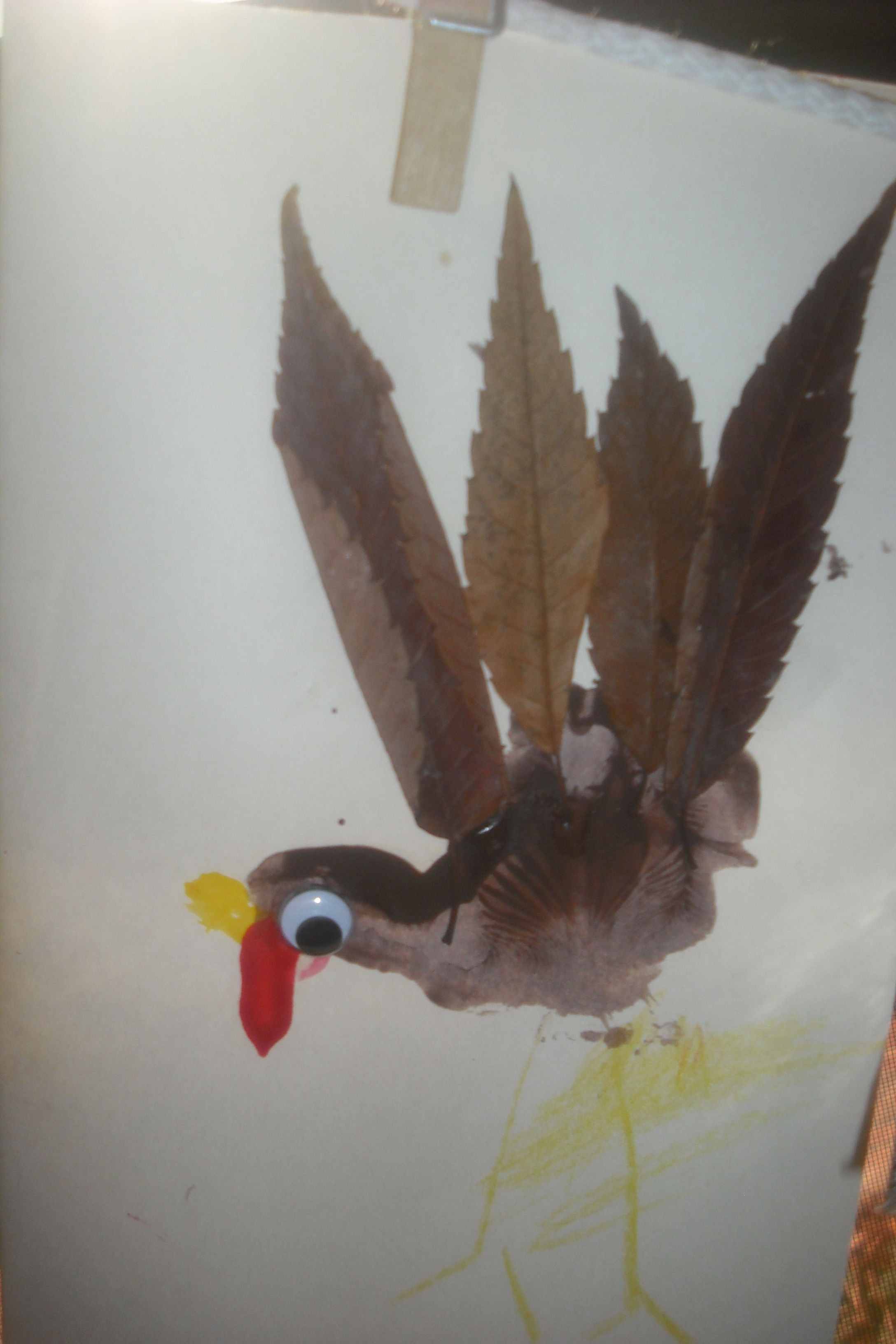
Fall leaves are abundant - and free - and make for great crafts like this turkey
Send me your comments and pictures about what you made with your leaves.
No, I didn’t Finish Reading Harry Potter. Now, I Must Hide in a Cave.

Am I the last on Earth to know the fate of Harry Potter?
As I write this, I realize that with the release of the first film from Harry Potter and the Deathly Hallows coming out on Nov. 19, I am in danger now of finding out the final fate of Harry Potter. Until now, I have sheltered the ending from myself, the final fate of Harry and He Who Must Not Be Named. Even if I had to enter my childen’s bedrooms as they listened to the book of the same title on CD and had to sing “Lalalalalala” to myself while I put their clean, folded laundry into their drawers.
No, I am in danger still. Because I know this blog post will be read by millions who will be clicking away at their keyboards to comment and tell me the end.
Okay, it might be read by three-dozen people who might bother to read it and then still take more of their precious time to comment and tell me. But really, please don’t. Give a mom a break!
I remember when we first started reading and/or listening to the Harry Potter Series as a family on paper and audio book format. My patient husband read our daughter Harry Potter and the Sourcerer’s Stone and then Harry Potter and the Chamber of Secrets , one chapter a night, when she was only in the first and second grades. I don’t know how we had all this time, because now I barely have time to read my third child a Dr. Seuss book.
By the time she was eight or nine, she was reading the third and fourth books on her own. She would shlep the hard-covered editions of The Prisoner of Azkaban to whatever errand we were running. I think the novel weighed more than she did. At the supermarket, I would shop and she would sit in the bottom of the cart, immersed in reading about Harry’s third year of wizarding school through the produce and cereal aisles.
I did my own reading and listening of the series. But, halfway through the Order of the Phoenix, and halfway through my third pregnancy, I just stopped. My interest went elsewhere while the rest of my family, excluding the baby of the family, gobbled up the rest of the series like it was a box of Chocolate Frogs and washed it down with Butter Beer.
My kids can’t believe I haven’t finished yet. And I tell them I will finish the series before I leave this earth.
There are a few things that I can do so I can finish the series and not have Hollywood ruin the ending for me:
- I can hire a House Elf to prepare the meals, wash the clothes and scrub the bathrooms
- I can purchase a wand from Olivander’s Wand Shop and wave it over the dinner table instead of shopping, chopping and cooking to get ready for meals.
- I can quit all three of my jobs that I work at to help pay for their Hogwarts-like overnight summer camp to free up my time.
- I can stop reading the other amazing pieces of literature I have tackled in my post, unfinished Harry Potter era. Books that took me to places and times the Hogwarts Express does not reach. Books like The Little Stranger, The Help, The Man in the White Shark Skin Suit, Snow Flower and the Secret Fan, and other wonderful adult novels I have finished. Not to mention The Kite Runner and A Thousand Splendid Suns by Khaled Hosseini.
So Harry, Hermione, the Weasleys, and Headless Nick, I will not cave to popular culture. You’ll just have to wait for me to finish. And when I’m good and ready.
Sorry Yemen, your mail bombs didn’t stop the Global Day of Jewish Learning

Chef Tal Renan cooks up vegetarian food - just like he made for Oprah
The foiled Yemen plot to bomb synagogues in Chicago occurred so closely to two occasions on the Jewish calendar – one historic and one contemporary – you have to wonder if the timing was planned or if it was an eerie coincidence. Had some terrorist in Yemen checked a calendar to see if something important was coming up on the calendar within the global Jewish community?What if the terrorists from Yemen did intentionally plan the bombing of Jewish institutions one week before the Global Day of Jewish Learning, which was planned in 350 communities around the world? What if it had succeeded, as terror plots did against Jewish institutions in Mumbai, Buenos Aires, and Casablanca?In the spirit of this learning event that celebrated asking Big Questions, I’ll add mine: If the Yemen bombing had succeeded, would Jewish learning and teaching on November 7th still had happened?Thankfully, this time, we will never know. This past weekend, synagogues and Jewish community centers all over the world were brimming with people listening, speaking, dancing, drumming, and of course eating, in a Jewish way. The Global Day of Jewish learning was held in honor of an esteemed Jerusalem Rabbi, who on this day will finish five decades of work interpreting the Talmud, a sacred book of Jewish commentary, making it accessible and more understandable to today’s Jews. So no, in honor of this milestone that took a half-century to reach, we weren’t staying home on account of a package. We were ready to learn and tackle questions, in my community and others, like
-
What is Jewish Mysticism?
-
Why do Jewish holidays happen late or early, but never on time?
-
How can God be both loving and mysterious?
And, in my household….
-
When will the newest version of Shalom Sesame Come out?
In my community, we came out to listen to keynote speaker Rabbi Lawrence Kushner, author many books, including I’m God and You’re Not, wich was released this Fall We learned about Jewish vegetarian cooking from Chef Tal Ronen, who has cooked for Oprah Winfrey and the Dali Lama. Our kids learned Krav Maga, the Israeli martial arts, and explored Psalm 150 through drumming with percussionist Mike Mason.A separate track was offered for area Jewish educators, where we learned to fascinate our students with the art of storytelling, how to weave the narrative of Israel into any lesson, and how to excite and engage Jewish kids who, let’s be honest, may not be thrilled about coming to Hebrew School in the first place.The second occurrence on the Jewish calendar so close to these planned bombs from Yemen will be commemorated tomorrow. On November 9, 1938, the Nazis unfurled Kristalnacht, their own terror campaign, on the Jews of Germany. On the Night of Broken Glass, 1,350 Jewish synagogues were burnt to the ground or destroyed; over 91 Jews were killed; 30,000 Jews were thrown into concentration camps; 7,000 Jewish businesses were destroyed; and thousands of Jewish homes were ransacked. It was the beginning of the end of European Jewry in the 20th Century.It may seem like a date that is far in the past, but in light of the foiled attacks from Yemen, it brings it all too close to home.One thing that did keep the 600,000 Jews of Los Angeles away from their day of Jewish Learning was poor planning. Unfortunately, the LA Day of Jewish Learning was cancelled because of low enrollment. Why? A long-held community day of good deeds (mitzvot) was planned for the same day and the community just couldn’t compete with itself.Someone wasn’t checking their calendars.
I melted my kid’s Halloween Candy

Even when it is melted and refrozen, chocolate still tastes good!
Anyone who thinks that they are up for the Most Evil Mom of the Year Award, they can just go home now.
I melted one of my children’s Halloween candy, the candy they trick-or-treated for in one of the coldest, wettest, and snowiest Halloweens in recent Rochester memory.
Yes, an adjustment one must make when you are Transplantednorth is to allow for the possibility that it may snow for Halloween.
My brave son made not one, not two, but three trick-or-treating runs this Halloween to collect the mother lode of chocolate, lollipops and other chewy, sticky treats. The numb toes and frozen fingers were completely worth it.
And then, I had to go melt it all.
It is partially his fault. If I didn’t hear him sneak candy at 6:15 a.m., if I didn’t hear the thudthud of the cabinets in the kitchen, if he would have had the discipline of self-control and not found every hiding place I ever imagined over the last 10 years of post-Halloween parenting, the candy would have gone unliquified.
And how do I know my kids sneak candy from their Halloween stash early in the morning? The incriminating Kit-Kat wrappers left between the sofa cushions and NOT buried deep in the garbage can give them away every time. If you are going to sneak candy, do it right.
Perhaps it is in my upbringing that I feel compelled to hide the Halloween candy. After all, I am the daughter of a dental hygeienist. Before the day when all Halloween treats must be pre-wrapped and store-bought, my family made bag after bag of buttered popcorn to give for Halloween, because mom thought this would be a more nutritious, less sugary treat for All Hallow’s Eve.
My brother and I eagerly headed out the door for the real stuff.
And after trick-or-treating, my brother and I, like any kids, dumped all the candy all over the first available indoor floor surface to assess the booty. After we gleefully eyed our treasure, mom would swoop in, eliminating anything that might stick to our teeth and cause tooth decay.
Sugar Daddies? We could keep a few. Taffy and caramels? Out of the question, they were removed from our collection and immediately discarded.
The rest of the candy was hidden at an undisclosed time after we went to bed. As hard as my brother and I tried to find the stash, my mom devised a hiding place system that was more complex than that of Sadaam Hussein’s during the invasion of Iraq.
At my mom’s office, children visiting the dentist during month of October would be lectured in my mom’s dental chair about the evils of sticky sweets that cause plaque, cavities and tooth decay.
But upstairs, in the staff lounge, far away from the X-ray machines and the drill and the spit sink, it was like Sodom and Gomorrah meets Candyland. All rules preached downstairs were broken, and there were bowls of candy everywhere!
So, in a desperate attempt to hide the candy and protect my son’s mouth, soon to be fitted with braces, from all that sugar, I found a new hiding place: The warming drawer of my Kenmore oven.
No one knows about the warming drawer. I barely even realize I have a warming drawer until I cook a big holiday meal.
And, as I placed the bag into this hiding place, I told myself “Just PLEASE remember to take out the candy from here before you use the oven!”
I guess should have told myself this after I had my first cup of coffee that morning. Last night, I roasted chicken for dinner, at 400 for one hour.
It’s a good thing chocolate refreezes.
Bye-bye Tar Beach, Hello Green Roof

Growing up in Brooklyn, if you couldn’t make it to the real beach on a hot summer day, all you had to do was go up to Tar Beach. Did you go to Tar Beach?
“It was really hot up there,” my mom told me on a recent visit, as she told me about how she and her friends would spend hours up on the roof using sun-reflectors even to maximize their tans. Ahh, the good old days!
Tar roofs, though hot and contributors to global warming, made great song material, though, you must admit.
The Drifters sang about the sun burning the tar up on the roof in “Under the Boardwalk” and how to forget all your cares “Up on the Roof.” Elton John sat up on his roof and kicked off some moss in “Your Song.”
Perhaps Elton should have cooled his boots for a moment and left the moss alone. Growing plants on roofs — from vegetable gardening to sophisticated sod membranes that soak up urban water runoff and cool the air — are becoming a required building material in cities like Toronto and Chicago.
I know that tar roofs are not exclusive to Brooklyn, no matter how Brooklyn-centric my point of reference may be. In fact, cities like Chicago, where new laws are in place requiring new buildings to have green roofing materials, the temperature on a tar roof can be 78 degrees hotter than that on a green roof.
Walk across any asphalt parking lot on a summer day and then walk across a green lawn. You don’t have to be a scientist writing a big fat feasibility study to understand how black top paved surfaces and roofs heat the earth and green areas have the potential to cool it.
In Rochester, NY, The Harley School is employing this technology as one long-term science project and can boast that they are the area’s first school to have a green roof. This sustainable technology will not only act as a natural insulator, keeping the school warmer in winter and cooler in summer, but it will teach its high school students about how buildings affect the environment.
The tar roofs of the past, according to environmentalists, are the bane of city living because they create urban heat islands and contribute vastly to water runoff. Rather than being just a green trend, cities such as Chicago and Toronto require roofs of new buildings to include cooling, greenhouse-gas absorbing plants.
The Harley School on Oct. 18 installed two 10 x 10 ft. plots of hearty winter grass on the roof of their building on 1981 Clover St. The school spent $2,000 for materials and also received an in-kind installation and materials donation from Zaretsky & Associates landscapers in Western New York. In order to grow a section of green roofing, school engineers had to assess if the school’s roof could withstand the additional weight of a weatherproof membrane barrier, two inches of topsoil, the weight of the growing plants, and the water they will retain. The grassy roof serves as a natural insulator and will keep the building cooler in the summer and warmer in the winter. School officials expect to reap the benefits of these initial costs within 3-10 years.
Peter Hentschke, a science teacher who will be working with Harley’s upper classmen on researching the impact of the green roof, said the project provides students with hands-on learning. The students will develop mathematical methods and equations to determine how much energy their school saves by comparing temperatures of the school’s different roofing materials. They will also calculate how water runoff is affected by the green roof.
“Rooftop plants catch rainwater and runoff that would have ultimately run into the sewer and overburden water treatment centers. The students are tracking current rainwater runoff with water gauges and will track this throughout the school year,” he said.
Chris Hartman, Harley’s social and environmental sustainability coordinator said the students are “all fired up” about learning about the green roof because it has real-world implications.
“The Harley students are really in the driver’s seat of this project. They know that it is cool to have a green roof, but the challenge will be to come up with the methodology to show how green roofs have an impact in the world around them,” said Hartman. He added that students hope to share the data from the green roof with their classmates, and perhaps local colleges such as the University of Rochester and Rochester Institute of Technology.
If we all started growing green things on our roofs, perhaps by the time these kids graduate college, our cities would from above look less like Tar Beach and more like the ancient hanging gardens of Babylonia. I wonder what songs they will inspire by then.
Bats in the Belfry: The educational conclusion
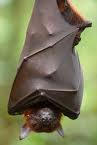 After you are told by the Batman in the middle of the night that you may have a bat colony in your attic, sleep does not come easy.
In my last blog post, I wrote about the night we were visited by a bat. There was a bat in our house. We saw it one minute and it flitted to an unknown location the next.
If you live up in the cold North like I do, and have not had the sufficient funds to replace every charming leaky window in your 77-year-old home, then you are familiar with the practice of wrapping your windows in shrink plastic for insulation. On The Night of the Bat, the wind outside howled, causing the plastic wrap on our bedroom wrinkle and crinkle. Of course, I mistook every wrinkle and crinkle for the wings of a bat and shot straight up in bed every 10 minutes throughout the night. I’d never wanted morning to come so badly.
Have you ever had a bat loose in your house in the middle of the night? I later learned that we were not alone in this experience. Bats seem to be a common occurance in older, charming homes. Bats are the one uncharming feature that the realtor leaves off the charming English Tudor house listing.
We shared this story the next day with many of our friends. One couple we know, who are avid campers, said when a bat swooshed over their heads in bed one night, they didn’t hesitate to pitch a tent over their bed to get a good night’s sleep.
I’ll have to remember that for the next time.
Morning finally came. I probably slept for two hours at best and my nerves were fried when my husband woke me to tell me about his discovery.
“You have to see this, I found the bat!”
He led me to our living room and I think I hid my head in his shoulder all the way down the stairs. Behind the honeycomb shades, up by the ceiling, there was a small shadow. Suddenly, this terrifying creature of the night seemed harmless. Even vulnerable. I quickly put on my boots and ran outside to get a better look.
Between the living room window and the shade, our winged intruder hung upside down and was fast asleep. I have to admit, swaddled in its pale grey wings, this small bat, the same creature that terrorized me, looked pretty cute.
A few hours later the Batman came for a visit. No, it wasn’t the Dark Knight or Caped Crusader of comic book fame. Just a guy with a five o’clock shadow at 10 a.m. wearing a red and black lumberjack flanel and jeans ripped through the knee.
He asked if our kids were around because they might like to see the bat up close and personal.
My fearless children ran down the stairs in their slippers to watch what became their own private wildlife demonstration. The Batman put on heavy gloves, produced a coffee can with holes cut in its lid, and gently removed the bat from our window shade. It was tiny, it was frightened, and now, in the capable hands of the Batman, it would be released into the wild.
As much as we love nature and wildlife, we resolved to keep these creatures out of our house for good. And no, upon further inpsection, we did not have a colony of bats in our attic.
What we did have was a lot of holes and cracks. Bats have a very flexible skeleton and can slip into a crevice the size of a matchbox. The Batman’s price for bat removal: $50. The Batman’s asking price for bat proofing my home: $1300.
After recovering from the sticker shock, we then called in another local hero: Leroy. Leroy is one of those guys that everyone knows by first name only and his name gets passed around by all the neighbors. For half the Batman’s asking price, he batproofed our home and gave me a full education on how you know if a bat is in your home.
1. Evidence of guano, or bat poop in your attic. Enough said here.
2. Look at places like attic louvers, where the chimney joins the house, and gable ends of your house structure itself. To my shock, I could put my eye between chimmney in our attic and the house frame and SEE outside. So this is where the critters were getting in. Leroy then used foam insulation and sealed up the gap like this:
 Keep in mind that sealing the opening must be done while also leaving for a way for bats to exit without re-entering the space. In an ingenious use of pantyhose, Leroy created a contraption that allowed a one-way exit for any bats that may have remained in our attic. If the openings are blocked during the daylight hours, the bats would have been sealed inside with the rest of the family.
I am happy to report that this story happened seven years ago and this house is clean of its bats. All the children are healthy rabies-free and none foam at the mouth. I wish you a bat-free winter and remember — bats really are harmless for the most part and want nothing to do with you, or your hair.
The only thing our society needs to fear – bedbugs!
Good night.
The Bats in My Belfry: Part I
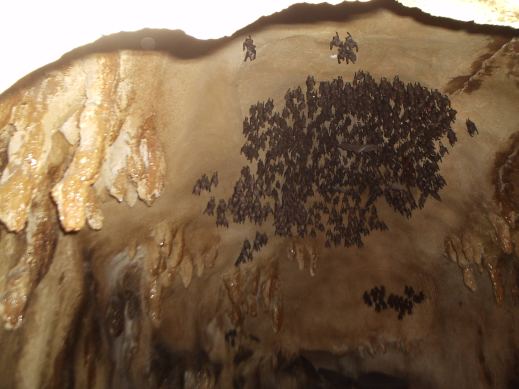

Could there be a colony of bats in your attic?
Since this is the Season of the Witch and all things creepy, it’s time to share a scary, true story with a very educational ending. This story is about bats … and the Batman.
I love our old house. We live in a 1920’s English Tudor with all the old-world English Tudor charm. This charm includes leaded glass windows that are beautiful yet leak in the cold Rochester winter drafts, and copper plumbing that offers enough water pressure to either take a shower OR run the washing machine, but not both at the same time.
It also features a walk-up, half-finished attic, with its own bedroom/bathroom suite and a claw foot tub in the bathroom. This is where all our guests spend the night.
I greatly respect and appreciate bats. I love that the average bat can consume 1,000 mosquitos per night, and how they use sonar to get around, and I love the children’s story Stellaluna.
I even worry about how white-nose syndrome is decimating bat populations in northeast. On October 28, the U.S. Fish and Wildlife Service posted new white-nose syndrome decontamination protocols and supporting documentation for cavers.
I want bats to have disease-free homes and be fruitful and multiply, just as long as their home is outside my home.
This is the part where things get scary.
One Saturday night, my husband and I were doing what we do on most Saturday nights: we were lying in bed watching Saturday Night Live. As you can see we do not get out much and that is why I blog for excitement.
We were nearly dozing off between the opening monologue and the musical guest when we thought we saw something fly by our bedroom door.
“Did you see that?”
“Wha….” my husband was nearly asleep…
“Um, did we close Charlie’s cage before we went to bed?” I asked, hopefully.
At the time, our daughter had a sweet green parakeet named Charlie. I desperately convinced myself that it was Charlie that just flew down the hall. Charlie got out, yup.
Please let that winged thing be Charlie.
We went to our daughter’s bedroom. Charlie the parakeet was safe in his cage, door closed. But something was still flying in the hall. Something with a wingspan far larger than your average parakeet.
We could now safely say we had a bat in our house.
I ran screaming into the bathroom in our bedroom. My brave husband threw a towel over his head and went to pursue the winged rodent with our bed sheet.
Then, like that, it disappeared.
The only thing worse than having a bat in your house is knowing there is a bat in your house but not knowing where it is.
With towels over our heads, my husband and I crept down to the kitchen to get the telephone book to search for someone, anyone, to help us. We dialed the town animal control hotline only to learn their hours were from 10-4 on Tuesdays and Thursdays. The outgoing message said to call 911 in an animal-related emergency.
Was this an emergency? SURE! There could be a rabid bat attacking us at any moment!
So my fingers shakily punched 911 and I alerted the local police that I had three sleeping children, including a 7-month-infant, and a bat was loose in my house.
In minutes, the police were at our door. Remember, this is Brighton, and not Staten Island, where years earlier I waited 45 minutes for police to arrive after calling about girls trying to break into my house to beat me up with a very different bat.
The friendly policeman came and humoured us by shining a flashlight all around the kids’ bedrooms and our living room, but found no bat.
“He probably found somewhere to hide. Bats are really shy and wherever he is, he will stay there till morning,” he reassured us.
This left me no comfort, and I scanned the Yellow Pages for more help after he left. By this time it was around 12:45 a.m.
Then, I found him. An ad for the Batman. From our bedroom, I called the number, figuring I would leave a message and someone would call me in the morning. Instead, to my surprise, I heard a low mysterious voice after a few rings.
“Hello?
“Um, are you — the Bat Man?”
“Yes, I am the Bat Man, how can I help you?”
I immediately apologized for calling at such a late hour, only to be answered with the Batman’s strange response.
“No need for apologies. This is usually the time when the calls come.”
Okaaayy. I told him the situation, and then he told me that this could wait until morning, that bats were very shy, want nothing to do with humans, and he would be by in the morning.
Oh, but one more thing, he said. There was a good possibility that if we found one bat, chances are there were not one – but a colony of bats in our attic.
A colony?
With that the Batman bid me goodnight.
Nighty night and sleep tight. Stay tuned for the conculsion of this bat tale.
What’s a Nice Jewish Girl to do about Halloween?

Some of my neighbors really get into decorating for Halloween
My birthday falls in late October. I will not disclose my age, and those of you who know me know what that number is. Unless a birthday is one that ends in a 0 or a 5, birthdays at this stage of life are no big deal.
But think back to when you were a kid. Those were the days when one counted down the days to their birthday party. And if you were lucky enough to be born on the cusp of the Scorpio sign, birthday parties were all about Halloween. Late October babies have a built-in costumed, candy-corn flavored theme that is perfectly gift wrapped with a giant fake spiderweb and grooves to the music of a Monster Mash soundtrack.
Each year, even up through high school, I celebrated my birthday with a costume party. On my seventh or eighth birthday, my grandmother transformed herself into a gypsy storyteller to the delight of all my costumed friends. My parents and grandparents even staged special effects, complete with a charmed stuffed snake to rise out of a wicker basket with the help of an invisible fishing wire.
All through childhood, my mother and grandmother were the master costume makers. My mom said that when she was growing up in her Bensonhurst, Brooklyn apartment, my grandmother would dress up as a witch and concoct costumes for every kid in the building.
And when it was my turn to dress up, mom and grandma could make me into anything I wanted because they both knew their way around a sewing machine. Pity my own children this time of year. I cook, I bake, I garden, I teach, I read Torah, but I cannot even decently hem a pair of pants.
I wanted to be a sunflower one year: mom made me a sunflower. And then scarecrow, and Indian Princess, and even a hairdryer. And my final Halloween birthday party, I made a really convincing Boy George.
Halloween birthday parties, trick-or-treating and getting candy went on happily and innocently until the seventh grade. That year, Halloween fell out on a Tuesday which was afternoon Hebrew School.
Hebrew School started at 4:30 and let out around 6 p.m. Through Chumash (bible) lessons, you could feel the tension in the class start to bubble like a witch’s cauldron: we were missing out on prime trick-or-treating time! We realized that by the time we got home, scarfed down some dinner and put on our costumes, maybe we could collect half a pillowcase worth of candy if we were lucky. But we had a plan.
“Rabbi,” one of our classmates sweetly inquired, “Can we get out of Hebrew School early today so we can go trick-or-treating?”
“Yeladim!” He shouted, saying the Hebrew word for children. “Jewish children should not celebrate Halloween. It is NOT a Jewish Holiday! If you want to dress up and have fun, we can do that later in the year, on Purim.”
In unison, the entire class gasped in disbelief. Up till this point, we were all completely unaware that Halloween could have other meanings besides dressing up, running around the neighborhood and getting candy. And, in the streets of Staten Island, we didn’t exactly live in a part of the world where Purim, a costume-filled Jewish holiday in the spring, was universally celebrated.
We were not deterred that night, or any year after, from our right as American kids to trick-or-treat. Okay, Halloween is not a Jewish holiday. In fact, I knew even back then that Halloween must have some Christian implications, because all the parochial school kids I knew in my neighborhood had off Nov. 1 for All Saint’s Day.
Halloween must be okay because my grandmother, the most Jewish lady I knew, still loved Halloween. One year, my grandparents went to Greenwich Village to see the famous Halloween parade. My grandmother had a blast and made friends with everyone, including “all the nice young men dressed up in the most elaborate costumes” who offered her a chair along the parade route.
My Yiddishe grandma, the one who made gifilte fish from scratch and sang me Jewish songs, found delight in hanging out in the Village with the drag queens on Halloween!
I always wanted to go into the Village for Halloween, but it wasn’t until my grandparents raved about it did I got the nerve to go to one of the best places in the country to celebrate on Oct. 31.
I spent two Halloweens in the Village in my 20’s, although I didn’t wear a costume. Then, out in San Francisco’s Castro district, I dressed as Mona Lisa in a frame and my beloved dressed as the Mad Hatter. People sang “Mona Lisa” to me. A few people even got the Elton John reference and sang a few bars of that song with us. The streets got crowded, and my frame did get entangled with other costumes, but it was all in good fun.
Those were some of the most memorable nights of my life. More than the candy, as young adult I saw Halloween as a time when people can express themselves and become someone else for just one night. Halloween costumes break down barriers between strangers. But beneath the costumes and candy, the darker messages that lurk below are just plain not Jewish.
I still love Halloween and my heart is tied to the Halloween memories of my childhood. But Halloween has shifted lower on my priority list.
After a month of putting energies into the Jewish fall holidays I mentioned in a recent blog post, I have little desire to turn my front lawn into a graveyard or put together a costume with a hot glue gun.
But we still carve our pumpkin. And I still let my kids go trick-or-treating. But they well understand and love that come spring, we will be busy making hamantashen cookies and baskets of food for friends and neighbors for the Jewish holiday of Purim. In that way, they learn that Purim, when you walk around the neighborhood giving treats, is in essence the exact opposite of Halloween’s tradition of going around the neighborhood begging for treats.
Am I sending my Jewish children mixed messages? Maybe. Will I someday, because of Jewish observance, let go of Halloween go altogether? Perhaps.
But in the meantime, it’s still fun to walk the neighborhood’s darkened streets, check out the glow in the dark decorations, and maybe get a little scared.
A Blessing and a Curse: Israeli advocacy though Social Networking
How do you connect to a country that is oceans and languages away? In the 21st Century, where can you go to have conversations with or show positive visual images of a country that has been dear to the Jewish soul for more than 2,000 years but the mainstream media continues to portray it as a human rights violator?
The best way to connect with Israel and meet Israelis is to make a visit. Or maybe two. Or live there for a while. Or, maybe move there. But, in the meantime, there is the blessing and the curse of connecting with Israelis and standing up for Israel through social networking.
There are about 13.5 million Jews in the world, give or take depending on who you ask. About half live in the United States, and 6.5 million live in Israel. Both these countries embrace democracy, diversity, religious freedom. In spite of these similarities, time, distance, and language barriers keep the world’s largest Jewish populations from feeling truly connected. Most Jewish Americans know little about modern Israeli life, history or politics. And Israeli counterparts, only know of America from what they see in their media.
Last summer, the Maurice and Marilyn Cohen Center for Jewish Studies at Brandeis University published a study called “Still Connected: American Jewish Attitudes About Israel,” The study, conducted in response to media coverage of the Gaza flotilla incident, found that participants aged 45 and under had less of a connected feeling to Israel.
If the Jewish people want to see continuity into future generations and a strong connection to Israel, it’s time that Jews in Israel and Jews in America start talking to each other and the best way is social networking.
In the 1980’s connecting with Israel seemed like a no-brainer. Many Jewish families during this time took a trip to Israel the year a child became a Bar or Bat Mitzvah. You toured the country with your family and had a ceremony either at the Western Wall or at the top of Masada. These were moments in Jewish family life that forged strong Jewish identities. If you couldn’t make it the year of your Bar or Bat Mitzvah, perhaps a trip during high school was in your plans, or a semester or year abroad in Israel.
Then came the intifadas of 1989 and 2000. Along with the death and the terror came the fear and doubt among American Jews how they felt connected to Israel based on what they saw on the news. Reports of terrorist attacks within Israel in 2000 saw tourism to the Jewish state plummet.
I taught Hebrew school to sixth graders that year who told me you had to be “crazy” to want to visit Israel. I asked parents during a family education program if they had anything to share with the students on how they felt about Israel or if they had memories of trips to Israel and I was met with blank stares.
So how to you teach Israel to children who may see Israel as nothing more than a tiny spec on the worldwide map? Again, the answer is through social networking.
I have been a Hebrew School teacher for almost 10 years and have used sites like Facebook, Twitter and YouTube to teach kids young and old about the daily ongoings of Israeli citizens. I have shown my littlest students on YouTube how families in Israel celebrate Tu B’shvat, the New Year of the Trees by singing the same songs we sang in our classroom. For my older students, I downloaded a video on the many faces and places of Israel set to pop song “New Soul” by Israeli singer Yael Naim.
The Internet provides a podium – to stand up for Israel but also provides an equal podium for those to wish to delegitimize the Jewish state. The flotilla that attempted to breach Israel’s blockade around the Gaza Strip launched hundreds of anti and pro Israel Facebook groups, including one I joined, called The Truth about Israel’s Defensive Actions Against the Flotilla The group aims to be online ambassadors to Israel, where supporters of Israel around the world, Jewish or not, can start discussions or point out the way Israel is being covered in the media.
In recent years, I had the opportunity to develop partnerships with Israeli teachers by both visiting and living with Israelis and hosting Israeli visitors to America.
I documented my trip in this video set to the background music of popular Israeli musicians such as The Idan Raichel Project and Shlomo Artzi, who also have Facebook pages. I wanted to show my students and members of my local Jewish community the beauty of Israel and everyday life in this tiny, diverse country. Take a look below:
“
Another time I empowered social networking to support Israel was during Operation Cast Lead, or Israel’s war on Gaza. During this time, many hateful comments were posted to the photos I posted from Israel on Facebook’s pro-Israel groups. I used discussion boards to request that a typical Israeli write back to me to explain to my 7th grade students what it was like to be in Israel during this time. I got a response from a young man living in Ashdod, not far from the Gaza strip. He was discharged from serving in the IDF from an ankle injury and was happy to help out my cause. In perfect English, he composed a letter to my seventh graders what it was like for he and his family to live under a daily barrage of missiles from Gaza. The email put a personal touch to the headlines that winter and sparked my students desire to make cards for Israeli soldiers.
These are just a few of the many ways ordinary people can stand up for Israel. What can you do?
About Me

Kreativ Blogger

Versatile Blogger Award


 Stacy Gittleman