
This is what Hatred Looks like on a Billboard

It is getting way close to home now.
This month, Detroiters traveling down the Southfield Freeway around eight mile get treated to this huge billboard:

Why now? Why now, when Israelis are facing stabbing attacks on the streets of their cities each day? Why now when the world, as represented by the United Nations, is delegitimizing Israel further by considering and even passing resolutions that Judaism’s claims to its holiest sites are bogus and they are Mulsim sites?
Most will speed by the billboard and only see those big words. They will not pay attention to who sponsored a group: a blatantly anti-Semitic organization that actively denies the Holocaust by refuting the claim that gas chambers existed; seeks to hold Jews in America accountable for the Israeli-Palestinian conflict, and promotes the lie that American Jews send American troops to their death. (http://blog.deiryassin.org/page/2/)
Here is my article on the topic, including an interview with American Jew Henry Herskovitz, who has asked an Ann Arbor synagogue to remove the Israeli flag from its sanctuary and who protests outside of it each Saturday morning as his fellow Jews go to worship inside. Please sign the petition that asks Lamar Advertising not to take any more money to advertise hatred here.
An intensely anti-Israel organization— whose local advisory board member has led Shabbat morning protests outside an Ann Arbor synagogue for the past 12 years — has placed a billboard at Eight Mile and the Southfield Freeway that reads “America First … NOT ISRAEL.”
“This billboard was placed to do one thing: To drive a wedge between Israel and the American people,” said Heidi Budaj,
Michigan regional director of the Anti-Defamation League. “It follows the age-old adage that falsely accuses Jews of not being loyal to the countries in which they live.”
The $3,000-a-month Lamar Advertising billboard is paid for by the advocacy group Deir Yassin Remembered (DYR) and will be on display until Nov. 15. The organization is trying to raise funds to keep it up for successive months.
Since 2012, DYR placed similar ads in 12 major cities across the country intended to, according to the ADL’s Budaj, “unravel the legitimacy of U.S.-Israel ties.”
DYR, with an address in western New York, is headed by Paul Eisen, a pro-Palestinian British Jew who believes Israelis committed slaughter of Arabs to drive them out of their villages during the 1948
War of Independence. He styles himself as a Holocaust denier.
Henry Herskovitz, a Jewish Ann Arborite and a member of DYR’s board of
advisers, said, “While the ADL is accusing us of creating a wedge, we think the wedge
already exists.” Since 2003, he has led an anti-Israel vigil Shabbat mornings outside
Ann Arbor’s Beth Israel Congregation. Herskovitz’s main grievances against
“the Jewish supremacist state” include the lack of separation between church and
state, no voting rights for Palestinians and penalties of the Israeli court system —
including prison time — for questioning the “standard narrative of Holocaust.”
Herskovitz added, “There is no closeness between the U.S. and the State of Israel. The
only reason Americans think this is true is propaganda put out by the Jewish lobby.”
A motorist, Robert Shaw of Oak Park, spotted the ad on a recent drive, pulled
over, snapped a photo and placed it on his Facebook page. The post was shared so
widely on Facebook that it was picked up by national and international media, and
there is now a fundraising campaign to place another ad to counter the original’s
“disturbing” message, he said.
“I fully believe in First Amendment rights because that is what makes America
strong,” Shaw said. “But freedom of expression must be tempered with common
sense and dignity toward others.”
Roni Leibovitch of West Bloomfield felt the ad was not a political statement but
an attack on American Jews. He set up an online petition asking the billboard company
to take it down.
In the first five days, the petition, accessible at chn.ge/1M0niLB, got some 800
signatures. It says, in part, “Please remove this billboard which causes hatred of
American Jews, and feeds off the same kind of dual-loyalty accusations which
were leveled against the Jews by Nazis in the years leading up to the Holocaust.”
DYR, bases its name upon Deir Yassin, one of the most controversial battles during
Israel’s War of Independence in 1948. There are conflicting reports on the circumstances
that left more than 200 Arabs from this village dead.
The New York Times report said more than 40 were captured and 70 women and
children were released. No hint of a massacre appeared in the report. According
to http://www.jewishvirtuallibrary.org, many of the Arabs who were killed were fighters
disguised as women or civilians. The DYR website says the event was an outright
massacre of innocent Arab civilians. DYR claims it has received support from
far-leftist British Labor Party leader Jeremy Corbyn, according to London’s Jewish
Chronicle. Corbyn is running for British prime minister. *
2 November 5 • 2015
Mother Rachel is Crying Again: Why skimping on teaching Jewish History is a dangerous thing

When I penned this last week for the Detroit Jewish News, Joseph’s Tomb had not been set on fire by Palestinians twice. Yet. The thought of the Palestinians petitioning UNESCO that the Western Wall should be declared a Muslim holy site went beyond the pale of imagination.
But here we are. According to the world authorities, Rachel’s Tomb and the Cave of the Machpelach have no Jewish connection. Will this be enough of a shakedown to shake us out of our complacency?
On Oct. 8, The New York Times published an article that disregarded any Jewish historical claims to the Temple Mount in Jerusalem. Ask the average pre-bnei mitzvah adolescent attending a supplementary congregational Hebrew school why this is so troubling and you may get some blank stares.
In a 2007 study from the AVI CHAI foundation, one Jewish educator lamented that in the ever-shrinking hours of a child’s Jewish education, “we have lost the battle for time.” The paucity of contact hours spent at Hebrew school means that our Jewish kids are getting a minimal Jewish education. They learn to decode Hebrew enough for Hebrew prayer and bnei mitzvah preparation. Through experiential learning, they get the basics of the Jewish holiday cycle and maybe a sprinkling of Torah stories. Teachers need to accomplish this within five or less hours of weekly instruction, all the while dealing with the disruption of kids arriving late or leaving early because of extra-curricular activities.
That means teaching Jewish history – from our most ancient beginnings in Judea, through the Roman exile and all the way up to the birth of the modern State of Israel – has mostly met the chopping block. If you need evidence, visit the resource room or library of any temple or synagogue and you will see volumes of history textbooks printed in the last decade languishing on the shelves.
I speak from experience. I have taught Hebrew school in one capacity or another here in Detroit and in Western New York for 13 years. I have been trained on several curricula that attempt to infuse experiential history lessons into the classroom using both traditional and the most up-to-date methods of the Digital Age, only to scrap carefully constructed lessons for the sake of time.
As a parent, a Jewish educator, and a writer who has been observing media coverage of the Israeli-Arab conflict since college, I cannot help but notice an ominous connection between the neglect of teaching Jewish history and the rise of the distortion and demonization of Israel and of Jews in Israel, on the American campus and throughout the world.
American Jewish kids with a minimal education, or no Jewish education after their bnei mitzvah, are blindsided when they reach the college campus and do not know how to respond when confronted with organizations on college campuses calling to boycott “apartheid” Israel.
As parents and Jewish professionals, we are doing ourselves a disservice when we let our children’s Jewish education take a back seat to our many other priorities. Our children need to learn Jewish history – to see where we have come from and what past generations endured to maintain their Judaism – to shape their own Jewish identity and destiny.
This year, after much soul searching, I decided to “home Hebrew school” my own child. I do not recommend this for everyone. Ideally, Jewish learning needs to take place in a communal setting and with lively discussion. Believe me, getting your own kid to take you seriously as a teacher is no cakewalk, but with the promise of a treat after a certain amount of studying has been accomplished, we settle down and get to work.
Each time, we get through one chapter from an age-appropriate textbook. Fortunately, there are many educational resources and videos online to make ancient Jewish history come alive. Right now, we are working our way through learning about ancient Judea and the Jewish revolts after the Romans conquered Jerusalem.
Even as Israel works hard to preserve its antiquities, there are some who wish to erase them. As we sat learning the other night, an online news source reported that Palestinians had destroyed a 1,900-year-old cave in the Gush Etzion region that dated back to the Bar Kochva revolt. If you had never heard of this era in Jewish history, I encourage you to look it up.
Detroit Dreamin’ With Michael Bolton

Detroit Jewish News
October 15 • 2015
arts & life
Michael Bolton’s tribute
to our fair city premiered
with a red-carpet celebration.
Stacy Gittleman | Contributing Writer
It’s hard to believe that Grammy Award winning
recording artist Michael Bolton is from Connecticut — and not from Detroit.
During his 30-year career, Bolton has literally sung the praises of Motown all over the globe.
Now, he is so confident that this city is on the “tipping point of greatness” that he is in the
final phases of releasing a $400,000 full-length documentary he personally financed, which
previewed at an exclusive sneak peek event last week at Detroit’s Fox Theatre and was attended
by some of the city’s most prominent leaders, businesspeople and entertainers.
Bolton, 62, walked the red carpet at the Fox on Friday, Oct. 2, for the premiere of Gotta Keep
Dreamin: Detroit’s 21st Century Renaissance, drawing a crowd of several hundred, including
Detroit Mayor Mike Duggan, U.S. Sen. Debbie Stabenow and U.S. Rep. John Conyers, along
with Chris Ilitch and Quicken Loans CEO Dan Gilbert. Detroit Free Press columnist Mitch Albom emceed a panel of the film’s stars before Martha Reeves closed out the night with a surprise performance of “Ain’t No Mountain High Enough”
with Bolton.

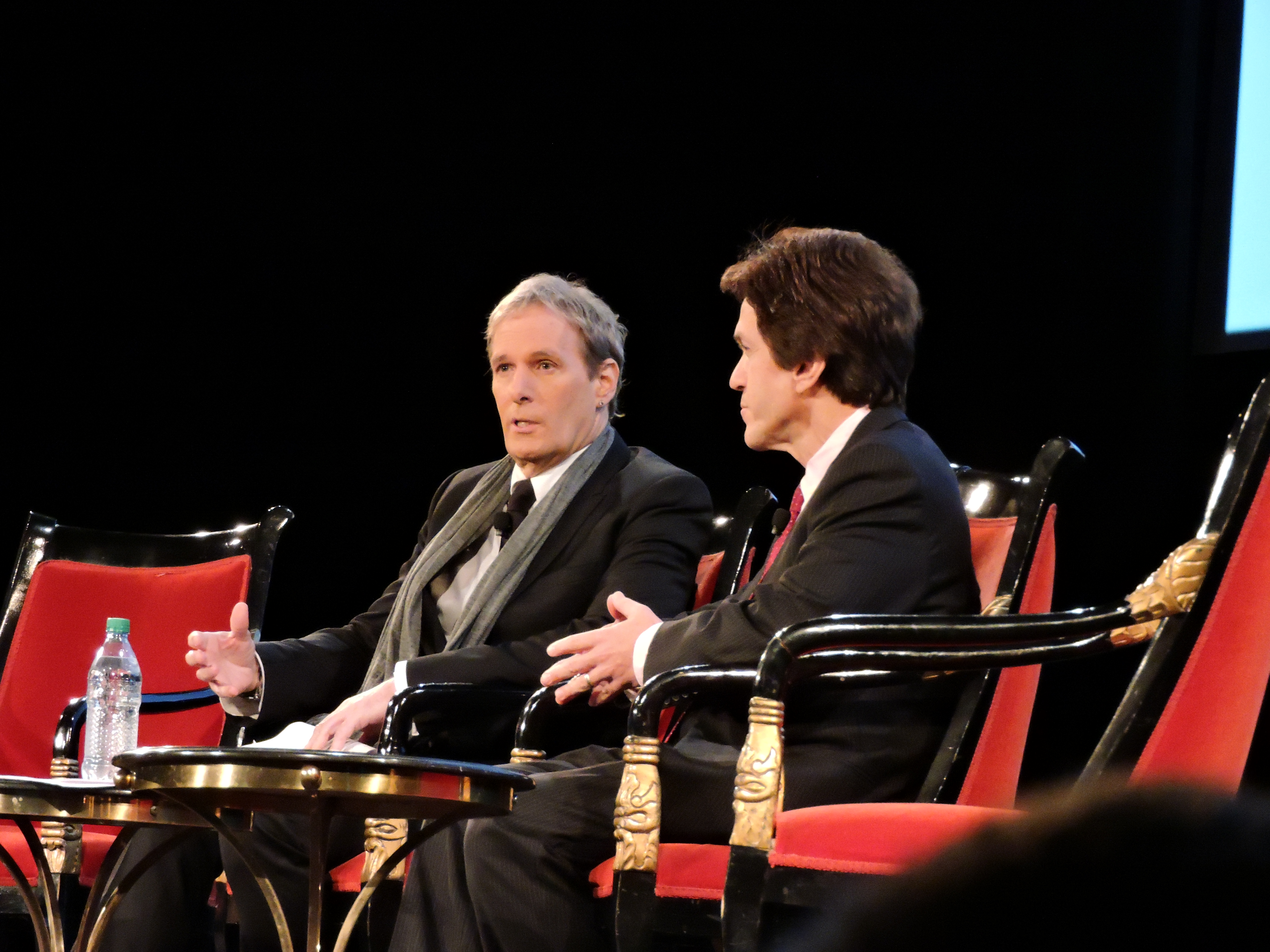

In addition to featuring Gilbert’s contributions to the city’s comeback, the movie
highlights a number of big names, including John Varvatos, Francis Ford Coppola, Alice
Cooper, Jerry Bruckheimer and more, as well as several young Jewish entrepreneurs
— such as Jacob Cohen, partner at Detroit Venture Partners, who participated in Jewish
Federation of Metropolitan Detroit’s inaugural Entrepreneurial Mission to Israel last April, and
dPOP CEO Melissa Price.
Price, who designs interior spaces for new businesses within once-decaying buildings
in Detroit’s rapidly growing downtown, spoke onstage about her recent move into a
Downtown Detroit apartment and the “endless” places to dine and explore within walking distance
of where she lives.
“There is an emerging belief system taking hold in Detroit that anything is possible,” Price
said.
Gilbert said Detroit’s history and its comeback “lies in the intersection of muscle and
brains” of its determined youthful population and the willingness of older, established businesses
to embrace and understand the culture of a digitally driven new generation.
“We can no longer operate with the old ways of thinking, that this is the way things have
always been done,” Gilbert said. “We need to build corporate cultures that attract young talent.
It is a culture that is proving that ideas, thoughts and beliefs are greater than money
when it comes to building businesses.”
Bolton, 62, was born and raised in a middle class Jewish home in 1950s New Haven, Conn.,
where he was taught by his family “not to hate,”even though his own family at times faced
discrimination as Jews. His connection to his Jewish heritage lies not in practice but in fond
memories of his Ukrainian-born grandparents, who taught him to believe in the American
dream.
“My grandparents came to America with nothing more than the confidence and belief
that they could provide a better life for their children,” Bolton said at a press conference
at the Westin Book Cadillac Detroit the day before the premiere. “That is the American
dream, and that dream is still alive right here in Detroit.”
What truly inspired Bolton to make this documentary was his lifelong love of Motown
music — he opened for Detroit’s own Bob Seger in his early years and, in 2013, he recorded an
album of Motown covers, Ain’t No Mountain High Enough. Recently, he discovered Hitsville
U.S.A., the nickname given to Motown studios’ first headquarters, and an introduction to
Gilbert by Bedrock Real Estate Services’ Detroit Ambassador Bruce Schwartz helped seal the
deal.
Bolton, who has had his share of uncomplimentary press, knows the sting of being
portrayed in a bad light by the media. His film comes on the heels of much negative national
coverage about Detroit, including the 2012 documentary Detropia, the book Detroit: The
American Autopsy by Charlie LeDuff (Penguin Books) and national coverage of the city’s 2013
bankruptcy.
“When the media wants to cover Detroit, they cannot resist the bloodiest part — the
blight and the decay — and I know how painful that can be,” Bolton said. “This film project
represents the greatness and the dignity of the people of Detroit. In the three years since I
started this project, more people with no roots in Detroit are increasingly interested in all the
good that is happening here.”
Bolton is back in Los Angeles making final edits with 2929 Entertainment to meet the
deadline to distribute the film for the 2016 film festival circuit. But this is not his last trip to
Detroit, not by a long shot.
“I do not have a kind of house-flipper, short-term relationship with Detroit,” he said. “The people I have met who helped me make this film are so inspiring. I hope this film has a long-lasting afterlife, and I intend to make it
reach as many people as possible to show off the town that keeps getting better every time I
come back.”
For Every Arab Day of Rage, I declare a Day of Hugging a Jew


Okay folks
These last 18 months or so have been rough for your friends who are Members of the Tribe.
There was last summer.
And now attacks that stab us in the back and leave us for dead.
We really thought that after the Holocaust and after the State of Israel was formed that the horrid days of the pograms and the persecution were behind us. How wrong we are.
Again we feel persecuted.
Lied about.
Vilified.
Demonized.
Mad as Hell.
Scared.
And utterly alone.
If you are not Jewish and have a Jewish friend, girfriend, boyfriend or spouse or co-worker, ask us how we are doing today.
If you are in the same town, please give us a hug.
Give us a call.
Send us a text.
An email.
Something.
Tell us, without condition, that you cannot believe the barbarism that is going on in Israel, where Jews are supposed to feel safe. Tell us that you stand strong with us and if the hatred comes here, wherever that might be in the Jewish diaspora, you will speak out for us and protect us.
Please. We need your friendship now.
“Just Another double Murder.” Here is proof that #NPR no longer even tries to hide its anti-Israel bias

Sukkot. The Feast of Booths. In Hebrew, the fall Jewish holiday is also known as “Zman Simchateinu,” the time of our joy.
Sadly, this week has been anything but.
It has been a season of Jewish blood.
It has become a season of terrorizing Jews in their own Jewish homeland.
It has become a time of complete isolation for Israel and the Jewish people, when at the United Nations not even the United States, with Kerry boycotting Netanyahu’s speech, stands strong with Israel.
Last week, I watched in horror as the Palestinian Flag, the same flag that was waved in triumph by throngs of celebrants in Judea and Samaria on 9/11 – was raised in recognition at the United Nations.
I was disgusted yet hardly surprised, at the raising of this flag, when Abbas announced in his speech to the United Nations as Abbas said his people are no longer held to the stipulations to the Oslo accords, as if they ever did have peaceful intentions of co-existence.
A shred of me was hopeful. If these people really want a nation, than perhaps that wavering flag would signal them to show the world that they can indeed conduct themselves with peaceful dignity. That they are ready to do the hard work it takes to create a country. That they are now more concerned with building up a nation of their own rather than destroying another.
In the morning, I woke to the news – on my Facebook feed, that a Jewish couple driving home from a Sukkot celebration were murdered by Palestinians in cold blood as four of their children sat in the back seat.
So, I turned on #National Public Radio and I waited to hear the coverage. Surely, after they dedicated so much coverage to another senseless death in Jerusalem when Israeli extremists torched an Arab home in Jerusalem, killing a baby and burning other family members.
I waited.
Yes, the news cycle was a crowded one: another mass shooting. Another hurricane barreling towards the East Coast. Th endless war in Syria.
But surely, there must be some time to dedicate 1 minute, 30 seconds to report the murder. Especially since Abbas’ Fatah Wing declared full responsibility immediately following his scathing speech at the UN General Assembly.
Nothing.
So, I called NPR on it.
I questioned them directly in a message on their Facebook page. Here, I screen captured the exchange:

Does this lift any doubt just how blatantly biased NPR is towards Israel?
Are you really still a supporter of NPR?
Leading Prayer in a prayerful time


With the #Pope visiting the United States, and the Jewish High Holiday season in full swing, I wanted to share with you an article I wrote published in the Detroit Jewish News’ High Holiday edition.
Two days ago, my wonderful congregation spent 26 hours in intensive prayer, fasting and reflection. Prayer is hard work. It does not come easy. That is why I am thankful to those in the community – in my synagogue, and in yours, or maybe in your church, temple or mosque – who volunteer their time to learn how to lead prayer.
Have you ever led a prayer service? If so, how did you learn? Why did you decide to lead? Did it feel different than sitting in the pews? I’d love it if you comment below.
During the Middle Ages, an unknown cantor, humbled at the task of praying on behalf of the entire congregation so that God would inscribe them into the Book of Life, penned the prayer Hineini, meaning “Here I Am.”
Before the invention of the printing press, leaders of tefilot, or Jewish worship, carried the weighty responsibility of keeping an entire congregation engaged and focused.
Fast forward several centuries, and not much has changed. Although the words of the Rosh Hashanah and Yom Kippur liturgy are widely available in printed machzorim or even transmitted electronically onto large video screens, it is still the task of the leader to be the shaliach tzibbur (lit. “messenger of the community”) in shepherding today’s Jews through the most prayer-intensive time on the Jewish calendar in an increasingly secular society.
Throughout Metropolitan Detroit, many consider it an honor to volunteer leading services alongside professional clergy as an ultimate expression of contributing to the Jewish community.
Rachel Jacobson, 28, of Silver Spring, Md. each year returns to her hometown congregation of B’nei Israel in West Bloomfield to be with family and to lead various parts of services. Inspired from her years in Jerusalem learning from pioneering women leading tefilot in egalitarian congregations, she was one of the first female prayer leaders for the B’nei Israel during the high holidays.
“I never was formally trained to lead,” said Jacobson. “It is something I picked up over the years in school, at Camp Ramah, and living in many different Jewish communities. It is when I can do my best praying because I am not only responsible for my own davening, but for the congregation before me.”
Jacobson credits her singing ability to her school days performing in musicals, though it is not necessary to be able to carry a tune in order to lead tefilot. But just as in show business, services must go on, even when the prayer leader is sick.
“Sometimes I think God does not want me to daven,” Jacobson jokingly said, thinking about leading Rosh Hashanah services while fighting a cold. “It is moments like that when I really must remind myself that I am not up there (on the bimah) to sound pretty. I am an emissary of all the congregation’s tefilot to deliver them to God. That is what leading prayer is all about.”
When Clergy get sick, congregants step up
Last Rosh Hashanah, Rabbi Norman Roman of Temple Kol Ami in West Bloomfield found himself not on the bimah but in the hospital. It was then that the congregation showed its strength and proudest moments according to congregant Diane Siegel Di Vita of Northville, who helps coordinate monthly lay-led services at Kol Ami throughout the year. She said the entire executive board filled in to lead the services and deliver sermons under the facilitation of Cantor Tiffany Green. Rabbi Roman’s stepson Chad Rochkind delivered the Yom Kippur sermon.
“What happened at Kol Ami last year was very community affirming,” said Green. “It was important for our membership to see fellow members stepping up to the plate at a moment’s notice, and showed how they care for their community through their leadership,” said Green. “Leading prayers shapes and grows our small congregation. It shows that our members care about what happens here.”
In an effort to bring to his fellow congregants the meaningfulness of the season, Bruce Plisner, an active congregant at Temple Beth El in Bloomfield Hills, designed with Rabbi Mark Miller a one-hour text study for Yom Kippur afternoon that will focus on the central themes of the day: the sounds of the shofar, fasting, repentance and forgiveness.
Plisner, 68 of Farmington Hills, said that Jews for generations have recited prayers such as the Ashmamu and the Unetana Tokef but may not know their origin or significance. Through text study and rabbinical and contemporary commentaries, he hopes to enlighten the worshippers by offering them something less passive and more participatory.
“During Yom Kippur, we say certain prayers over and over again which few people understand what or why we are saying them,” said Plisner, who said he tries to get to services during the year as much as he can to usher and lead. “We thought it would be meaningful to take a different approach to reading about the prayers through rabbinical interpretation. We will also examine the tradition of fasting and through various texts, will explore who fasts and who is pardoned from fasting.”
In synagogues and temples that do not have a chazzan, rabbis such as Steven Rubenstein of Congregation Beth Ahm in West Bloomfield rely upon a deep core of capable and willing congregants to lead prayers. This year there will be some new Torah readers joining the ranks of volunteers, he said.
“Leading tefilot is a big part of our congregation’s culture,” Rubenstein said. “Leading gives people the opportunity to be invested and involved in congregational life. It makes services more enjoyable, not only for the High Holidays but throughout the entire year.”
How Much of the Summer Did You Spend in front of a Screen?


Brandon Solomon on his trip at a stop in Bryce Canyon National Park
All over the country this summer, you could hear a plea of GenXer parents to their Millennial children that sounded something like this:
“Get off your screen. Stop playing Angry Birds. Go outside and look at some real birds.”
Screen addiction is as real as that YouTube video of a person walking into a fountain in a shopping mall because they had their head down in their smart phone. Jane Brody, health blogger for the New York Times dedicates many posts to overuse of mobile devices. In July, PBS aired the documentary Web Junkie, which followed Chinese families taking the draconian step of sending their gaming-obsessed teens to a rehabilitation center not unlike a center for drug addiction.
In 2010, a Kaiser Family Foundation study concluded “the average 8- to 10-year-old spends nearly eight hours a day with a variety of different media, and older children and teenagers spend more than 11 hours per day.” Excessive screen time is bad for a child’s physical health and mental wellbeing. Childhood risks include obesity, a rise in blood sugar, poor posture and the inability to develop proper socialization skills. GenXers, who are the last generation to talk to their friends through a telephone lassoed to the kitchen wall with a corkscrew cord, find a chasm between themselves and their Digital Age native children wider and deeper than any other in history.


Do we let our teens Skype in their bedroom with members of the opposite sex with the door closed? How do we trust our children to independently stay on task and complete their homework on their tablets, now a mainstay school supply, when distractions are only a click away?
WEANING AWAY FROM THE SCREEN
The methods of curbing screen time vary for each family. Some have short-term experiments like kicking the habit for a solid week. Others find that observing Shabbat provides a weekly refuge from every ping and tweet from their mobile devices.
Whether they spent it in day camps or overnight camp, hiking out West or splashing in a neighborhood pool, summertime is the perfect time to rein in a child’s screen habits and think about ways to continue minimizing screen time into the fall.
Brandon Solomon, 15, of West Bloomfield says he uses technology “a lot.” The rising Bloomfield Hills High School sophomore plays video games with his friends up to four hours daily, either hanging out in person or over the Internet. During the school year, he keeps track of homework assignments on his smart phone. Calling Facebook a “bit old school,” he prefers texting and using social media platforms such as Twitter and Instagram to stay in touch with friends.
The day before a 35-day Tamarack Camps Western travel program that would take him and more than two dozen area Jewish teens to hike, raft and camp out in national parks like Bryce, Zion and Yellowstone, his phone broke.
“It was just as well because we weren’t allowed to take them along anyway.” Between their treks out in the wild, the teens traveled for long stretches at a time by bus. Without their phones, instead of texting to friends far away, they were better able to get to know the kids around them through old-fashioned conversation.
When they weren’t chatting, they read, looked out at the passing landscape or just slept. Now that he is back in civilization, Solomon said he learned a lot about what life can be like away from a screen.
“I realize now that playing video games is not a very productive hobby, and I’m going to try very hard to cut back on that,” Solomon said. “This coming school year, I will try to be more in touch with my friends by getting out, taking a walk and riding bikes. It would also help to be more in touch and on top of my homework.”
TOO MUCH TEXTING?
A few weeks into the trip, the teen tour stopped in St. Louis, Mo. Solomon noticed a group of local teens who texted and stared down at their smart phones screens as they shuffled down the street.
“They looked like a bunch of zombies!” Solomon said. “It made me realize: That is how I look most of the year when I have my phone.”
Indeed, teens prefer texting over talking on the phone or in person. According to a 2012 Pew Research Center study, half of children aged 12-17 send or receive 60 or more texts a day on average, and researchers at the JFK Medical Center in New York found that teenagers send an average of 34 texts from bed. Does all this texting and the abbreviations that go along with it signal the downfall of the written English language?
Kim Lifton, president of Wow Writing Workshop LLC, says not so. Lifton teaches college-bound students how to be reflective as they approach their college essay and application.
She said with training, teens have no problems creatively expressing their thoughts in their writing. Abbreviations commonly used in texting do not find their way to the essays she edits. However, if you are her student, do not text that essay to Lifton to edit. She embraces texting, but she has her limits.
As far as texting, this GenXer sees it as a communication tool just as her generation used the phone to keep in touch with her United Synagogue Youth pals in various cities across the Midwest when she was in high school.
“I remember my mom scolding me that I would never develop good communication skills because I spent so much time talking on the phone,” Lifton said. “Today, I keep up with these same USY friends on Facebook. It is the evolution of communication, but these tools must be used in moderation.”
What concerns Lifton and other professionals who work with teens is not their grammar but interacting with people in real-time. Some local therapists say that when both teens and adults are overly reliant on texting, they are just venting their feelings and frustrations and are not necessarily having a quality two-way conversation. In seeking immediacy in responses from others, teens are also having difficulty with working things out on their own.
Abby Segal, LCSW, does not always have her cell phone with her. When she sees patients — often teens coming to see her to work through anxieties associated with overuse of technology — her phone is off. According to Segal, the digital age is causing us not only to lose our ability to be present with others without distraction; we are also losing the comfort of solitude. Many of her young clients fear they feel excluded from their friends if they do not immediately answer their texts. Several have been so sleep-deprived from late-night texting or video game sessions that they overslept through their appointments.
“Young people need to use their imagination and play outside more,” Segal said. “Getting out in the neighborhood on a walk with a friend — that is the kind of communicating kids need the most.”
A NOVEL EXPERIMENT
Jen Lovy of West Bloomfield made national news on Good Morning America this summer when the show learned how in March of 2014 she and her family decided to avoid screens for an entire week. Lovy was “fed up” with the amount of time her three sons, then ages 8, 9, and 11, spent with their technology. So, they kicked the habit for a week. Doing homework, however, on a computer was OK. During the experiment, there was a snow day, plus one of her children caught a late-winter bug that left him home sick for a few days. Still, they
“Young people need to use their imagination and play outside more.” — Social worker Abby Segal
managed by building with Legos, reading and working on some crafts projects.
“One important lesson my kids learned is that they did not die of boredom,” Lovy said. “And we actually got outside to enjoy the snow.”
The unplugged week showed the Lovys just how much they normally used their screens. After the week, the kids went back to plugging in, although Lovy said she tries her best to limit nonhomework screen time to an hour.
Miriam Svidler, LLMSW of Southfi eld, who works as a counselor at the Cruz Clinic in Livonia, said it is no wonder that kids have a hard time being pried away from their games. According to Svidler, games are designed to make the brain feel good, and this is why children and teens display great irritability when they are asked to stop playing. Noting the extremely addicting nature of computer games and the constant updates on one’s social media newsfeed, Svidler advises no more than two hours a day of screen time if that screen is used for things other than homework.
“Game programmers know exactly how to design a game to make our brains feel good when we use them and bad when we are abruptly torn away from them,” Svidler said. “You need to tell the child that restricting screen time is not a punishment but a motivation to find other pursuits or to spend time with other people face to face.” Svidler advises that sometimes getting that last text from a friend can be reassuring before bedtime. But teens should not rely on texting as a main form of communication with friends.
“It is always best for a teen to have open communication with their parents,” Svidler said. “But if that one text from a good friend can help them get through the night before bedtime, that is OK, too.”
WEEKLY BREAK
Like many Jews who have become observant, Svidler knows that Shabbat, a 25-hour rest, can be the best weekly break from technology. “For 25 hours, I am able to be present and in the moment, which I have learned is hardest thing for teenagers to do,” said Svidler, who gradually became Shabbat observant through her adulthood. “Before Shabbat, if I want to be with my friends, we make a plan, pick a place, and they just have to trust that I am going to be there.”
When it comes to teaching and learning prayer, Melissa Ser, director of education at Adat Shalom Synagogue in Farmington Hills, said there are a multitude of apps and technology to help students young and old. But trying to fi nd that meaningful moment during religious services, she added, becomes increasingly more challenging. Too much screen time is only partly the reason.
“We do not know how to slow down,” said Ser, who takes full advantage of the time Shabbat gives her and husband, Sam, to enjoy a day of unplugged time with their three children. “The world has picked up pace so much in the last few decades, and one no longer has to search and research to fi nd answers. The art of prayer asks a person to dig down into various layers of thinking, and this is something we are not accustomed to doing anymore.”
We are Merely Freshmen


On a hot sand dune overlooking Lake Michigan, an older woman, newly transplanted from Philadelphia greeted us on our hike with a friendly hello when she noticed my husband was wearing a baseball cap from the University of Pennsylvania.
We struck up a conversation. Yes, we were transplants too from back east. Yes, my husband did go to school there. And soon, our daughter would be starting her freshman year in Philadelphia.
“She is going to love it! So much has changed there since you went to school. Some people call it the sixth borough of New York City.”
……Now, I do not know if a true Philadelphian would appreciate that comment – Philadelphia truly can stand on its own with its own identity as a full-fledged city. Perhaps she was just trying to reassure us. That Philadelphia was great and getting better by the day. That the City of Brotherly Love would be kind to my daughter, a freshman. And kind to her parents, who are freshmen again in some ways, trying to start over another chapter with one kid out the door and on her way to adulthood.
She’s starting her first semester of classes there. The rest of her family, we are making the adjustments.
- I have inherited a whole bunch of T-shirts, hoodie sweatshirts and athletic clothing she deemed “too high school” to be worn on a college campus.
- We have moved her place setting and her chair away. All the more pasta at dinner time for the boys.
- Without her to keep it closed and shout “out!” the second any of her brothers would dare to enter, my oldest son has architectural renderings of how to turn his sister’s room into a soundproof recording studio. Not really. But he wishes he could.
- My youngest son just pines away and wonders when big sister will ever be home for a long time again.
Now, readers, I know I am not the first parent with a kid going away to college. But I never expected to transplant our family so far from our east-coast roots, only to have a kid return to the east coast. From here on in, life changes. It is not certain if she will ever live home full-time again. It is not even certain if she will return in the summers. Two years ago, we were all freshmen in Michigan. Two years ago, I really thought she was going to be a college freshman. At Michigan.
Just hours before, the three of us – my daughter husband and I woke in a hotel room. My daughter opened the curtain and took some time to stare out at the campus sixteen stories below her. The next four years of her life could be seen from a bird’s-eye view.
At 7:30, Philadelphia was waking up as workers grabbed their coffee to go and headed out on the hot sidewalk. The city was also gearing up to welcome back all the students.
Streets were blocked off around the dorms:

We pulled up to a loading spot where an army of kids wearing bright yellow T-shirts were there to help us. What took us about a half hour to load, they unloaded in about five minutes.

They then whisked my daughter away through the heavily secured gateway to her dorm quad
Her quad is peaceful and serene, lined with Ivy-clad dormitories, benches, gardens, statues and graced with an old dorm room beset with a marble and concrete facade in a quadrangle of other old buildings graced with Ivy and a centuries-old Elm tree providing shade for studying, or just a good nap,

Within a few hours, we had all her stuff moved up her third floor dorm room, complete with a “basement.”
Yes, her dorm room has its own basement. If you are packing up your kids for college, I highly recommend getting those squishable zip-lock bags that can vacuum seal your kid’s winter coats to the thickness of a crepe:
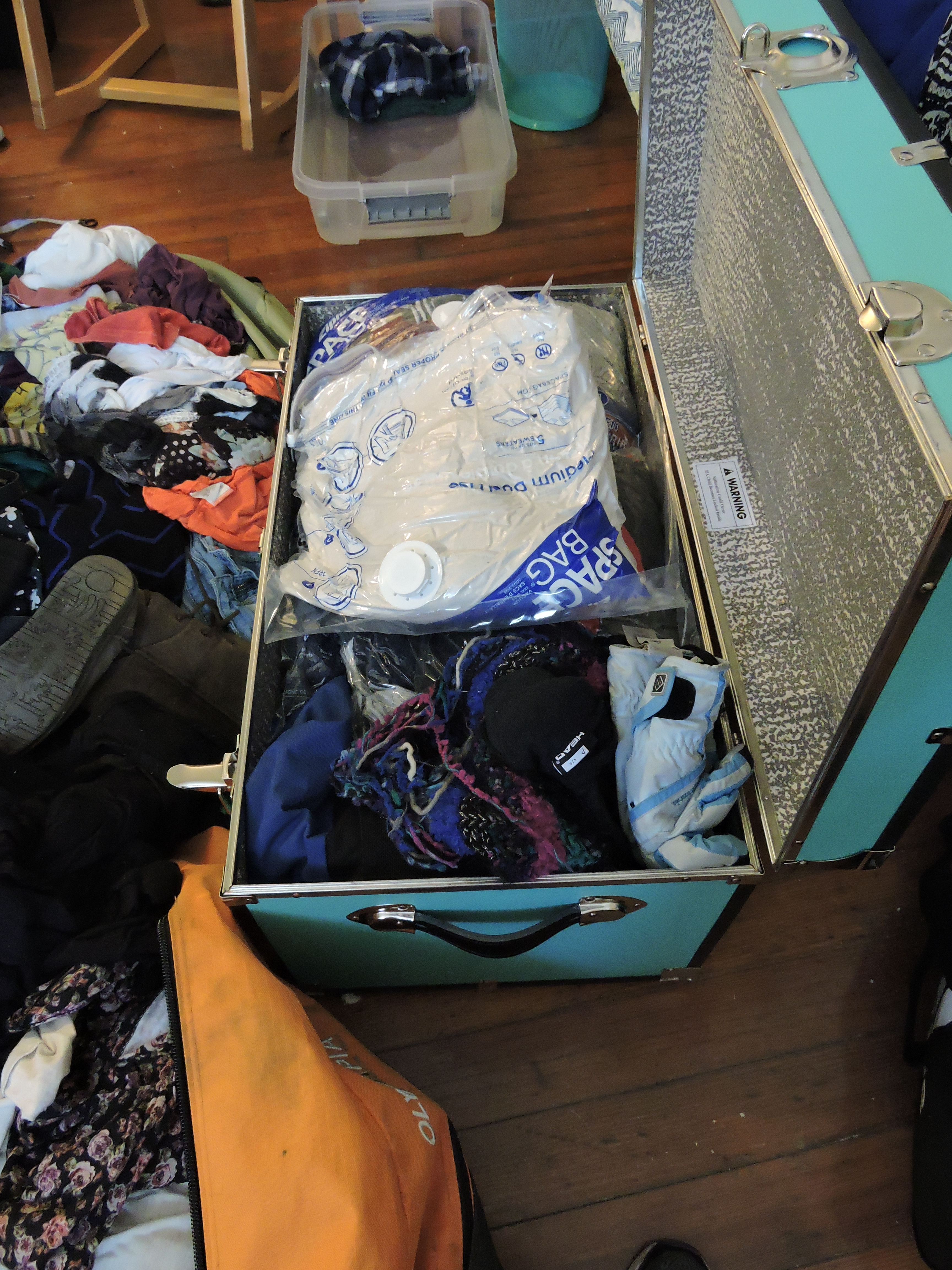
See? With five of these bags I was able to squish several coats and a winter’s worth of sweaters into her “basement” – really a trunk that is stored under the bed.
After we settled her in, it was time to explore.
I had many emotions coursing through me. Pride. Happiness. Awe. Sadness. But they couldn’t match what my husband was feeling that day. See, this was his college. His memories. His old haunts and stomping grounds. He even took us into his old dorm, in the same ancient quad just a few buildings down from my daughter’s:

I admit I have a bit of resentment. The two of them as close as they are will share these years at Penn, something I will never share. As a men’s chorus sang The Red and the Blue, I could not help feel a sense of envy, and strained in my own memory to hear verses of “On the Banks of the Old Raritan” from Rutgers. She will never go there. None of my kids will.
Still, like going to a school even older than Rutgers – Penn was founded in 1740 – you cannot help feel a sense the heritage of this place.

Hello Ben!
Even within with Penn Library exists some of our country’s most significant historical artifacts, including amazing one of only 48 printed copies of the Emancipation Proclamation signed by President Lincoln himself, which we had the rare opportunity to see.

As I stood on line to glimpse at this bit of history – hastily retrieved from the archives by a librarian who did not know that the University president suggested all incoming freshmen and their parents to visit the library to see it before they parted campus – my husband beckoned me over to another treasure trove of an exhibit.
There, in a quiet corner gallery in the library’s sixth floor, was a collection on display of some original artwork and some rare original printings of Ludwig Bemelmans, most famously known for his Madeline children’s books.
A book read to my girl as she sat on my lap night after night, A book that was one of the first she had learned to read herself ….now this young woman starting college,
:

As the afternoon wore on, it was time for us to say goodbye and for her to start her life.
As we walked her back to her dorm room one last time, I wondered what it would feel like for her, waking up for the first time pretty much by herself. She had no breakfasts in her meal plan. Who would she hang out with? What would she eat? Would she make a healthy choice at the nearest Wawa (you don’t know what Wawa is?) or would she consume complete crap? Who was going to tell her to drink the milk? To whom would she roll her eyes in response?
As I gave her my final embrace until October, I noticed a closed yet filled Nalgene water bottle laying on its side on her brand new comforter set from Bed Bath and Beyond.
An avid runner, she has left filled water bottles astray on many surfaces in my house: on the floor of the family room, on the floor of her bedroom, on her bed.
For probably the first time, I didn’t nag her about leaving things lying around. For eighteen plus years, I have done all the nagging a mother can do that is in within the limits of legality. After all, this was her bed. In her dorm. In her new life at college.
So as I learn to let her go, I let that water bottle go.
I just wonder if she knows what setting to put the dryer on if indeed there was a leak.
Good luck, to all the freshmen out there and to all the families out there with one less being underfoot!
The Incredible Weekend Getaway of the Six Invisibilia Women

 Before summer completely slips away and before I have to hop in my car again to take my kid to his second cross-country practice of the day, I must linger in the slow pace of summer and tell you about the incredible weekend getaway of the Six Invisibilia Women.
Maybe, if you also were lucky enough, you found some time to spend on friendship this summer. Not on your job or your marriage, or your kids, but pure, unadulterated time for kindling friendship.
Somewhere between your college graduation, your first job, your first marriage and your first diaper change, your identify as a girlfriend or a Best Friend Forever starts to slip away.
By the time you find yourself in mid-life, you become something of an egg white folded into a chocolate soufflé. Sure, the chocolate souffle is delicious and satisfying. You add body and texture to the family you created: your spouse, your children. You are the glue. You are the one who finally finds the watch the husband has been searching for in a pants pocket at the bottom of the laundry hamper. You are the one who is around to schedule and chauffeur the children to every last pediatrician, dentist and emergency orthodontist appointment.
But in those efforts, you sacrifice some of the stuff that made you you, and you start to become invisible.
If you are reading this and you are a man and the breadwinner of the house, I don’t know if this feeling of losing yourself applies to you. If I am wrong, please explain why in the comment box below.
Perhaps I am waxing post-feminism here, but guys, you pretty much shape the life, and where that life happens, for your family. From my experience, if a family relocates, they are relocating for the husband’s job and not for the wife’s career. You rarely look back compared to your trailing spouse. Outside your home, you have defined yourself and your path through your work, the reputation you have built around your career and the colleagues who know you near and far.
For the trailing spouse, however, (that would be me) you have to keep reinventing yourself with each move. You must chart a new course for yourself and you are pretty much on your own in your own reincarnation. Friendships from different chapters of your life fall away because of time, distance and family obligations. The more moves, the stronger the trailing spouse realizes their own sense of invisibility because making friends is that much harder.
Why is it that the deeper one moves into marriage and motherhood, the less time they have for friends? The long, uninterrupted conversations with college friends and the friends of the urban tribe pre-marriage get truncated into 30 minute coffee chats here and there at best. It is no secret that making friends in mid-life is tough. A 2012 New York Times piece says that, unlike when you are in your teens and 20’s, life is no longer wide open to new experiences or explorations.
Unless you move. When you pick up and move in your mid forties or later, however, you most likely no longer have babies or preschoolers to provide that cute entry path to new friendships. With teens and tweens, you plop down into a suburban setting where the mommy playgroups have all been played out, where all the coffee dates and walking groups have already been gelled. Your kid and your kid’s friends all have cell phones, so there is no need for the kid or the parent to call you to make social arrangements.
Everyone already has more than enough friends and connections in town. You can tell by the way they barely notice you at curriculum night or at the orthodontist or at the track meets. They’ve most likely had these same B.F.F’s since high school or college, making you feel all the more invisible. Sorry, mom of the teen and tween – all carpools and all the PTO committees have been pre-ordained since preschool. You can be sure of that.
If you are lucky enough, like me, the invisible trailing spouse, through forces of invisibilia, finds her path to friendship.
So what’s the deal with this word invisibilia? Invisibilia is a Latin word for all the invisible things, the invisible forces that control human behavior – ideas, beliefs, assumptions and emotions.
Invisibilia is also the name of a new N.P.R. podcast I was introduced to by a friend, a new friend who generously included me in her circle of friends – who also sometimes feel invisible amongst the ladies of the PTO – on this getaway weekend Up North. (If you are unfamiliar with the term Up North, you do not live in Michigan.)
As much as I would like to talk about the podcasts – and the books – we read and talked about – this is not a post about books and podcasts. It is about friendship.
So what happens when six women who all meet much later in life find themselves a free weekend in August with no obligations to anything else but friendship? They pack up some suitcases, lots of food and drink and share the four-hour ride Up North in a very spacious minivan. Let’s just say that by the time we got to our destination – our host’s parent’s lake house – our voices were all sore from talking.
After all, when you meet friends in your forties and up, you have a lifetime of stories to catch up on. The conversations were endless. There were no husbands, children or wifi. Cell phone reception was spotty. Therefore, old-fashioned and unfettered conversations flowed freely from topic to topic: our hometowns, how our husbands proposed, sagas on labor and parenting, and now challenges and struggles in our careers.
While we talked, we walked, cooked and ate. Some of us spent too much time cooking and were reminded by others to sit down and read their book for God’s sake! That is a friend, I tell you!
Some of us hung out in the hot tub. Some of us tried our skills in a canoe. We called out to the loons. When did we feel it was okay to show we were loony enough to call out to a loon? Some of us even braved the uninterrupted darkness at night to find a constellation or catch a glimpse of a shooting star. We tried to contain our shrieks of joy but it is kind of hard to do when a shooting star lasts for about five seconds leaving a trail across the dark unsuburban sky.
The only thing that interrupted our conversations was the sight of a flitting fleet of hummingbirds that visited the feeder attached to the large back window. Or the call of the loons in the lake. Or times at night when there was a seemingly silent pact that we would all sit around and read.
I have not felt as close a bond to other women since college. Even though I was surrounded by all these new friends, flickers of memories of old friendships darted in and out of my mind.
I thought of one of them when she asked us once, walking along a beach at the New Jersey Shore: “When did we come to a point of trusting one another with our secrets? How did we know we were at a point in our friendship where we could be silly with each other? At what point did we know how to make each other laugh?”
Back to the present… I realize that even though I have not seen some of my college friends in years, they have not left me. There still remains this invisible tie between us. Ties built on trust and shared confidences. They have only enriched my life by coaxing me out of invisibility to take chances on new friendships.
About Me

Kreativ Blogger

Versatile Blogger Award


 Stacy Gittleman