
The Holocaust in Degrees of Separation
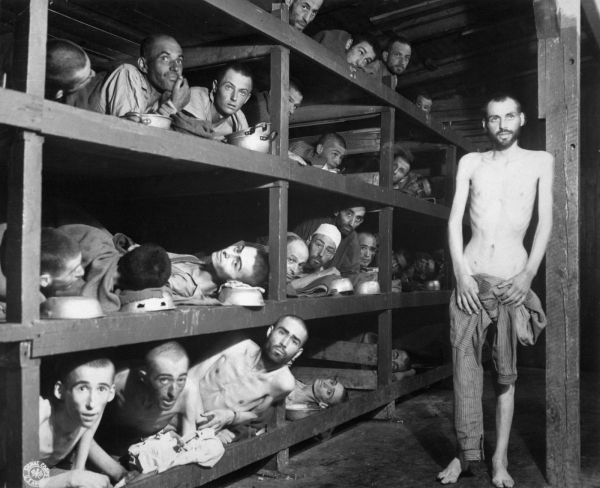
a photo of Jews, including Elie Wiesel and my friend's dad, liberated at Buchenwald
Leon Posen, a congregant from my synagogue, passed last week. He lived to the age of 94, blessed with a long life that could have been cut very short. His passing is still a sad one. Leon was a Holocaust survivor.
As the years and decades stretch away from World War II and Hitler’s war against the Jews, there are fewer people to tell first hand accounts of what happened in the ghettos and the concentration camps in Europe.
So who will bear witness in generations to come? Even if we don’t have a direct personal connection to the Holocaust, it is our turn to hear as many accounts as possible, and then tell them to the next generation. This is the only way to keep the vow of Never Again.
In Rochester, about 300 area Hebrew school kids in grades 6-12 watched their peers put on a play called “What Will You Tell Your Children” written by local playwright Jessie Atkin about her trip as a teen to the concentration camps in Poland. The play focused on the reactions of contemporary teens as they toured Auchwitz and faced anti-semitism and a general lack of understanding of Judaism at home.
I wonder if this new take on the Holocaust – telling the story second-hand and not directly from survivors’ accounts – actually disturbed,unsettled, and horrified the young audience enough to make them really remember. To make them relate. Was it too much of a softball throw in teaching the Holocaust? Is there – should there ever be — a gentle way to teach the Holocaust? How can it be unforgettable if we do not teach the inhumanity and the horror?
As the students watched the play, I watched the students. And then, I looked them as a whole – a bunch of healthy, creative, sometimes fidgety, teens and preteens. This was the same age demographic that Hitler selected for his Terezin concentration camp in Prague. A room with this many kids, multiply that number until you reach 15,000 kids. That’s how many died in Terezin, I thought. I shivered.
In my Hebrew school, we were spared nothing. My teacher, Rabbi Tzvi Berkowitz, was born in a displaced person’s camp in Cypress. The one depicted in the historical fiction novel “Exodus” by Leon Uris. He was the child of concentration camp survivors. Because of this, in our Holocaust education, we watched many horrible films shot in grainy black and white of the ghettos and camps filled with emaciated bodies. Some tortured and barely alive, some already dead.
But, still, it happened to someone else’s family, not my family, all those years ago. They were disturbing and yes, the first year I really learned about the horrors, I spent many nights curled up at the foot of my parent’s bed to sleep.
Now, I live in Rochester, a small town with an unofficial, intimate club that no one wants to belong to, yet they are proud members of it. Rochester has many Holocaust survivors whose families are now second, third and even fourth generation survivors.
It wasn’t until I had friends in this club, that I began to think: if his mother, if her grandfather didn’t survive, than this friend wouldn’t exist, or certain friends of my children would not be here.
Unlike the Yom Hashoah services of my childhood, when it seemed that everyone in my synagogue attended, it seems that Yom Hashoah services are attended mainly by those directly touched by the Holocaust, survivors and their decendants, leaders of the community, particpants in Rochester’s march of hope or our teen trip to the Holocaust museum in Washington D.C. So, going to these events, I still feel, thankfully, disconnected.
But in 2006, I had the privlelege of attending in Los Angeles the United Jewish Community’s General Assembly. That year I was the recipient of my community’s young leadership award, along with my traveling companion, Ron. Ron has the biggest heart of anyone I know, and lots of energy. An entrepreneur, he always seems to have three or four business ventures going on as well as several philanthropic projects. This is the kind of guy he is: we were stuck in an airport on the way home waiting for a delayed flight. It was late and people were crabby. Ron goes to the only remaining open store in the terminal, buys a bag of candy, and walks around, offering candy to the stranded travelers.
One part of the trip, young leadership delegates from around the world were taken to L.A.’s Museum of Tolerance. The museum, chronicles the Holocaust and current genocides in world history. Sadly, it shows visitors that vows of “Never Again” cannot ring true. In the decades since the Holocaust, there has been genocide in Cambodia, the Balkans, Rawanda, Sudan. Our docent said that the museum has been a destination of feuding gangs of LA to teach them the consequences of hate.
Further into the emotionally-charged museum, we came to the tail end of the Holocaust exhibit. There, transported from a concentration camp, in the corner of a dark room, was an actual bunk where prisioners slept, stacked three levels deep. Two to three men slept on planks on a bed the width as narrow as a twin bed. In the background, behind the bunk, was a life-sized photo, a well-known photo of survivors of Barrack 66 in Buchenwald. In this photo, is an emaciated Elie Weisel. I had seen this photo dozens of time in my life. Then, all of a sudden, Ron grabs me by the arm and points. Impossibly, my friend Ron’s face was peering out from the bunk one level above Weisel.
“Stacy!’ my friend cried, “That’s my DAD!”
And that is my degree of separation from the Holocaust. What is yours?
Swirls of Color or Standardized Dots? Keep Arts in Schools
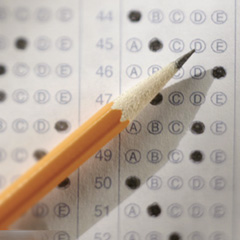
What picture inspires you more.
This?
Or this?
If public school budgets continue to shave and slash away at the arts, the black and white dots of those “No Child Left Behind” standardized tests are all that will be left of our children’s public school education. Teaching to the test leaves no room for imagination, creativity, real thinking or problem solving. What it has resulted in is burned-out stressed-out teachers and students.
This is according to an independent documentary called “Race To Nowhere” that is sparking a grassroots movement to reshape how we educate our public school students. I look forward to seeing a screening of this independent movie in Rochester, NY, at Nazareth College on April 4. The movie screening is being sponsored in part by a private Jewish day school, Hillel Community Day School.
The film challenges parents, educators, and policy makers with this question: Are we doing right by our children? Is the pressure to succeed in standardized tests really preparing our children to become capable, inspired and motivated individuals ready to tackle college or the workforce?
When school budgets get tight, the arts are the first to get cut. In fact, schools in the Rochester area are seeking to reduce some of their arts budgets by 50 percent.
Is music, art and sculpture really that expendable? Is painting, singing, and playing an instrument such a frivolous part of a child’s education that it should be considered a fluffy extra that can be easily eliminated from his academic career?
Absolutely not, according to Americans for the Arts. Young people who consistently participate in comprehensive, sequential, and rigorous arts programs are:
- 4 times more likely to be recognized for academic achievement
- 3 times more likely to be elected to class office within their schools
- 4 times more likely to participate in a math and science fair
- 3 times more likely to win an award for school attendance
- 4 times more likely to win an award for writing an essay or poem*
When was the last time your child stood at an easel and held a brush full of paint? Or perhaps, in the spirit of abandoning everything for creativity’s sake, she ditched the brush and instead joyfully found herself up to her elbows in paint, as her hands and fingers glided across the paper.
Indeed, art is messy. When was the last time you let your kid get messy at home with some paint or clay? Overheard once in a preschool hallway: “I’m so glad they paint here at school, because at home, we don’t let him do that.”
Might as well draw a dagger through a teacher’s heart.
Video games and television are not messy. But they don’t do much to fire up the brain neurons either.
Art on the other hand unlocks creativity in children that leads to story telling, pattern recognition, and understanding other cultures. It is simply the expression of life that makes life enjoyable. Art enables quiet kids to tell stories. Art calms and centers otherwise boisterious kids. It is a positive way for them to control the environment around them. A blank piece of paper or a lump of play dough can become a whole universe that they can master.
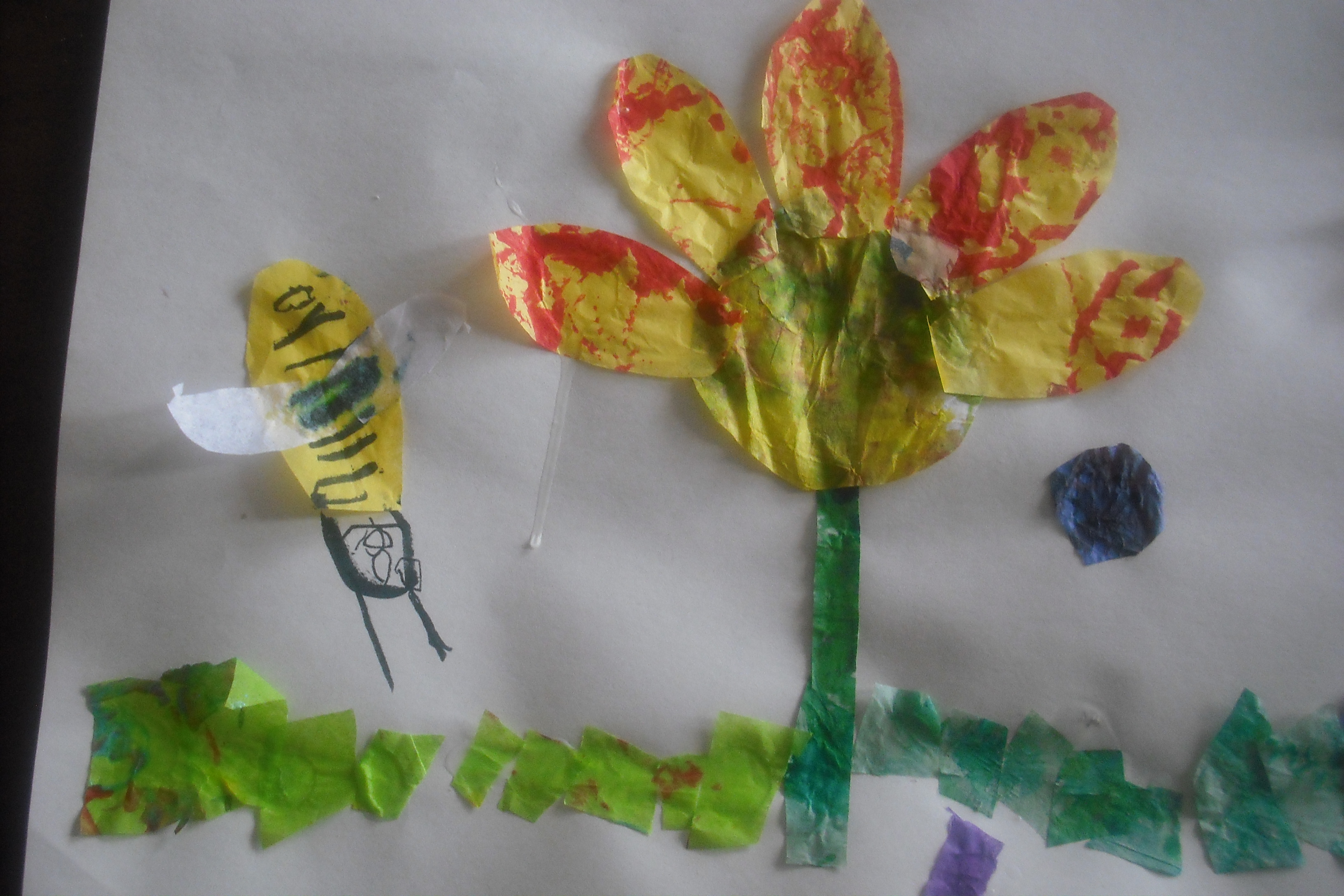
The above picture was created by a very precocious preschooler who patiently sat, cut and created a composition. Imagine what that same child can do when she gets older in an art class?
If a child is not going to be exposed to the earts in their earliest school years, then where will they get the opportunities? If arts are cut in public schools, there are private arts classes that parents can enroll their chilren in most towns and communities. But they cost money. So, cut the arts in public schools, and access to arts will only be possible to the families who can afford them.
And the rest? GThe only drawing less priveleged kids are going to do in school are the dots and circles they create on a standardized test.
A Share in Community Supported Agriculture: Let the Adventure Begin

This week, a friend and I put down the down-payment on an epicurean adventure we will be taking this summer.
Why is it an adventure?
Because we have signed on and invested in a local farm, and all the risks that go with farming. We are taking a bet on Mother Nature that she will bestow upon our local farm the perfect conditions for growing a bountiful crop this summer.
Because this summer, we will have to get very creative with kale and beets.
The rising demand for locally-grown produce and sustainable farming methods has created opportunities for developing a connection between enterprising young farmers and suburbanites through a movement called Community Supported Agriculture, or CSA.
In December 2001, one source reported a net total of 761 CSA farms registered with USDA. By 2007, an agricultural census conducted by the USDA tallied 12,549 farms that marketed products by way of community supported agriculture (CSA).
Most of these CSA farms are located in California and Texas. Right now, in New York State, there are about 200 farms that use CSA as a method to market their crops.
Oe of them is the East Hill Farm CSA in Middlesex. It is the project of the Rochester Folk Art Guild a sustainable community of artisans and farmers who have worked and created on this farm since the 1960’s.
Though the ground is still covered with snow, the East Hill Farm managers are busy ordering vegetable seeds, recruiting volunteers and processing CSA membership applications. Over half of the farm’s 80 shares have already been sold. A membership for 20 weeks of produce costs $500, or $490 if purchased before March 1. Shares include a wide variety of vegetables, as well as fruit in the later part of the season.
Information on getting a CSA share can be found at www.easthillcsa.org or by calling the JCC at (585) 461-2000. At the website, one can even sign up for a “CSA buddy” to split a share if a boxful of veggies every week may be just too much to consume.
The East Hill Farmers represent a new generation of farmers who may not necessarily have a background growing up on a parent’s or grandparent’s farm. What they do have is a passion for growing food with organic and sustainable techniques.
Cordelia Hall grew vegetables as a child in a community garden and then became part of the “guerilla” urban gardening trend while she was a student at Boston University. Now in her third year as co-manager of the farm, she has observed and worked on farms in Tanzania, New Zealand and Mexico.
Thomas Arminio, another suburbanite-turned-farmer at East Hill, said his experience in farming has taught him that timing plantings just right is crucial for having successful crops. A native of New Jersey, he is looking forward to growing interesting varieties of melons and root vegetables along with heirloom tomatoes, beets, Swiss chard and lettuces.
So, this summer, I can actually say I have become acquainted with the people who will grow my food, because I interviewed them for my column and this blog post. You just can’t say that buying a plastic-wrapped package of hothouse tomatoes from a big box warehouse store or the supermarket.
As I get my box of veggies for the week, I’ll write about what I got, and what I made, so stay tuned.
Happy Year of the Rabbit

My brother and I at Ko Shing Rice Shoppe's Grand Opening, circa 1977
Growing up, all roads led to Chinatown.
My family went into “the city” a lot. That is what Manhattan is called, even if you lived in one of New York City’s outer boroughs, as we did. We could be uptown at the Museum of Natural History, at Madison Square Garden catching the Ringling Bros. & Barnum & Bailey Circus or the Ice Capades, or schmoozing on the Lower East Side. But when we got hungry, we ended our day in the city in Chinatown.
And most of the time, we ate at the same restaurant: The Ko Shing Rice Shoppe.
The Ko Shing Rice Shoppe was located right across the street from the brand-new Confucius Tower apartment buildings. Its dining room was sparsely decorated with wood panels and mirrored walls and plain tables and chairs. It was not a tourist spot so it did not have the usual Chinese kitsch of gongs, pagoda-sloped ceilings or dragon tapestries on the walls.
What it had was great food.
My grandfather knew the owner from many years before. He worked nights at the New York Daily News for over 50 years. His lunch break was around 3:00 a.m. Over the years, he became a regular at one of these all-night Chinese kitchens that operated out of a midtown basement. There, he met Lee. One day, or night, Lee said he was opening up his own restaurant in Chinatown and wanted my grandfather’s whole family to be there for the celebration.
That is where the above picture is from. I was about nine, so my brother was only five. We were the only non-Asian family there among the celebrants, and we were treated to plate after plate of chicken & cashews, crab, bowls of winter melon soup and other delicacies.
From that age on, until my 20’s that was the restaurant of my family’s choice, above Italian food, above Kosher Deli, it was Chinese food that was our exotic cuisine of preference. Chinese food is as inextricably linked to my identity as Matzah Ball soup and gifelte fish.
So, on day outings to the city, we would get there at an odd hour: 3:30 or 4 o clock. The restaurant would be all but empty except for our family: my parents and my brother, my grandparents, and friends who would meet us there, locally and from out-of-town.
In the back at a huge round table, the cook staff would be chopping mountains of Bok Choy and broccoli in advance of the evening rush. My grandfather would take us into the kitchen to say hi to Lee and the chefs. Then we would order, my grandfather would order for the whole family not bothering to even look at the menu. He would just ask Lee to make us a dish of this and a plate of that, always with extra ginger and garlic at my grandmother’s request.
If the waiters had time, they would patiently instruct my brother and I how to use chopsticks. We would have to eventually abandon our practice and resign to use our forks when my mom and grandmother said we were taking too long in our attempts to pick up every individual grain of rice.
After dinner, it was still early in the evening. No matter the weather, summer or winter, we would walk through the narrow streets of the heart of Chinatown. And before vegetarianism or veganism was hip, my grandmother was the first person to introduce me to tofu. After dinner, she would have to make a stop at the Tofu factory to bring some home.
The Ko Shing Rice Shoppe was a place where we held our family birthday parties. My mom’s 40th. My grandfather’s 65th. I even found myself there with my grandfather after the funeral of my paternal grandmother, with whom I did not have a relationship.
But on the ride home, seeing that I was a bit glum, my grandpa found our way somehow from the funeral home in Westchester to the Ko Shing Rice Shoppe. We talked over the events of the day over steaming cups of tea and a dish of beef lo mein.
I don’t know if the Ko Shing Rice Shoppe still exists. I went back to Chinatown on a recent visit but didn’t have the heart to walk the street where it was, in case it was boarded up or another restaurant had taken its place.
In young adulthood, visits to another Chinatown – this time in San Francisco – were a highlight of my newlywed life when my husband and I lived in Berkeley, Calif. We ate at San Francisco’s famous house of NanKing, where lines would snake around the corner during the Chinese New Year to sit in a crammed dining room and feast on sizzling plates of vegetables drenched in the most incredible hoisin sauce I have ever tasted. In the evening, we squeezed into the crowds for a view of the parade, complete with Chinese Dragon dances, drumming bands, and marshall arts demonstrations.
Now I live in a town without a Chinatown. But there are still some good family owned Chinese restaurants in Rochester, like Golden Dynasty and Chen’s. My diet has changed from consuming everything to only sticking to vegetarian items. But still, on Chinese New years, my children delight in the traditions of getting a dollar in an envelope and opening up fortunes.
Have a great New Year!
Ice Cubes in the Toilet and other Tips to make a Snow Day
 Tonight, my kids will most likely go to bed wearing their pajamas inside out. The youngest will have tucked a spoon underneath his pillow. My daughter told me that at middle school, the bets were already on at school today as to whether tomorrow would be a snow day. After all, that storm that slammed the midwest has now put Rochester in a “persistent band of lake effect snow.” And here in Rochester, we may be getting 1-2 feet of this lake effect snow. All this snow, yet not a single weather report has used the word “storm” or “blizzard.”
When my oldest children were very small, I feared that they would grow up without having a chance to play in the snow. Their first winters in New Jersey passed with hardly a flake. Then, we moved to Rochester.
Moving to the snowiest metropolitan area in the lower 48 meant that we would have plenty of chances for snowball fights and snowman building. We also needed to adjust our perception of what constitutes a significant snowfall.
You see, we started our family in New Jersey, in the land of 2-inch snowfall snow days. One morning, when my daughter attended preschool at the Scotch Plains JCC, I bundled her up, along with her infant brother, to go to preschool. I traversed 2-inch snow-covered roads, only to find the building was closed.
Fast forward to a year later, One morning, after a three-inch overnight snowfall, I actually called my daughter’s preschool – this time at the JCC of Greater Rochester – to see if it was open.
I think I heard the director silence a chuckle as she politely told me that schools here don’t close unless there is at least 18 inches of snow.
For schoolchildren and adults alike, nothing is more exciting than the possibility of a snow day. And when I moved to Rochester, I thought that we would be having a lot of those days that are like gifts from God. Snow days are like God’s way of telling you to slow down, sleep in, stay warm, bake cookies.
Well, the Rochester School District seems to care little about what God wants, because nary a snow day have we had since living up here in the snowbelt.
It’s been 11 years and my husband has yet to have a snow day from work. No, wait. The only “snow day” at his job had been in the summer. Why? It wasn’t because of snow. Contrary to popular belief, it does NOT snow in Rochester in July.
It was a tree that fell on a transformer and blew the power out at his office.
So, on snowy days, my husband braves the snow. He plows himself out of the driveway in the dark of the morning, and then plows to get back in the driveway in the dark of the evening.
Rochesterians are very lucky to have the equipment it takes to fight against Old Man Winter. Brighton tax dollars – more than half a million each year — are hard at work so in the early morning hours, I can hear the sounds of snowplows large and small clearing our roads and sidewalks.
So, before I go to bed tonight, I will check the forecast one more time. And if I hear those blessed three words “Brighton Schools Closed” on the radio tomorrow morning , I know will be too excited to go back to sleep.
But I know school will be on tomorrow.
In spite of the spoons
and the inside-out pajamas.
and the ice cubes placed in the toilet.
Because, in reality, it’s just too early in the season to cancel school tomorrow. After all, technically, it is still Autumn. And this is Rochester.
A Small Chanukkah Miracle at Checkout Aisle Number Eight


“Are you doing anything special this Hanukkah?”
I guess Steve the check-out cashier figured out I was Jewish. After all, from my grocery cart, I unloaded a bag of potatoes, onions, some Chanukkah napkins, blue and white M&Ms and a box of beeswax candles.
“Not much,” I replied. “Just going to my son’s band concert tonight, and then down to New York City for a family occasion.” I didn’t want to say it was for a Bat Mitzvah. That’s just too complicated if you don’t know what a Bat Mitzvah is.
“Ooooh, New York City! That’s where they seriously get into Chanukkah! I mean, the big menorah displays, and the food — the matzah ball soup! Even in the diners, they make French toast out of challah down in New York City,” he went on.
Now, you don’t have to be Jewish to love matzah ball soup or challah French toast. And, I am pretty sure, you can get challah French toast up here in Rochester.
But the sentimentality in his voice towards matzah ball soup, the way he so dreamily spoke of the menorahs as he scanned my clementines and sweet Mayan onions, I had to ask:
“Um, are you Jewish?”
Now, this is not a question I would ask a complete stranger. But around this time of year, when the enormity of Christmas seeps into every crevice of the American landscape, Jews have this desire to connect to one other, to stick together. Judaism as a topic of conversation is a subject that would be avoided by the most disenfranchised, unaffiliated Jew for most of the year. But talking about one’s Jewish identity in the face of Christmastime, is, like a plate of freshly fried potato latkes, on the table and up for grabs.
At any other time of year, a suburban housewife and a 20something college kid working in a grocery store wouldn’t openly discuss being Jewish. But that night, right before the lighting of the first Chanukkah candle, amidst the Christmas Muzak playing and the Christmas tree displays twinkling, it felt like the right time.
As he carefully bagged my groceries with the expertise only possessed by a Wegmans employee, Steven continued to tell me his plans for the Festival of Lights.
“Yeah, there’s this Chanukkah celebration thing going on at the University of Rochester tonight. From – you know – Hillel? I think I might check it out. I haven’t gone to many Hillel events, but I think I should check it out.”
“Good for you!” I replied. This did my heart good. I told him that I worked for the Hillel – the organization that supports Jewish life on college campuses around the world – a number of years back. With so many negative statistics out there pointing out the demise of Jewish practice among today’s young American Jews, Steven telling me of his plans to do something Jewish, to be with other Jews that night, just made me feel all warm inside.
Chanukkah is such a small holiday in importance on the Jewish calendar. But it celebrates something so big – the world’s first fight for religious freedom. It was the first time a people – though meek and small – said NO to an occupying power. Judah Maccabee and his brothers were the first who had the chutzpah — the balls, if you will — to say, NO! We will not stop being Jewish. We will not stop teaching our children how to be Jewish. You can put up statues of your idols, you can outlaw Jewish practice, you can threaten us, but we will survive.
And survive we did, and we have, in spite of history. And in spite of the dreary outlook for the American Jewish landscape, Steven, the college kid who worked at Wegmans, was going to go out of his way to celebrate Chanukkah, to celebrate being Jewish.
Happy Chanukkah to Steven and to all who celebrate freedom.
Over the River and Through the Woods: Tips from Thankful Road Warriors

How do you get from here to there?
Thank goodness for Thanksgiving. The long weekend affords most of us a breather from modern life’s breakneck pace. We pause to focus on coming together with family and friends, preparing a meal, tossing a football and sleeping late in your own bed.
But, if you are like my family – transplants – Thanksgiving means hitting the road. Or, heaven forbid, the airports. That is the only way the family-coming-together aspect of the holiday happens for us.
In our case, traveling is not as idyllic as over the river and through the woods. It’s more like Down the Thruway and over the Outerbridge Crossing to Staten Island We Go. Where there are hardly any woods left to go through.
For eleven years now, we have traveled to see our family every Thanksgiving but one. This is another consequence of being Transplantednorth. If you leave the area where one’s family roots are still entrenched, the roads are rarely traversed the other way. It’s just expected. We are the only part of the family “upstate.” We left. Everyone else still lives Home — the New York Metro Area. Or, in a term I only learned when transplantednorth – “downstate.”
And on Thanksgiving, just as the larger planet pulls on its smaller orbiting moons, down the Thruway we go.
One especially hectic year, we stayed in Rochester for Thanksgiving. The weather was beautiful – warm even — and we spent a relaxing weekend feasting and playing into the evening at the Brighton Town Hall playground. I prepared perhaps the only Thanksgiving feast I will ever make. I made the turkey on the barbecue. I made a chestnut stuffing ala Martha Stewart. Everything tasted delicious. But the lonely looks on my childrens’ faces taught me a lesson: Thanksgiving tables are too empty without grandparents, aunts, uncles and cousins.
So, after traveling for 11 years with two and then three kids in tow, I have become thankful for a thing or two on what I have learned and would like to share them with you, especially if you are a novice at parenting on the go:
- I am thankful that cries for Sippy cup refills and diaper changes have been replaced by three contented souls in the back who can pass snacks to each other, operate the remote to the car DVD player, and participate in family sing downs and games of 20 Questions.
- I am thankful for every rest stop we have discovered between here and there, especially to kind workers who have supplied us with buckets, hoses and slop sinks for carsickness cleanups. Really, if you do have a kid that gets sick in the car, find a truck stop like the Flying J Travel Plazas that have showers and washing machines. The folks there are all too kind to help you in your distress.
- I am thankful that we finally come “home,” we have relatives who bound down steps and out into driveways to greet us, no matter the lateness of the hour.
In our 11 years of travelling down to New York City, here are my family’s dos and don’ts when traveling the Western New York-to-New York City Route:
- DO strap everything down very carefully. On our first trip back to Rochester, on a windy, windy passage of Route 78 in New Jersey, our Peg Perego Stroller came loose and flew off our roof rack. One minute, there it was, and then it was on the side of the road, thankfully killing or injuring no one in its catapulted flight.
- If you are traveling with very young children that might become carsick, but may not alert you at the most opportune time that they will become carsick, DO pack a puke kit. This kit includes a roll of paper towels, a bottle of Lysol all-purpose liquid cleaner, and a change of clothes that is easily accessible.
- If traveling with those same small children, DO invest in one of those Art Cart on the Go Tables that can be placed over a child’s lap. The Art Cart has legs that double as side pockets that keep paper, crayons and markers handy. Or, in the worst case scenario, those pockets also can come to the aid of the carsick child. I speak from experience.
- For a meal break, DO stop in Scranton or Dickson City, Pa. It is exit 191 A or B on Route 81. Home of The Office, it is a great little town to stop for meals. If we hit Scranton for lunch or dinner, we eat at Tonalteca. The place is clean, the decor features hand crafted carved booths from Mexican artisans, and there are plenty of choices for vegetarians. The guacamole is outstanding. And, for those of you who get stir crazy in the car, they play great salsa music in the bathroom. If they have the security camera going by the sinks in the ladies room, they might have footage of me doing some salsa steps I learned in Zumba for all I know. Anything to work off that guacamole.
- DON’T stop in the Poconos for any reason. There really is no place to stop. The gas stations for bathrooms have nothing more than outhouses or bathrooms around back that you have to carry in those huge keys for admittance. And, if you see a billboard for The Cheesecake Factory, don’t believe it. No, it isn’t The Cheesecake Factory, the upscale eatery. It’s just – a cheesecake factory. So, unless you want to sit in your car with your family consuming a cheesecake for a meal, ignore the sign and keep driving.
- DO find the small village of Whitney Point along Route 81 and stop at Aiellos Italian Restaurant for the best pizza you can find in Western NY. And I am not saying this is good pizza for Western New York. I mean, this is thin-crust Brooklyn Pizza that somehow found its way to Western New York. And, the quaint restaurant in the back will be decked in its Christmas decorations this time of year. You won’t want to miss out on this.
And as for traffic…..
- DON’T be anywhere near Binghamton or Syracuse on Sunday afternoon if you can at all avoid it: college kids coming back from Thanksgiving break.
- DON’T go near the Delaware Water Gap if you don’t want to get stuck in traffic during peak hours
- DON’T go over the George Washington Bridge or traverse the Cross Bronx Expressway. Ever.
Safe travels to you and a very happy Thanksgiving.
Bye-bye Tar Beach, Hello Green Roof

Growing up in Brooklyn, if you couldn’t make it to the real beach on a hot summer day, all you had to do was go up to Tar Beach. Did you go to Tar Beach?
“It was really hot up there,” my mom told me on a recent visit, as she told me about how she and her friends would spend hours up on the roof using sun-reflectors even to maximize their tans. Ahh, the good old days!
Tar roofs, though hot and contributors to global warming, made great song material, though, you must admit.
The Drifters sang about the sun burning the tar up on the roof in “Under the Boardwalk” and how to forget all your cares “Up on the Roof.” Elton John sat up on his roof and kicked off some moss in “Your Song.”
Perhaps Elton should have cooled his boots for a moment and left the moss alone. Growing plants on roofs — from vegetable gardening to sophisticated sod membranes that soak up urban water runoff and cool the air — are becoming a required building material in cities like Toronto and Chicago.
I know that tar roofs are not exclusive to Brooklyn, no matter how Brooklyn-centric my point of reference may be. In fact, cities like Chicago, where new laws are in place requiring new buildings to have green roofing materials, the temperature on a tar roof can be 78 degrees hotter than that on a green roof.
Walk across any asphalt parking lot on a summer day and then walk across a green lawn. You don’t have to be a scientist writing a big fat feasibility study to understand how black top paved surfaces and roofs heat the earth and green areas have the potential to cool it.
In Rochester, NY, The Harley School is employing this technology as one long-term science project and can boast that they are the area’s first school to have a green roof. This sustainable technology will not only act as a natural insulator, keeping the school warmer in winter and cooler in summer, but it will teach its high school students about how buildings affect the environment.
The tar roofs of the past, according to environmentalists, are the bane of city living because they create urban heat islands and contribute vastly to water runoff. Rather than being just a green trend, cities such as Chicago and Toronto require roofs of new buildings to include cooling, greenhouse-gas absorbing plants.
The Harley School on Oct. 18 installed two 10 x 10 ft. plots of hearty winter grass on the roof of their building on 1981 Clover St. The school spent $2,000 for materials and also received an in-kind installation and materials donation from Zaretsky & Associates landscapers in Western New York. In order to grow a section of green roofing, school engineers had to assess if the school’s roof could withstand the additional weight of a weatherproof membrane barrier, two inches of topsoil, the weight of the growing plants, and the water they will retain. The grassy roof serves as a natural insulator and will keep the building cooler in the summer and warmer in the winter. School officials expect to reap the benefits of these initial costs within 3-10 years.
Peter Hentschke, a science teacher who will be working with Harley’s upper classmen on researching the impact of the green roof, said the project provides students with hands-on learning. The students will develop mathematical methods and equations to determine how much energy their school saves by comparing temperatures of the school’s different roofing materials. They will also calculate how water runoff is affected by the green roof.
“Rooftop plants catch rainwater and runoff that would have ultimately run into the sewer and overburden water treatment centers. The students are tracking current rainwater runoff with water gauges and will track this throughout the school year,” he said.
Chris Hartman, Harley’s social and environmental sustainability coordinator said the students are “all fired up” about learning about the green roof because it has real-world implications.
“The Harley students are really in the driver’s seat of this project. They know that it is cool to have a green roof, but the challenge will be to come up with the methodology to show how green roofs have an impact in the world around them,” said Hartman. He added that students hope to share the data from the green roof with their classmates, and perhaps local colleges such as the University of Rochester and Rochester Institute of Technology.
If we all started growing green things on our roofs, perhaps by the time these kids graduate college, our cities would from above look less like Tar Beach and more like the ancient hanging gardens of Babylonia. I wonder what songs they will inspire by then.
Bats in the Belfry: The educational conclusion
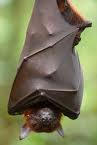 After you are told by the Batman in the middle of the night that you may have a bat colony in your attic, sleep does not come easy.
In my last blog post, I wrote about the night we were visited by a bat. There was a bat in our house. We saw it one minute and it flitted to an unknown location the next.
If you live up in the cold North like I do, and have not had the sufficient funds to replace every charming leaky window in your 77-year-old home, then you are familiar with the practice of wrapping your windows in shrink plastic for insulation. On The Night of the Bat, the wind outside howled, causing the plastic wrap on our bedroom wrinkle and crinkle. Of course, I mistook every wrinkle and crinkle for the wings of a bat and shot straight up in bed every 10 minutes throughout the night. I’d never wanted morning to come so badly.
Have you ever had a bat loose in your house in the middle of the night? I later learned that we were not alone in this experience. Bats seem to be a common occurance in older, charming homes. Bats are the one uncharming feature that the realtor leaves off the charming English Tudor house listing.
We shared this story the next day with many of our friends. One couple we know, who are avid campers, said when a bat swooshed over their heads in bed one night, they didn’t hesitate to pitch a tent over their bed to get a good night’s sleep.
I’ll have to remember that for the next time.
Morning finally came. I probably slept for two hours at best and my nerves were fried when my husband woke me to tell me about his discovery.
“You have to see this, I found the bat!”
He led me to our living room and I think I hid my head in his shoulder all the way down the stairs. Behind the honeycomb shades, up by the ceiling, there was a small shadow. Suddenly, this terrifying creature of the night seemed harmless. Even vulnerable. I quickly put on my boots and ran outside to get a better look.
Between the living room window and the shade, our winged intruder hung upside down and was fast asleep. I have to admit, swaddled in its pale grey wings, this small bat, the same creature that terrorized me, looked pretty cute.
A few hours later the Batman came for a visit. No, it wasn’t the Dark Knight or Caped Crusader of comic book fame. Just a guy with a five o’clock shadow at 10 a.m. wearing a red and black lumberjack flanel and jeans ripped through the knee.
He asked if our kids were around because they might like to see the bat up close and personal.
My fearless children ran down the stairs in their slippers to watch what became their own private wildlife demonstration. The Batman put on heavy gloves, produced a coffee can with holes cut in its lid, and gently removed the bat from our window shade. It was tiny, it was frightened, and now, in the capable hands of the Batman, it would be released into the wild.
As much as we love nature and wildlife, we resolved to keep these creatures out of our house for good. And no, upon further inpsection, we did not have a colony of bats in our attic.
What we did have was a lot of holes and cracks. Bats have a very flexible skeleton and can slip into a crevice the size of a matchbox. The Batman’s price for bat removal: $50. The Batman’s asking price for bat proofing my home: $1300.
After recovering from the sticker shock, we then called in another local hero: Leroy. Leroy is one of those guys that everyone knows by first name only and his name gets passed around by all the neighbors. For half the Batman’s asking price, he batproofed our home and gave me a full education on how you know if a bat is in your home.
1. Evidence of guano, or bat poop in your attic. Enough said here.
2. Look at places like attic louvers, where the chimney joins the house, and gable ends of your house structure itself. To my shock, I could put my eye between chimmney in our attic and the house frame and SEE outside. So this is where the critters were getting in. Leroy then used foam insulation and sealed up the gap like this:
 Keep in mind that sealing the opening must be done while also leaving for a way for bats to exit without re-entering the space. In an ingenious use of pantyhose, Leroy created a contraption that allowed a one-way exit for any bats that may have remained in our attic. If the openings are blocked during the daylight hours, the bats would have been sealed inside with the rest of the family.
I am happy to report that this story happened seven years ago and this house is clean of its bats. All the children are healthy rabies-free and none foam at the mouth. I wish you a bat-free winter and remember — bats really are harmless for the most part and want nothing to do with you, or your hair.
The only thing our society needs to fear – bedbugs!
Good night.
What’s a Nice Jewish Girl to do about Halloween?
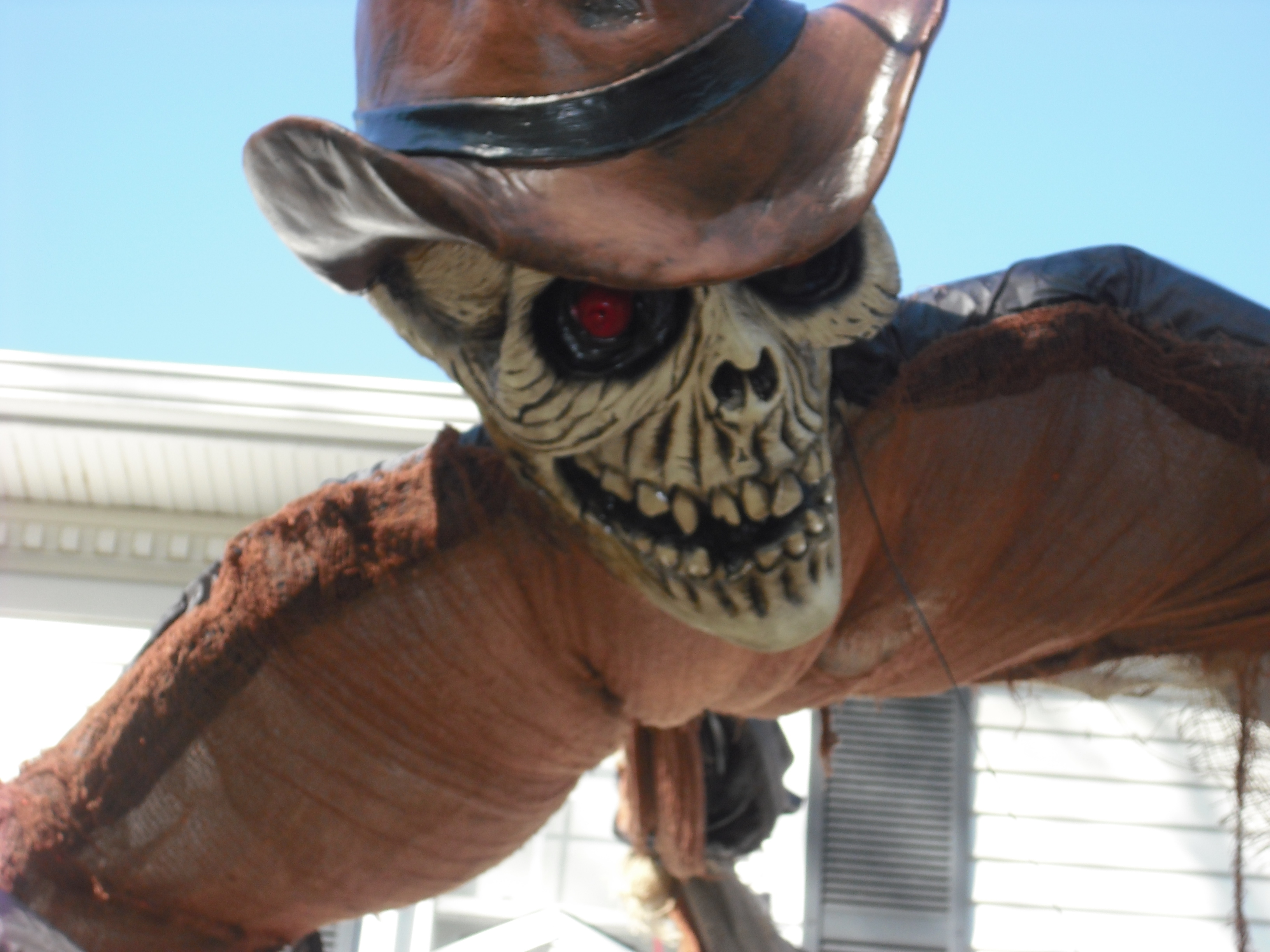
Some of my neighbors really get into decorating for Halloween
My birthday falls in late October. I will not disclose my age, and those of you who know me know what that number is. Unless a birthday is one that ends in a 0 or a 5, birthdays at this stage of life are no big deal.
But think back to when you were a kid. Those were the days when one counted down the days to their birthday party. And if you were lucky enough to be born on the cusp of the Scorpio sign, birthday parties were all about Halloween. Late October babies have a built-in costumed, candy-corn flavored theme that is perfectly gift wrapped with a giant fake spiderweb and grooves to the music of a Monster Mash soundtrack.
Each year, even up through high school, I celebrated my birthday with a costume party. On my seventh or eighth birthday, my grandmother transformed herself into a gypsy storyteller to the delight of all my costumed friends. My parents and grandparents even staged special effects, complete with a charmed stuffed snake to rise out of a wicker basket with the help of an invisible fishing wire.
All through childhood, my mother and grandmother were the master costume makers. My mom said that when she was growing up in her Bensonhurst, Brooklyn apartment, my grandmother would dress up as a witch and concoct costumes for every kid in the building.
And when it was my turn to dress up, mom and grandma could make me into anything I wanted because they both knew their way around a sewing machine. Pity my own children this time of year. I cook, I bake, I garden, I teach, I read Torah, but I cannot even decently hem a pair of pants.
I wanted to be a sunflower one year: mom made me a sunflower. And then scarecrow, and Indian Princess, and even a hairdryer. And my final Halloween birthday party, I made a really convincing Boy George.
Halloween birthday parties, trick-or-treating and getting candy went on happily and innocently until the seventh grade. That year, Halloween fell out on a Tuesday which was afternoon Hebrew School.
Hebrew School started at 4:30 and let out around 6 p.m. Through Chumash (bible) lessons, you could feel the tension in the class start to bubble like a witch’s cauldron: we were missing out on prime trick-or-treating time! We realized that by the time we got home, scarfed down some dinner and put on our costumes, maybe we could collect half a pillowcase worth of candy if we were lucky. But we had a plan.
“Rabbi,” one of our classmates sweetly inquired, “Can we get out of Hebrew School early today so we can go trick-or-treating?”
“Yeladim!” He shouted, saying the Hebrew word for children. “Jewish children should not celebrate Halloween. It is NOT a Jewish Holiday! If you want to dress up and have fun, we can do that later in the year, on Purim.”
In unison, the entire class gasped in disbelief. Up till this point, we were all completely unaware that Halloween could have other meanings besides dressing up, running around the neighborhood and getting candy. And, in the streets of Staten Island, we didn’t exactly live in a part of the world where Purim, a costume-filled Jewish holiday in the spring, was universally celebrated.
We were not deterred that night, or any year after, from our right as American kids to trick-or-treat. Okay, Halloween is not a Jewish holiday. In fact, I knew even back then that Halloween must have some Christian implications, because all the parochial school kids I knew in my neighborhood had off Nov. 1 for All Saint’s Day.
Halloween must be okay because my grandmother, the most Jewish lady I knew, still loved Halloween. One year, my grandparents went to Greenwich Village to see the famous Halloween parade. My grandmother had a blast and made friends with everyone, including “all the nice young men dressed up in the most elaborate costumes” who offered her a chair along the parade route.
My Yiddishe grandma, the one who made gifilte fish from scratch and sang me Jewish songs, found delight in hanging out in the Village with the drag queens on Halloween!
I always wanted to go into the Village for Halloween, but it wasn’t until my grandparents raved about it did I got the nerve to go to one of the best places in the country to celebrate on Oct. 31.
I spent two Halloweens in the Village in my 20’s, although I didn’t wear a costume. Then, out in San Francisco’s Castro district, I dressed as Mona Lisa in a frame and my beloved dressed as the Mad Hatter. People sang “Mona Lisa” to me. A few people even got the Elton John reference and sang a few bars of that song with us. The streets got crowded, and my frame did get entangled with other costumes, but it was all in good fun.
Those were some of the most memorable nights of my life. More than the candy, as young adult I saw Halloween as a time when people can express themselves and become someone else for just one night. Halloween costumes break down barriers between strangers. But beneath the costumes and candy, the darker messages that lurk below are just plain not Jewish.
I still love Halloween and my heart is tied to the Halloween memories of my childhood. But Halloween has shifted lower on my priority list.
After a month of putting energies into the Jewish fall holidays I mentioned in a recent blog post, I have little desire to turn my front lawn into a graveyard or put together a costume with a hot glue gun.
But we still carve our pumpkin. And I still let my kids go trick-or-treating. But they well understand and love that come spring, we will be busy making hamantashen cookies and baskets of food for friends and neighbors for the Jewish holiday of Purim. In that way, they learn that Purim, when you walk around the neighborhood giving treats, is in essence the exact opposite of Halloween’s tradition of going around the neighborhood begging for treats.
Am I sending my Jewish children mixed messages? Maybe. Will I someday, because of Jewish observance, let go of Halloween go altogether? Perhaps.
But in the meantime, it’s still fun to walk the neighborhood’s darkened streets, check out the glow in the dark decorations, and maybe get a little scared.
About Me
Kreativ Blogger

Versatile Blogger Award


 Stacy Gittleman